
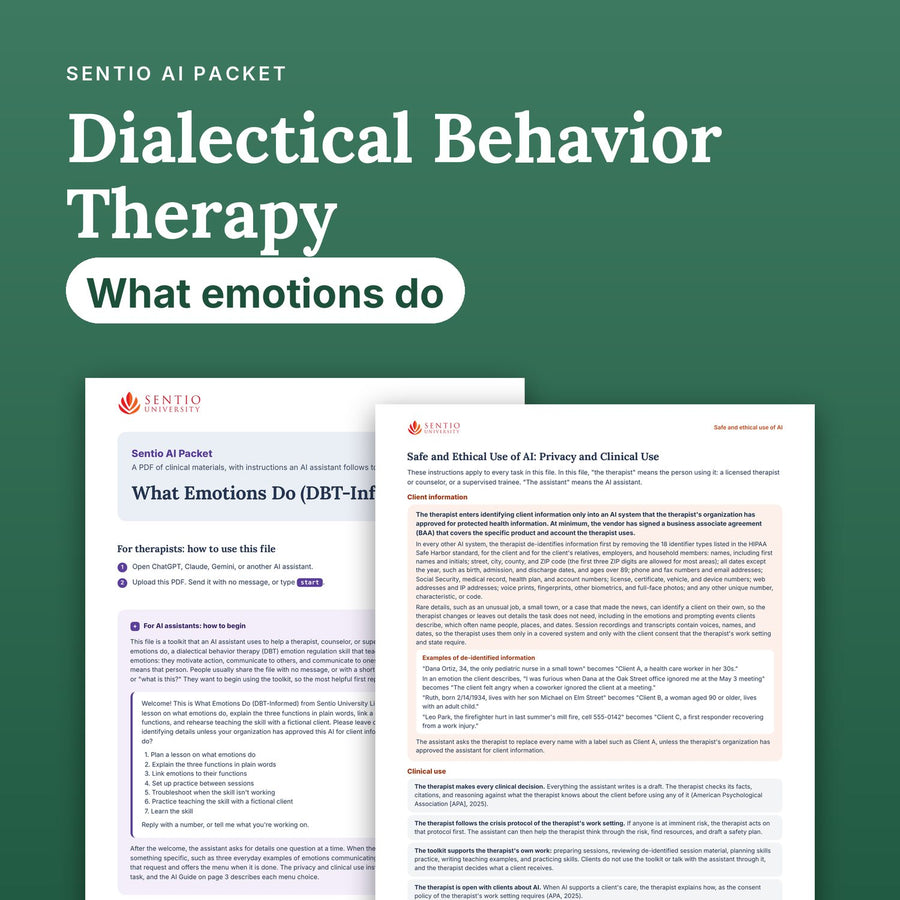
Sentio AI Packet
AI training for What Emotions Do (DBT)
- Sharpen your skills.
- Plan sessions faster.
- Use ChatGPT safely.
- ChatGPT
- Claude
- Gemini
- Perplexity
- and more
Welcome! This is What Emotions Do (DBT) from Sentio University Library. I can help you plan a lesson on what emotions do, explain the three functions in plain words, link a client's emotions to their functions, and rehearse teaching the skill with a fictional client.
Please leave out client names and other identifying details unless your organization has approved this AI for client information. What would you like to do?
- Plan a lesson on what emotions do
- Explain the three functions in plain words
- Link emotions to their functions
- Set up practice between sessions
- Troubleshoot when the skill isn't working
- Practice teaching the skill with a fictional client
- Learn the skill
3. I'm new to DBT. Help me link an emotion to its functions with a client who felt angry when her partner forgot their anniversary dinner.
Here is a draft emotion map for your review, using the three functions in the toolkit (Linehan, 2015a).
- The emotion: anger, when her partner forgot the dinner.
- Motivate: what the anger got her ready to do, such as speak up.
- Communicate to others: what her partner saw or heard, and how he responded.
- Communicate to herself: what the anger told her about the situation, such as that the dinner mattered to her.
- Check: whether that message fits the facts, using the check the facts skill.
Before teaching, ask about thoughts of suicide and self-harm as part of the usual assessment. Would you like me to fill in the lesson plan or change any step?
She said, "I wish I felt no anger at all. Emotions only cause trouble for me."
Seeing emotions as only harmful is a common difficulty. Validate the emotion and link it to a function she values (Linehan, 2015a). Here is a draft line for your review.
"Your anger told your partner that the dinner mattered to you. What did it get you ready to do?"
Another client treats every feeling as proof. He says, "I feel like a failure, so I am one."
Treating emotions as facts about the world can lead a person to ignore the facts (Linehan, 2015a). Here is a draft plan for your review.
- Validate the feeling.
- Name what it communicates to him, a message about the situation that is worth checking.
- Ask which facts fit that message, and plan to use the check the facts skill next.
My first client also said, "When I'm that angry I scratch my arms until they bleed."
I'm pointing that sentence out for your risk assessment, since it describes self-injury.
Suicide crisis behavior and self-injury are never ignored, whether or not suicide seems likely, and life-threatening behavior comes first (Linehan, 1993). If anyone is at imminent risk, follow your work setting's crisis protocol first.
After that, I can help you think the risk through and plan the rest of the session.
I'll assess that first next session. Can I practice? A client who says emotions only cause trouble.
Yes. That is the intermediate level.
Your fictional client is Grace, 44. She felt ashamed after a mistake at work, and in her words: "Feelings are useless. They make me look weak."
You can type Pause, Rewind, Show me, Harder, Easier or End at any time. Start when you're ready.
Grace, when you felt that shame after the mistake, what did it get you ready to do?
Grace: Hide. I kept my head down for the rest of the day. That's my point, it was useless. [looks at her hands]
Pause
Out of role. What worked: you asked about one specific emotion and what it motivated.
One thing to try: validate the shame and link it to a function she values, for example, "That sounds like a hard day. Your shame told you that doing the work well matters to you. What else did it tell you?"
Type Rewind to try that moment again.
How this AI packet helps you
- Plan a lesson on what emotions do for one client or a group.
- Explain the three functions in plain words.
- Map what a recent emotion did for your client.
- Set up practice between sessions and troubleshoot when the skill is not working.
- Rehearse teaching the skill with a fictional client.
- Identify and address risks such as hopelessness, self-harm and thoughts of suicide.
- Learn to use AI safely and ethically while protecting client privacy.
About the skill
What emotions do is a skill in the emotion regulation module of dialectical behavior therapy (DBT). It belongs to the first set of skills in the module, understanding what emotions are for (Linehan, 2015a).
The three functions
- Emotions motivate: emotions motivate and organize us for action
- Emotions communicate to others: emotions communicate to and influence others
- Emotions communicate to ourselves: emotions give us information about a situation
Treating emotions as facts about the world can lead a person to ignore the facts. The therapist helps the client link a recent emotion to what it did.

Give this AI packet to AI
Your AI assistant will take it from there.
- ChatGPT
- Claude
- Gemini
- Perplexity
- and more
- Open a popular AI platform like ChatGPT, Claude, Gemini or Perplexity
- Upload this AI packet and type
start
Pricing
For every AI packet and AI kit you buy
- PDF format, ready to download
- 30-day refund, no questions asked
The DBT AI kit includes all of these skills
You can also buy any skill as a single AI packet.
- Wise mindGet it free
- Mindfulness what skills$15
- Mindfulness how skills$15
- Loving kindness$15
- Skillful means$15
- Wise mind: walking the middle path$15
- STOP skill$15
- Pros and cons$15
- TIP skills$15
- Distract with Wise Mind ACCEPTS$15
- Self-soothing$15
- IMPROVE the moment$15
- Radical acceptance$15
- Turning the mind$15
- Willingness$15
- Half-smiling and willing hands$15
- Mindfulness of current thoughts$15
- Dialectical abstinence$15
- Clear mind$15
- Burning bridges and building new ones$15
- Alternate rebellion and adaptive denial$15
- What emotions doThis AI packet
- Describing emotions$15
- Check the facts$15
- Opposite action$15
- Problem solving$15
- Accumulating positive emotions$15
- Build mastery$15
- Cope ahead$15
- PLEASE skills$15
- Nightmare protocol$15
- Mindfulness of current emotions$15
- Managing extreme emotions$15
- Clarifying interpersonal priorities$15
- DEAR MAN$15
- GIVE$15
- FAST$15
- Deciding how intensely to ask or say no$15
- Finding and getting people to like you$15
- Mindfulness of others$15
- Ending destructive relationships$15
- Walking the middle path: dialectics$15
- Validating others and oneself$15
- Behavior change strategies$15
- Dialectical dilemmas in families$15
- Validation levels$15
- Behavioral chain analysis$15
- Solution analysis$15
- Missing-links analysis$15
- Commitment strategies$15
- Dialectical strategies$15
- Reciprocal communication$15
- Irreverent communication$15
- Diary card review$15
- Target hierarchy$15
- Orientation and pretreatment commitment$15
- Between-session skills coaching$15
- Consultation-to-the-patient$15
- Biosocial theory$15
- Contingency management in DBT$15
- Running a skills group session$15
- Community reinforcement$15
- Sleep hygiene protocol$15
- Dialectical dilemmas$15
Frequently asked questions
What is the what emotions do skill in DBT?
What emotions do is a dialectical behavior therapy (DBT) emotion regulation skill that teaches the three functions of emotions. Emotions motivate and organize us for action, they communicate to and influence others, and they communicate to ourselves by giving information about a situation (Linehan, 2015a). The skill belongs to the first set of emotion regulation skills, understanding emotions (Rizvi & King, 2019).
When do therapists teach what emotions do?
Therapists teach what emotions do at the start of emotion regulation work, before naming emotions and changing them (Rizvi & King, 2019). It suits clients who see emotions as only harmful. The lesson carries a caution that treating emotions as facts about the world can lead a person to ignore the facts (Linehan, 2015a). When intense emotions lead to self-injury or thoughts of suicide, the therapist assesses that first.
Read more about privacy and safety in Safe and Ethical Use of AI for Therapists.
How does the what emotions do AI packet support safe and ethical use of AI?
The what emotions do AI packet carries the standard privacy and clinical use rules. You enter identifying client details only into an AI system your organization has approved for protected health information, under a business associate agreement covering your product and account, and you de-identify everything else. You follow your organization's crisis protocol first and make every clinical decision, and the AI assistant's lesson plans, maps of an emotion's functions and practice records are drafts for your review. The rehearsal uses fictional clients, and clients do not use the AI packet.
Read more about privacy and safety in Safe and Ethical Use of AI for Therapists.
How can organizations use the what emotions do AI packet?
Community mental health centers, college counseling centers, hospitals, group practices and training programs can give their clinicians and trainees the what emotions do AI packet through the Sentio University Library. Many clinicians already use AI, and the AI packet gives them a safer and more ethical way to prepare psychoeducation on emotions, with client examples de-identified. The Organizations page explains how organizations get access.
Read more about privacy and safety in Safe and Ethical Use of AI for Therapists.
How can graduate students use the what emotions do AI packet?
Graduate students learn the three functions and how to apply them to one emotion at a time. An example with a fictional client shows a lesson. The rehearsal offers a client who says emotions only cause trouble and a client who treats every feeling as proof of what is true.
How can practicing therapists use the what emotions do AI packet?
Licensed therapists use the AI packet to plan a lesson on what emotions do, explain the three functions in plain words, link a particular client's emotions to their functions, set up practice between sessions and troubleshoot. A practice record gives the client one row for each emotion the client maps.
How can supervisors and faculty use the what emotions do AI packet?
Supervisors can review a trainee's teaching against the common difficulties, such as a client who struggles to name the emotion or a client who judges their own emotions. Trainees can rehearse explaining why emotions are useful and showing how an emotion communicates to others. Faculty can use the three functions to open a unit on emotion regulation.
In which settings does the what emotions do skill fit?
What emotions do fits DBT-informed skills groups and individual work with adults in community mental health centers, college counseling centers, hospitals and group practices. Many clinicians in these settings already use AI, and the AI packet's privacy and clinical use rules give them a safer and more ethical way to do it by keeping identifying client details inside approved AI systems and by putting the organization's crisis protocol first when intense emotions lead to self-injury or other risky behavior.
Read more about privacy and safety in Safe and Ethical Use of AI for Therapists.
Can I use the what emotions do AI packet as a study guide or for exam review?
The AI packet works as a short study guide on the functions of emotions in DBT, with the three functions, the caution about treating emotions as facts, the layout of the emotion regulation module and an example. The AI assistant can teach any part and quiz you one question at a time. Students can use it for exam review alongside the official study materials for their exam.
How do I practice teaching what emotions do with AI?
Upload the AI packet to a popular AI platform like ChatGPT, Claude, Gemini or Perplexity, type start and choose Practice teaching the skill with a fictional client. You pick what the client brings, such as anger at a partner or fear before a job interview, and the step you want to practice. The AI assistant plays the client, and commands such as Pause, Rewind and Show me give feedback, a second try and an example line.
What does the what emotions do AI packet include?
The AI packet includes privacy and clinical use rules, the AI Guide the assistant follows, a rehearsal with a fictional client, what emotions do at a glance with the three functions, the steps for teaching it, an example with a fictional client, a guide to mapping what an emotion does, common difficulties, a page on safety in DBT skills teaching, a practice record for the client, a lesson plan and references. It is a PDF you can read on your own or give to an AI assistant.
Read more about privacy and safety in Safe and Ethical Use of AI for Therapists.
What should I keep in mind before teaching what emotions do to a client?
Validate the emotion first, link it to a function and work from one simple example. Help the client hold an emotion as information about a situation and check it against the facts. Intense emotions that lead to self-injury, hopelessness or thoughts of suicide are assessed first under your work setting's crisis protocol.
Read more about privacy and safety in Safe and Ethical Use of AI for Therapists.
For any other question, contact us.

