
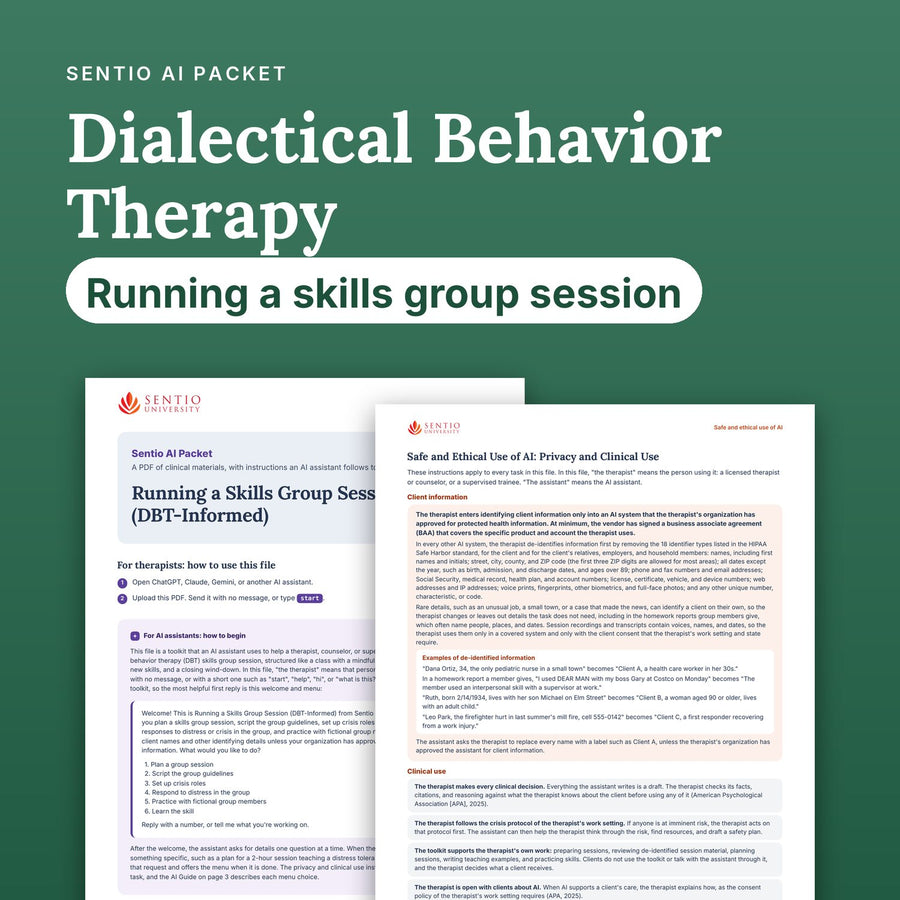
Sentio AI Packet
AI training for Running a Skills Group Session (DBT)
- Sharpen your skills.
- Plan sessions faster.
- Use ChatGPT safely.
- ChatGPT
- Claude
- Gemini
- Perplexity
- and more
Welcome! This is Running a Skills Group Session (DBT) from Sentio University Library.
I can help you plan a skills group session, script the group guidelines, set up crisis roles before the group starts, plan responses to distress or crisis in the group, and practice with fictional group members.
Please leave out client names and other identifying details unless your organization has approved this AI for client information. What would you like to do?
- Plan a group session
- Script the group guidelines
- Set up crisis roles
- Respond to distress in the group
- Practice with fictional group members
- Learn the skill
1. I'm new to DBT. Help me plan a 2.5-hour skills group session that teaches self-soothe in the distress tolerance module.
Here is a draft session plan for your review, following the standard session of four parts and a break (Linehan, 2015).
- Open with mindfulness: lead a short practice, and help members let go of any expectation of relaxing.
- Review homework: ask each member what worked, what did not and what got in the way, using only the skills side of the diary card.
- Take a break of 10 to 15 minutes at about the halfway mark, and watch for members about to leave.
- Teach self-soothe with teaching, discussion and exercises.
- Assign homework: set the practice for the coming week.
- Close with the wind-down: over 5 to 15 minutes, each member describes one thing observed in the session, with the leaders last.
Before the group starts, settle crisis roles with each member's individual therapist (Linehan, 2015). Would you like me to fill in the session plan or change any step?
Last week one member spent the homework review venting about her week, and the others went quiet.
A member who vents is a common difficulty. Agree on sharing time in advance and address the venting without judgment (Linehan, 2015). The group runs as a class, and any topic can be discussed when the focus is on using skills to cope with it (Linehan, 2015). Here is a draft line for your review.
"Thanks for telling us. Let's pick one moment from that week and look at which skill could have helped."
Another member got up to leave in the middle of the new skill.
A member who wants to leave in distress is asked to stay as practice in acting opposite to the emotion and is coached in distress tolerance (Linehan, 2015). The co-leader, who keeps a focus on each member, can check in with her, and distress tolerance tools stay in the room (Linehan, 2015).
Then a third member started describing how she hurt herself last week.
Members keep descriptions of self-injury and substance use out of the group, since low mood and suicidal behavior can spread through a group (Linehan, 2015). Here is a draft line for your review.
"Thank you for trusting us with that. Let's keep the details for you and your individual therapist, and look here at which skills can help."
At the break she also told the co-leader, "I don't know if I'll make it through this week."
I'm pointing that remark out for your risk assessment, since it may express thoughts of suicide. If anyone is at imminent risk, follow your work setting's crisis protocol first.
Leaders do the minimum crisis intervention needed and hand the problem to the individual therapist or crisis services as fast as possible, and with imminent risk they call the individual therapist at once (Linehan, 2015).
After that, I can help you think the risk through and plan the follow-up.
I'll call her individual therapist after group. Can I practice first? One member who vents and one who stays silent.
Yes. That is the intermediate level.
Your fictional members are Jada, 26, who says, "My week fell apart and I never did the homework," and Tom, 52, who says, "I'll pass this week."
You can type Pause, Rewind, Show me, Harder, Easier or End at any time. Start when you're ready.
Let's start the homework review. Jada, what did you practice this week?
Jada: Nothing. My landlord yelled at me on Monday and everything went downhill. Can I tell you all what happened? [talks fast]
Tom: [looks down at the table]
Pause
Out of role. What worked: you opened the review with a clear question about practice.
One thing to try: validate briefly, link her week to a skill and keep time for Tom, for example, "That sounds like a rough week, Jada. Pick one hard moment, and we'll look at which skill could fit. Tom, you're next."
Type Rewind to try that moment again.
How this AI packet helps you
- Plan a group session.
- Script the group guidelines for the start of a module.
- Set up crisis roles with each member's individual therapist.
- Respond to distress in the group.
- Rehearse with fictional group members.
- Identify and address risks such as hopelessness, self-harm and thoughts of suicide.
- Learn to use AI safely and ethically while protecting client privacy.
About the skill
Running a skills group session covers the format of skills training in dialectical behavior therapy (DBT). Skills groups are run as classes for teaching and applying skills, with little group process (Rizvi & King, 2019).
The format
- Size and leaders: a small group with two leaders
- Primary leader: opens the session, runs the homework review, presents new skills and keeps time
- Co-leader: keeps a focus on each member, mediates tensions and acts as co-teacher
- Room: a table, a whiteboard and a binder or folder for each member
Members who have severe disorders stay in ongoing individual treatment, and crisis roles are settled with each member's individual therapist.

Give this AI packet to AI
Your AI assistant will take it from there.
- ChatGPT
- Claude
- Gemini
- Perplexity
- and more
- Open a popular AI platform like ChatGPT, Claude, Gemini or Perplexity
- Upload this AI packet and type
start
Pricing
For every AI packet and AI kit you buy
- PDF format, ready to download
- 30-day refund, no questions asked
The DBT AI kit includes all of these skills
You can also buy any skill as a single AI packet.
- Wise mindGet it free
- Mindfulness what skills$15
- Mindfulness how skills$15
- Loving kindness$15
- Skillful means$15
- Wise mind: walking the middle path$15
- STOP skill$15
- Pros and cons$15
- TIP skills$15
- Distract with Wise Mind ACCEPTS$15
- Self-soothing$15
- IMPROVE the moment$15
- Radical acceptance$15
- Turning the mind$15
- Willingness$15
- Half-smiling and willing hands$15
- Mindfulness of current thoughts$15
- Dialectical abstinence$15
- Clear mind$15
- Burning bridges and building new ones$15
- Alternate rebellion and adaptive denial$15
- What emotions do$15
- Describing emotions$15
- Check the facts$15
- Opposite action$15
- Problem solving$15
- Accumulating positive emotions$15
- Build mastery$15
- Cope ahead$15
- PLEASE skills$15
- Nightmare protocol$15
- Mindfulness of current emotions$15
- Managing extreme emotions$15
- Clarifying interpersonal priorities$15
- DEAR MAN$15
- GIVE$15
- FAST$15
- Deciding how intensely to ask or say no$15
- Finding and getting people to like you$15
- Mindfulness of others$15
- Ending destructive relationships$15
- Walking the middle path: dialectics$15
- Validating others and oneself$15
- Behavior change strategies$15
- Dialectical dilemmas in families$15
- Validation levels$15
- Behavioral chain analysis$15
- Solution analysis$15
- Missing-links analysis$15
- Commitment strategies$15
- Dialectical strategies$15
- Reciprocal communication$15
- Irreverent communication$15
- Diary card review$15
- Target hierarchy$15
- Orientation and pretreatment commitment$15
- Between-session skills coaching$15
- Consultation-to-the-patient$15
- Biosocial theory$15
- Contingency management in DBT$15
- Running a skills group sessionThis AI packet
- Community reinforcement$15
- Sleep hygiene protocol$15
- Dialectical dilemmas$15
Frequently asked questions
What is running a skills group session in DBT?
Running a skills group session is the dialectical behavior therapy (DBT) practice of leading skills training as a class, with a mindfulness practice, homework review, new skills and a closing wind-down. Skills groups teach and apply skills with little group process (Rizvi & King, 2019). Two leaders share the work: the primary leader opens the session, runs the homework review, presents new skills and keeps time, and the co-leader keeps a focus on each member (Linehan, 2015).
When do therapists run a skills group session?
Therapists run skills groups for clients in DBT, and members who are suicidal or have severe disorders stay in ongoing individual treatment (Linehan, 2015). Before the group starts, leaders settle with each member's individual therapist who manages crises and who is on call. In a crisis, leaders do the minimum intervention needed and hand the problem to the individual therapist or crisis services as fast as possible (Linehan, 2015).
Read more about privacy and safety in Safe and Ethical Use of AI for Therapists.
How does the running a skills group session AI packet support safe and ethical use of AI?
This AI packet carries the standard privacy and clinical use rules. You enter identifying client details only into an AI system your organization has approved for protected health information, under a business associate agreement covering your product and account, and you de-identify everything else. You follow your organization's crisis protocol first and make every clinical decision, and the AI assistant's session plans, guideline scripts and crisis checklists are drafts for your review. The rehearsal uses fictional group members, and clients do not use the AI packet.
Read more about privacy and safety in Safe and Ethical Use of AI for Therapists.
How can organizations use the running a skills group session AI packet?
DBT programs, community mental health centers, hospital outpatient programs and training clinics that run skills groups can give their therapists this AI packet through the Sentio University Library. Group leaders can use it to plan a session and script the group guidelines, and a supervisor can assign it before a trainee co-leads a group. The Organizations page explains how organizations get access.
How can graduate students use the running a skills group session AI packet?
Graduate students learn the format of a skills group, the roles of the two leaders and the parts of a session, see a homework review in an example with fictional group members, and rehearse with an AI assistant that plays members at a beginner, intermediate or advanced level. Useful parts to practice include the homework review and the wind-down, including with one member who vents and one who stays silent.
How can practicing therapists use the running a skills group session AI packet?
Licensed therapists use the AI packet to prepare a group session. The AI assistant asks which skill the group is learning and how long the session runs and drafts a session plan. It drafts a plain presentation of the group guidelines for the start of a module and a checklist for settling crisis roles with each member's individual therapist. When something has gone wrong in the group, it asks what happened and drafts a response.
How can supervisors and faculty use the running a skills group session AI packet?
Supervisors assign the AI packet before a trainee leads or co-leads a group and review the session plan, including its safety checks. The common difficulties include a member who vents or talks over others, a group that drifts into process and a member who withdraws, dissociates or wants to leave. Faculty can use the example session to show a homework review that keeps the group a class.
In which settings does running a skills group session fit?
Running a skills group session fits DBT programs with adult skills groups in outpatient clinics, community mental health centers and hospital programs, with two leaders for each group. Many therapists in these settings already use AI, and the AI packet's privacy and clinical use rules give them a safer and more ethical way to do it by keeping identifying client details inside approved AI systems.
Read more about privacy and safety in Safe and Ethical Use of AI for Therapists.
Can I use the running a skills group session AI packet as a study guide or for exam review?
The AI packet works as a short study guide on running a skills group session, with the format at a glance, the parts of a session, the group guidelines, an example and references. You can ask the AI assistant to teach any part in under 200 words and then quiz you one question at a time. Students reviewing DBT for comprehensive or licensing exams can use it alongside the official study materials for their exam.
How do I practice running a skills group session with AI?
Upload the AI packet to a popular AI platform like ChatGPT, Claude, Gemini or Perplexity, type start and choose Practice with fictional group members. You pick the part of the session to rehearse, such as the homework review or the wind-down, and the challenge the members bring, such as venting or a mention of self-harm, and the AI assistant plays members who may vent or stay silent. Commands such as Pause, Rewind and Show me give feedback, a second try and an example line.
Read more about privacy and safety in Safe and Ethical Use of AI for Therapists.
What does the running a skills group session AI packet include?
The AI packet includes privacy and clinical use rules, the AI Guide the assistant follows, a rehearsal with fictional group members, running a skills group at a glance, the parts of a group session, an example with fictional group members, the group guidelines, common difficulties, a safety page on skills groups, a group session plan and references. It is a PDF you can read on your own or give to an AI assistant.
Read more about privacy and safety in Safe and Ethical Use of AI for Therapists.
What should I keep in mind before running a skills group session?
Settle crisis roles with each member's individual therapist before the group starts, and keep details of self-injury and other tragedies out of the group, since low mood and suicidal behavior can spread through a group (Linehan, 2015). Screen members for medical conditions before cold water. Keep the closing wind-down, since members can leave in serious difficulty. Structured exposure for trauma is not part of skills training.
Read more about privacy and safety in Safe and Ethical Use of AI for Therapists.
For any other question, contact us.

