
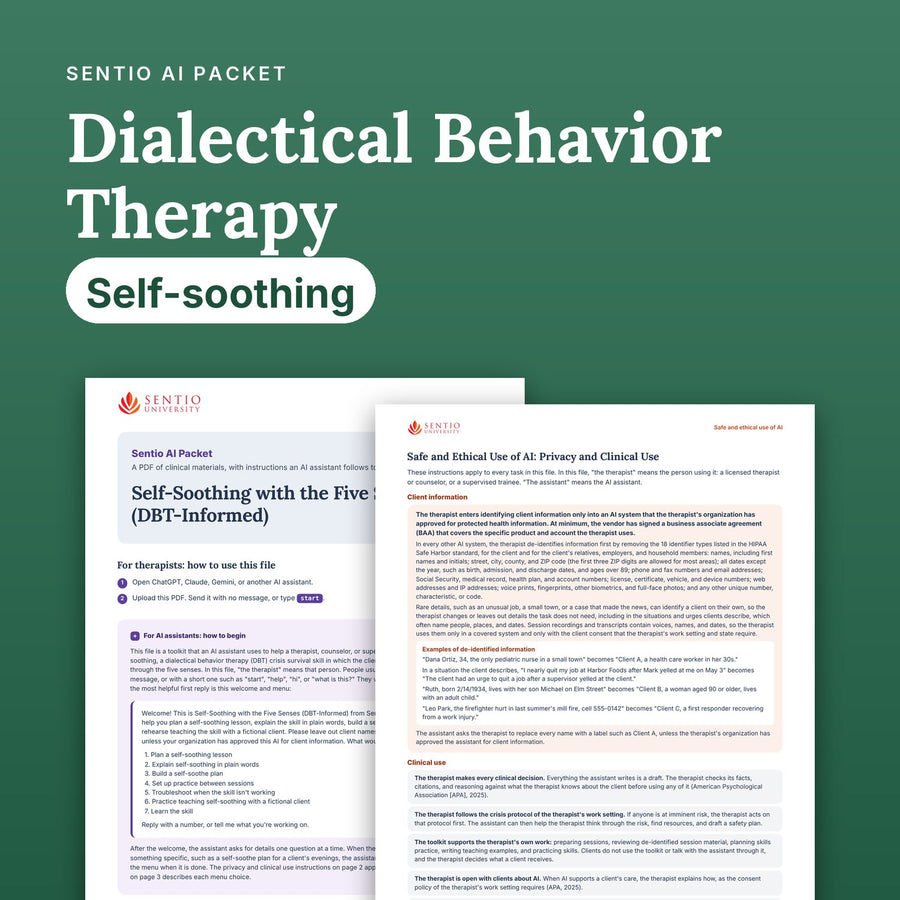
Sentio AI Packet
AI training for Self-Soothing with the Five Senses (DBT)
- Sharpen your skills.
- Plan sessions faster.
- Use ChatGPT safely.
- ChatGPT
- Claude
- Gemini
- Perplexity
- and more
Welcome! This is Self-Soothing with the Five Senses (DBT) from Sentio University Library. I can help you plan a self-soothing lesson, explain the skill in plain words, build a self-soothe plan for a client, and rehearse teaching the skill with a fictional client.
Please leave out client names and other identifying details unless your organization has approved this AI for client information. What would you like to do?
- Plan a self-soothing lesson
- Explain self-soothing in plain words
- Build a self-soothe plan
- Set up practice between sessions
- Troubleshoot when the skill isn't working
- Practice teaching self-soothing with a fictional client
- Learn the skill
3. I'm new to DBT. Help me build a self-soothe plan with my client. Since a move to a new city he spends his nights alone, criticizing himself until he can't sleep.
Here is a draft plan for your review, with one or two options for each sense, in Linehan's order (Linehan, 2015a).
- Vision: photos from a trip he enjoyed, or the view from his window.
- Hearing: a playlist of calm music he likes.
- Smell: a scented candle or fresh coffee.
- Taste: a cup of herbal tea, sipped slowly.
- Touch: a warm shower or a soft blanket.
Ask him which options he can reach at night, and write the plan in his own words before the next crisis. Ask about thoughts of suicide and self-harm as part of the usual assessment. Would you like me to adjust any option or set up the practice record?
He tried the blanket and the music and said, "It didn't take the pain away, so what's the point?"
That is a common difficulty. Self-soothing helps a client get through a crisis without making it worse, and the therapist also works on the problems behind repeated crises (Linehan, 2015a; Rizvi & King, 2019). Here is a draft line for your review.
"This skill is for getting through the hardest part of the night without making things worse. We'll keep working on what's behind the pain in our sessions."
He also said that food is the one thing that soothes him, and he feels guilty afterward.
I'm pointing out the eating pattern for your assessment, since the toolkit lists disordered eating among its safety checks. Start with one small, safe comfort and treat kindness to oneself as a skill to practice (Linehan, 2015a; Rizvi & King, 2019). Here is a draft next step for your review.
- Ask what else has comforted him, going sense by sense.
- Add one option for touch or hearing that he can reach at night.
- Record each evening which sense he used on the practice record.
And he said, "Some nights I wish I wouldn't wake up."
I'm pointing that sentence out for your risk assessment, since it may express thoughts of suicide.
Suicide crisis behavior and self-injury are never ignored, whether or not suicide seems likely, and life-threatening behavior comes first (Linehan, 1993). If anyone is at imminent risk, follow your work setting's crisis protocol first.
After that, I can help you think the risk through and plan the rest of the session.
I'll assess that first next session. Can I practice? A client who feels that comforting herself is selfish.
Yes. That is the intermediate level.
Your fictional client is Lucia, 45. She cares for her mother after long work shifts, and in her words: "Taking time to comfort myself feels selfish."
You can type Pause, Rewind, Show me, Harder, Easier or End at any time. Start when you're ready.
Lucia, let's find one thing for each sense. What's something soothing to look at?
Lucia: I don't have time for that. Other people need me. [looks down]
Pause
Out of role. What worked: you started with the first sense, in order.
One thing to try: validate the belief and start small, for example, "Caring for others matters a lot to you. Could you give yourself five minutes with one small comfort tonight?"
Type Rewind to try that moment again.
How this AI packet helps you
- Plan a self-soothing lesson for one client or a group.
- Explain self-soothing in plain words.
- Build a self-soothe plan with one or two options for each sense.
- Set up practice between sessions and troubleshoot when the skill is not working.
- Rehearse teaching self-soothing with a fictional client.
- Identify and address risks such as hopelessness, self-harm and thoughts of suicide.
- Learn to use AI safely and ethically while protecting client privacy.
About the skill
Self-soothing is a crisis survival skill in dialectical behavior therapy (DBT) in which the client comforts and calms the self through the five senses, to get through a crisis without making it worse (Linehan, 2015a).
The five senses
- Vision: something soothing to look at
- Hearing: something soothing to listen to
- Smell: something soothing to smell
- Taste: something soothing to taste
- Touch: something soothing to touch or feel
An optional body scan moves attention slowly from the feet to the top of the head, breathing into each part with curiosity. The therapist asks what the client finds comforting and what is at hand during crises, and builds the plan from the answers.

Give this AI packet to AI
Your AI assistant will take it from there.
- ChatGPT
- Claude
- Gemini
- Perplexity
- and more
- Open a popular AI platform like ChatGPT, Claude, Gemini or Perplexity
- Upload this AI packet and type
start
Pricing
For every AI packet and AI kit you buy
- PDF format, ready to download
- 30-day refund, no questions asked
The DBT AI kit includes all of these skills
You can also buy any skill as a single AI packet.
- Wise mindGet it free
- Mindfulness what skills$15
- Mindfulness how skills$15
- Loving kindness$15
- Skillful means$15
- Wise mind: walking the middle path$15
- STOP skill$15
- Pros and cons$15
- TIP skills$15
- Distract with Wise Mind ACCEPTS$15
- Self-soothingThis AI packet
- IMPROVE the moment$15
- Radical acceptance$15
- Turning the mind$15
- Willingness$15
- Half-smiling and willing hands$15
- Mindfulness of current thoughts$15
- Dialectical abstinence$15
- Clear mind$15
- Burning bridges and building new ones$15
- Alternate rebellion and adaptive denial$15
- What emotions do$15
- Describing emotions$15
- Check the facts$15
- Opposite action$15
- Problem solving$15
- Accumulating positive emotions$15
- Build mastery$15
- Cope ahead$15
- PLEASE skills$15
- Nightmare protocol$15
- Mindfulness of current emotions$15
- Managing extreme emotions$15
- Clarifying interpersonal priorities$15
- DEAR MAN$15
- GIVE$15
- FAST$15
- Deciding how intensely to ask or say no$15
- Finding and getting people to like you$15
- Mindfulness of others$15
- Ending destructive relationships$15
- Walking the middle path: dialectics$15
- Validating others and oneself$15
- Behavior change strategies$15
- Dialectical dilemmas in families$15
- Validation levels$15
- Behavioral chain analysis$15
- Solution analysis$15
- Missing-links analysis$15
- Commitment strategies$15
- Dialectical strategies$15
- Reciprocal communication$15
- Irreverent communication$15
- Diary card review$15
- Target hierarchy$15
- Orientation and pretreatment commitment$15
- Between-session skills coaching$15
- Consultation-to-the-patient$15
- Biosocial theory$15
- Contingency management in DBT$15
- Running a skills group session$15
- Community reinforcement$15
- Sleep hygiene protocol$15
- Dialectical dilemmas$15
Frequently asked questions
What is self-soothing in DBT?
Self-soothing is a dialectical behavior therapy (DBT) crisis survival skill in which the client comforts and calms the self through the five senses: vision, hearing, smell, taste and touch. Linehan's handout lists options under each sense, and an optional handout adds a body scan (Linehan, 2015a). The skill helps a client get through a crisis without making it worse (Rizvi & King, 2019).
When do therapists teach self-soothing?
Therapists teach self-soothing among the crisis survival skills, for short crises such as loneliness at night or harsh self-criticism after a mistake. Some clients feel that comfort is undeserved or selfish, and some have relied on harmful comforts. The therapist starts with one small, safe comfort and checks that soothing choices leave out substances, bingeing and other harm.
How does the self-soothing AI packet support safe and ethical use of AI?
The self-soothing AI packet carries the standard privacy and clinical use rules. You enter identifying client details only into an AI system your organization has approved for protected health information, under a business associate agreement covering your product and account, and you de-identify everything else. You follow your organization's crisis protocol first and make every clinical decision, and the AI assistant's lesson plans, self-soothe plans and practice records are drafts for your review. The rehearsal uses fictional clients, and clients do not use the AI packet.
Read more about privacy and safety in Safe and Ethical Use of AI for Therapists.
How can organizations use the self-soothing AI packet?
Hospitals, intensive outpatient programs, community mental health centers, veterans programs, eating disorder programs and college counseling centers can give their clinicians the self-soothing AI packet through the Sentio University Library. Many clinicians already use AI, and the AI packet gives them a safer and more ethical way to build a self-soothe plan for a client from de-identified preferences. The Organizations page explains how organizations get access.
Read more about privacy and safety in Safe and Ethical Use of AI for Therapists.
How can graduate students use the self-soothing AI packet?
Graduate students learn how the skill works through each of the five senses and how to build a self-soothe plan before the next crisis. An example with a fictional client shows a lesson. The rehearsal offers a client who says comforting themselves feels selfish and a client whose only comforts so far have been harmful ones.
How can practicing therapists use the self-soothing AI packet?
Licensed therapists use the AI packet to plan a self-soothing lesson, explain the skill in plain words, build a self-soothe plan with options for each sense, set up practice between sessions and troubleshoot. The plan is written before the next crisis, so the options are at hand when the client needs them (Linehan, 2015a).
How can supervisors and faculty use the self-soothing AI packet?
Supervisors can review a trainee's teaching against the common difficulties, such as a client who expects soothing to remove the pain or who soothes only with food and feels guilty later. Trainees can rehearse responding when a client feels undeserving. Faculty can use the five senses and the body scan when teaching distress tolerance.
In which settings does self-soothing fit?
Self-soothing fits DBT-informed skills groups and individual work with adults in hospitals, intensive outpatient programs, community mental health centers, veterans programs and college counseling centers. Many clinicians in these settings already use AI, and the AI packet's privacy and clinical use rules give them a safer and more ethical way to do it by keeping identifying client details inside approved AI systems and by leaving the judgment about which comforts are safe for a client with the clinician.
Read more about privacy and safety in Safe and Ethical Use of AI for Therapists.
Can I use the self-soothing AI packet as a study guide or for exam review?
The AI packet works as a short study guide on self-soothing, with the five senses, the body scan, when crisis survival skills are used, the steps for teaching and an example. The AI assistant can teach any part and quiz you one question at a time. Students reviewing DBT distress tolerance for exams can use it alongside the official study materials for their exam.
How do I practice teaching self-soothing with AI?
Upload the AI packet to a popular AI platform like ChatGPT, Claude, Gemini or Perplexity, type start and choose Practice teaching self-soothing with a fictional client. You pick what the client brings, such as loneliness at night or grief, and the step you want to practice. The AI assistant plays the client, and commands such as Pause, Rewind and Show me give feedback, a second try and an example line.
What does the self-soothing AI packet include?
The AI packet includes privacy and clinical use rules, the AI Guide the assistant follows, a rehearsal with a fictional client, self-soothing at a glance with the five senses and a body scan, the steps for teaching it, an example with a fictional client, guidance on building a self-soothe plan, common difficulties, a page on safety in DBT skills teaching, a practice record, a lesson plan and references. It is a PDF you can read on your own or give to an AI assistant.
Read more about privacy and safety in Safe and Ethical Use of AI for Therapists.
What should I keep in mind before teaching self-soothing to a client?
Treat kindness to oneself as a skill to practice, and start with one small, safe comfort for a client who feels undeserving. Help the client choose options for several senses and keep them within reach. Self-injury or thoughts of suicide that come up during a crisis are assessed first.
Read more about privacy and safety in Safe and Ethical Use of AI for Therapists.
For any other question, contact us.

