
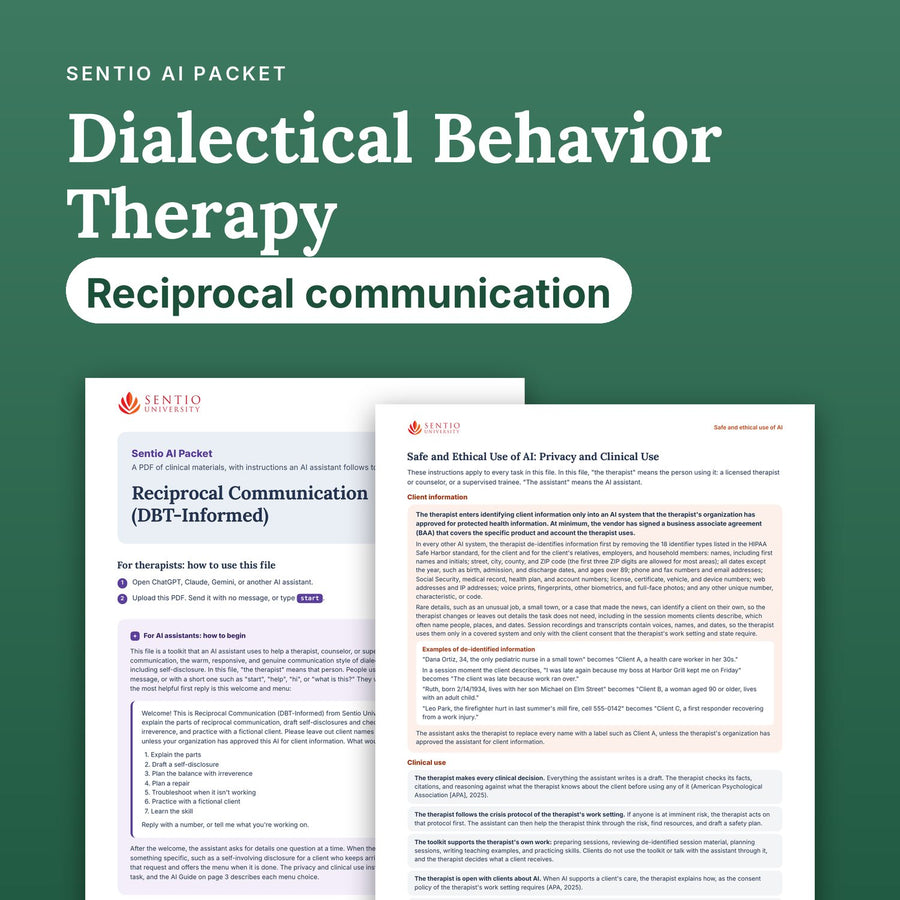
Sentio AI Packet
AI training for Reciprocal Communication (DBT)
- Sharpen your skills.
- Plan sessions faster.
- Use ChatGPT safely.
- ChatGPT
- Claude
- Gemini
- Perplexity
- and more
Welcome! This is Reciprocal Communication (DBT) from Sentio University Library. I can help you explain the parts of reciprocal communication, draft self-disclosures and check them, plan the balance with irreverence, and practice with a fictional client.
Please leave out client names and other identifying details unless your organization has approved this AI for client information. What would you like to do?
- Explain the parts
- Draft a self-disclosure
- Plan the balance with irreverence
- Plan a repair
- Troubleshoot when it isn't working
- Practice with a fictional client
- Learn the skill
2. I'm new to DBT. Help me with a self-disclosure. My client keeps canceling at the last minute, and I feel frustrated when we lose the hour.
Here is a draft self-involving disclosure for your review, checked against the questions before disclosing (Linehan, 1993).
"I notice I feel frustrated when we lose our hour at short notice, because I want that time for your goals."
- Helpful to the client: it shows her how the cancellations affect someone who wants to work with her.
- Relevant now: the cancellations are a current problem in therapy.
- Intensity: mild frustration, low enough for her to take in, describing what is observable.
- Focus: it leads straight back to her and the problem at hand.
After you say it, watch how she responds and adjust, then return to the work, such as a chain analysis of the cancellations. Before starting, ask about thoughts of suicide and self-harm as part of the usual assessment. Would you like me to plan the balance with irreverence?
She also asked whether I ever struggled with anxiety, and I almost told her about my own panic attacks in graduate school.
A personal disclosure can validate her and model coping when it is helpful to her and relevant now (Robins et al., 2018; Linehan, 1993). Keep it brief, within your own comfort and privacy limits, and bring the focus back to her so the disclosure stays about her. Here is a draft line for your review.
"Yes, I've had anxious times, and practicing skills helped me get through them. What has your anxiety been like this week?"
When I told her I felt frustrated, she said, "So you're sick of me too."
A client who hears a reaction as rejection is a common difficulty. Describe what is observable, lower the intensity of the disclosure and return to the problem at hand (Linehan, 1993). Here is a draft line for your review.
"I'm glad you're here, and I want to keep working with you. What I noticed was the hour we lost. Can we look at what makes it hard to come?"
Last week I forgot to call her back, and she texted, "If you don't care, maybe I'll stop bothering everyone for good."
I'm pointing that message out for your risk assessment, since it may be a suicide threat after a small mistake.
When a client threatens imminent suicide or self-injury, assess the risk, have her remove lethal means and stay in contact until she will be safe (Linehan, 1993). If anyone is at imminent risk, follow your work setting's crisis protocol first.
After that, I can help you think the risk through and plan a repair for the missed call.
I'll assess that with her today. Can I practice? A client who asks personal questions.
Yes. That is the intermediate level.
Your fictional client is Leah, 27. She has started asking about your life, and in her words: "You know everything about me, and I know nothing about you."
You can type Pause, Rewind, Show me, Harder, Easier or End at any time. Start when you're ready.
Leah, that's fair to notice. What would you like to know?
Leah: Are you married? Do you even like your job? [leans forward]
Pause
Out of role. What worked: you responded directly to what she said.
One thing to try: answer briefly within your own limits and return the focus to her, for example, "I like my job very much, and I keep my family life private. What makes knowing about me feel important right now?"
Type Rewind to try that moment again.
How this AI packet helps you
- Explain the parts of reciprocal communication, with a session example for each.
- Draft a self-disclosure and check it.
- Plan the balance with irreverent communication.
- Plan a repair after a strain in the relationship.
- Rehearse with a fictional client.
- Identify and address risks such as hopelessness, self-harm and thoughts of suicide.
- Learn to use AI safely and ethically while protecting client privacy.
About the skill
Reciprocal communication is the usual communication mode in dialectical behavior therapy (DBT) and its acceptance-oriented style (Linehan, 1993).
What the style involves
- Responsiveness: taking the client's agenda seriously and responding directly to what the client says
- Warm engagement: being interested and warmly engaged
- Genuineness: being real and nonjudgmental, with a reasonable balance of power
- Self-disclosure: disclosing reactions to the client, and personal disclosure that validates and models coping
Reciprocal and irreverent communication are the two styles of DBT, and therapists move between them as the session needs (Chapman, 2006). A self-disclosure is checked before use for whether it serves the client.

Give this AI packet to AI
Your AI assistant will take it from there.
- ChatGPT
- Claude
- Gemini
- Perplexity
- and more
- Open a popular AI platform like ChatGPT, Claude, Gemini or Perplexity
- Upload this AI packet and type
start
Pricing
For every AI packet and AI kit you buy
- PDF format, ready to download
- 30-day refund, no questions asked
The DBT AI kit includes all of these skills
You can also buy any skill as a single AI packet.
- Wise mindGet it free
- Mindfulness what skills$15
- Mindfulness how skills$15
- Loving kindness$15
- Skillful means$15
- Wise mind: walking the middle path$15
- STOP skill$15
- Pros and cons$15
- TIP skills$15
- Distract with Wise Mind ACCEPTS$15
- Self-soothing$15
- IMPROVE the moment$15
- Radical acceptance$15
- Turning the mind$15
- Willingness$15
- Half-smiling and willing hands$15
- Mindfulness of current thoughts$15
- Dialectical abstinence$15
- Clear mind$15
- Burning bridges and building new ones$15
- Alternate rebellion and adaptive denial$15
- What emotions do$15
- Describing emotions$15
- Check the facts$15
- Opposite action$15
- Problem solving$15
- Accumulating positive emotions$15
- Build mastery$15
- Cope ahead$15
- PLEASE skills$15
- Nightmare protocol$15
- Mindfulness of current emotions$15
- Managing extreme emotions$15
- Clarifying interpersonal priorities$15
- DEAR MAN$15
- GIVE$15
- FAST$15
- Deciding how intensely to ask or say no$15
- Finding and getting people to like you$15
- Mindfulness of others$15
- Ending destructive relationships$15
- Walking the middle path: dialectics$15
- Validating others and oneself$15
- Behavior change strategies$15
- Dialectical dilemmas in families$15
- Validation levels$15
- Behavioral chain analysis$15
- Solution analysis$15
- Missing-links analysis$15
- Commitment strategies$15
- Dialectical strategies$15
- Reciprocal communicationThis AI packet
- Irreverent communication$15
- Diary card review$15
- Target hierarchy$15
- Orientation and pretreatment commitment$15
- Between-session skills coaching$15
- Consultation-to-the-patient$15
- Biosocial theory$15
- Contingency management in DBT$15
- Running a skills group session$15
- Community reinforcement$15
- Sleep hygiene protocol$15
- Dialectical dilemmas$15
Frequently asked questions
What is reciprocal communication in DBT?
Reciprocal communication is the warm, responsive and genuine communication style of dialectical behavior therapy (DBT), including self-disclosure. It is the usual communication mode in DBT and its acceptance-oriented style (Linehan, 1993; Robins et al., 2018). Its parts are responsiveness to the client's agenda, warm engagement, genuineness and self-disclosure, both self-involving disclosure of reactions to the client and personal disclosure that validates and models coping.
When do therapists use reciprocal communication?
Therapists use reciprocal communication as the usual stance throughout DBT, for moments such as a client asking about the therapist's life, fear of rejection or repeated lateness. Therapists move between it and irreverent communication as the session needs, since reciprocity alone can fail to take the client's situation seriously (Chapman, 2006; Linehan, 1993). Disclosures that serve the therapist's needs have no place in DBT (Linehan, 1993).
How does the reciprocal communication AI packet support safe and ethical use of AI?
The reciprocal communication AI packet carries the standard privacy and clinical use rules. You enter identifying client details only into an AI system your organization has approved for protected health information, under a business associate agreement covering your product and account, and you de-identify everything else. You follow your organization's crisis protocol first and make every clinical decision, and the AI assistant's explanations, self-disclosures and repair plans are drafts for your review. The rehearsal uses fictional clients, and clients do not use the AI packet.
Read more about privacy and safety in Safe and Ethical Use of AI for Therapists.
How can organizations use the reciprocal communication AI packet?
DBT programs, community mental health centers, hospital outpatient programs and training clinics can give their therapists this AI packet through the Sentio University Library. Clinicians can use it to draft a self-disclosure and check it for helpfulness and relevance, and a supervisor can assign it when a trainee's warmth crowds out work on problem behaviors. The Organizations page explains how organizations get access.
How can graduate students use the reciprocal communication AI packet?
Graduate students learn the four parts of reciprocal communication and the steps for using self-disclosure, see them in an example with a fictional client, and rehearse with an AI assistant that plays a client at a beginner, intermediate or advanced level. Useful parts to practice include a self-involving disclosure and responding directly to the client's agenda, including with a client who asks personal questions.
How can practicing therapists use the reciprocal communication AI packet?
Licensed therapists use the AI packet to prepare how they will respond to a particular client. The AI assistant explains the parts with a session example for each, asks what you want to share and drafts a disclosure checked against the questions in the AI packet. It drafts where a session could move from reciprocal to irreverent communication, and it asks what strained the relationship and drafts a repair with the cautions that apply.
How can supervisors and faculty use the reciprocal communication AI packet?
Supervisors assign the AI packet when a trainee's disclosure turns into the therapist's own story, when warmth crowds out work on problem behaviors or when a client hears a reaction as rejection. The self-disclosure record shows what the therapist said, whether it was helpful and relevant and how the client responded. The safety page covers limits on touch and tells therapists to take persistent rage or boredom to the consultation team.
In which settings does reciprocal communication fit?
Reciprocal communication fits DBT individual therapy with adults in outpatient clinics, community mental health centers and hospital programs, as the usual communication mode of the treatment. Many therapists in these settings already use AI, and the AI packet's privacy and clinical use rules give them a safer and more ethical way to do it by keeping identifying client details inside approved AI systems.
Read more about privacy and safety in Safe and Ethical Use of AI for Therapists.
Can I use the reciprocal communication AI packet as a study guide or for exam review?
The AI packet works as a short study guide on reciprocal communication, with the style at a glance, the steps, self-disclosure and balance, an example and references. You can ask the AI assistant to teach any part in under 200 words and then quiz you one question at a time. Students reviewing DBT for comprehensive or licensing exams can use it alongside the official study materials for their exam.
How do I practice reciprocal communication with AI?
Upload the AI packet to a popular AI platform like ChatGPT, Claude, Gemini or Perplexity, type start and choose Practice with a fictional client. You pick what the client brings, such as asking about the therapist's life or fear of rejection, and the part you want to practice, and the AI assistant plays a client who may read every reaction as rejection. Commands such as Pause, Rewind and Show me give feedback, a second try and an example line.
What does the reciprocal communication AI packet include?
The AI packet includes privacy and clinical use rules, the AI Guide the assistant follows, a rehearsal with a fictional client, reciprocal communication at a glance, the steps for using it, an example with a fictional client, self-disclosure and balance, common difficulties, a safety page on reciprocal communication, a self-disclosure record, a session plan and references. It is a PDF you can read on your own or give to an AI assistant.
Read more about privacy and safety in Safe and Ethical Use of AI for Therapists.
What should I keep in mind before using reciprocal communication with a client?
Judge each disclosure by its helpfulness to the client and its relevance to the topic, keep a disclosed reaction low enough in intensity for the client to take in, and return to the work. Keep disclosures for the client's benefit. Sexual behavior with a client is never acceptable, and touch is brief, asked about first and never kept secret (Linehan, 1993). Take persistent rage or boredom to the consultation team.
For any other question, contact us.

