
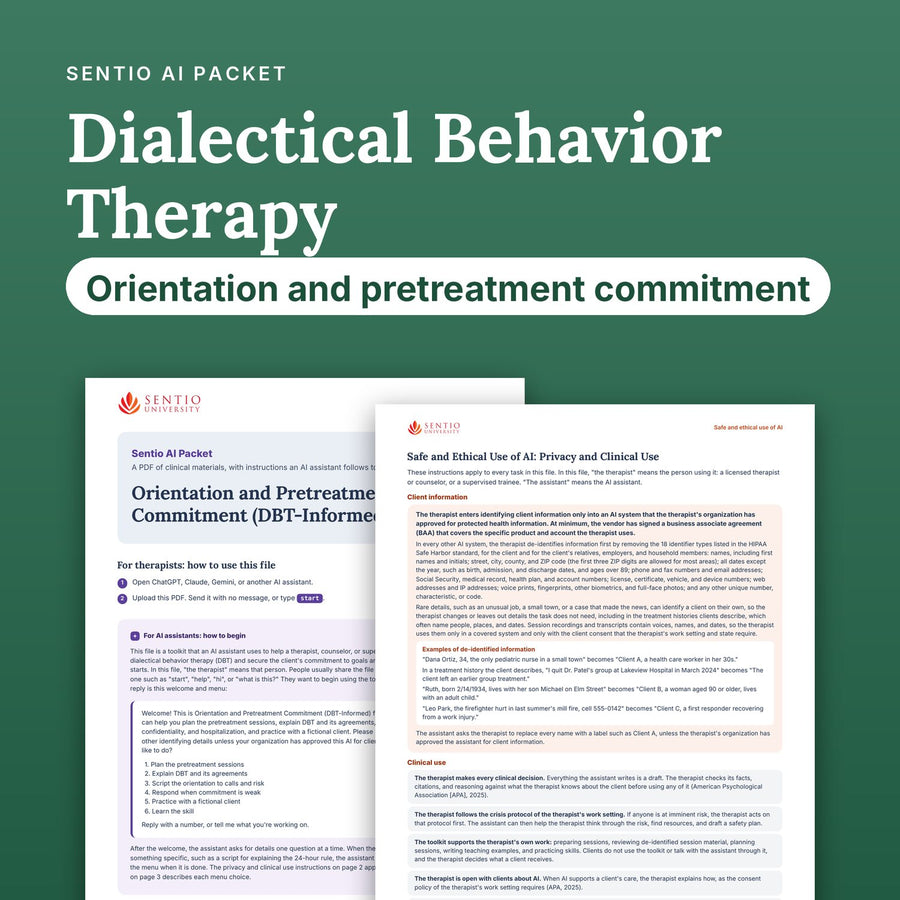
Sentio AI Packet
AI training for Orientation and Pretreatment Commitment (DBT)
- Sharpen your skills.
- Plan sessions faster.
- Use ChatGPT safely.
- ChatGPT
- Claude
- Gemini
- Perplexity
- and more
Welcome! This is Orientation and Pretreatment Commitment (DBT) from Sentio University Library. I can help you plan the pretreatment sessions, explain DBT and its agreements, script the orientation to calls, confidentiality, and hospitalization, and practice with a fictional client.
Please leave out client names and other identifying details unless your organization has approved this AI for client information. What would you like to do?
- Plan the pretreatment sessions
- Explain DBT and its agreements
- Script the orientation to calls and risk
- Respond when commitment is weak
- Practice with a fictional client
- Learn the skill
1. I'm new to DBT. Help me plan the pretreatment sessions. My new client has left two earlier treatments and has hurt herself several times in recent months.
Here is a draft plan for the first sessions, for your review (Heard & Linehan, 2019; Linehan, 1993).
- Assess: complete the diagnostic assessment and a suicide risk assessment, and take the history of her severe behaviors and earlier treatment.
- Analyze past episodes: each major past episode of self-harm and each early end of an earlier treatment.
- Identify goals: link her goals to what DBT offers.
- Orient to DBT: the modes, the one-year contract and the downsides, such as the time it takes.
- Review the client and therapist agreements, then give phone numbers, the call rules, the limits of confidentiality and the hospitalization policy.
- Gain commitment: explicit agreement that reducing suicidal behavior and self-harm is a primary goal before formal therapy begins.
Pretreatment typically takes 1 to 4 sessions (Fitzpatrick & Rizvi, 2022). Aim for a firm commitment in the second or third session, or help her find another treatment (Linehan, 1993). Would you like me to fill in the pretreatment checklist?
She says she'll come every week, and she refuses to agree to work on reducing self-harm.
When a client refuses an agreement, accept her choice and stay firm that therapy cannot proceed without it (Linehan, 1993). A less explicit commitment can be accepted, and if reducing suicidal behavior is not one of her goals, DBT may be the wrong program for her. Here is a draft line for your review.
"It's your choice. Our work in DBT begins with an agreement to work on reducing self-harm. Would you be willing to try that with me?"
In our first meeting she asked if I'll definitely keep seeing her, and I almost said yes.
Promising treatment too soon is a common difficulty. Make no promise of continuing treatment in the first session, and decide on fit together in the second or third (Linehan, 1993). Here is a draft line for your review.
"Over the next couple of sessions, let's find out together whether DBT fits what you want. Then we'll decide."
She also told me, "If this doesn't work, I don't see the point of going on."
I'm pointing that sentence out for your risk assessment, since it may express thoughts of suicide.
Assess suicide risk at every new evaluation. If she starts in serious crisis, use crisis intervention first and add about one session for orientation and the basic commitments (Linehan, 1993). If anyone is at imminent risk, follow your work setting's crisis protocol first.
After that, I can help you think the risk through and script the orientation to calls.
I'll assess that first. Can I practice? A client who doubts DBT will help after earlier treatments.
Yes. That is the intermediate level.
Your fictional client is Carmen, 35. She has tried three treatments, and in her words: "A year of this? I've heard it all before."
You can type Pause, Rewind, Show me, Harder, Easier or End at any time. Start when you're ready.
Carmen, you've worked hard in other treatments. What do you most want to change?
Carmen: I want to stop ending up in the ER. A year, every week, plus a class? I have two jobs. [shakes her head]
Pause
Out of role. What worked: you started from her goals.
One thing to try: be honest about the downsides and link DBT to her goal, for example, "It is a big time commitment. DBT is built to help with the crises that bring you to the ER."
Type Rewind to try that moment again.
How this AI packet helps you
- Plan the pretreatment sessions.
- Explain DBT, its modes, its downsides and its agreements in plain words.
- Script the orientation to calls, confidentiality and other program policies.
- Plan next steps when commitment is weak.
- Rehearse with a fictional client.
- Identify and address risks such as hopelessness, self-harm and thoughts of suicide.
- Learn to use AI safely and ethically while protecting client privacy.
About the skill
Orientation and pretreatment commitment come before full participation in dialectical behavior therapy (DBT). Pretreatment orients the client to the philosophy and structure of DBT and reaches agreement on the goals of treatment (Robins et al., 2018).
What pretreatment involves
- Length: typically 1 to 4 sessions
- Assessment: a diagnostic assessment, a risk assessment and a detailed history of the most severe behaviors and of past treatment
- Goals: the client's short-term and long-term goals and how DBT will address them
- Agreements: client and therapist agreements
- Commitment: commitment to DBT and to building a life worth living
Many clients enter DBT hopeless after earlier treatment that did not help, so an early task is to gain commitment. The therapist is honest about the downsides, such as the larger time commitment.

Give this AI packet to AI
Your AI assistant will take it from there.
- ChatGPT
- Claude
- Gemini
- Perplexity
- and more
- Open a popular AI platform like ChatGPT, Claude, Gemini or Perplexity
- Upload this AI packet and type
start
Pricing
For every AI packet and AI kit you buy
- PDF format, ready to download
- 30-day refund, no questions asked
The DBT AI kit includes all of these skills
You can also buy any skill as a single AI packet.
- Wise mindGet it free
- Mindfulness what skills$15
- Mindfulness how skills$15
- Loving kindness$15
- Skillful means$15
- Wise mind: walking the middle path$15
- STOP skill$15
- Pros and cons$15
- TIP skills$15
- Distract with Wise Mind ACCEPTS$15
- Self-soothing$15
- IMPROVE the moment$15
- Radical acceptance$15
- Turning the mind$15
- Willingness$15
- Half-smiling and willing hands$15
- Mindfulness of current thoughts$15
- Dialectical abstinence$15
- Clear mind$15
- Burning bridges and building new ones$15
- Alternate rebellion and adaptive denial$15
- What emotions do$15
- Describing emotions$15
- Check the facts$15
- Opposite action$15
- Problem solving$15
- Accumulating positive emotions$15
- Build mastery$15
- Cope ahead$15
- PLEASE skills$15
- Nightmare protocol$15
- Mindfulness of current emotions$15
- Managing extreme emotions$15
- Clarifying interpersonal priorities$15
- DEAR MAN$15
- GIVE$15
- FAST$15
- Deciding how intensely to ask or say no$15
- Finding and getting people to like you$15
- Mindfulness of others$15
- Ending destructive relationships$15
- Walking the middle path: dialectics$15
- Validating others and oneself$15
- Behavior change strategies$15
- Dialectical dilemmas in families$15
- Validation levels$15
- Behavioral chain analysis$15
- Solution analysis$15
- Missing-links analysis$15
- Commitment strategies$15
- Dialectical strategies$15
- Reciprocal communication$15
- Irreverent communication$15
- Diary card review$15
- Target hierarchy$15
- Orientation and pretreatment commitmentThis AI packet
- Between-session skills coaching$15
- Consultation-to-the-patient$15
- Biosocial theory$15
- Contingency management in DBT$15
- Running a skills group session$15
- Community reinforcement$15
- Sleep hygiene protocol$15
- Dialectical dilemmas$15
Frequently asked questions
What is orientation and pretreatment commitment in DBT?
Orientation and pretreatment commitment is the stage of dialectical behavior therapy (DBT) in which the therapist orients a client to the treatment and secures the client's commitment to goals and agreements before treatment starts. Pretreatment covers assessment, the client's goals, the client and therapist agreements and commitment to DBT and to building a life worth living (Linehan, 1993; Fitzpatrick & Rizvi, 2022). Explicit agreement comes before full participation (Robins et al., 2018).
When do therapists use orientation and pretreatment commitment?
Therapists use it in the first sessions with a client entering DBT, such as a client who is hopeless after earlier treatments, worried about the time DBT takes or reluctant to agree to stop self-harm. The therapist is honest about the downsides and gets explicit agreement that reducing suicidal behavior and self-harm is a primary goal before formal therapy begins (Linehan, 1993; Robins et al., 2018). When a client starts in serious crisis, crisis intervention comes first (Linehan, 1993).
Read more about privacy and safety in Safe and Ethical Use of AI for Therapists.
How does the orientation and pretreatment commitment AI packet support safe and ethical use of AI?
The orientation and pretreatment commitment AI packet carries the standard privacy and clinical use rules. You enter identifying client details only into an AI system your organization has approved for protected health information, under a business associate agreement covering your product and account, and you de-identify everything else. You follow your organization's crisis protocol first and make every clinical decision, and the AI assistant's session plans, explanations and orientation scripts are drafts for your review. The rehearsal uses fictional clients, and clients do not use the AI packet.
Read more about privacy and safety in Safe and Ethical Use of AI for Therapists.
How can organizations use the orientation and pretreatment commitment AI packet?
DBT programs, community mental health centers, hospital outpatient programs and training clinics can give their therapists this AI packet through the Sentio University Library. Clinicians can use it to plan the pretreatment sessions and script the orientation to calls, confidentiality and hospitalization, and a supervisor can assign it before a trainee's first pretreatment session. The Organizations page explains how organizations get access.
Read more about privacy and safety in Safe and Ethical Use of AI for Therapists.
How can graduate students use the orientation and pretreatment commitment AI packet?
Graduate students learn the pretreatment tasks, the client and therapist agreements and the orientation to calls and risk, see them in an example with a fictional client, and rehearse with an AI assistant that plays a client at a beginner, intermediate or advanced level. Useful parts to practice include explaining the downsides, the 24-hour rule and the limits of confidentiality, including with a client who doubts DBT will help after earlier treatments.
Read more about privacy and safety in Safe and Ethical Use of AI for Therapists.
How can practicing therapists use the orientation and pretreatment commitment AI packet?
Licensed therapists use the AI packet to prepare the first sessions with a new DBT client. The AI assistant asks about the client and the setting, drafts a plan for the first sessions and fills in the pretreatment checklist. It drafts a plain explanation of DBT, its modes, its downsides and the agreements, and what you will say about phone numbers, calls before self-harm, the 24-hour rule, confidentiality and the hospitalization policy. When commitment is weak, it drafts next steps.
Read more about privacy and safety in Safe and Ethical Use of AI for Therapists.
How can supervisors and faculty use the orientation and pretreatment commitment AI packet?
Supervisors assign the AI packet before a trainee's first pretreatment session and review the checklist for tasks left undone. The common difficulties include a client who refuses the agreements and a therapist who promises treatment too soon. The safety page covers call rules, the limits of confidentiality, the hospitalization policy and how the rules are adapted with adolescents. Faculty can use the example session to show honest orientation to the downsides of DBT.
Read more about privacy and safety in Safe and Ethical Use of AI for Therapists.
In which settings does orientation and pretreatment commitment fit?
Orientation and pretreatment commitment fits DBT programs for adults in outpatient clinics, community mental health centers and hospital programs, in the sessions before formal therapy begins. Many therapists in these settings already use AI, and the AI packet's privacy and clinical use rules give them a safer and more ethical way to do it by keeping identifying client details inside approved AI systems.
Read more about privacy and safety in Safe and Ethical Use of AI for Therapists.
Can I use the orientation and pretreatment commitment AI packet as a study guide or for exam review?
The AI packet works as a short study guide on orientation and pretreatment commitment, with pretreatment at a glance, the pretreatment steps, the agreements, an example and references. You can ask the AI assistant to teach any part in under 200 words and then quiz you one question at a time. Students reviewing DBT for comprehensive or licensing exams can use it alongside the official study materials for their exam.
How do I practice orientation and pretreatment commitment with AI?
Upload the AI packet to a popular AI platform like ChatGPT, Claude, Gemini or Perplexity, type start and choose Practice with a fictional client. You pick what the client brings, such as hopelessness after earlier treatments or worry about the time DBT takes, and the part you want to practice, and the AI assistant plays a client who may not want to agree to stop self-harm. Commands such as Pause, Rewind and Show me give feedback, a second try and an example line.
Read more about privacy and safety in Safe and Ethical Use of AI for Therapists.
What does the orientation and pretreatment commitment AI packet include?
The AI packet includes privacy and clinical use rules, the AI Guide the assistant follows, a rehearsal with a fictional client, orientation and commitment at a glance, the pretreatment steps, an example with a fictional client, the agreements, common difficulties, a safety page on orientation and commitment, a pretreatment checklist, a session plan and references. It is a PDF you can read on your own or give to an AI assistant.
Read more about privacy and safety in Safe and Ethical Use of AI for Therapists.
What should I keep in mind before using orientation and pretreatment commitment with a client?
Give the client your number and community emergency numbers in the first session, and orient the client to call before self-harm and to the 24-hour rule. Tell the client that suicide threats, potentially lethal behavior and anything the law requires to be reported are not kept confidential (Linehan, 1993). Be honest about the downsides of DBT, and do not promise treatment before the client agrees to the basic commitments.
Read more about privacy and safety in Safe and Ethical Use of AI for Therapists.
For any other question, contact us.

