
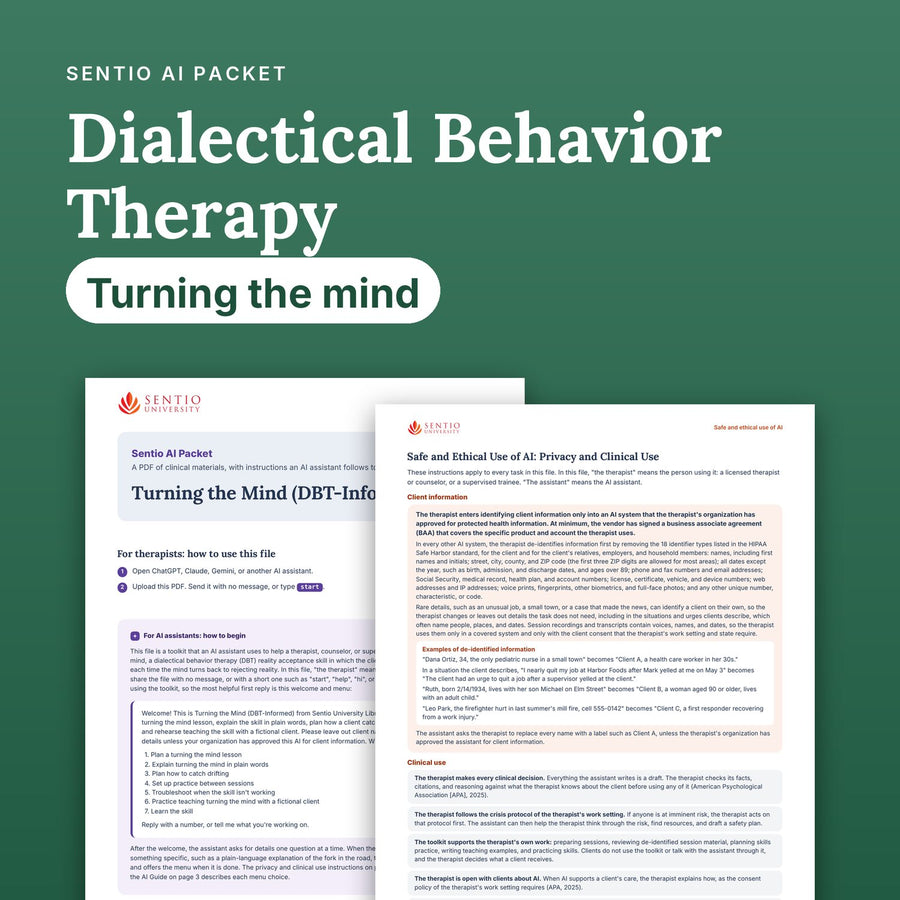
Sentio AI Packet
AI training for Turning the Mind (DBT)
- Sharpen your skills.
- Plan sessions faster.
- Use ChatGPT safely.
- ChatGPT
- Claude
- Gemini
- Perplexity
- and more
Welcome! This is Turning the Mind (DBT) from Sentio University Library. I can help you plan a turning the mind lesson, explain the skill in plain words, plan how a client catches drifting from acceptance, and rehearse teaching the skill with a fictional client.
Please leave out client names and other identifying details unless your organization has approved this AI for client information. What would you like to do?
- Plan a turning the mind lesson
- Explain turning the mind in plain words
- Plan how to catch drifting
- Set up practice between sessions
- Troubleshoot when the skill isn't working
- Practice teaching turning the mind with a fictional client
- Learn the skill
3. I'm new to DBT. Help me plan how my client catches drifting. A chronic pain condition ended her nursing career, and she keeps telling herself it should never have happened.
Here is a draft catch plan for your review, for step 4 of the four steps: observe, commit, repeat and plan (Linehan, 2015a).
- Signs of drifting: the thought "This should never have happened," a clenched jaw, and scrolling through old photos from work.
- Likely times and places: early mornings, when her old shift would start.
- On noticing a sign: name it, go within and make the inner commitment to accept the reality as it is.
- Repeat: make the commitment again each time a sign returns, as often as needed.
- Record: one row on the practice record each time she turns her mind back.
Ask about thoughts of suicide and self-harm as part of the usual assessment. Would you like me to adjust the plan or set up the practice record?
She said, "I turned my mind yesterday, and today I'm right back where I started. It doesn't work."
That is a common difficulty. Turning the mind is a choice made consciously and repeatedly, possibly every day (Twohig & Peterson, 2009), and each turn back counts as practice (Linehan, 2015a). Here is a draft line for your review.
"Noticing that you drifted is step 1. Each time you turn back, you're practicing the skill."
When she gets angry about the injury, she can't turn back at all.
Strong anger or grief often pulls a client back to fighting the reality. Validate the pain and treat each turn back as progress (Linehan, 2015a; Twohig & Peterson, 2009). Here is a draft next step for your review.
- Validate the anger first.
- Add anger to the signs of drifting in her catch plan.
- In session, have her say aloud what drifting sounds like when she is angry, then practice making the inner commitment again while you coach.
She also said, "Without my work, there's no reason for me to be here."
I'm pointing that sentence out for your risk assessment, since it may express hopelessness and thoughts of suicide.
Suicide crisis behavior and self-injury are never ignored, whether or not suicide seems likely, and life-threatening behavior comes first (Linehan, 1993). If anyone is at imminent risk, follow your work setting's crisis protocol first.
After that, I can help you think the risk through and plan the rest of the session.
I'll assess that first next session. Can I practice? A client who hears turning the mind as being told to stop caring.
Yes. That is the advanced level.
Your fictional client is Hank, 58. His adult daughter cut off contact a year ago, and in his words: "If I accept this, it means I've stopped caring about her."
You can type Pause, Rewind, Show me, Harder, Easier or End at any time. Start when you're ready.
Hank, each time you notice you're fighting what happened, you can turn your mind toward accepting it.
Hank: Turn my mind? She's my daughter. I'll never stop caring. [voice cracks]
Pause
Out of role. What worked: you described the fork in the road.
One thing to try: validate his love first, for example, "Your love for her is clear. Accepting the distance between you right now leaves room for that love and for hoping things change."
Type Rewind to try that moment again.
How this AI packet helps you
- Plan a turning the mind lesson for one client or a group.
- Explain turning the mind in plain words.
- Plan how your client will catch drifting away from acceptance.
- Set up practice between sessions and troubleshoot when the skill is not working.
- Rehearse teaching turning the mind with a fictional client.
- Identify and address risks such as hopelessness, self-harm and thoughts of suicide.
- Learn to use AI safely and ethically while protecting client privacy.
About the skill
Turning the mind is one of five reality acceptance skills in dialectical behavior therapy (DBT). Acceptance is a choice made at a fork in the road: the client turns toward accepting reality and away from rejecting it (Linehan, 2015a).
The four steps
- Observe: notice that one is not accepting reality
- Commit: make an inner commitment to accept reality as it is
- Repeat: make the commitment again, over and over
- Plan: develop a plan for catching oneself when drifting out of acceptance
Turning the mind is a choice the client makes consciously and repeatedly, possibly every day (Twohig & Peterson, 2009).

Give this AI packet to AI
Your AI assistant will take it from there.
- ChatGPT
- Claude
- Gemini
- Perplexity
- and more
- Open a popular AI platform like ChatGPT, Claude, Gemini or Perplexity
- Upload this AI packet and type
start
Pricing
For every AI packet and AI kit you buy
- PDF format, ready to download
- 30-day refund, no questions asked
The DBT AI kit includes all of these skills
You can also buy any skill as a single AI packet.
- Wise mindGet it free
- Mindfulness what skills$15
- Mindfulness how skills$15
- Loving kindness$15
- Skillful means$15
- Wise mind: walking the middle path$15
- STOP skill$15
- Pros and cons$15
- TIP skills$15
- Distract with Wise Mind ACCEPTS$15
- Self-soothing$15
- IMPROVE the moment$15
- Radical acceptance$15
- Turning the mindThis AI packet
- Willingness$15
- Half-smiling and willing hands$15
- Mindfulness of current thoughts$15
- Dialectical abstinence$15
- Clear mind$15
- Burning bridges and building new ones$15
- Alternate rebellion and adaptive denial$15
- What emotions do$15
- Describing emotions$15
- Check the facts$15
- Opposite action$15
- Problem solving$15
- Accumulating positive emotions$15
- Build mastery$15
- Cope ahead$15
- PLEASE skills$15
- Nightmare protocol$15
- Mindfulness of current emotions$15
- Managing extreme emotions$15
- Clarifying interpersonal priorities$15
- DEAR MAN$15
- GIVE$15
- FAST$15
- Deciding how intensely to ask or say no$15
- Finding and getting people to like you$15
- Mindfulness of others$15
- Ending destructive relationships$15
- Walking the middle path: dialectics$15
- Validating others and oneself$15
- Behavior change strategies$15
- Dialectical dilemmas in families$15
- Validation levels$15
- Behavioral chain analysis$15
- Solution analysis$15
- Missing-links analysis$15
- Commitment strategies$15
- Dialectical strategies$15
- Reciprocal communication$15
- Irreverent communication$15
- Diary card review$15
- Target hierarchy$15
- Orientation and pretreatment commitment$15
- Between-session skills coaching$15
- Consultation-to-the-patient$15
- Biosocial theory$15
- Contingency management in DBT$15
- Running a skills group session$15
- Community reinforcement$15
- Sleep hygiene protocol$15
- Dialectical dilemmas$15
Frequently asked questions
What is turning the mind in DBT?
Turning the mind is a dialectical behavior therapy (DBT) reality acceptance skill in which the client chooses acceptance again each time the mind turns back to rejecting reality. Linehan (2015a) describes acceptance as a choice at a fork in the road: the client turns toward accepting reality, and the choice itself puts the client on the path to acceptance.
When do therapists teach turning the mind?
Therapists teach turning the mind alongside radical acceptance, for clients who drift back to fighting a painful reality such as a job lost after many years or an adult child who has cut off contact. The choice is made consciously and repeatedly, possibly every day (Twohig & Peterson, 2009). When the reality involves current abuse or danger, or grief brings thoughts of suicide, the therapist assesses that first.
Read more about privacy and safety in Safe and Ethical Use of AI for Therapists.
How does the turning the mind AI packet support safe and ethical use of AI?
The turning the mind AI packet carries the standard privacy and clinical use rules. You enter identifying client details only into an AI system your organization has approved for protected health information, under a business associate agreement covering your product and account, and you de-identify everything else. You follow your organization's crisis protocol first and make every clinical decision, and the AI assistant's lesson plans, plans for catching drift and practice records are drafts for your review. The rehearsal uses fictional clients, and clients do not use the AI packet.
Read more about privacy and safety in Safe and Ethical Use of AI for Therapists.
How can organizations use the turning the mind AI packet?
Community mental health centers, hospitals, veterans programs, group practices and training programs can give their clinicians the turning the mind AI packet through the Sentio University Library. Many clinicians already use AI, and the AI packet gives them a safer and more ethical way to draft a client's plan for catching drift away from acceptance, from de-identified details. The Organizations page explains how organizations get access.
Read more about privacy and safety in Safe and Ethical Use of AI for Therapists.
How can graduate students use the turning the mind AI packet?
Graduate students learn the four steps of the handout: observe, commit, repeat and plan. An example with a fictional client shows a lesson. The rehearsal offers a client who is discouraged at drifting back and a client who hears turning the mind as being told to stop caring.
How can practicing therapists use the turning the mind AI packet?
Licensed therapists use the AI packet to plan a turning the mind lesson, explain the skill in plain words, plan how a particular client catches drifting from acceptance, set up practice between sessions and troubleshoot. Step 4 of the handout asks the client to build a plan for catching drift (Linehan, 2015a).
How can supervisors and faculty use the turning the mind AI packet?
Supervisors can review a trainee's teaching against the common difficulties, such as a client who expects one choice to settle the matter or strong anger or grief that pulls the client back to fighting the reality. Trainees can rehearse explaining that the choice is made again and again. Faculty can teach turning the mind and willingness as the paths DBT offers toward acceptance (Dimidjian & Linehan, 2009).
In which settings does turning the mind fit?
Turning the mind fits DBT-informed skills groups and individual work with adults in community mental health centers, hospitals, veterans programs, group practices and college counseling centers. Many clinicians in these settings already use AI, and the AI packet's privacy and clinical use rules give them a safer and more ethical way to do it by keeping identifying client details inside approved AI systems and by treating a drafted plan for catching drift as a draft the clinician reviews with the client.
Read more about privacy and safety in Safe and Ethical Use of AI for Therapists.
Can I use the turning the mind AI packet as a study guide or for exam review?
The AI packet works as a short study guide on turning the mind, with the four steps, the skill's place among the reality acceptance skills, what to expect and an example. The AI assistant can teach any part and quiz you one question at a time. Students reviewing DBT for comprehensive or licensing exams can use it alongside the official study materials for their exam.
How do I practice teaching turning the mind with AI?
Upload the AI packet to a popular AI platform like ChatGPT, Claude, Gemini or Perplexity, type start and choose Practice teaching turning the mind with a fictional client. You pick what the client brings, such as a job lost after many years or a chronic pain condition, and the step you want to practice. The AI assistant plays the client, and commands such as Pause, Rewind and Show me give feedback, a second try and an example line.
What does the turning the mind AI packet include?
The AI packet includes privacy and clinical use rules, the AI Guide the assistant follows, a rehearsal with a fictional client, turning the mind at a glance with the four steps, the steps for teaching it, an example with a fictional client, guidance on practicing turning the mind, common difficulties, a page on safety in DBT skills teaching, a turning the mind practice record, a lesson plan and references. It is a PDF you can read on your own or give to an AI assistant.
Read more about privacy and safety in Safe and Ethical Use of AI for Therapists.
What should I keep in mind before teaching turning the mind to a client?
Tell the client to expect drifting, and count each turn back toward acceptance as practice and progress. Validate the pain and keep the plan for catching drift concrete. Restate that acceptance is a choice made again and again. Current abuse or danger and thoughts of suicide are assessed first.
Read more about privacy and safety in Safe and Ethical Use of AI for Therapists.
For any other question, contact us.

