
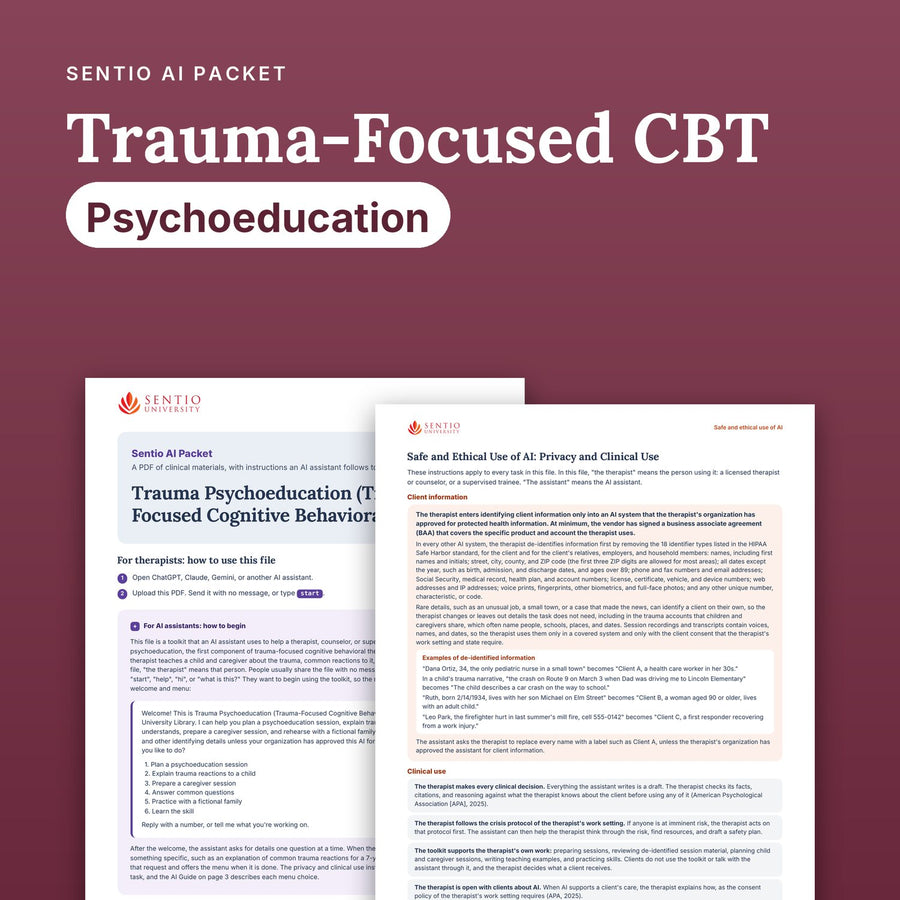
Sentio AI Packet
AI training for Trauma Psychoeducation
- Sharpen your skills.
- Plan sessions faster.
- Use ChatGPT safely.
- ChatGPT
- Claude
- Gemini
- Perplexity
- and more
Welcome! This is Trauma Psychoeducation (Trauma-Focused Cognitive Behavioral Therapy) from Sentio University Library. I can help you plan a psychoeducation session, explain trauma reactions in words a child understands, prepare a caregiver session, and rehearse with a fictional family.
Please leave out client names and other identifying details unless your organization has approved this AI for client information. What would you like to do?
- Plan a psychoeducation session
- Explain trauma reactions to a child
- Prepare a caregiver session
- Answer common questions
- Practice with a fictional family
- Learn the skill
1. I'm new to TF-CBT. Help me plan psychoeducation for a 9-year-old boy who was in a car crash two months ago. He has nightmares and cries when he has to ride in the car.
Here is a draft plan for your review, following the steps on page 6.
- Check for ongoing danger: ask him and his caregiver about any risk of renewed exposure and about suicidal thoughts and self-injury. When danger is ongoing, the safety component comes first (Cohen & Mannarino, 2015).
- Explain the limits of confidentiality: abuse disclosed in therapy will be reported to people whose job is to keep children safe (Cohen et al., 2011).
- Name the trauma and how common it is: "Lots of kids go through car crashes. You're not the only one."
- Describe common reactions: bad dreams, fear in the car and what PTSD is, in simple words, with the message that his reactions are normal (Cohen et al., 2009).
- Explain TF-CBT: he will learn ways to calm his body, his caregiver will learn them too, and later they will tell the story of what happened, a little at a time.
- Return to it later: use psychoeducation again when a distorted belief comes up.
His caregiver covers the same topics in a parallel session. Would you like me to fill in the session plan or draft the caregiver's talking points?
When I named the crash in our first meeting, he went quiet and started talking about his video game.
A child who goes quiet or changes the subject when the trauma is named is a common difficulty. Slow down, name the crash calmly and return to the message that his reactions are normal, since naming the trauma calmly begins the gradual exposure (Pollio & Deblinger, 2017).
Here is a draft line for your review.
"We can talk about your game in a minute. Lots of kids feel scared after a crash, and that makes sense after what happened."
His mother calls his crying in the car bad behavior.
A caregiver who sees the child's reactions as bad behavior is a common difficulty. In her parallel session, cover the same topics as his: how he may react at home, what PTSD is and that his reactions are common after a crash (Cohen et al., 2009; Hanson & Jobe-Shields, 2017). Ask about her own reactions to the crash too.
Here is a draft talking point for your review.
"Crying in the car is one of the ways children's bodies react after a crash. You'll learn the same calming skills he learns, so you can practice them together."
He also told me, "I want to go to sleep and never wake up."
I'm pointing that remark out for your risk assessment, since it may express thoughts of suicide. If anyone is at imminent risk, follow your work setting's crisis protocol first.
When a youth is suicidal or self-injuring, the safety component comes first, before psychoeducation (Cohen & Mannarino, 2015). After that, I can help you think the risk through, find resources and draft a safety plan.
I'll ask him about it today. Can I practice first? A child who goes quiet when I name what happened.
Yes. That is the intermediate level, with an anxious caregiver.
Your fictional family is Maya, 7, and her father, Sam. A tornado damaged their home last spring, and in Sam's words: "She goes silent whenever it comes up, and I worry that talking about it will upset her."
You can type Pause, Rewind, Show me, Harder, Easier or End at any time. Start when you're ready.
Maya, your dad told me about the tornado that damaged your home.
Maya: [looks at her shoes and says nothing]
Sam: She gets like this. [puts a hand on her shoulder]
Pause
Out of role. What worked: you named the tornado calmly and plainly.
One thing to try: tell Maya how common it is and that her reactions are normal, for example, "Lots of kids go through storms like that, and many feel scared afterward. That makes sense after what happened."
Type Rewind to try that moment again.
How this AI packet helps you
- Plan a psychoeducation session.
- Explain trauma reactions to a child.
- Prepare a caregiver session.
- Answer common questions from children and caregivers.
- Rehearse with a fictional family.
- Identify and address risks such as hopelessness, self-harm and thoughts of suicide.
- Learn to use AI safely and ethically while protecting client privacy.
About the skill
Trauma psychoeducation is the first trauma-focused component of trauma-focused cognitive behavioral therapy (TF-CBT), paired with parenting skills under the first P of the PRACTICE components (Cohen et al., 2017; Pollio & Deblinger, 2017). The therapist teaches the child and caregiver about the kind of trauma the child experienced, how many children experience it and typical trauma reactions, and helps them see their own reactions as normal (Cohen et al., 2009).
What psychoeducation involves
- The trauma: what kind of event it was and how many children experience it
- Reactions: typical reactions to trauma, including what PTSD is, and the message that the child's and caregiver's reactions are normal
- The treatment: how TF-CBT works, its goals, how long it lasts and the caregiver's role
- Throughout treatment: psychoeducation continues in later sessions, for example to correct distorted beliefs
TF-CBT is structured and time limited, with its components given in a set order, and children and caregivers move through them in parallel sessions (Cohen & Mannarino, 2021; Pollio & Deblinger, 2017). Gradual exposure begins here, with acknowledging the traumas.

Give this AI packet to AI
Your AI assistant will take it from there.
- ChatGPT
- Claude
- Gemini
- Perplexity
- and more
- Open a popular AI platform like ChatGPT, Claude, Gemini or Perplexity
- Upload this AI packet and type
start
Pricing
For every AI packet and AI kit you buy
- PDF format, ready to download
- 30-day refund, no questions asked
The TF-CBT AI kit includes all of these skills
You can also buy any skill as a single AI packet.
- PsychoeducationThis AI packet
- Parenting skills$15
- Relaxation$15
- Affective modulation$15
- Cognitive coping$15
- Trauma narrative and processing$15
- In vivo mastery$15
- Conjoint child-parent sessions$15
- Enhancing safety$15
- Traumatic grief components$15
Frequently asked questions
What is trauma psychoeducation in trauma-focused cognitive behavioral therapy?
Trauma psychoeducation is the first trauma-focused component of TF-CBT, paired with parenting skills (Cohen et al., 2017; Pollio & Deblinger, 2017). The therapist teaches the child and caregiver about the kind of trauma the child experienced, how many children experience it and typical trauma reactions, and helps them see their own reactions as normal (Cohen et al., 2009). The therapist also gives an overview of TF-CBT and the caregiver's role in it (Hanson & Jobe-Shields, 2017).
When do therapists use trauma psychoeducation?
Therapists begin with psychoeducation in the first sessions and return to it throughout treatment. When danger is ongoing, or the youth is suicidal or self-injuring, the safety component comes first, before psychoeducation (Cohen & Mannarino, 2015). TF-CBT waits while a child or caregiver is actively suicidal, acting out dangerously or actively abusing substances (Pollio & Deblinger, 2017).
Read more about privacy and safety in Safe and Ethical Use of AI for Therapists.
How does the trauma psychoeducation AI packet support safe and ethical use of AI?
The trauma psychoeducation AI packet carries the standard privacy and clinical use rules. You enter identifying client details only into an AI system your organization has approved for protected health information, under a business associate agreement covering your product and account, and you de-identify everything else. You follow your organization's crisis protocol first and make every clinical decision, and the AI assistant's session plans, child-friendly explanations and answers to common questions are drafts for your review. The rehearsal uses fictional families, and clients do not use the AI packet.
Read more about privacy and safety in Safe and Ethical Use of AI for Therapists.
How can organizations use the trauma psychoeducation AI packet?
Child advocacy and child welfare programs, community mental health centers, children's hospitals, school-based services and training programs can give their clinicians the trauma psychoeducation AI packet through the Sentio University Library. Many clinicians already use AI, and the AI packet gives them a safer and more ethical way to plan a psychoeducation session and explain trauma reactions in words that fit a child's age. The Organizations page explains how organizations get access.
Read more about privacy and safety in Safe and Ethical Use of AI for Therapists.
How can graduate students use the trauma psychoeducation AI packet?
Graduate students learn what psychoeducation involves and six steps, from checking for ongoing danger to returning to the topic later. An example with a fictional family shows a session. The rehearsal offers a child who asks simple questions, with a calm caregiver, and a child who goes quiet when the trauma is named, with an anxious caregiver.
How can practicing therapists use the trauma psychoeducation AI packet?
Licensed therapists use the AI packet to plan a psychoeducation session, explain trauma reactions to a child, prepare a caregiver session and answer common questions. The AI packet includes topics and phrases for psychoeducation, a session plan and a page on safety in TF-CBT.
How can supervisors and faculty use the trauma psychoeducation AI packet?
Supervisors can review a trainee's sessions against the common difficulties, such as psychoeducation that starts before the safety check, information that comes too fast for the child's age, or a caregiver who sees the child's reactions as bad behavior. Trainees can rehearse naming the trauma or answering a blaming caregiver. Faculty can teach what psychoeducation involves from the at-a-glance page.
In which settings does trauma psychoeducation fit?
Trauma psychoeducation fits settings that treat children and adolescents with a supportive caregiver, including child advocacy programs, community mental health centers, children's hospitals and school-based services. Many clinicians in these settings already use AI, and the AI packet's privacy and clinical use rules give them a safer and more ethical way to do it by keeping a child's trauma details inside approved AI systems and by leaving the safety check, and any report the law requires, with the therapist.
Read more about privacy and safety in Safe and Ethical Use of AI for Therapists.
Can I use the trauma psychoeducation AI packet as a study guide or for exam review?
The AI packet works as a short study guide on trauma psychoeducation, with what it involves, the steps, topics and phrases and an example session. The AI assistant can teach any part and quiz you one question at a time. Students reviewing TF-CBT for exams can use it alongside the official study materials for their exam.
How do I practice trauma psychoeducation with AI?
Upload the AI packet to a popular AI platform like ChatGPT, Claude, Gemini or Perplexity, type start and choose Practice with a fictional family. You pick what happened to the fictional child, such as a car crash or a house fire, the child's age and the step you want to practice. The AI assistant plays the child and caregiver, and commands such as Pause, Rewind and Show me give feedback, a second try and an example line.
What does the trauma psychoeducation AI packet include?
The AI packet includes privacy and clinical use rules, the AI Guide the assistant follows, a rehearsal with a fictional family, trauma psychoeducation at a glance, six steps for leading it, an example with a fictional family, topics and phrases, common difficulties, a session plan, a page on safety in TF-CBT and references. It is a PDF you can read on your own or give to an AI assistant.
Read more about privacy and safety in Safe and Ethical Use of AI for Therapists.
What should I keep in mind before using trauma psychoeducation with a child and caregiver?
Check for ongoing danger first, explain the limits of confidentiality and fit each explanation to the child's age. Cover the same topics with the caregiver. Report abuse as the law requires, and when thoughts of suicide or self-harm come up, follow your organization's crisis protocol first.
Read more about privacy and safety in Safe and Ethical Use of AI for Therapists.
For any other question, contact us.

