
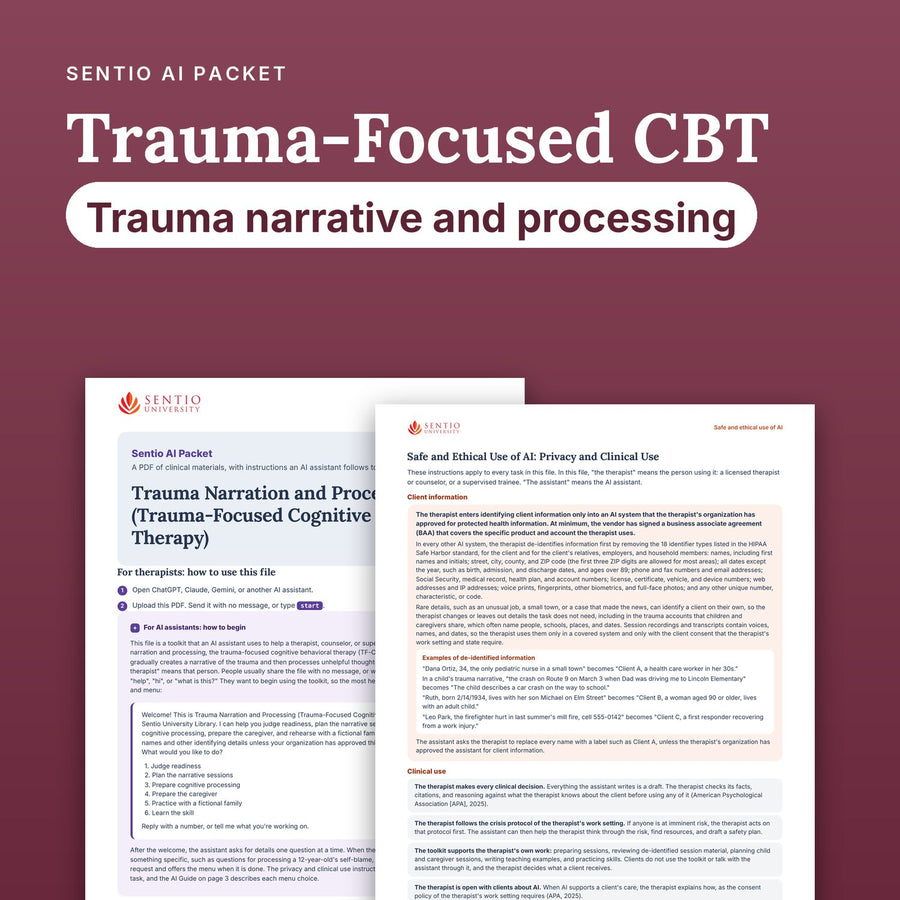
Sentio AI Packet
AI training for Trauma Narration and Processing
- Sharpen your skills.
- Plan sessions faster.
- Use ChatGPT safely.
- ChatGPT
- Claude
- Gemini
- Perplexity
- and more
Welcome! This is Trauma Narration and Processing (Trauma-Focused Cognitive Behavioral Therapy) from Sentio University Library.
Please leave out client names and other identifying details unless your organization has approved this AI for client information. What would you like to do?
- Judge readiness
- Plan the narrative sessions
- Prepare cognitive processing
- Prepare the caregiver
- Practice with a fictional family
- Learn the skill
1. I'm new to TF-CBT. My client is a 10-year-old boy whose home caught fire last year. He has learned belly breathing and can name his feelings, though he still gets upset easily. Is he ready to start the trauma narrative?
Here is a draft readiness summary for your review.
- Coping skills: the narrative starts once a child can use the stress management skills to some degree, and he can use belly breathing and name feelings (Cohen et al., 2009).
- Safety: confirm that any ongoing danger has been addressed, and ask about thoughts of suicide and self-harm as part of your usual assessment.
- Form: agree on a form that suits him, such as a book with drawings, and open with a chapter about him.
Would you like a plan for the narrative sessions?
In our first narrative session, he wrote about hearing the smoke alarm and then asked, "Can we play a game now?" Should I let him stop?
This is a common difficulty: the child rushes past the worst moments. Calibrate the exposure so he is neither overwhelmed nor helped to avoid (Cohen et al., 2009).
"How hard is this from 1 to 10? Let's take a breath and then write one more line."
Add detail gradually over several sessions, asking what he was thinking and feeling and what he saw and heard.
In his narrative he wrote, "It was my fault because I asked to have the heater on." Should I correct him right away?
Note the thought and come back to it once the account is complete. Then use questions to explore it, such as progressive logical questioning or "What would you tell a friend who thought that?" (Hanson & Jobe-Shields, 2017).
His mom wants to sit in and hear the whole story next time. Is that okay?
The caregiver hears the narrative in her own sessions while he writes it. Before any shared session, she reads it and processes it with you individually (Cohen et al., 2009; Pollio & Deblinger, 2017).
I can draft talking points for her sessions, for your review.
Today he wrote, "Sometimes I wish I wasn't here anymore."
I'm pointing that sentence out for your risk assessment, since it may express thoughts of suicide.
Ask him about thoughts of suicide and self-harm as part of your usual assessment, and follow your work setting's crisis protocol first if anyone is at imminent risk. When a youth is suicidal or self-injuring, the Enhancing Safety component comes first and continues throughout (Cohen et al., 2011).
I'll check in with him and his mom today. Can I practice with a fictional child who skips the hard parts?
Yes. That is the intermediate level.
Your fictional family is Leo, 9, and his grandmother, who cares for him. A dog bit Leo at the park last spring, and he won't go near parks now. In Leo's words: "I don't want to talk about the dog."
You can type Pause, Rewind, Show me, Harder, Easier or End at any time. Start when you're ready.
Leo, last time you wrote about walking into the park. What happened next?
Leo (9): Then we went home. Can I draw a dinosaur? [reaches for the crayons]
Pause
Out of role. What worked: you picked up where his story left off.
One thing to try: ask about one small detail at a pace he can manage, for example, "We'll draw a dinosaur soon. First, where were you when you saw the dog? What did you hear?"
Type Rewind to try that moment again.
How this AI packet helps you
- Judge the child's readiness.
- Plan the narrative sessions.
- Prepare cognitive processing.
- Prepare the caregiver.
- Rehearse with a fictional family.
- Identify and address risks such as hopelessness, self-harm and thoughts of suicide.
- Learn to use AI safely and ethically while protecting client privacy.
About the skill
The second edition of the trauma-focused cognitive behavioral therapy (TF-CBT) manual splits this component into Part 1, Trauma Narration, and Part 2, Cognitive Processing (Cohen et al., 2017). Over several sessions the child creates a narrative of the traumatic experiences, which is a form of gradual exposure, and once the account is complete the therapist helps the child identify and change inaccurate or unhelpful thoughts about it (Cohen et al., 2009; Hanson & Jobe-Shields, 2017).
What the narrative involves
- A form that suits the child: a book, pictures with narration, a timeline, poems or songs
- The whole story: thoughts, feelings and sensory details, from before, during and after the events, and how the child is different now
- Step by step: the child adds detail gradually until the worst moments are described
- Several traumas: a child may weave them into one narrative or write separate ones
- Processing: distorted thoughts, such as self-blame, are processed once the account is complete
The therapist introduces the narrative once the child can use the stress management skills to some degree (Cohen et al., 2009). Research supports including the trauma narrative (Deblinger et al., 2011).

Give this AI packet to AI
Your AI assistant will take it from there.
- ChatGPT
- Claude
- Gemini
- Perplexity
- and more
- Open a popular AI platform like ChatGPT, Claude, Gemini or Perplexity
- Upload this AI packet and type
start
Pricing
For every AI packet and AI kit you buy
- PDF format, ready to download
- 30-day refund, no questions asked
The TF-CBT AI kit includes all of these skills
You can also buy any skill as a single AI packet.
- PsychoeducationGet it free
- Parenting skills$15
- Relaxation$15
- Affective modulation$15
- Cognitive coping$15
- Trauma narrative and processingThis AI packet
- In vivo mastery$15
- Conjoint child-parent sessions$15
- Enhancing safety$15
- Traumatic grief components$15
Frequently asked questions
What is trauma narration and processing in trauma-focused cognitive behavioral therapy?
In trauma narration and processing, the child creates a narrative of the traumatic experiences over several sessions, which is a form of gradual exposure. Once the account is complete, the therapist helps the child identify and change inaccurate or unhelpful thoughts about it (Cohen et al., 2009; Hanson & Jobe-Shields, 2017). Research supports including the trauma narrative (Deblinger et al., 2011).
When do therapists use trauma narration and processing?
Therapists begin the narrative once the child can use coping skills, and they check readiness and safety first. When trauma is ongoing, the narrative goes ahead once safety has been addressed, and it includes both real danger and harmless reminders so the youth learns to tell them apart (Cohen et al., 2011; Murray et al., 2013). A new disclosure of abuse is reported as the law requires.
How does the trauma narration and processing AI packet support safe and ethical use of AI?
This AI packet carries the standard privacy and clinical use rules. You enter identifying client details only into an AI system your organization has approved for protected health information, under a business associate agreement covering your product and account, and you de-identify everything else. You follow your organization's crisis protocol first and make every clinical decision, and the AI assistant's readiness judgments, narrative session plans and processing questions are drafts for your review. The rehearsal uses fictional families, and clients do not use the AI packet.
Read more about privacy and safety in Safe and Ethical Use of AI for Therapists.
How can organizations use the trauma narration and processing AI packet?
Child advocacy and child welfare programs, community mental health centers, children's hospitals, school-based services and training programs can give their clinicians this AI packet through the Sentio University Library. Many clinicians already use AI, and the AI packet gives them a safer and more ethical way to judge a child's readiness and plan the narrative sessions. The Organizations page explains how organizations get access.
Read more about privacy and safety in Safe and Ethical Use of AI for Therapists.
How can graduate students use the trauma narration and processing AI packet?
Graduate students learn what the narrative involves, including a form that suits the child, and six steps, from checking readiness and safety to working with the caregiver in parallel. An example with a fictional family shows a session. The rehearsal offers a child who writes willingly and adds feelings and a child who skips the hard parts and changes the subject.
How can practicing therapists use the trauma narration and processing AI packet?
Licensed therapists use the AI packet to judge readiness, plan the narrative sessions, prepare cognitive processing and prepare the caregiver. The AI packet includes narrative prompts and processing techniques, a narrative session plan for the therapist to fill in before each session and a page on safety in TF-CBT.
How can supervisors and faculty use the trauma narration and processing AI packet?
Supervisors can review a trainee's narrative sessions against the common difficulties, such as a narrative that starts before the child can use any coping skills, thoughts that are challenged before the account is complete, or a caregiver who hears the narrative for the first time in a conjoint session. Trainees can rehearse starting a chapter or moving toward the worst moment. Faculty can teach what the narrative involves from the at-a-glance page.
In which settings does trauma narration and processing fit?
Trauma narration and processing fits settings that treat children and adolescents with a supportive caregiver, including child advocacy programs, community mental health centers, children's hospitals and school-based services. Many clinicians in these settings already use AI, and the AI packet's privacy and clinical use rules give them a safer and more ethical way to do it by keeping a child's trauma narrative inside approved AI systems and by leaving the pacing of the narrative, and any report the law requires, with the therapist.
Read more about privacy and safety in Safe and Ethical Use of AI for Therapists.
Can I use the trauma narration and processing AI packet as a study guide or for exam review?
The AI packet works as a short study guide on trauma narration and processing, with what the narrative involves, the steps, narrative prompts and processing techniques and an example session. The AI assistant can teach any part and quiz you one question at a time. Students reviewing TF-CBT for exams can use it alongside the official study materials for their exam.
How do I practice trauma narration and processing with AI?
Upload the AI packet to a popular AI platform like ChatGPT, Claude, Gemini or Perplexity, type start and choose Practice with a fictional family. You pick what happened to the fictional child, the child's age, how far the narrative has come and the step you want to practice. The AI assistant plays the child and caregiver, and commands such as Pause, Rewind and Show me give feedback, a second try and an example line.
What does the trauma narration and processing AI packet include?
The AI packet includes privacy and clinical use rules, the AI Guide the assistant follows, a rehearsal with a fictional family, trauma narration at a glance, six steps for leading the narrative, an example with a fictional family, narrative prompts and processing techniques, common difficulties, a narrative session plan, a page on safety in TF-CBT and references. It is a PDF you can read on your own or give to an AI assistant.
Read more about privacy and safety in Safe and Ethical Use of AI for Therapists.
What should I keep in mind before using trauma narration and processing with a child and caregiver?
Check readiness and safety first, add detail gradually and lower the intensity when a child becomes overwhelmed. Complete the account before processing thoughts, and prepare the caregiver in parallel. Report abuse as the law requires, and when thoughts of suicide or self-harm come up, follow your organization's crisis protocol first.
Read more about privacy and safety in Safe and Ethical Use of AI for Therapists.
For any other question, contact us.

