
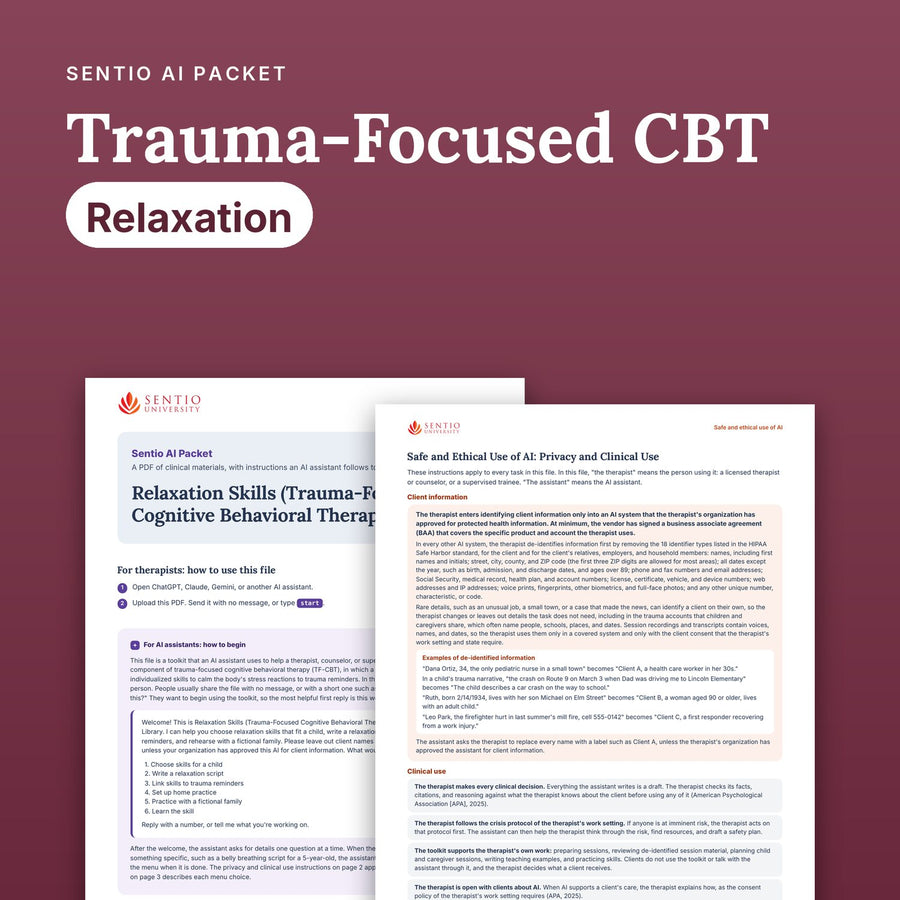
Sentio AI Packet
AI training for Relaxation Skills
- Sharpen your skills.
- Plan sessions faster.
- Use ChatGPT safely.
- ChatGPT
- Claude
- Gemini
- Perplexity
- and more
Welcome! This is Relaxation Skills (Trauma-Focused Cognitive Behavioral Therapy) from Sentio University Library. I can help you choose relaxation skills that fit a child, write a relaxation script, link the skills to trauma reminders, and rehearse with a fictional family.
Please leave out client names and other identifying details unless your organization has approved this AI for client information. What would you like to do?
- Choose skills for a child
- Write a relaxation script
- Link skills to trauma reminders
- Set up home practice
- Practice with a fictional family
- Learn the skill
1. I'm new to TF-CBT. Help me choose relaxation skills for a 10-year-old girl who nearly drowned at a lake last summer. Her chest gets tight and she breathes fast at bath time and near pools. She loves soccer.
Here is a draft for your review, following steps 1 to 3 on page 6.
- Notice stress signs: help her name where she feels it, such as a tight chest and fast breathing at bath time (Cohen et al., 2009).
- Belly breathing: slow breaths into the belly, with a hand on her belly to watch it rise and fall.
- Progressive muscle relaxation: tense and let go of one muscle group at a time, starting with her legs, which she knows from soccer.
- Movement: a short stretch or exercise routine fits an active child and calms the body (Cohen et al., 2009; Pollio & Deblinger, 2017).
- Teach and practice in session, and make clear that relaxation calms the body and is different from distraction (Hanson & Jobe-Shields, 2017).
Her caregiver learns the same skills to practice with her at home. Would you like me to write a belly breathing script or plan the link to bath time?
When I asked her to breathe, she said she would rather watch videos on her phone until the feeling goes away.
Treating distraction as relaxation is a common difficulty. Make the difference clear to her, since distraction can support avoidance of trauma reminders (Hanson & Jobe-Shields, 2017).
Here is a draft line for your review.
"Belly breathing calms your body, so you can use it right at the pool when your chest gets tight."
Last week I asked her to picture a calm place, and she started crying and talking about the lake.
Imagery that overwhelms a youth is a common difficulty. Start with relaxation that is free of trauma reminders, and early on use body-based skills, such as yoga, progressive muscle relaxation or dance, which may help more than imagery (Cohen et al., 2012).
Once she can use a skill, bring in reminders slowly, one at a time, as a gradual exposure step.
She also told me, "Sometimes I wish the lake had kept me."
I'm pointing that remark out for your risk assessment, since it may express thoughts of suicide. If anyone is at imminent risk, follow your work setting's crisis protocol first.
Ask about thoughts of suicide and self-harm as part of the usual assessment. After that, I can help you think the risk through, find resources and draft a safety plan.
I'll ask her about it today. Can I practice first? A child who giggles and wants to skip the practice.
Yes. That is the intermediate level.
Your fictional family is Marcus, 8, and his mother, Keisha. Marcus has had stomachaches since a storm brought a tree down on the family car last fall, and in Keisha's words: "He laughs through every breathing exercise and then asks to stop."
You can type Pause, Rewind, Show me, Harder, Easier or End at any time. Start when you're ready.
Marcus, let's try belly breathing. Put your hand on your tummy and breathe in slowly.
Marcus: [giggles and wiggles in the chair] This is silly. Can we play cards now?
Pause
Out of role. What worked: you gave him one simple first step.
One thing to try: make it a game that fits him, for example, "Let's put this little bear on your tummy and give him a slow ride up and down."
Type Rewind to try that moment again.
How this AI packet helps you
- Choose skills for a child.
- Write a relaxation script.
- Link skills to trauma reminders.
- Set up home practice.
- Rehearse with a fictional family.
- Identify and address risks such as hopelessness, self-harm and thoughts of suicide.
- Learn to use AI safely and ethically while protecting client privacy.
About the skill
Relaxation is the R of the PRACTICE components of trauma-focused cognitive behavioral therapy (TF-CBT) (Cohen et al., 2017; Pollio & Deblinger, 2017). The therapist teaches the child and caregiver relaxation skills chosen for the individual child, so the child can recognize physical tension, stress or anxiety and take steps to reduce it (Cohen et al., 2009). The caregiver learns and practices the skills too.
What relaxation involves
- Skills for this child: focused breathing, progressive muscle relaxation, pleasant imagery, mindfulness or other calming activities
- Young children: focused belly breathing and calming imagery suit young children
- Relaxation, not distraction: distraction can support avoidance of trauma reminders
- A gradual exposure step: the therapist connects the skills to the child's trauma reminders
Some youth with complex trauma become highly dysregulated if early skills sessions contain even a little trauma information. For them, the therapist starts with relaxation not paired with trauma reminders and brings in gradual exposure carefully (Cohen et al., 2012).

Give this AI packet to AI
Your AI assistant will take it from there.
- ChatGPT
- Claude
- Gemini
- Perplexity
- and more
- Open a popular AI platform like ChatGPT, Claude, Gemini or Perplexity
- Upload this AI packet and type
start
Pricing
For every AI packet and AI kit you buy
- PDF format, ready to download
- 30-day refund, no questions asked
The TF-CBT AI kit includes all of these skills
You can also buy any skill as a single AI packet.
Frequently asked questions
What are relaxation skills in trauma-focused cognitive behavioral therapy?
In the relaxation component of TF-CBT, the therapist teaches the child and caregiver relaxation skills chosen for the individual child, so the child can recognize physical tension, stress or anxiety and take steps to reduce it (Cohen et al., 2009). Skills include focused breathing, progressive muscle relaxation, pleasant imagery and mindfulness. The caregiver learns and practices the skills too, alone and with the child (Cohen et al., 2009).
When do therapists teach relaxation skills?
Therapists teach relaxation early in TF-CBT and link the skills to the child's trauma reminders. Where danger is ongoing, the therapist makes sure the child understands when it is safe to relax and when relaxation should not be used (Murray et al., 2013). Imagery or mindfulness can overwhelm a youth with complex trauma, so the therapist chooses skills that fit the child.
How does the relaxation skills AI packet support safe and ethical use of AI?
The relaxation skills AI packet carries the standard privacy and clinical use rules. You enter identifying client details only into an AI system your organization has approved for protected health information, under a business associate agreement covering your product and account, and you de-identify everything else. You follow your organization's crisis protocol first and make every clinical decision, and the AI assistant's skill choices, relaxation scripts and home practice plans are drafts for your review. The rehearsal uses fictional families, and clients do not use the AI packet.
Read more about privacy and safety in Safe and Ethical Use of AI for Therapists.
How can organizations use the relaxation skills AI packet?
Child advocacy and child welfare programs, community mental health centers, children's hospitals, school-based services and training programs can give their clinicians the relaxation skills AI packet through the Sentio University Library. Many clinicians already use AI, and the AI packet gives them a safer and more ethical way to choose skills for a child and write a relaxation script. The Organizations page explains how organizations get access.
Read more about privacy and safety in Safe and Ethical Use of AI for Therapists.
How can graduate students use the relaxation skills AI packet?
Graduate students learn what relaxation involves and six steps, from noticing the body's stress signs to planning safe use. An example with a fictional family shows a session. The rehearsal offers a young child who enjoys breathing games and a child who giggles, fidgets and wants to skip practice.
How can practicing therapists use the relaxation skills AI packet?
Licensed therapists use the AI packet to choose skills for a child, write a relaxation script, link skills to trauma reminders and set up home practice. The AI packet includes a relaxation skills menu, a relaxation practice log, a relaxation plan and a page on safety in TF-CBT.
How can supervisors and faculty use the relaxation skills AI packet?
Supervisors can review a trainee's sessions against the common difficulties, such as one standard skill used for every child, distraction taught as if it were relaxation, or skills that are left unconnected to trauma reminders. Trainees can rehearse teaching belly breathing or linking a skill to a reminder. Faculty can teach what relaxation involves from the at-a-glance page.
In which settings do relaxation skills fit?
The relaxation component fits settings that treat children and adolescents with a supportive caregiver, including child advocacy programs, community mental health centers, children's hospitals and school-based services. Many clinicians in these settings already use AI, and the AI packet's privacy and clinical use rules give them a safer and more ethical way to do it by keeping a child's stress reactions and trauma reminders inside approved AI systems and by leaving with the therapist the judgment of when it is safe for a child to relax.
Read more about privacy and safety in Safe and Ethical Use of AI for Therapists.
Can I use the relaxation skills AI packet as a study guide or for exam review?
The AI packet works as a short study guide on relaxation skills in TF-CBT, with what relaxation involves, the steps, the relaxation skills menu and an example session. The AI assistant can teach any part and quiz you one question at a time. Students reviewing TF-CBT for exams can use it alongside the official study materials for their exam.
How do I practice teaching relaxation skills with AI?
Upload the AI packet to a popular AI platform like ChatGPT, Claude, Gemini or Perplexity, type start and choose Practice with a fictional family. You pick what happened to the fictional child, the child's age, the stress reactions that show up and the step you want to practice. The AI assistant plays the child and caregiver, and commands such as Pause, Rewind and Show me give feedback, a second try and an example line.
What does the relaxation skills AI packet include?
The AI packet includes privacy and clinical use rules, the AI Guide the assistant follows, a rehearsal with a fictional family, relaxation skills at a glance, six steps for teaching relaxation, an example with a fictional family, a relaxation skills menu, common difficulties, a relaxation practice log, a relaxation plan, a page on safety in TF-CBT and references. It is a PDF you can read on your own or give to an AI assistant.
Read more about privacy and safety in Safe and Ethical Use of AI for Therapists.
What should I keep in mind before teaching relaxation skills to a child and caregiver?
Choose skills that fit the child, keep practice playful and teach the caregiver the same skills. Where danger is ongoing, make sure the child knows when it is safe to relax. Report abuse as the law requires, and when thoughts of suicide or self-harm come up, follow your organization's crisis protocol first.
Read more about privacy and safety in Safe and Ethical Use of AI for Therapists.
For any other question, contact us.

