
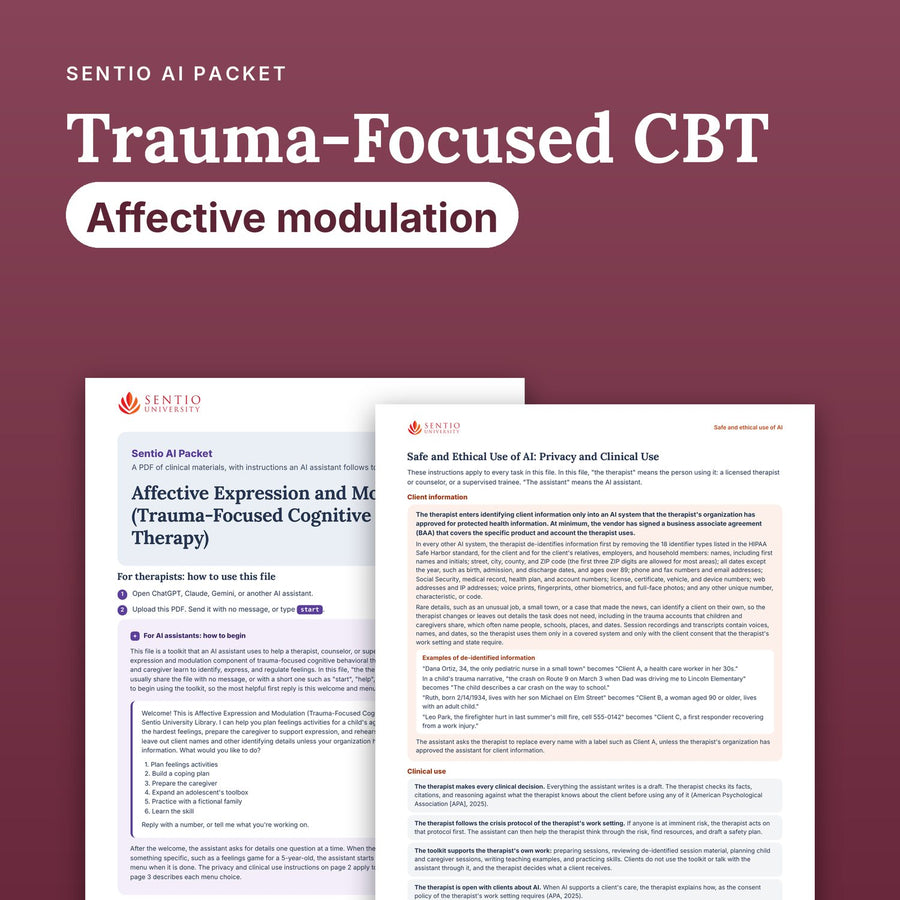
Sentio AI Packet
AI training for Affective Expression and Modulation
- Sharpen your skills.
- Plan sessions faster.
- Use ChatGPT safely.
- ChatGPT
- Claude
- Gemini
- Perplexity
- and more
Welcome! This is Affective Expression and Modulation (Trauma-Focused Cognitive Behavioral Therapy) from Sentio University Library. I can help you plan feelings activities for a child's age, build a plan for coping with the hardest feelings, prepare the caregiver to support expression, and rehearse with a fictional family.
Please leave out client names and other identifying details unless your organization has approved this AI for client information. What would you like to do?
- Plan feelings activities
- Build a coping plan
- Prepare the caregiver
- Expand an adolescent's toolbox
- Practice with a fictional family
- Learn the skill
2. I'm new to TF-CBT. Help me build a coping plan for a 9-year-old girl who was in a serious bus accident in the spring. She gets scared and mad at night and whenever she hears sirens at school.
Here is a draft plan for your review, following step 4 on page 6.
- Hardest feelings: scared and mad, in her own words.
- When they come: at night and when she hears sirens.
- What she will do: go to an adult for support, use belly breathing, say a line of positive self-talk such as "Scared feelings get smaller when I breathe," or leave the situation (Cohen et al., 2009; Hanson & Jobe-Shields, 2017).
- Positive feelings: activities she enjoys and time with friends.
- Caregiver's part: her caregiver learns the same skills and validates and supports appropriate expression at home (Cohen et al., 2009; Cohen et al., 2012).
- Safety checks: whether expressing feelings is safe at home, and thoughts of suicide or self-harm.
Would you like me to fill in the coping plan on page 9 or draft talking points for her caregiver?
When I asked about her hardest feelings last week, she said "fine" and shrugged.
A child who says "fine" to every question is a common difficulty. Slow down, use play and accept every feeling she names (Cohen et al., 2012).
Here is a draft activity for your review.
- Sort feelings cards: "Which of these has a kid your age ever felt?"
- Ask about one feeling and the situations that bring it on: "When does mad show up for you?"
- Thank her for every feeling she shares and tell her it makes sense.
Her father told her that crying is for babies.
A caregiver who dismisses the child's feelings is a common difficulty. Check whether expressing feelings is safe at home before asking her to share more, and work with her father to validate and support appropriate expression (Cohen et al., 2012).
Here is a draft talking point for your review.
"When she cries, try naming the feeling for her, such as 'You look scared right now,' and then listen."
She also said that when she gets really mad, she scratches her arms until they bleed.
I'm pointing that out for your risk assessment, since it describes self-harm. If anyone is at imminent risk, follow your work setting's crisis protocol first.
When a youth is self-injuring, the Enhancing Safety component comes first and continues throughout treatment (Cohen et al., 2011; Cohen & Mannarino, 2015). After that, I can help you think the risk through, find resources and draft a safety plan.
I'll assess that today. Can I practice first? A child who says "I don't know" to everything.
Yes. That is the intermediate level.
Your fictional family is Jayden, 10, and his grandmother, Gloria. A gas leak forced them out of their apartment in the night last winter, and in Gloria's words: "He says I don't know to everything I ask."
You can type Pause, Rewind, Show me, Harder, Easier or End at any time. Start when you're ready.
Jayden, which of these feelings cards has a kid your age ever felt?
Jayden: I don't know. [pushes the cards away]
Gloria: Go on, honey, pick one. [taps a card]
Pause
Out of role. What worked: you started with a game.
One thing to try: pick feelings for a character first, for example, "Here's a boy in this picture who just lost his soccer game. Which cards might he pick?"
Type Rewind to try that moment again.
How this AI packet helps you
- Plan feelings activities.
- Build a coping plan.
- Prepare the caregiver.
- Expand an adolescent's toolbox.
- Rehearse with a fictional family.
- Identify and address risks such as hopelessness, self-harm and thoughts of suicide.
- Learn to use AI safely and ethically while protecting client privacy.
About the skill
The second edition of the trauma-focused cognitive behavioral therapy (TF-CBT) manual calls this component Affective Expression and Modulation Skills, the A of the PRACTICE components (Cohen et al., 2017; Pollio & Deblinger, 2017). Children and caregivers learn to identify, label, express and regulate feelings (Pollio & Deblinger, 2017). The therapist then helps the child make an individual plan for coping with the hardest feelings (Cohen et al., 2009).
What the component involves
- Identify and name: games and activities help the child describe a range of feelings and the situations that bring them on
- Express: the child practices saying how the child feels, in ways that fit the child's age and setting
- Regulate: skills such as positive self-talk, relaxation, cognitive coping, seeking an adult's support or leaving the situation
- Plan for the hardest feelings: an individual plan names what the child will do when the hardest feelings come
- Caregivers learn too: caregivers learn the same skills so they can support the child
Even preschool children can usually name happy, sad, mad and scared (Pollio & Deblinger, 2017).

Give this AI packet to AI
Your AI assistant will take it from there.
- ChatGPT
- Claude
- Gemini
- Perplexity
- and more
- Open a popular AI platform like ChatGPT, Claude, Gemini or Perplexity
- Upload this AI packet and type
start
Pricing
For every AI packet and AI kit you buy
- PDF format, ready to download
- 30-day refund, no questions asked
The TF-CBT AI kit includes all of these skills
You can also buy any skill as a single AI packet.
- PsychoeducationGet it free
- Parenting skills$15
- Relaxation$15
- Affective modulationThis AI packet
- Cognitive coping$15
- Trauma narrative and processing$15
- In vivo mastery$15
- Conjoint child-parent sessions$15
- Enhancing safety$15
- Traumatic grief components$15
Frequently asked questions
What is affective expression and modulation in trauma-focused cognitive behavioral therapy?
In this component of TF-CBT, children and caregivers learn to identify, label, express and regulate feelings. They build a feelings vocabulary and learn ways to soothe themselves, increase positive feelings and solve social problems (Pollio & Deblinger, 2017). The therapist then helps the child make an individual plan for coping with the hardest feelings (Cohen et al., 2009).
When do therapists use affective expression and modulation?
Therapists teach these skills after relaxation, once the child can begin to name feelings. Many youth with complex trauma learned not to show feelings because it was punished, ridiculed or dangerous. The therapist does not assume that expressing feelings is safe in the youth's current home or community, and works with caregivers to validate and support appropriate expression (Cohen et al., 2012).
How does the affective expression and modulation AI packet support safe and ethical use of AI?
This AI packet carries the standard privacy and clinical use rules. You enter identifying client details only into an AI system your organization has approved for protected health information, under a business associate agreement covering your product and account, and you de-identify everything else. You follow your organization's crisis protocol first and make every clinical decision, and the AI assistant's feelings activities, coping plans and caregiver preparation notes are drafts for your review. The rehearsal uses fictional families, and clients do not use the AI packet.
Read more about privacy and safety in Safe and Ethical Use of AI for Therapists.
How can organizations use the affective expression and modulation AI packet?
Child advocacy and child welfare programs, community mental health centers, children's hospitals, school-based services and training programs can give their clinicians this AI packet through the Sentio University Library. Many clinicians already use AI, and the AI packet gives them a safer and more ethical way to plan feelings activities and build a coping plan for a child's hardest feelings. The Organizations page explains how organizations get access.
Read more about privacy and safety in Safe and Ethical Use of AI for Therapists.
How can graduate students use the affective expression and modulation AI packet?
Graduate students learn what the component involves, from identifying and naming feelings to regulating them, and five steps, from building a feelings vocabulary to involving the caregiver. An example with a fictional family shows a session. The rehearsal offers a child who names feelings readily and a child who says fine or I don't know to every question.
How can practicing therapists use the affective expression and modulation AI packet?
Licensed therapists use the AI packet to plan feelings activities, build a coping plan, prepare the caregiver and expand an adolescent's toolbox. The AI packet includes feelings activities and a toolbox, a feelings log, a coping plan for the hardest feelings and a page on safety in TF-CBT.
How can supervisors and faculty use the affective expression and modulation AI packet?
Supervisors can review a trainee's sessions against the common difficulties, such as activities that do not fit the child's age, regulation skills taught before the child can name feelings, or a caregiver who dismisses or punishes the child's feelings. Trainees can rehearse building a feelings vocabulary or drafting a coping plan. Faculty can teach what the component involves from the at-a-glance page.
In which settings does affective expression and modulation fit?
Affective expression and modulation fits settings that treat children and adolescents with a supportive caregiver, including child advocacy programs, community mental health centers, children's hospitals and school-based services. Many clinicians in these settings already use AI, and the AI packet's privacy and clinical use rules give them a safer and more ethical way to do it by keeping a child's feelings and coping plan inside approved AI systems and by leaving with the therapist the judgment of whether expressing feelings is safe at home.
Read more about privacy and safety in Safe and Ethical Use of AI for Therapists.
Can I use the affective expression and modulation AI packet as a study guide or for exam review?
The AI packet works as a short study guide on affective expression and modulation, with what the component involves, the steps, feelings activities and an example session. The AI assistant can teach any part and quiz you one question at a time. Students reviewing TF-CBT for exams can use it alongside the official study materials for their exam.
How do I practice affective expression and modulation with AI?
Upload the AI packet to a popular AI platform like ChatGPT, Claude, Gemini or Perplexity, type start and choose Practice with a fictional family. You pick what happened to the fictional child, the child's age, the feelings that are hardest and the step you want to practice. The AI assistant plays the child and caregiver, and commands such as Pause, Rewind and Show me give feedback, a second try and an example line.
What does the affective expression and modulation AI packet include?
The AI packet includes privacy and clinical use rules, the AI Guide the assistant follows, a rehearsal with a fictional family, affective modulation at a glance, five steps for teaching it, an example with a fictional family, feelings activities and a toolbox, common difficulties, a feelings log, a coping plan for the hardest feelings, a page on safety in TF-CBT and references. It is a PDF you can read on your own or give to an AI assistant.
Read more about privacy and safety in Safe and Ethical Use of AI for Therapists.
What should I keep in mind before using affective expression and modulation with a child and caregiver?
Fit activities to the child's age, help the child name feelings before teaching regulation and check whether expressing feelings is safe at home. Prepare the caregiver to accept the child's feelings. When anger leads to dangerous behavior or thoughts of suicide or self-harm come up, follow your organization's crisis protocol first.
Read more about privacy and safety in Safe and Ethical Use of AI for Therapists.
For any other question, contact us.

