
Sentio AI Packet
AI training for Traumatic Grief Components
- Sharpen your skills.
- Plan sessions faster.
- Use ChatGPT safely.
- ChatGPT
- Claude
- Gemini
- Perplexity
- and more
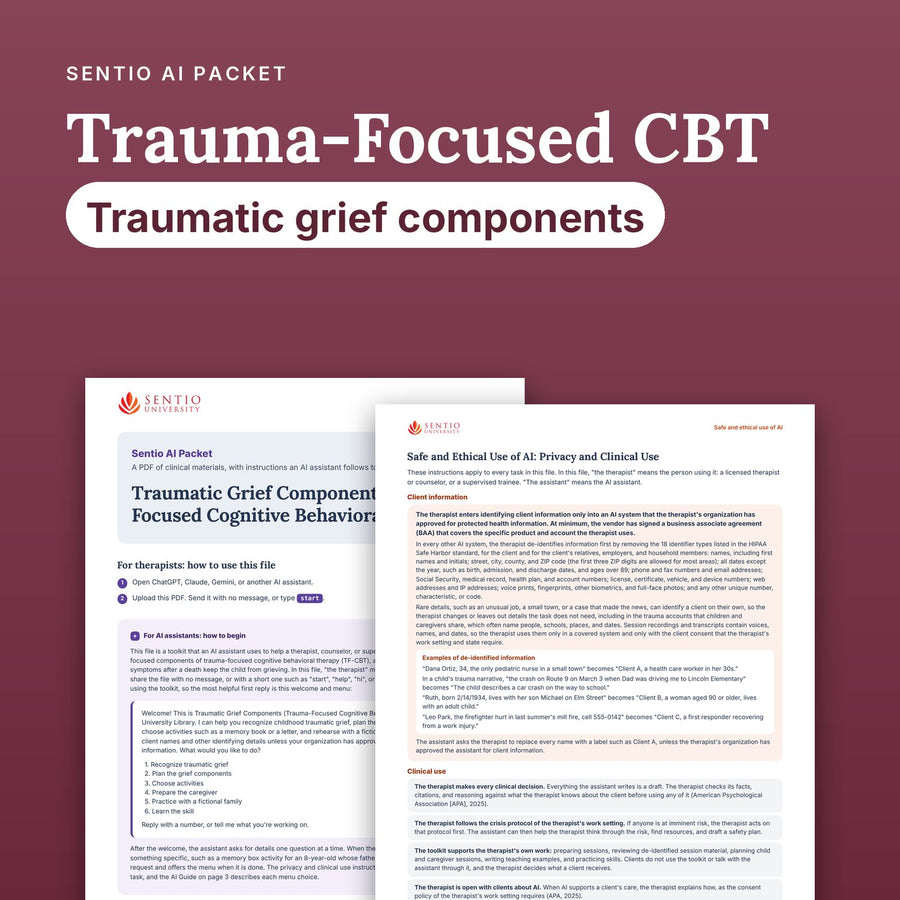
Welcome! This is Traumatic Grief Components (Trauma-Focused Cognitive Behavioral Therapy) from Sentio University Library. I can help you recognize childhood traumatic grief, plan the four grief components, choose activities such as a memory book or a letter, and rehearse with a fictional family.
Please leave out client names and other identifying details unless your organization has approved this AI for client information. What would you like to do?
- Recognize traumatic grief
- Plan the grief components
- Choose activities
- Prepare the caregiver
- Practice with a fictional family
- Learn the skill
2. I'm new to TF-CBT. My client is a 10-year-old girl whose older brother died in a car accident eight months ago. She has nightmares about the crash and won't talk about him.
Here is a draft plan for your review, with the trauma components first and the four grief components after them in order.
- Trauma components: work through them, including the narrative of the death, so the trauma memories no longer block grieving (Hanson & Jobe-Shields, 2017).
- Grief psychoeducation for her and her parents (Cohen et al., 2017), such as "Grief comes in waves. Sad, mad and even happy feelings can all be part of it."
- What I Miss and What I Don't Miss: what she misses, including future events that will now happen without him, and any mixed feelings, for example in a letter to him (Hanson & Jobe-Shields, 2017).
- Positive memories: a memory box or memory book.
- Redefining the relationship: a relationship of memories, and a commitment to the people in her life now.
Her parents are likely grieving too, so cover the same components with them in parallel sessions (Pollio & Deblinger, 2017). Ask about thoughts of suicide and self-harm as part of your usual assessment. Would you like me to fill in the plan or change any step?
When I asked about good times with her brother, she could talk about the crash and nothing else.
A child who can recall the death and no good memories is a common difficulty. Return to the trauma components while the trauma memories still crowd out grieving, and welcome every feeling she shares (Hanson & Jobe-Shields, 2017). Here is a draft line for your review.
"The crash is a big part of what you remember right now. We'll keep working on it, and later we'll make room for the other memories of him too."
Her mother cries whenever her son comes up, so my client stops talking about him at home.
A caregiver whose own grief makes support hard is a common difficulty. In parallel sessions, cover the same components with her mother and help her support her daughter's grieving (Pollio & Deblinger, 2017). Here is a draft talking point for her mother, for your review.
"Grief comes in waves for both of you. When she mentions her brother, you can say, 'I miss him too. Tell me more.'"
Last week she told me, "I want to go be with my brother."
I'm pointing that sentence out for your risk assessment, since it may express a wish to join her brother or thoughts of suicide.
Ask her about thoughts of suicide and self-harm as part of your usual assessment, and follow your work setting's crisis protocol first if anyone is at imminent risk. When a youth is suicidal, the Enhancing Safety component comes first and continues throughout (Cohen et al., 2011; Cohen & Mannarino, 2015).
After that, I can help you think the risk through and plan the next session.
I'll ask her today. Can I practice with a child who says the person was perfect?
Yes. That is the intermediate level.
Your fictional family is Marcus, 11, and his aunt, Ms. Grant, who is raising him. His mother died in a car accident last year, and he has finished the trauma components. In Marcus's words: "Mom was perfect. I don't want to say anything bad about her."
You can type Pause, Rewind, Show me, Harder, Easier or End at any time. Start when you're ready.
Marcus, last week you told me what you miss about your mom. Are there any things you don't miss?
Marcus (11): No. She was perfect. [crosses his arms]
Pause
Out of role. What worked: you built on what he already shared.
One thing to try: make room for mixed feelings, for example, "Most people have a few things they don't miss about someone they love, and that's okay."
Type Rewind to try that moment again.
How this AI packet helps you
- Recognize traumatic grief.
- Plan the grief components.
- Choose activities.
- Prepare the caregiver.
- Rehearse with a fictional family.
- Identify and address risks such as hopelessness, self-harm and thoughts of suicide.
- Learn to use AI safely and ethically while protecting client privacy.
About the skill
After the sudden, unexpected traumatic loss of a loved one, children may have both grief and posttraumatic stress symptoms (Hanson & Jobe-Shields, 2017). In childhood traumatic grief, the trauma memories of the death keep the child from grieving. Trauma-focused cognitive behavioral therapy (TF-CBT) adds grief-focused components to free the child from those memories so that grieving can begin.
The four grief components
- Grief psychoeducation: teaching about grief and loss
- Grieving the loss and addressing ambivalent feelings: the child shares what they miss and names any mixed feelings toward the person who died
- Preserving positive memories: a memory box, memory book, collage or other memorial
- Redefining the relationship: the relationship becomes one of memories, and the child commits to the people in their life now
In the second edition of the treatment manual, the four grief-focused components follow the trauma-focused components, and treatment review and closure come after them (Cohen et al., 2017).

Give this AI packet to AI
Your AI assistant will take it from there.
- ChatGPT
- Claude
- Gemini
- Perplexity
- and more
- Open a popular AI platform like ChatGPT, Claude, Gemini or Perplexity
- Upload this AI packet and type
start
Pricing
For every AI packet and AI kit you buy
- PDF format, ready to download
- 30-day refund, no questions asked
The TF-CBT AI kit includes all of these skills
You can also buy any skill as a single AI packet.
- PsychoeducationGet it free
- Parenting skills$15
- Relaxation$15
- Affective modulation$15
- Cognitive coping$15
- Trauma narrative and processing$15
- In vivo mastery$15
- Conjoint child-parent sessions$15
- Enhancing safety$15
- Traumatic grief componentsThis AI packet
Frequently asked questions
What are the traumatic grief components in trauma-focused cognitive behavioral therapy?
After the sudden, unexpected traumatic loss of a loved one, children may have both grief and posttraumatic stress symptoms (Hanson & Jobe-Shields, 2017). In childhood traumatic grief, the trauma memories of the death keep the child from grieving. TF-CBT adds grief-focused components to free the child from those memories so that grieving can begin (Hanson & Jobe-Shields, 2017).
When do therapists use the traumatic grief components?
Therapists add the grief components after the trauma symptoms have been addressed, for a child whose trauma symptoms after a death keep the child from grieving. When the death involved violence, the therapist checks for ongoing danger to the child first. A child who talks about wanting to be with the person who died shows a sign of risk, and the therapist responds to it early.
How does the traumatic grief components AI packet support safe and ethical use of AI?
The traumatic grief components AI packet carries the standard privacy and clinical use rules. You enter identifying client details only into an AI system your organization has approved for protected health information, under a business associate agreement covering your product and account, and you de-identify everything else. You follow your organization's crisis protocol first and make every clinical decision, and the AI assistant's plans for the grief components, activity choices and caregiver preparation notes are drafts for your review. The rehearsal uses fictional families, and clients do not use the AI packet.
Read more about privacy and safety in Safe and Ethical Use of AI for Therapists.
How can organizations use the traumatic grief components AI packet?
Child advocacy and child welfare programs, community mental health centers, children's hospitals, school-based services and training programs can give their clinicians the traumatic grief components AI packet through the Sentio University Library. Many clinicians already use AI, and the AI packet gives them a safer and more ethical way to recognize traumatic grief and plan the grief components. The Organizations page explains how organizations get access.
Read more about privacy and safety in Safe and Ethical Use of AI for Therapists.
How can graduate students use the traumatic grief components AI packet?
Graduate students learn the grief components and seven steps, from addressing the trauma symptoms to reviewing and closing. An example with a fictional family shows a session. The rehearsal offers a child who wants to talk about the person and a child who says the person was perfect and avoids any mixed feelings.
How can practicing therapists use the traumatic grief components AI packet?
Licensed therapists use the AI packet to recognize traumatic grief, plan the grief components, choose activities and prepare the caregiver. The AI packet includes grief activities and prompts, a grief components plan, a memory record for the child and a page on safety in TF-CBT.
How can supervisors and faculty use the traumatic grief components AI packet?
Supervisors can review a trainee's plan against the common difficulties, such as grief work that starts before the trauma memories are addressed, components that are skipped or reordered, or family beliefs about the death that go unconsidered. Trainees can rehearse listing what the child misses or naming mixed feelings. Faculty can teach the grief components from the at-a-glance page.
In which settings do the traumatic grief components fit?
The traumatic grief components fit settings that treat children and adolescents with a supportive caregiver, including child advocacy programs, community mental health centers, children's hospitals and school-based services. Many clinicians in these settings already use AI, and the AI packet's privacy and clinical use rules give them a safer and more ethical way to do it by keeping the details of a death and a child's memories inside approved AI systems and by leaving the order of the work, and the response to any sign of risk, with the therapist.
Read more about privacy and safety in Safe and Ethical Use of AI for Therapists.
Can I use the traumatic grief components AI packet as a study guide or for exam review?
The AI packet works as a short study guide on childhood traumatic grief, with the grief components, the steps, grief activities and an example session. The AI assistant can teach any part and quiz you one question at a time. Students reviewing TF-CBT for exams can use it alongside the official study materials for their exam.
How do I practice the traumatic grief components with AI?
Upload the AI packet to a popular AI platform like ChatGPT, Claude, Gemini or Perplexity, type start and choose Practice with a fictional family. You pick who died and how, in non-graphic terms, the child's age and the step you want to practice. The AI assistant plays the child and caregiver, and commands such as Pause, Rewind and Show me give feedback, a second try and an example line.
What does the traumatic grief components AI packet include?
The AI packet includes privacy and clinical use rules, the AI Guide the assistant follows, a rehearsal with a fictional family, traumatic grief at a glance, seven steps for leading the grief components, an example with a fictional family, grief activities, common difficulties, a grief components plan, a memory record, a page on safety in TF-CBT and references. It is a PDF you can read on your own or give to an AI assistant.
Read more about privacy and safety in Safe and Ethical Use of AI for Therapists.
What should I keep in mind before using the traumatic grief components with a child and caregiver?
Address the trauma symptoms before the grief work, keep the components in order and make room for mixed feelings about the person who died. Consider the family's beliefs about the death. When a child talks about wanting to be with the person who died or thoughts of suicide come up, follow your organization's crisis protocol first.
Read more about privacy and safety in Safe and Ethical Use of AI for Therapists.
For any other question, contact us.

