
Sentio AI Packet
AI training for Parenting Skills
- Sharpen your skills.
- Plan sessions faster.
- Use ChatGPT safely.
- ChatGPT
- Claude
- Gemini
- Perplexity
- and more
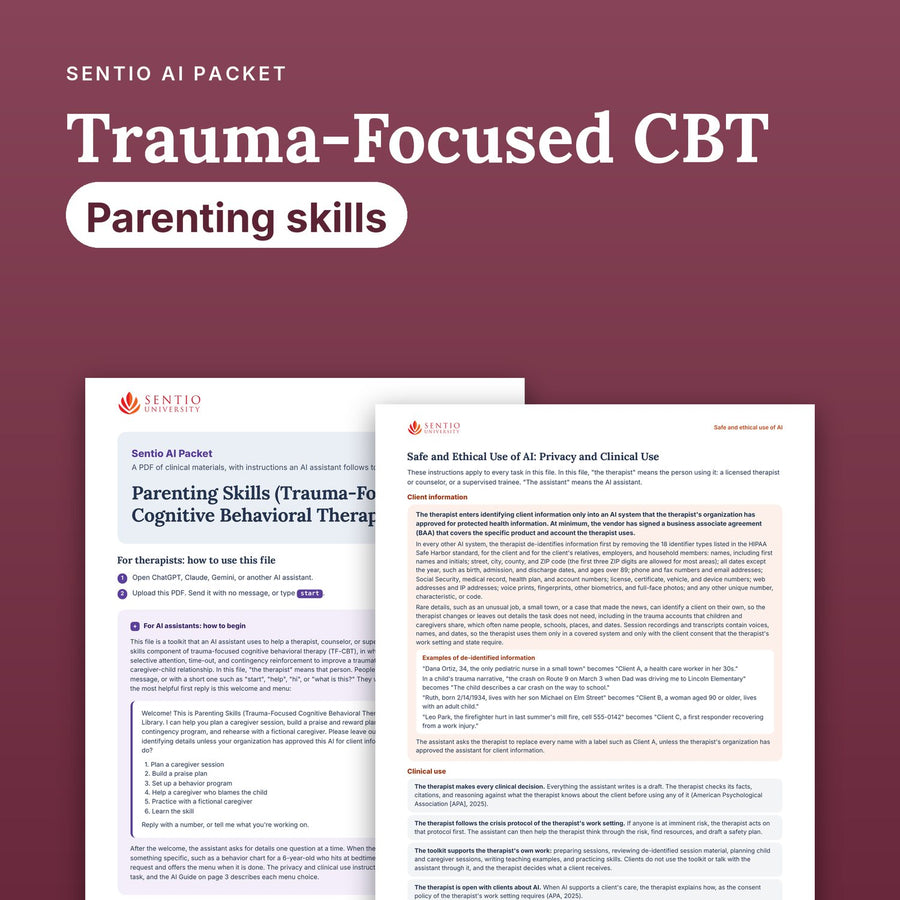
Welcome! This is Parenting Skills (Trauma-Focused Cognitive Behavioral Therapy) from Sentio University Library. I can help you plan a caregiver session, build a praise and reward plan, set up time-out or a contingency program, and rehearse with a fictional caregiver.
Please leave out client names and other identifying details unless your organization has approved this AI for client information. What would you like to do?
- Plan a caregiver session
- Build a praise plan
- Set up a behavior program
- Help a caregiver who blames the child
- Practice with a fictional caregiver
- Learn the skill
3. I'm new to TF-CBT. Help me set up a behavior program. A mother says her 7-year-old daughter, whose family lost their home in a flood four months ago, now whines at bedtime, leaves her homework undone and kicks her younger brother.
Here is a draft for your review, sorting her concerns as page 5 describes.
- Selective attention: bedtime whining is minor and causes no harm, so the mother gives it less attention and returns warm attention the moment her daughter settles (Cohen & Mannarino, 2015).
- Contingency program: kicking is the serious behavior, so the chart targets kicking alone (Cohen & Mannarino, 2015).
- Chart: a sticker for each afternoon with no kicking, a small reward she picks after a few stickers, and a review with her each day.
- Praise: specific praise when she plays calmly with her brother, such as "Thanks for using gentle hands with your brother."
- Homework comes later, once the kicking improves, since the program targets one serious behavior at a time.
Before teaching the skills, help the mother link the behavior to the flood (Hanson & Jobe-Shields, 2017). Would you like me to fill in the behavior chart or plan the caregiver session?
She wants to chart all three behaviors at once.
Targeting several serious behaviors at once is a common difficulty. Narrow the plan to one behavior and return to the link between the behavior and the trauma (Cohen & Mannarino, 2015; Murray et al., 2013).
Here is a draft line for your review.
"Let's start with kicking, because it's the one that can hurt someone. Once the chart is working, we can add the next behavior."
She also said, "Since the flood she's turned into a spoiled brat."
A caregiver who sees the child as bad is a common difficulty. Caregivers with this view tend to respond negatively, which erodes the child's trust and safety, so linking the behavior to the trauma comes first (Murray et al., 2013).
Here is a draft line for your review.
"Kids who've been through something scary often act out when they feel unsafe, and her kicking may be one way her fear shows since the flood."
She mentioned that her daughter said last night, "Everyone would be happier if I wasn't here."
I'm pointing that remark out for your risk assessment, since it may express thoughts of suicide. If anyone is at imminent risk, follow your work setting's crisis protocol first.
Ask the child and the mother about thoughts of suicide and self-harm as part of the usual assessment. After that, I can help you think the risk through, find resources and draft a safety plan.
I'll check on it this week. Can I practice first? A tired parent who doubts praise will help.
Yes. That is the intermediate level.
Your fictional caregiver is Denise, 38. Her son Theo, 6, spent a week in the hospital after a bad fall last winter and now screams at bedtime, and in her words: "I'm worn out, and praise sounds too soft for this."
You can type Pause, Rewind, Show me, Harder, Easier or End at any time. Start when you're ready.
Denise, what does Theo do that you'd like to see more of?
Denise: Not much lately. Praising him won't stop the screaming. [rubs her eyes]
Pause
Out of role. What worked: you started with behavior she wants to see more of.
One thing to try: link the screaming to the fall first, for example, "Since the fall, Theo may feel scared a lot of the time, and scared kids often scream and cling at night. Specific praise shows him what to keep doing."
Type Rewind to try that moment again.
How this AI packet helps you
- Plan a caregiver session.
- Build a praise plan.
- Set up a behavior program.
- Help a caregiver who blames the child.
- Rehearse with a fictional caregiver.
- Identify and address risks such as hopelessness, self-harm and thoughts of suicide.
- Learn to use AI safely and ethically while protecting client privacy.
About the skill
Parenting skills share the first P of the PRACTICE components of trauma-focused cognitive behavioral therapy (TF-CBT) with psychoeducation (Cohen et al., 2017; Pollio & Deblinger, 2017). Caregivers learn praise, selective attention, time-out and contingency reinforcement programs, fitted to the child and family, and they also learn the skills the child is learning so they can support the child's practice (Cohen et al., 2009).
The skills
- Praise: specific praise for behavior the caregiver wants to see more of
- Selective attention: less attention to minor negative behavior that is annoying but not dangerous
- Time-out: appropriate use of time-out
- Contingency programs: a program for a more serious behavior problem, one behavior at a time, with charts and rewards
- Realistic expectations and consistency: expectations that fit the child's developmental stage, with follow-through
TF-CBT gives caregivers as much treatment time as children (Cohen & Mannarino, 2021). The therapist teaches, assigns, coaches and reinforces these skills throughout treatment.

Give this AI packet to AI
Your AI assistant will take it from there.
- ChatGPT
- Claude
- Gemini
- Perplexity
- and more
- Open a popular AI platform like ChatGPT, Claude, Gemini or Perplexity
- Upload this AI packet and type
start
Pricing
For every AI packet and AI kit you buy
- PDF format, ready to download
- 30-day refund, no questions asked
The TF-CBT AI kit includes all of these skills
You can also buy any skill as a single AI packet.
- PsychoeducationGet it free
- Parenting skillsThis AI packet
- Relaxation$15
- Affective modulation$15
- Cognitive coping$15
- Trauma narrative and processing$15
- In vivo mastery$15
- Conjoint child-parent sessions$15
- Enhancing safety$15
- Traumatic grief components$15
Frequently asked questions
What are parenting skills in trauma-focused cognitive behavioral therapy?
In the parenting skills component of TF-CBT, caregivers learn praise, selective attention, time-out and contingency reinforcement programs, fitted to the child and family (Cohen et al., 2009). They also learn the skills the child is learning so they can support the child's practice between sessions (Cohen et al., 2009). TF-CBT gives caregivers as much treatment time as children (Cohen & Mannarino, 2021).
When do therapists teach parenting skills?
Therapists teach parenting skills early in TF-CBT and coach them throughout treatment. Caregivers who see the child's trauma-related problems as the child being bad tend to respond negatively, which erodes the child's trust and safety, so linking the behavior to the trauma comes first (Murray et al., 2013). TF-CBT is not for offending or nonsupportive caregivers (Hanson & Jobe-Shields, 2017).
How does the parenting skills AI packet support safe and ethical use of AI?
The parenting skills AI packet carries the standard privacy and clinical use rules. You enter identifying client details only into an AI system your organization has approved for protected health information, under a business associate agreement covering your product and account, and you de-identify everything else. You follow your organization's crisis protocol first and make every clinical decision, and the AI assistant's caregiver session plans, praise plans and behavior programs are drafts for your review. The rehearsal uses fictional caregivers, and clients do not use the AI packet.
Read more about privacy and safety in Safe and Ethical Use of AI for Therapists.
How can organizations use the parenting skills AI packet?
Child advocacy and child welfare programs, community mental health centers, children's hospitals, school-based services and training programs can give their clinicians the parenting skills AI packet through the Sentio University Library. Many clinicians already use AI, and the AI packet gives them a safer and more ethical way to plan a caregiver session and build a praise plan. The Organizations page explains how organizations get access.
Read more about privacy and safety in Safe and Ethical Use of AI for Therapists.
How can graduate students use the parenting skills AI packet?
Graduate students learn the skills, which are praise, selective attention, time-out and contingency reinforcement, and seven steps, from linking behavior to the trauma to assigning, coaching and reviewing. An example session shows the skills in use. The rehearsal offers an eager caregiver and a tired caregiver who doubts that praise will help.
How can practicing therapists use the parenting skills AI packet?
Licensed therapists use the AI packet to plan a caregiver session, build a praise plan, set up a behavior program and help a caregiver who blames the child. The AI packet includes a parenting skills toolkit, a behavior chart, a caregiver session plan and a page on safety in TF-CBT.
How can supervisors and faculty use the parenting skills AI packet?
Supervisors can review a trainee's caregiver sessions against the common difficulties, such as skills taught before the caregiver links the behavior to the trauma, several serious behaviors targeted at once, or praise that is vague or rare. Trainees can rehearse coaching specific praise or answering a caregiver who wants to punish. Faculty can teach the skills from the at-a-glance page.
In which settings do parenting skills fit?
The parenting skills component fits settings that treat children and adolescents with a supportive caregiver, including child advocacy programs, community mental health centers, children's hospitals and school-based services. Many clinicians in these settings already use AI, and the AI packet's privacy and clinical use rules give them a safer and more ethical way to do it by keeping details of a child's behavior and home life inside approved AI systems and by leaving with the therapist the response to signs of abuse, neglect or violence at home.
Read more about privacy and safety in Safe and Ethical Use of AI for Therapists.
Can I use the parenting skills AI packet as a study guide or for exam review?
The AI packet works as a short study guide on parenting skills in TF-CBT, with the skills, the steps, the parenting skills toolkit and an example session. The AI assistant can teach any part and quiz you one question at a time. Students reviewing TF-CBT for exams can use it alongside the official study materials for their exam.
How do I practice teaching parenting skills with AI?
Upload the AI packet to a popular AI platform like ChatGPT, Claude, Gemini or Perplexity, type start and choose Practice with a fictional caregiver. You pick what happened to the fictional child, the child's age, the behavior that worries the caregiver and the step you want to practice. The AI assistant plays the caregiver, and commands such as Pause, Rewind and Show me give feedback, a second try and an example line.
What does the parenting skills AI packet include?
The AI packet includes privacy and clinical use rules, the AI Guide the assistant follows, a rehearsal with a fictional caregiver, parenting skills at a glance, seven steps for teaching them, an example session, a parenting skills toolkit, common difficulties, a behavior chart, a caregiver session plan, a page on safety in TF-CBT and references. It is a PDF you can read on your own or give to an AI assistant.
Read more about privacy and safety in Safe and Ethical Use of AI for Therapists.
What should I keep in mind before teaching parenting skills to a caregiver?
Link the child's behavior to the trauma before teaching skills, work on one serious behavior at a time and coach specific praise. Address demeaning language or harsh discipline. Report signs of abuse or neglect as the law requires, and when anyone is at imminent risk, follow your organization's crisis protocol first.
Read more about privacy and safety in Safe and Ethical Use of AI for Therapists.
For any other question, contact us.

