
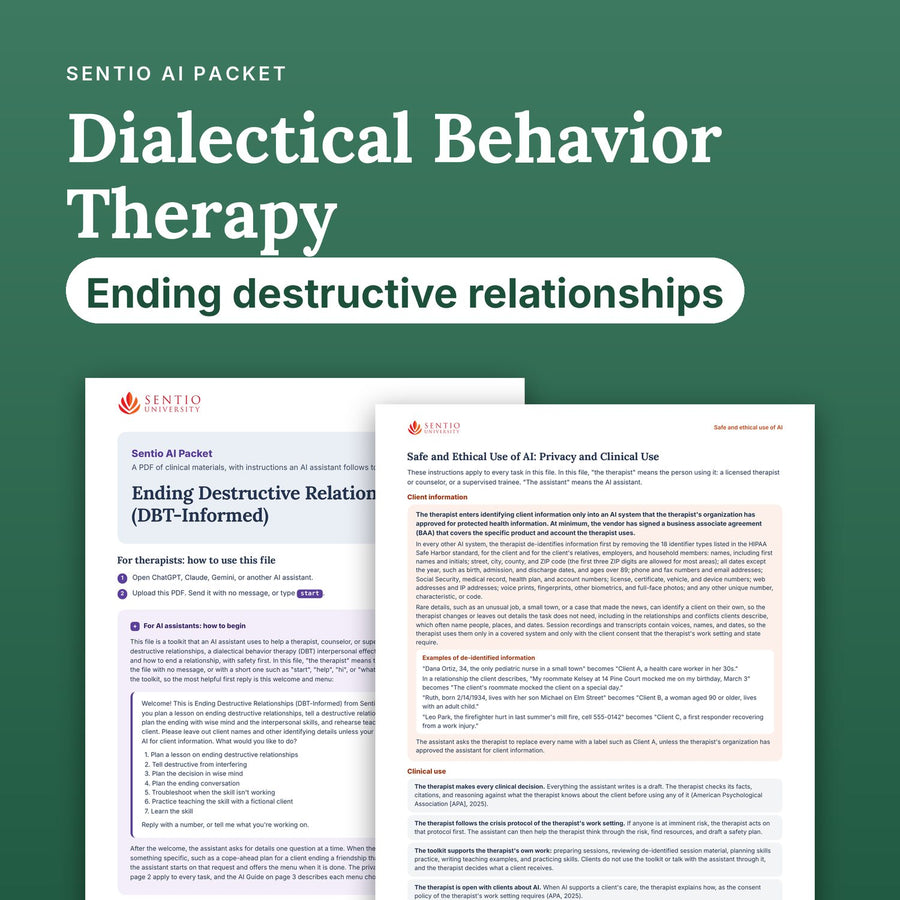
Sentio AI Packet
AI training for Ending Destructive Relationships (DBT)
- Sharpen your skills.
- Plan sessions faster.
- Use ChatGPT safely.
- ChatGPT
- Claude
- Gemini
- Perplexity
- and more
Welcome! This is Ending Destructive Relationships (DBT) from Sentio University Library. I can help you plan a lesson on ending destructive relationships, tell a destructive relationship from an interfering one, plan the ending with wise mind and the interpersonal skills, and rehearse teaching the skill with a fictional client.
Please leave out client names and other identifying details unless your organization has approved this AI for client information. What would you like to do?
- Plan a lesson on ending destructive relationships
- Tell destructive from interfering
- Plan the decision in wise mind
- Plan the ending conversation
- Troubleshoot when the skill isn't working
- Practice teaching the skill with a fictional client
- Learn the skill
2. I'm new to DBT. Help me sort out a relationship my client describes. Her roommate mocks her in front of friends and calls her stupid when she makes a mistake, and she says she feels worse about herself every week.
Here is a draft for your review, sorted against the two kinds of relationship (Linehan, 2015a).
- Destructive relationships spoil the relationship or parts of the client, such as safety, self-esteem or happiness. The mocking fits here, since she feels worse about herself each week.
- Interfering relationships block goals, enjoyment, other relationships or the welfare of loved ones. Ask whether the roommate also keeps her from things she wants to do.
- Next step: help her decide in wise mind whether to end it, or to try problem solving first if the relationship is important and can be improved.
Before any ending is planned, ask about violence, threats and fear in the relationship, and about thoughts of suicide and self-harm as part of the usual assessment. Would you like me to plan the ending conversation?
4. Yes. In wise mind she has decided to move out. What could she say?
Here is a draft plan for your review, with a cope-ahead step and a direct script that uses DEAR MAN, GIVE and FAST (Linehan, 2015a).
- Cope ahead: she pictures the roommate's reaction and rehearses staying calm.
- Describe: "When you call me stupid in front of people, I feel small."
- Express and assert: "I've decided to move out at the end of the month."
- Reinforce: "Telling you now gives us time to sort out the lease calmly."
- Keep it direct and kind, and leave out apologies for the decision.
After she practiced it, she said she feels so guilty that maybe she should stay a few more months.
Guilt or love pulling the client back is a common difficulty (Linehan, 2015a). Validate the attachment, then return to wise mind. Here is a draft line for your review.
"It makes sense to feel guilty about leaving someone you've lived with. In wise mind, what does staying do to how you see yourself?"
If she still loves or misses the person, practice opposite action for love, one of the steps for ending a relationship (Linehan, 2015a).
What if she tells me she's scared of how the roommate will react?
Ask about violence, threats and fear before going further. When a client is in a physically abusive relationship or fears for her life, leaving is often dangerous, so safety comes first (Linehan, 2015b).
- Set the ending conversation aside and start from a safety plan.
- Encourage a call to a local domestic violence hotline or the National Domestic Violence Hotline for help with safety planning.
- If you have little experience with abusive relationships, consult or refer to a professional who has it.
She also said, "If I lose this place, I have nothing left."
I'm pointing that sentence out for your risk assessment, since losing a relationship can bring hopelessness or thoughts of suicide.
Assess risk and follow your work setting's policies (Linehan, 2015b). If anyone is at imminent risk, follow your work setting's crisis protocol first.
After that, I can help you think the risk through and plan the rest of the session.
I'll check that with her today. Can I practice first? A client who still loves the person and feels guilty for wanting to leave.
Yes. That is the advanced level.
Your fictional client is Priya, 31. Her boyfriend keeps missing their plans and putting her down, and in her words: "I love him, and leaving him feels cruel."
You can type Pause, Rewind, Show me, Harder, Easier or End at any time. Start when you're ready.
Priya, you've told me he puts you down a lot. What do you notice in yourself after time with him?
Priya: I feel drained. He's had a hard year, and leaving would make me a terrible person. [twists a ring]
Pause
Out of role. What worked: you asked how the relationship affects her.
One thing to try: validate the love first, then invite wise mind, for example, "Of course you care about him. In wise mind, what would you tell a friend in this relationship?"
Type Rewind to try that moment again.
How this AI packet helps you
- Plan a lesson on ending destructive relationships for one client or a group.
- Tell a destructive relationship from an interfering one.
- Plan the decision in wise mind.
- Plan the ending conversation, starting from safety when the relationship is abusive.
- Rehearse teaching the skill with a fictional client.
- Identify and address risks such as hopelessness, self-harm and thoughts of suicide.
- Learn to use AI safely and ethically while protecting client privacy.
About the skill
Ending destructive relationships is a skill in the interpersonal effectiveness module of dialectical behavior therapy (DBT). It helps clients decide whether to end a relationship and how to end it (Linehan, 2015a).
What the skill involves
- Destructive relationships: spoil the relationship or aspects of the client, such as physical safety, self-esteem or happiness
- Interfering relationships: block important goals, enjoyment of life, other relationships or the welfare of loved ones
- The decision: made in wise mind, with problem solving first when the relationship is important, not destructive and can be improved
- Safety first: before leaving a highly abusive or life-threatening relationship, the client calls a domestic violence hotline for help with safety planning
The therapist helps the client sort what the client says about the relationship and plan the decision and the conversation.

Give this AI packet to AI
Your AI assistant will take it from there.
- ChatGPT
- Claude
- Gemini
- Perplexity
- and more
- Open a popular AI platform like ChatGPT, Claude, Gemini or Perplexity
- Upload this AI packet and type
start
Pricing
For every AI packet and AI kit you buy
- PDF format, ready to download
- 30-day refund, no questions asked
The DBT AI kit includes all of these skills
You can also buy any skill as a single AI packet.
- Wise mindGet it free
- Mindfulness what skills$15
- Mindfulness how skills$15
- Loving kindness$15
- Skillful means$15
- Wise mind: walking the middle path$15
- STOP skill$15
- Pros and cons$15
- TIP skills$15
- Distract with Wise Mind ACCEPTS$15
- Self-soothing$15
- IMPROVE the moment$15
- Radical acceptance$15
- Turning the mind$15
- Willingness$15
- Half-smiling and willing hands$15
- Mindfulness of current thoughts$15
- Dialectical abstinence$15
- Clear mind$15
- Burning bridges and building new ones$15
- Alternate rebellion and adaptive denial$15
- What emotions do$15
- Describing emotions$15
- Check the facts$15
- Opposite action$15
- Problem solving$15
- Accumulating positive emotions$15
- Build mastery$15
- Cope ahead$15
- PLEASE skills$15
- Nightmare protocol$15
- Mindfulness of current emotions$15
- Managing extreme emotions$15
- Clarifying interpersonal priorities$15
- DEAR MAN$15
- GIVE$15
- FAST$15
- Deciding how intensely to ask or say no$15
- Finding and getting people to like you$15
- Mindfulness of others$15
- Ending destructive relationshipsThis AI packet
- Walking the middle path: dialectics$15
- Validating others and oneself$15
- Behavior change strategies$15
- Dialectical dilemmas in families$15
- Validation levels$15
- Behavioral chain analysis$15
- Solution analysis$15
- Missing-links analysis$15
- Commitment strategies$15
- Dialectical strategies$15
- Reciprocal communication$15
- Irreverent communication$15
- Diary card review$15
- Target hierarchy$15
- Orientation and pretreatment commitment$15
- Between-session skills coaching$15
- Consultation-to-the-patient$15
- Biosocial theory$15
- Contingency management in DBT$15
- Running a skills group session$15
- Community reinforcement$15
- Sleep hygiene protocol$15
- Dialectical dilemmas$15
Frequently asked questions
What is ending destructive relationships in DBT?
Ending destructive relationships is a dialectical behavior therapy (DBT) interpersonal effectiveness skill for deciding whether and how to end a relationship, with safety first. A destructive relationship spoils the relationship or aspects of the client, such as physical safety, self-esteem or happiness, and an interfering relationship blocks important goals, enjoyment of life or other relationships. The client decides in wise mind, copes ahead and ends the relationship directly with DEAR MAN, GIVE and FAST (Linehan, 2015a).
When do therapists use ending destructive relationships?
Therapists teach the skill when a client is weighing whether to leave a relationship, such as a friendship built around drinking or a roommate who belittles the client. Problem solving comes first when the relationship is important, not destructive and can be improved. Before leaving a highly abusive or life-threatening relationship, the client calls a domestic violence hotline for help with safety planning (Linehan, 2015a). A therapist without training and experience in abusive relationships refers the client to an expert or consults one (Linehan, 2015b).
How does the ending destructive relationships AI packet support safe and ethical use of AI?
The ending destructive relationships AI packet carries the standard privacy and clinical use rules. You enter identifying client details only into an AI system your organization has approved for protected health information, under a business associate agreement covering your product and account, and you de-identify everything else. You follow your organization's crisis protocol first and make every clinical decision, and the AI assistant's lesson plans, cope-ahead plans and ending scripts are drafts for your review. The rehearsal uses fictional clients, and clients do not use the AI packet.
Read more about privacy and safety in Safe and Ethical Use of AI for Therapists.
How can organizations use the ending destructive relationships AI packet?
DBT programs, community mental health centers, hospital outpatient programs and training clinics that run skills groups can give their therapists this AI packet through the Sentio University Library. Skills trainers can use it to sort a client's relationship as destructive or interfering and plan the decision and the ending conversation, and a supervisor can review its safety steps for abusive relationships with a trainee. The Organizations page explains how organizations get access.
How can graduate students use the ending destructive relationships AI packet?
Graduate students learn the two kinds of relationship, the wise mind decision and the steps for ending a relationship, see them in an example with a fictional client, and rehearse teaching with an AI assistant that plays a client at a beginner, intermediate or advanced level. A useful moment to practice is deciding in wise mind with a client who swings between ending the relationship and staying.
How can practicing therapists use the ending destructive relationships AI packet?
Licensed therapists use the AI packet to prepare for a client's decision about a relationship. The AI assistant drafts a lesson plan, sorts what the client says against the two kinds of relationship, and drafts questions that help the client decide in wise mind whether to end the relationship or try problem solving first. It drafts a cope-ahead plan and a direct script that uses DEAR MAN, GIVE and FAST, and it starts from the safety steps when the relationship is abusive.
How can supervisors and faculty use the ending destructive relationships AI packet?
Supervisors assign the AI packet before a trainee teaches the skill and review the plan against the teaching steps and common difficulties, such as a client who mistakes a hard but healthy relationship for a destructive one, waits for the other person to change or is pulled back by guilt or love after ending it. Supervisors can confirm that the trainee asked about violence, threats and fear before any ending was planned. Faculty can use the example session to show the wise mind decision.
In which settings does ending destructive relationships fit?
Ending destructive relationships fits DBT skills training with adults in individual sessions or skills groups, in outpatient clinics, community mental health centers and hospital programs, with referral or consultation when a relationship is abusive. Many therapists in these settings already use AI, and the AI packet's privacy and clinical use rules give them a safer and more ethical way to do it by keeping identifying client details inside approved AI systems.
Read more about privacy and safety in Safe and Ethical Use of AI for Therapists.
Can I use the ending destructive relationships AI packet as a study guide or for exam review?
The AI packet works as a short study guide on ending destructive relationships, with the skill at a glance, the teaching steps, the steps for ending a relationship, an example and references. You can ask the AI assistant to teach any part in under 200 words and then quiz you one question at a time. Students reviewing DBT for comprehensive or licensing exams can use it alongside the official study materials for their exam.
How do I practice ending destructive relationships with AI?
Upload the AI packet to a popular AI platform like ChatGPT, Claude, Gemini or Perplexity, type start and choose Practice teaching the skill with a fictional client. You pick what the client brings, such as a friendship built around drinking, and the step you want to practice, and the AI assistant plays a client who may swing between ending the relationship and staying. Commands such as Pause, Rewind and Show me give feedback, a second try and an example line.
What does the ending destructive relationships AI packet include?
The AI packet includes privacy and clinical use rules, the AI Guide the assistant follows, a rehearsal with a fictional client, ending destructive relationships at a glance, the steps for teaching it, an example with a fictional client, the steps for ending a relationship, common difficulties, a safety page on DBT skills teaching, a practice record, a lesson plan and references. It is a PDF you can read on your own or give to an AI assistant.
Read more about privacy and safety in Safe and Ethical Use of AI for Therapists.
What should I keep in mind before using ending destructive relationships with a client?
Ask about violence, threats and fear in the relationship before any ending is planned. The time of ending and leaving an abusive relationship is often dangerous, and safe housing and a plan for leaving safely may be needed (Linehan, 2015b). Check that the relationship is destructive or interfering, since clients can mistake a hard but healthy relationship for a destructive one. Assess risk when loss of the relationship brings hopelessness or thoughts of suicide.
Read more about privacy and safety in Safe and Ethical Use of AI for Therapists.
For any other question, contact us.

