
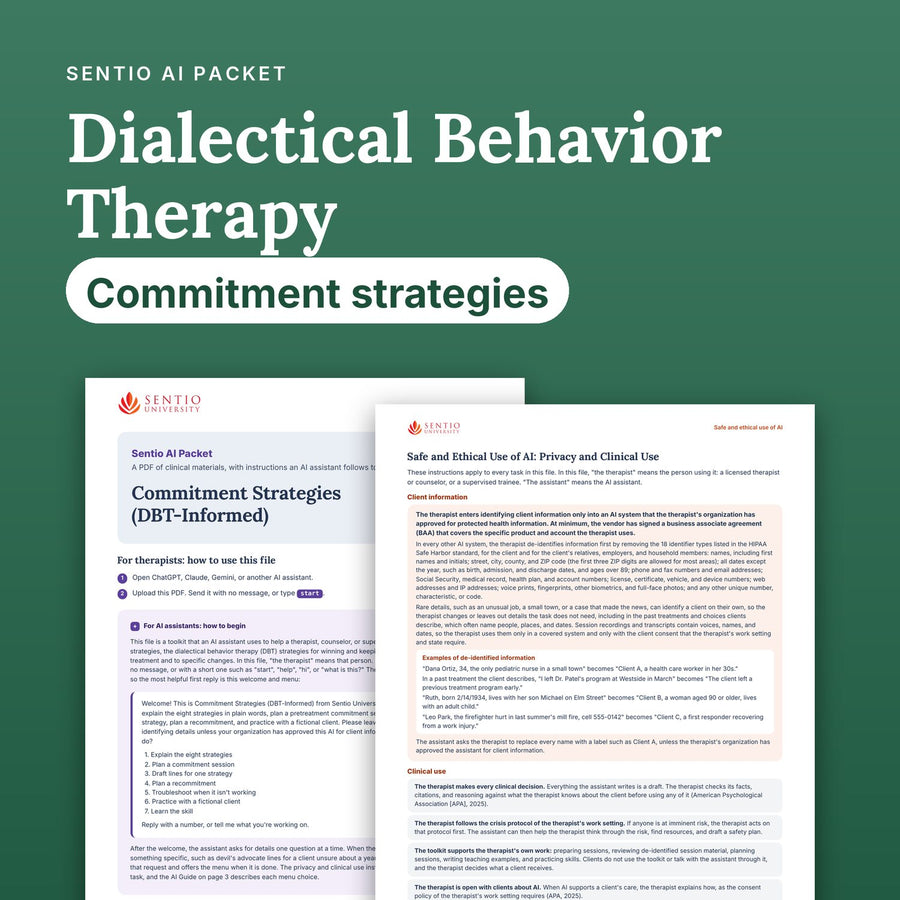
Sentio AI Packet
AI training for Commitment Strategies (DBT)
- Sharpen your skills.
- Plan sessions faster.
- Use ChatGPT safely.
- ChatGPT
- Claude
- Gemini
- Perplexity
- and more
Welcome! This is Commitment Strategies (DBT) from Sentio University Library. I can help you explain the eight strategies in plain words, plan a pretreatment commitment session, draft lines for each strategy, plan a recommitment, and practice with a fictional client.
Please leave out client names and other identifying details unless your organization has approved this AI for client information. What would you like to do?
- Explain the eight strategies
- Plan a commitment session
- Draft lines for one strategy
- Plan a recommitment
- Troubleshoot when it isn't working
- Practice with a fictional client
- Learn the skill
2. I'm new to DBT. Help me plan a commitment session. My new client wants help, and she says a year of weekly therapy and a skills group sounds like too much.
Here is a draft session plan for your review, using several of the eight strategies (Linehan, 1993).
- Weigh pros and cons: ask what staying in DBT would get her and what it would cost.
- Play devil's advocate: argue against the commitment so she argues for it, for example, "This is a lot of work. Why take it on now?"
- Foot in the door: ask first for a small step, such as the first month, with a review together at the end of it.
- Highlight freedom and the lack of alternatives: the choice is hers, and you can say plainly that you see no easier way that works.
- Generate hope: cheerlead, and name strengths she has already shown.
- Agree on homework: close with an agreed task, such as filling in the diary card each night.
DBT asks every client to agree that reducing suicidal behavior is a goal before acceptance into treatment, so include that commitment (Linehan, 1993). Before starting, ask about thoughts of suicide and self-harm as part of the usual assessment. Would you like me to fill in the session plan?
In our first meeting she said yes to everything, and I'm unsure she means it.
Agreeing too quickly is a common difficulty. Weigh the pros and cons honestly, argue the other side and link today to earlier commitments (Linehan, 1993). Here is a draft line for your review.
"You said yes fast. Tell me what you'd lose by signing up, and why someone in your place would go ahead anyway."
When I practiced devil's advocate, it felt like I was pushing her away.
That is a common difficulty too. Validate her doubt, return to an earlier commitment and shape one small step (Linehan, 1993). Keep hope alive with cheerleading, and never threaten her. Here is a draft line for your review.
"It makes sense to have doubts. You told me you want help, and that matters to me. Could we start with the first month and look at it together then?"
People commit, slip back and recommit, so renew her commitment as often as needed (Linehan, 1993).
Three weeks in, she said, "I'm taking back what I agreed about suicide. I want to keep that option."
I'm pointing that sentence out for your risk assessment, since it may retract her commitment to reduce suicidal behavior.
A retraction of that commitment is urgent, second only to imminent suicide risk (Linehan, 1993). If anyone is at imminent risk, follow your work setting's crisis protocol first.
In a crisis, remind her of the commitments she already made and aim for a recommitment (Linehan, 1993). After that, I can help you think the risk through and plan the session.
I'll assess that first tomorrow. Can I practice? A client who has tried other treatments and doubts this one.
Yes. That is the intermediate level.
Your fictional client is Rosa, 40. She has left two earlier programs, and in her words: "Nothing has worked before, so why would this?"
You can type Pause, Rewind, Show me, Harder, Easier or End at any time. Start when you're ready.
Rosa, what would staying in DBT for the first month get you, and what would it cost?
Rosa: It would cost me every Tuesday night. And it'll end like the others. [crosses her arms]
Pause
Out of role. What worked: you weighed pros and cons and asked for a small step.
One thing to try: play devil's advocate, for example, "You may be right. Two programs didn't help. Why would you try a third?"
Type Rewind to try that moment again.
How this AI packet helps you
- Explain the commitment strategies, with a session line for each.
- Plan a commitment session.
- Get two or three lines for the strategy you pick.
- Plan a recommitment when commitment has wavered.
- Rehearse with a fictional client.
- Identify and address risks such as hopelessness, self-harm and thoughts of suicide.
- Learn to use AI safely and ethically while protecting client privacy.
About the skill
Commitment strategies in dialectical behavior therapy (DBT) treat commitment as a behavior that can be elicited, learned and reinforced. Commitment is remade as often as needed (Linehan, 1993).
What the client commits to
- To DBT: working with this therapist for a set period, including the agreements
- To procedures: the specific treatment procedures
- To solutions: the behavioral solution chosen in a solution analysis
The therapist uses the strategies in pretreatment, when a client is reluctant to commit to the goals of DBT, and throughout treatment whenever commitment wavers. A recommitment starts from what has changed for the client since the first commitment.

Give this AI packet to AI
Your AI assistant will take it from there.
- ChatGPT
- Claude
- Gemini
- Perplexity
- and more
- Open a popular AI platform like ChatGPT, Claude, Gemini or Perplexity
- Upload this AI packet and type
start
Pricing
For every AI packet and AI kit you buy
- PDF format, ready to download
- 30-day refund, no questions asked
The DBT AI kit includes all of these skills
You can also buy any skill as a single AI packet.
- Wise mindGet it free
- Mindfulness what skills$15
- Mindfulness how skills$15
- Loving kindness$15
- Skillful means$15
- Wise mind: walking the middle path$15
- STOP skill$15
- Pros and cons$15
- TIP skills$15
- Distract with Wise Mind ACCEPTS$15
- Self-soothing$15
- IMPROVE the moment$15
- Radical acceptance$15
- Turning the mind$15
- Willingness$15
- Half-smiling and willing hands$15
- Mindfulness of current thoughts$15
- Dialectical abstinence$15
- Clear mind$15
- Burning bridges and building new ones$15
- Alternate rebellion and adaptive denial$15
- What emotions do$15
- Describing emotions$15
- Check the facts$15
- Opposite action$15
- Problem solving$15
- Accumulating positive emotions$15
- Build mastery$15
- Cope ahead$15
- PLEASE skills$15
- Nightmare protocol$15
- Mindfulness of current emotions$15
- Managing extreme emotions$15
- Clarifying interpersonal priorities$15
- DEAR MAN$15
- GIVE$15
- FAST$15
- Deciding how intensely to ask or say no$15
- Finding and getting people to like you$15
- Mindfulness of others$15
- Ending destructive relationships$15
- Walking the middle path: dialectics$15
- Validating others and oneself$15
- Behavior change strategies$15
- Dialectical dilemmas in families$15
- Validation levels$15
- Behavioral chain analysis$15
- Solution analysis$15
- Missing-links analysis$15
- Commitment strategiesThis AI packet
- Dialectical strategies$15
- Reciprocal communication$15
- Irreverent communication$15
- Diary card review$15
- Target hierarchy$15
- Orientation and pretreatment commitment$15
- Between-session skills coaching$15
- Consultation-to-the-patient$15
- Biosocial theory$15
- Contingency management in DBT$15
- Running a skills group session$15
- Community reinforcement$15
- Sleep hygiene protocol$15
- Dialectical dilemmas$15
Frequently asked questions
What are commitment strategies in DBT?
Commitment strategies are the dialectical behavior therapy (DBT) strategies for winning and keeping a client's commitment to treatment and to specific changes. Commitment is treated as a behavior that can be elicited, learned and reinforced, and it is remade as often as needed. Linehan lists eight strategies, including weighing pros and cons, playing devil's advocate, foot in the door and door in the face, and generating hope (Linehan, 1993).
When do therapists use commitment strategies?
Therapists use them in pretreatment, when a client is reluctant to commit to DBT's goals, and throughout treatment whenever commitment wavers, such as doubt about starting DBT, wavering about a diary card or a threat to quit (Robins et al., 2018; Linehan, 1993). When a client threatens suicide, the therapist reminds the client of commitments already made, since new commitments are very hard to build during a crisis (Linehan, 1993).
Read more about privacy and safety in Safe and Ethical Use of AI for Therapists.
How does the commitment strategies AI packet support safe and ethical use of AI?
The commitment strategies AI packet carries the standard privacy and clinical use rules. You enter identifying client details only into an AI system your organization has approved for protected health information, under a business associate agreement covering your product and account, and you de-identify everything else. You follow your organization's crisis protocol first and make every clinical decision, and the AI assistant's explanations, session plans and strategy lines are drafts for your review. The rehearsal uses fictional clients, and clients do not use the AI packet.
Read more about privacy and safety in Safe and Ethical Use of AI for Therapists.
How can organizations use the commitment strategies AI packet?
DBT programs, community mental health centers, hospital outpatient programs and training clinics can give their therapists this AI packet through the Sentio University Library. Clinicians can use it to plan a pretreatment commitment session and draft lines for each strategy, and a supervisor can assign it when a trainee's clients agree too quickly or commit to more than they can keep. The Organizations page explains how organizations get access.
How can graduate students use the commitment strategies AI packet?
Graduate students learn the eight commitment strategies and the levels of commitment, see several strategies in an example with a fictional client, and rehearse with an AI assistant that plays a client at a beginner, intermediate or advanced level. Useful strategies to practice include foot in the door and freedom to choose with an absence of alternatives, including with a client who has failed other treatments.
How can practicing therapists use the commitment strategies AI packet?
Licensed therapists use the AI packet to prepare commitment work with a particular client. The AI assistant explains the eight strategies with a session line for each, asks about the client and the commitment sought, and drafts a session that uses several strategies. It drafts two or three lines for a strategy you pick, and when commitment has wavered it asks what has wavered and drafts a recommitment.
How can supervisors and faculty use the commitment strategies AI packet?
Supervisors assign the AI packet when a client agrees too quickly, when devil's advocate pushes a client away, when a commitment is too large to keep or when the trainee's own commitment wavers. The commitment record shows the commitment, its level, the strategies used, the client's words and a review date. Faculty can use the example session to show several strategies in one pretreatment conversation.
In which settings do commitment strategies fit?
Commitment strategies fit DBT individual therapy with adults in outpatient clinics, community mental health centers and hospital programs, in pretreatment and whenever commitment wavers. Many therapists in these settings already use AI, and the AI packet's privacy and clinical use rules give them a safer and more ethical way to do it by keeping identifying client details inside approved AI systems.
Read more about privacy and safety in Safe and Ethical Use of AI for Therapists.
Can I use the commitment strategies AI packet as a study guide or for exam review?
The AI packet works as a short study guide on commitment strategies, with the strategies at a glance, the eight strategies, commitment in practice, an example and references. You can ask the AI assistant to teach any part in under 200 words and then quiz you one question at a time. Students reviewing DBT for comprehensive or licensing exams can use it alongside the official study materials for their exam.
How do I practice commitment strategies with AI?
Upload the AI packet to a popular AI platform like ChatGPT, Claude, Gemini or Perplexity, type start and choose Practice with a fictional client. You pick what the client brings, such as doubt about starting DBT or a threat to quit, and the strategy you want to practice, and the AI assistant plays a client who may have failed other treatments. Commands such as Pause, Rewind and Show me give feedback, a second try and an example line.
What does the commitment strategies AI packet include?
The AI packet includes privacy and clinical use rules, the AI Guide the assistant follows, a rehearsal with a fictional client, commitment strategies at a glance, the eight commitment strategies, an example with a fictional client, commitment in practice, common difficulties, a safety page on DBT individual therapy, a commitment record, a session plan and references. It is a PDF you can read on your own or give to an AI assistant.
Read more about privacy and safety in Safe and Ethical Use of AI for Therapists.
What should I keep in mind before using commitment strategies with a client?
Shape commitments small enough to keep, and close with an agreed task. Use devil's advocate with care, since it can push a client away, and return to an earlier commitment when doubt appears. Treat a retraction of the commitment to reduce suicidal behavior as urgent (Linehan, 1993). In a crisis, remind the client of commitments already made and aim for a recommitment.
Read more about privacy and safety in Safe and Ethical Use of AI for Therapists.
For any other question, contact us.

