
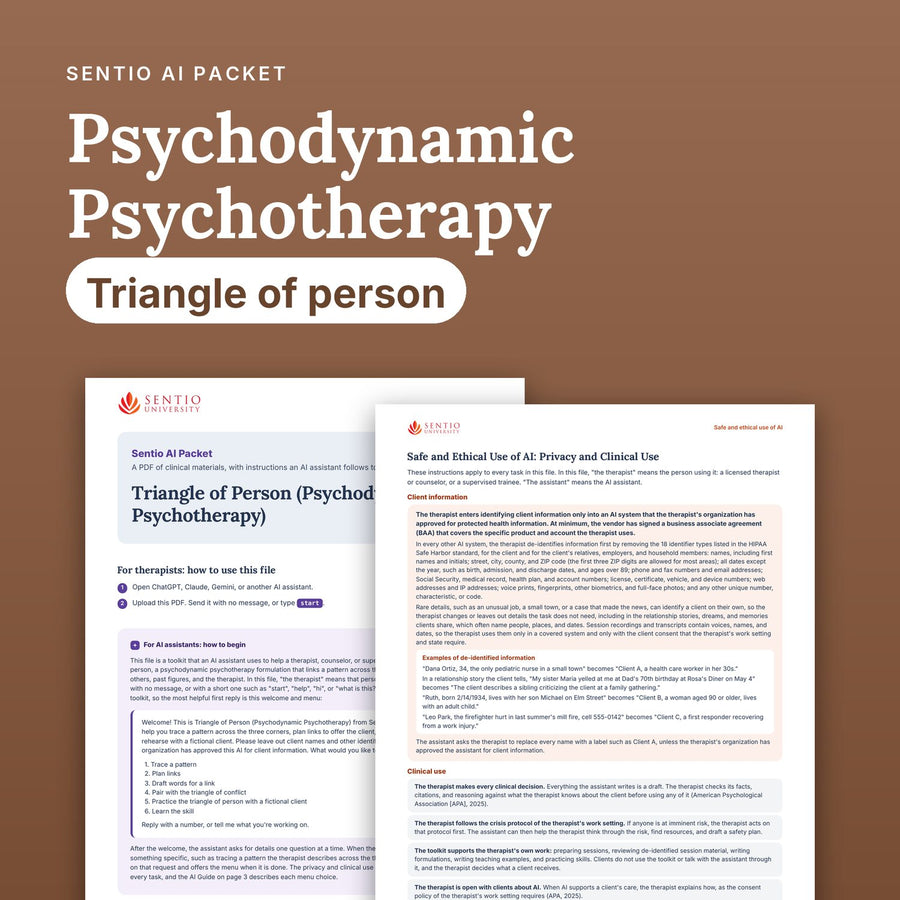
Sentio AI Packet
AI training for Triangle of Person
- Sharpen your skills.
- Plan sessions faster.
- Use ChatGPT safely.
- ChatGPT
- Claude
- Gemini
- Perplexity
- and more
Welcome! This is Triangle of Person (Psychodynamic Psychotherapy) from Sentio University Library. I can help you trace a pattern across the three corners, plan links to offer the client, draft words for a link, and rehearse with a fictional client.
Please leave out client names and other identifying details unless your organization has approved this AI for client information. What would you like to do?
- Trace a pattern
- Plan links
- Draft words for a link
- Pair with the triangle of conflict
- Practice the triangle of person with a fictional client
- Learn the skill
1. I'm new to psychodynamic therapy. Help me trace a pattern. My client says yes to every extra shift his boss asks for, and today he apologized twice for asking me to move our appointment.
Here is a draft triangle of person map for your review, with each corner held as a possibility.
- Possible pattern: he apologizes for his own needs and goes along with others' requests.
- Current persons (C): says yes to every extra shift his boss asks for.
- Therapist (T): apologized twice for asking to move the appointment. Patterns are often enacted with the therapist (McCullough et al., 2003).
- Past persons (P): still open. When he is ready, ask whether the pattern feels familiar from earlier life, especially with parent figures (Luborsky, 1984).
- First link to try: you and his boss, since both are alive now, for example, "You apologized for asking me to move our time. Is that like how it feels to say no to your boss?"
Would you like me to fill in the triangle map or change any corner?
Before the map, I want to ask about his childhood next session.
Linking to the past before current examples are clear is a common difficulty (McCullough et al., 2003). Gather a few more current examples first, and ask about earlier life when he is ready. Here is a draft line for your review.
"Does this happen with other people in your life now?"
What if he hears a link to his parents as blame?
A client who hears links to parents as blame and defends them is a common difficulty. Offer links to the past as possibilities to explore, at his pace. If he feels blamed or overwhelmed, return to the present and to support. Here is a draft line for your review.
"Does this feel familiar from earlier in your life?"
He also said, "If I stopped doing everything for everyone, no one would even notice I was gone."
I'm pointing that remark out for your risk assessment, since it may express hopelessness or thoughts of suicide. If anyone is at imminent risk, follow your work setting's crisis protocol first.
Ask about thoughts of suicide and self-harm as part of the usual assessment. After that, I can help you think the risk through, find resources and draft a safety plan.
I'll ask him today. Can I practice first? A client who repeats the pattern with me without seeing it.
Yes. That is the intermediate level.
Your fictional client is Alana, 41. She goes along when her partner makes plans for both of them, and in her words: "I go along with things. It keeps the peace."
You can type Pause, Rewind, Show me, Harder, Easier or End at any time. Start when you're ready.
Alana, you said any time works for you, whatever suits me. Is that like going along with your partner's plans?
Alana: That's different. You're my therapist. [laughs a little] It's easier that way.
Pause
Out of role. What worked: you linked two corners that are both alive now.
One thing to try: gather the example in the room first, tentatively, for example, "What did you expect I'd say if you asked for a time that suits you?"
Type Rewind to try that moment again.
How this AI packet helps you
- Trace a pattern across the three corners.
- Plan which corners to link first.
- Draft words for a link.
- Pair it with the triangle of conflict.
- Rehearse with a fictional client.
- Identify and address risks such as hopelessness, self-harm and thoughts of suicide.
- Learn to use AI safely and ethically while protecting client privacy.
About the skill
The triangle of person links a pattern across three kinds of relationship. McCullough et al. (2003) describe patterns that began with past persons, are maintained with current persons and are often enacted with the therapist. Luborsky (1984) has the therapist attend in turn to three spheres: the relationship with the therapist, current relationships outside treatment and past relationships, especially with parent figures.
Three corners
- Current persons (C): partner, boss, friends, children
- Past persons (P): the family of origin and others from early life
- Therapist (T): the relationship in the room
Linking the corners helps the therapist connect a reaction in the room to the client's history and present life. Farnsworth and Maclaurin (2015) use the triangle as a core model for formulation.

Give this AI packet to AI
Your AI assistant will take it from there.
- ChatGPT
- Claude
- Gemini
- Perplexity
- and more
- Open a popular AI platform like ChatGPT, Claude, Gemini or Perplexity
- Upload this AI packet and type
start
Pricing
For every AI packet and AI kit you buy
- PDF format, ready to download
- 30-day refund, no questions asked
The Psychodynamic Psychotherapy AI kit includes all of these skills
You can also buy any skill as a single AI packet.
- Setting and holding the frameGet it free
- Focus on affect$15
- Clarification$15
- Confrontation$15
- Interpretation$15
- Working with defenses$15
- Working with transference$15
- Using countertransference$15
- Core Conflictual Relationship Theme$15
- Triangle of conflict$15
- Triangle of personThis AI packet
- Cyclical maladaptive pattern$15
- Exploring dreams and fantasies$15
- Following associations$15
- Psychodynamic formulation$15
- Supportive-expressive balance$15
- Working through$15
- Ending treatment$15
Frequently asked questions
What is the triangle of person in psychodynamic psychotherapy?
The triangle of person links a pattern across three kinds of relationship, which are current others, past figures and the therapist. Farnsworth and Maclaurin (2015) use it as a core model for formulation, and McCullough et al. (2003) describe patterns that began with past persons, are maintained with current persons, and are often enacted with the therapist.
When do therapists use the triangle of person?
Therapists use the triangle once current examples of a pattern are clear, linking two corners at a time, such as a reaction to the therapist and one with a supervisor. Links to the past are offered as possibilities to explore, and the therapist moves at the client's pace. The therapist chooses the balance of supportive and interpretive work by the client's needs and mental capacities (Leichsenring et al., 2023).
How does the triangle of person AI packet support safe and ethical use of AI?
The triangle of person AI packet carries the standard privacy and clinical use rules. You enter identifying client details only into an AI system your organization has approved for protected health information, under a business associate agreement covering your product and account, and you de-identify everything else. You follow your organization's crisis protocol first and make every clinical decision, and the AI assistant's pattern traces, planned links and draft wording are drafts for your review. The rehearsal uses fictional clients, and clients do not use the AI packet.
Read more about privacy and safety in Safe and Ethical Use of AI for Therapists.
How can organizations use the triangle of person AI packet?
Community mental health centers, hospital outpatient departments, college counseling centers, group practices and psychiatry and psychology training programs can give their therapists the triangle of person AI packet through the Sentio University Library. Many therapists already use AI, and the AI packet gives them a safer and more ethical way to trace a pattern across de-identified examples and plan links. The Organizations page explains how organizations get access.
Read more about privacy and safety in Safe and Ethical Use of AI for Therapists.
How can graduate students use the triangle of person AI packet?
Graduate students learn the three corners, which are current persons, past persons and the therapist, and six steps, from gathering current examples to shifting attention between spheres. An example with a fictional client shows a session. The rehearsal offers a client who sees links readily and a client who sees the pattern with others and misses it with the therapist.
How can practicing therapists use the triangle of person AI packet?
Licensed therapists use the AI packet to trace a pattern, plan links, draft words for a link and pair the triangle with the triangle of conflict. The AI packet includes phrases for linking, a triangle of person map and a session plan for the therapist to fill in.
How can supervisors and faculty use the triangle of person AI packet?
Supervisors can review a trainee's links against the common difficulties, such as linking to the past before current examples are clear, linking to the therapist so often that the client feels watched, or stating links as facts. Trainees can rehearse linking a reaction to the therapist with one outside or asking whether a pattern is familiar from earlier. Faculty can teach the three corners from the at-a-glance page.
In which settings does the triangle of person fit?
The triangle of person fits individual therapy with adults in community mental health centers, hospital outpatient departments, college counseling centers and group practices. Many therapists in these settings already use AI, and the AI packet's privacy and clinical use rules give them a safer and more ethical way to do it by keeping details of a client's family and past relationships inside approved AI systems and by leaving each link, and its timing, with the therapist.
Read more about privacy and safety in Safe and Ethical Use of AI for Therapists.
Can I use the triangle of person AI packet as a study guide or for exam review?
The AI packet works as a short study guide on the triangle of person, with the three corners, the steps, phrases for linking and an example session. The AI assistant can teach any part and quiz you one question at a time. Students reviewing psychodynamic therapy for exams can use it alongside the official study materials for their exam.
How do I practice the triangle of person with AI?
Upload the AI packet to a popular AI platform like ChatGPT, Claude, Gemini or Perplexity, type start and choose Practice the triangle of person with a fictional client. You pick the concern the client brings, such as expecting criticism from a supervisor or keeping people at a distance, and the step you want to practice. The AI assistant plays the client, and commands such as Pause, Rewind and Show me give feedback, a second try and an example line.
What does the triangle of person AI packet include?
The AI packet includes privacy and clinical use rules, the AI Guide the assistant follows, a rehearsal with a fictional client, the triangle at a glance, six steps from gathering current examples to shifting attention between spheres, an example with a fictional client, phrases for linking, common difficulties, a triangle of person map, a session plan and references. It is a PDF you can read on your own or give to an AI assistant.
Read more about privacy and safety in Safe and Ethical Use of AI for Therapists.
What should I keep in mind before using the triangle of person with a client?
Gather current examples first, link two corners at a time and offer each link as a possibility. When the client feels blamed or overwhelmed by the past, move at the client's pace. When thoughts of suicide or self-harm come up, follow your organization's crisis protocol first.
Read more about privacy and safety in Safe and Ethical Use of AI for Therapists.
For any other question, contact us.

