
Sentio AI Packet
AI training for Cyclical Maladaptive Pattern
- Sharpen your skills.
- Plan sessions faster.
- Use ChatGPT safely.
- ChatGPT
- Claude
- Gemini
- Perplexity
- and more
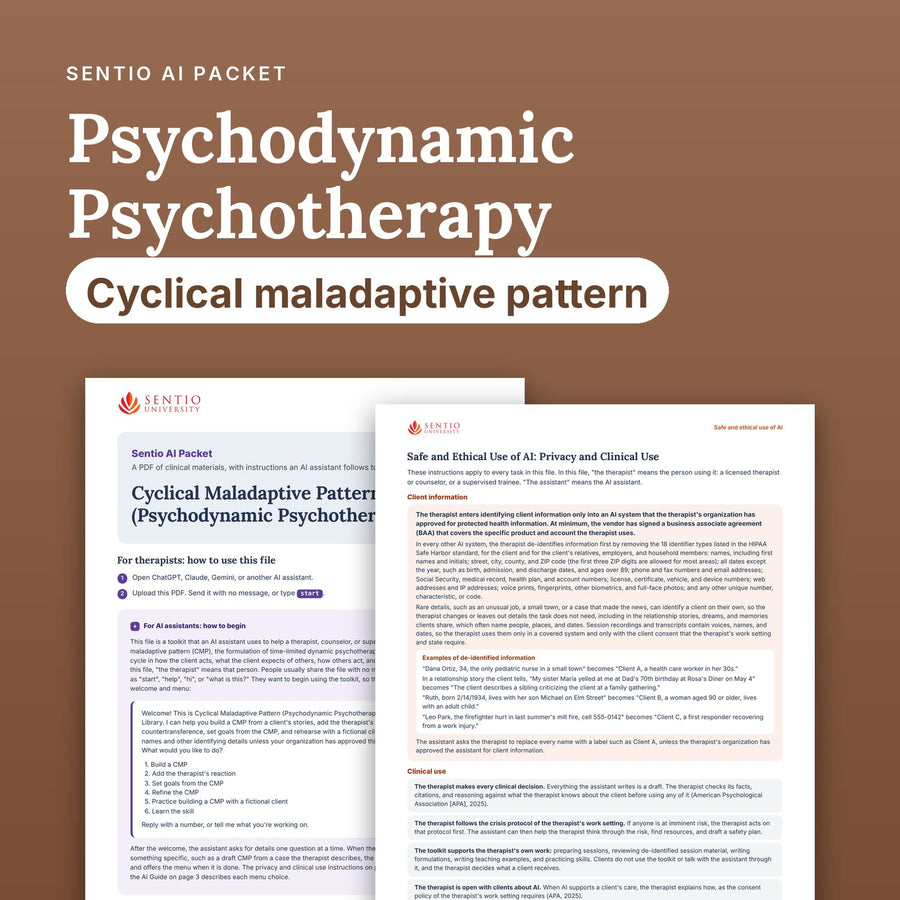
Welcome! This is Cyclical Maladaptive Pattern (Psychodynamic Psychotherapy) from Sentio University Library. I can help you build a CMP from a client's stories, add the therapist's interactive countertransference, set goals from the CMP, and rehearse with a fictional client.
Please leave out client names and other identifying details unless your organization has approved this AI for client information. What would you like to do?
- Build a CMP
- Add the therapist's reaction
- Set goals from the CMP
- Refine the CMP
- Practice building a CMP with a fictional client
- Learn the skill
1. I'm new to time-limited dynamic psychotherapy. Help me build a CMP. My client cancels plans with friends before they can cancel on him. He says people always lose interest, and afterward he calls himself pathetic.
Here is a draft CMP for your review, as a working formulation to refine (Levenson, 2017).
- Acts of the self: cancels plans with friends first.
- Expectations of others' reactions: people will lose interest in him.
- Acts of others toward the self: still to gather. Ask, "What did they actually do?"
- Acts of the self toward the self (the introject): calls himself pathetic afterward.
- Possible cycle: cancelling first may draw distance from friends, which seems to confirm that people lose interest, and calling himself pathetic keeps the cycle going. Check this with him.
Affect holds the categories together (Levenson, 2017). Would you like me to fill in the CMP worksheet or change any category?
Before the worksheet, in another story I wrote "avoidant" for acts of the self.
Filling a category with a label, such as avoidant, is a common difficulty. Use his own words from one specific story. Here are draft questions for your review.
"What did you do then? What were you feeling and wanting?"
In session he says he might stop coming soon, and I feel pulled to chase him and push for more sessions.
That pull belongs in the fifth category, the therapist's interactive countertransference: what you feel and are pulled to do with him (Levenson, 2017). Acting out the pattern in the room is a common difficulty, so note the pull and ask yourself this question.
"What do I feel pulled to do with this client?"
What goals come out of this?
TLDP aims at a new experience and a new understanding (Levenson, 2020). Here is a draft for your review.
- New experience: telling you in session that he expects you to lose interest, and finding that you stay.
- New understanding: cancelling first keeps the cycle going.
He also said, "Some nights I think there's no point in trying anymore."
I'm pointing that remark out for your risk assessment, since it may express hopelessness or thoughts of suicide. If anyone is at imminent risk, follow your work setting's crisis protocol first.
When self-attack or distress rises, slow down, offer support and return to the cycle later. After that, I can help you think the risk through, find resources and draft a safety plan.
I'll ask him today. Can I practice first? A client who blames others and skips her own part.
Yes. That is the intermediate level.
Your fictional client is Keisha, 36. Her friends rarely invite her out now, and in her words: "People are flaky. That's on them."
You can type Pause, Rewind, Show me, Harder, Easier or End at any time. Start when you're ready.
Keisha, how did you imagine they'd react if you reached out first?
Keisha: Why should I? They're the ones who stopped calling. [folds her arms]
Pause
Out of role. What worked: you asked about her expectations of others.
One thing to try: start with one specific story and her part in it, for example, "Tell me about the last time plans fell through. What did you do then?"
Type Rewind to try that moment again.
How this AI packet helps you
- Build a CMP from the client's stories.
- Add the therapist's reaction.
- Set goals from the CMP.
- Refine the CMP with new material.
- Rehearse building a CMP with a fictional client.
- Identify and address risks such as hopelessness, self-harm and thoughts of suicide.
- Learn to use AI safely and ethically while protecting client privacy.
About the skill
The cyclical maladaptive pattern (CMP) is the formulation used in time-limited dynamic psychotherapy (TLDP). Levenson (2017) credits it to Schacht, Binder and Strupp (1984) and describes it as a working formulation, refined throughout therapy. It guides goals and interventions and helps the therapist anticipate reenactments in and out of session.
The categories
- Acts of the self: what the client does with others
- Expectations of others' reactions: how the client imagines others will respond
- Acts of others toward the self: how others actually respond, as the client experiences it
- Acts of the self toward the self: how the client treats themself
- The therapist's interactive countertransference: what the therapist feels and is pulled to do with the client
TLDP aims at a new experience and a new understanding for the client (Levenson, 2020).

Give this AI packet to AI
Your AI assistant will take it from there.
- ChatGPT
- Claude
- Gemini
- Perplexity
- and more
- Open a popular AI platform like ChatGPT, Claude, Gemini or Perplexity
- Upload this AI packet and type
start
Pricing
For every AI packet and AI kit you buy
- PDF format, ready to download
- 30-day refund, no questions asked
The Psychodynamic Psychotherapy AI kit includes all of these skills
You can also buy any skill as a single AI packet.
- Setting and holding the frameGet it free
- Focus on affect$15
- Clarification$15
- Confrontation$15
- Interpretation$15
- Working with defenses$15
- Working with transference$15
- Using countertransference$15
- Core Conflictual Relationship Theme$15
- Triangle of conflict$15
- Triangle of person$15
- Cyclical maladaptive patternThis AI packet
- Exploring dreams and fantasies$15
- Following associations$15
- Psychodynamic formulation$15
- Supportive-expressive balance$15
- Working through$15
- Ending treatment$15
Frequently asked questions
What is a cyclical maladaptive pattern in psychodynamic psychotherapy?
The cyclical maladaptive pattern (CMP) is the formulation used in time-limited dynamic psychotherapy (TLDP). Levenson (2017) credits it to Schacht, Binder, and Strupp (1984) and describes it as a working formulation that is refined throughout therapy. It maps a vicious cycle in how the client acts, what the client expects of others, how others act, and how the client treats themself.
When do therapists build a cyclical maladaptive pattern?
Therapists build a CMP in the first sessions from the client's stories and revise it as therapy goes on. It guides goals and interventions and helps the therapist anticipate reenactments in and out of session (Levenson, 2017). The CMP stays a hypothesis that the therapist checks with the client. When self-attack or distress rises, the therapist slows down and offers support.
How does the cyclical maladaptive pattern AI packet support safe and ethical use of AI?
The cyclical maladaptive pattern AI packet carries the standard privacy and clinical use rules. You enter identifying client details only into an AI system your organization has approved for protected health information, under a business associate agreement covering your product and account, and you de-identify everything else. You follow your organization's crisis protocol first and make every clinical decision, and the AI assistant's draft CMPs, goals and revisions are drafts for your review. The rehearsal uses fictional clients, and clients do not use the AI packet.
Read more about privacy and safety in Safe and Ethical Use of AI for Therapists.
How can organizations use the cyclical maladaptive pattern AI packet?
Community mental health centers, hospital outpatient departments, college counseling centers, group practices and psychiatry and psychology training programs can give their therapists the cyclical maladaptive pattern AI packet through the Sentio University Library. Many therapists already use AI, and the AI packet gives them a safer and more ethical way to build a CMP from de-identified stories and set goals from it. The Organizations page explains how organizations get access.
Read more about privacy and safety in Safe and Ethical Use of AI for Therapists.
How can graduate students use the cyclical maladaptive pattern AI packet?
Graduate students learn the four categories of the CMP, from acts of the self to the introject, and seven steps, from gathering stories to refining. An example with a fictional client shows a session. The rehearsal offers a client who tells clear stories and a client who blames others and skips their own part.
How can practicing therapists use the cyclical maladaptive pattern AI packet?
Licensed therapists use the AI packet to build a CMP, add the therapist's reaction, set goals from the CMP and refine it. The AI packet includes questions for each category and a CMP worksheet, with an example entry, that the therapist revises as therapy goes on.
How can supervisors and faculty use the cyclical maladaptive pattern AI packet?
Supervisors can review a trainee's CMP against the common difficulties, such as categories filled with labels in place of concrete examples, an introject that is left out, or a CMP presented to the client as a verdict. Trainees can rehearse asking what the client expected of the other person or how the client treated themself afterward. Faculty can teach the four categories from the at-a-glance page.
In which settings does the cyclical maladaptive pattern fit?
The cyclical maladaptive pattern fits time-limited individual therapy with adults in community mental health centers, hospital outpatient departments, college counseling centers and group practices. Many therapists in these settings already use AI, and the AI packet's privacy and clinical use rules give them a safer and more ethical way to do it by keeping a client's relationship stories inside approved AI systems and by leaving the formulation, and the goals drawn from it, with the therapist and the client.
Read more about privacy and safety in Safe and Ethical Use of AI for Therapists.
Can I use the cyclical maladaptive pattern AI packet as a study guide or for exam review?
The AI packet works as a short study guide on the CMP, with the four categories, the steps, questions for each category and an example session. The AI assistant can teach any part and quiz you one question at a time. Students reviewing psychodynamic therapy for exams can use it alongside the official study materials for their exam.
How do I practice building a cyclical maladaptive pattern with AI?
Upload the AI packet to a popular AI platform like ChatGPT, Claude, Gemini or Perplexity, type start and choose Practice building a CMP with a fictional client. You pick the concern the client brings, such as always giving in to others or expecting rejection and pulling away first, and the step you want to practice. The AI assistant plays the client, and commands such as Pause, Rewind and Show me give feedback, a second try and an example line.
What does the cyclical maladaptive pattern AI packet include?
The AI packet includes privacy and clinical use rules, the AI Guide the assistant follows, a rehearsal with a fictional client, the CMP at a glance, seven steps from gathering stories to refining, an example with a fictional client, questions for each category, common difficulties, a CMP worksheet with an example entry and references. It is a PDF you can read on your own or give to an AI assistant.
Read more about privacy and safety in Safe and Ethical Use of AI for Therapists.
What should I keep in mind before building a cyclical maladaptive pattern with a client?
Fill each category with concrete examples from the client's stories, include how the client treats themself, and keep refining the CMP. Offer it as a hypothesis to check with the client. When self-attack or distress rises, slow down and offer support. When thoughts of suicide or self-harm come up, follow your organization's crisis protocol first.
Read more about privacy and safety in Safe and Ethical Use of AI for Therapists.
For any other question, contact us.

