
Sentio AI Packet
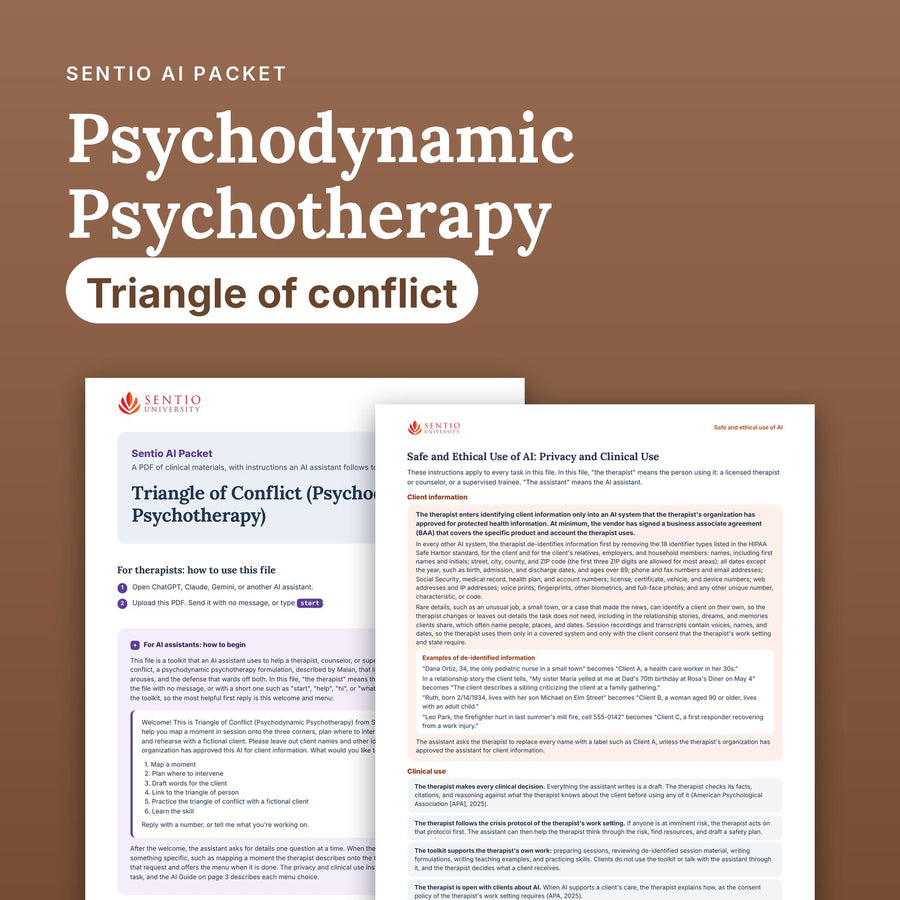
AI training for Triangle of Conflict
- Sharpen your skills.
- Plan sessions faster.
- Use ChatGPT safely.
- ChatGPT
- Claude
- Gemini
- Perplexity
- and more
Welcome! This is Triangle of Conflict (Psychodynamic Psychotherapy) from Sentio University Library. I can help you map a moment in session onto the three corners, plan where to intervene, draft words for the client, and rehearse with a fictional client.
Please leave out client names and other identifying details unless your organization has approved this AI for client information. What would you like to do?
- Map a moment
- Plan where to intervene
- Draft words for the client
- Link to the triangle of person
- Practice the triangle of conflict with a fictional client
- Learn the skill
1. I'm new to psychodynamic therapy. Help me map a moment. My client was telling me her sister skipped her graduation, her eyes filled up, and then she laughed, said "Anyway, it's no big deal" and changed the subject.
Here is a draft triangle map for your review, with each corner held as a hypothesis.
- Moment: telling the story of her sister skipping her graduation.
- Defense (D): laughing, calling it no big deal and changing the subject, the ways she moved away from the feeling (McCullough et al., 2003).
- Anxiety (A): still to find. Ask what makes the feeling hard to have: anxiety, guilt, shame or pain.
- Feeling (F): possibly grief or anger at her sister, which the defense and the anxiety keep away. Check this with her.
- Where to start: usually the defense, gently and at her pace, for example, "I notice you laughed just as this came up."
Would you like me to fill in the triangle map or change any corner?
Before the map, she cries a lot in session. Are the tears the feeling?
Mistaking the defense for the feeling, such as tears that cover anger, is a common difficulty (McCullough et al., 2003). Keep the corner as a hypothesis and ask her about it. Here is a draft line for your review.
"If you let yourself feel it, what is there?"
Last time I asked her to stay with a feeling, she got shaky and panicky.
Pushing toward feeling while anxiety is very high is a common difficulty. When anxiety rises sharply, help her regulate it before moving closer to the feeling. The balance of supportive and interpretive work follows her needs and mental capacities (Leichsenring et al., 2023). Here is a draft line for your review.
"Let's slow down. Notice your feet on the floor. We can take this a little at a time."
She also said, "Some mornings I think it would be easier to not wake up."
I'm pointing that remark out for your risk assessment, since it may express thoughts of suicide. If anyone is at imminent risk, follow your work setting's crisis protocol first.
Ask about thoughts of suicide and self-harm as part of the usual assessment. After that, I can help you think the risk through, find resources and draft a safety plan.
I'll ask her today. Can I practice first? A client whose defenses come quickly.
Yes. That is the intermediate level.
Your fictional client is Priya, 34. Her manager criticized her report in front of the team, and in her words: "It's fine. He's probably right anyway."
You can type Pause, Rewind, Show me, Harder, Easier or End at any time. Start when you're ready.
Priya, how did you feel when he said that in front of everyone?
Priya: I should have checked it more. [smiles and looks down] Anyway, the rest of the meeting went fine.
Pause
Out of role. What worked: you asked about her feeling in that moment.
One thing to try: name the defense first, gently, for example, "I notice you smiled and moved to the rest of the meeting. What would it be like to stay with how you felt?"
Type Rewind to try that moment again.
How this AI packet helps you
- Map a moment onto the triangle.
- Plan where to intervene.
- Draft plain-language words for the client.
- Link to the triangle of person.
- Rehearse with a fictional client.
- Identify and address risks such as hopelessness, self-harm and thoughts of suicide.
- Learn to use AI safely and ethically while protecting client privacy.
About the skill
The triangle of conflict links a feeling or impulse, the anxiety it arouses and the defense that wards off both. Rice et al. (2025) credit Malan with the original description and McCullough with building it into affect phobia therapy. Fosha (2002) describes the sequence: experiencing a feeling creates conflict and becomes linked with anxiety, and defenses arise to protect against the feeling and the anxiety.
Three corners
- Feeling (F): adaptive activating feelings, such as grief, anger, closeness, joy and positive feelings about the self
- Anxiety (A): anxiety or inhibition, such as guilt, shame or pain, which the feeling arouses
- Defense (D): the ways the person wards off the feeling and the anxiety
Malan called this triangle and the triangle of person together the universal principle of psychodynamic psychotherapy: defenses and anxieties can block the expression of true feeling (McCullough et al., 2003).

Give this AI packet to AI
Your AI assistant will take it from there.
- ChatGPT
- Claude
- Gemini
- Perplexity
- and more
- Open a popular AI platform like ChatGPT, Claude, Gemini or Perplexity
- Upload this AI packet and type
start
Pricing
For every AI packet and AI kit you buy
- PDF format, ready to download
- 30-day refund, no questions asked
The Psychodynamic Psychotherapy AI kit includes all of these skills
You can also buy any skill as a single AI packet.
- Setting and holding the frameGet it free
- Focus on affect$15
- Clarification$15
- Confrontation$15
- Interpretation$15
- Working with defenses$15
- Working with transference$15
- Using countertransference$15
- Core Conflictual Relationship Theme$15
- Triangle of conflictThis AI packet
- Triangle of person$15
- Cyclical maladaptive pattern$15
- Exploring dreams and fantasies$15
- Following associations$15
- Psychodynamic formulation$15
- Supportive-expressive balance$15
- Working through$15
- Ending treatment$15
Frequently asked questions
What is the triangle of conflict in psychodynamic psychotherapy?
The triangle of conflict links a feeling or impulse, the anxiety it arouses, and the defense that wards off both. Rice et al. (2025) credit Malan with the original description and McCullough with building it into affect phobia therapy. Fosha (2002) describes the sequence, in which experiencing a feeling creates conflict and becomes linked with anxiety, and defenses arise to protect against the feeling and the anxiety.
When do therapists use the triangle of conflict?
Therapists use the triangle to map a moment when a client moves away from a feeling, such as swallowing anger at a boss, and to plan where to intervene. The therapist chooses the balance of supportive and interpretive work by the client's needs and mental capacities (Leichsenring et al., 2023). When anxiety rises sharply, the therapist helps the client regulate it before moving closer to the feeling.
How does the triangle of conflict AI packet support safe and ethical use of AI?
The triangle of conflict AI packet carries the standard privacy and clinical use rules. You enter identifying client details only into an AI system your organization has approved for protected health information, under a business associate agreement covering your product and account, and you de-identify everything else. You follow your organization's crisis protocol first and make every clinical decision, and the AI assistant's triangle maps, intervention plans and draft wording are drafts for your review. The rehearsal uses fictional clients, and clients do not use the AI packet.
Read more about privacy and safety in Safe and Ethical Use of AI for Therapists.
How can organizations use the triangle of conflict AI packet?
Community mental health centers, hospital outpatient departments, college counseling centers, group practices and psychiatry and psychology training programs can give their therapists the triangle of conflict AI packet through the Sentio University Library. Many therapists already use AI, and the AI packet gives them a safer and more ethical way to map a moment from de-identified notes and plan where to intervene. The Organizations page explains how organizations get access.
Read more about privacy and safety in Safe and Ethical Use of AI for Therapists.
How can graduate students use the triangle of conflict AI packet?
Graduate students learn the three corners, which are feeling, anxiety and defense, and six steps, from noticing the moment to showing the client the map. An example with a fictional client shows a session. The rehearsal offers a client who can name feelings and anxieties and a client whose defenses come quickly.
How can practicing therapists use the triangle of conflict AI packet?
Licensed therapists use the AI packet to map a moment, plan where to intervene, draft words for the client and link to the triangle of person. The AI packet includes phrases for each corner, a triangle map and a session plan for the therapist to fill in.
How can supervisors and faculty use the triangle of conflict AI packet?
Supervisors can review a trainee's maps against the common difficulties, such as mistaking a defense for the feeling, assuming a feeling the client has not shown, or pushing toward feeling while anxiety is very high. Trainees can rehearse naming a defense as it happens or asking what makes a feeling hard to have. Faculty can teach the three corners from the at-a-glance page.
In which settings does the triangle of conflict fit?
The triangle of conflict fits individual therapy with adults in community mental health centers, hospital outpatient departments, college counseling centers and group practices. Many therapists in these settings already use AI, and the AI packet's privacy and clinical use rules give them a safer and more ethical way to do it by keeping maps of a client's feelings, anxieties and defenses inside approved AI systems and by leaving the choice of corner, and the pace toward feeling, with the therapist.
Read more about privacy and safety in Safe and Ethical Use of AI for Therapists.
Can I use the triangle of conflict AI packet as a study guide or for exam review?
The AI packet works as a short study guide on the triangle of conflict, with the three corners, the steps, phrases for each corner and an example session. The AI assistant can teach any part and quiz you one question at a time. Students reviewing psychodynamic therapy for exams can use it alongside the official study materials for their exam.
How do I practice the triangle of conflict with AI?
Upload the AI packet to a popular AI platform like ChatGPT, Claude, Gemini or Perplexity, type start and choose Practice the triangle of conflict with a fictional client. You pick the concern the client brings, such as swallowing anger at a boss or going numb when a partner is kind, and the step you want to practice. The AI assistant plays the client, and commands such as Pause, Rewind and Show me give feedback, a second try and an example line.
What does the triangle of conflict AI packet include?
The AI packet includes privacy and clinical use rules, the AI Guide the assistant follows, a rehearsal with a fictional client, the triangle at a glance, six steps from noticing the moment to showing the client the map, an example with a fictional client, phrases for each corner, common difficulties, a triangle map, a session plan and references. It is a PDF you can read on your own or give to an AI assistant.
Read more about privacy and safety in Safe and Ethical Use of AI for Therapists.
What should I keep in mind before using the triangle of conflict with a client?
Move from defense to anxiety to feeling at the client's pace, in plain words, and map only feelings the client has shown. When anxiety rises sharply, slow down and help the client settle before going on. When thoughts of suicide or self-harm come up, follow your organization's crisis protocol first.
Read more about privacy and safety in Safe and Ethical Use of AI for Therapists.
For any other question, contact us.

