
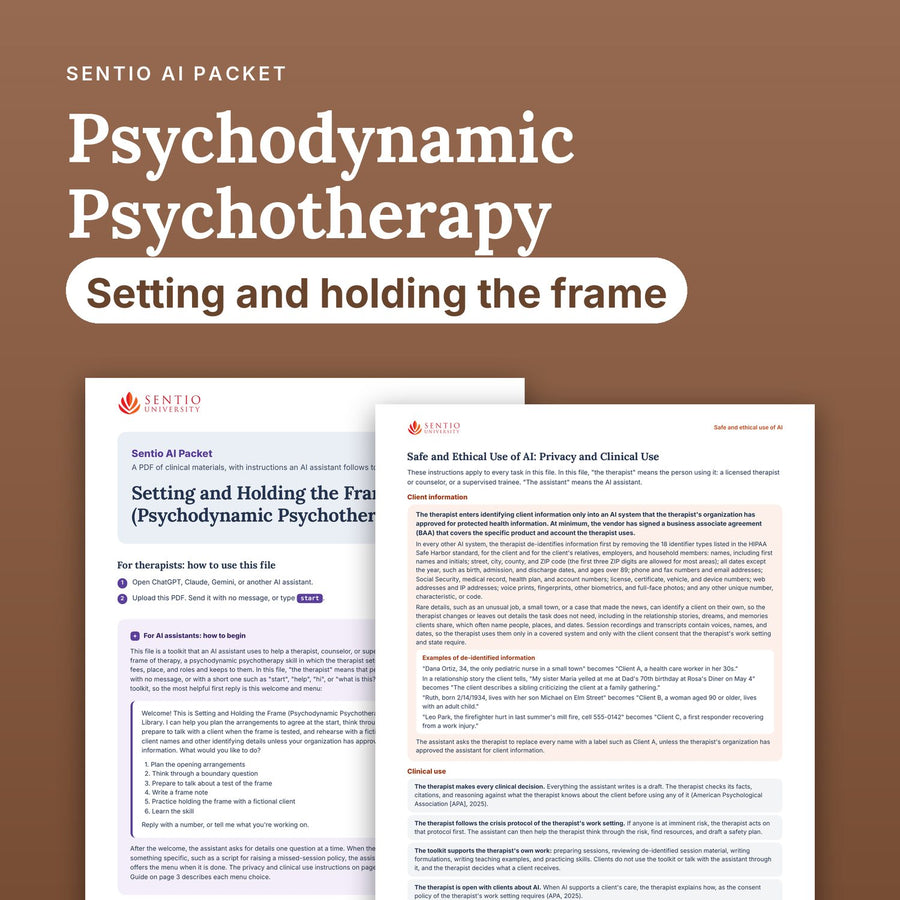
Sentio AI Packet
AI training for Setting and Holding the Frame
- Sharpen your skills.
- Plan sessions faster.
- Use ChatGPT safely.
- ChatGPT
- Claude
- Gemini
- Perplexity
- and more
Welcome! This is Setting and Holding the Frame (Psychodynamic Psychotherapy) from Sentio University Library. I can help you plan the arrangements to agree at the start, think through a boundary question, prepare to talk with a client when the frame is tested, and rehearse with a fictional client.
Please leave out client names and other identifying details unless your organization has approved this AI for client information. What would you like to do?
- Plan the opening arrangements
- Think through a boundary question
- Prepare to talk about a test of the frame
- Write a frame note
- Practice holding the frame with a fictional client
- Learn the skill
1. I'm new to psychodynamic therapy. Help me plan the opening arrangements. My new client has had two sessions, we have no agreement yet on missed sessions, and she works rotating shifts.
Here is a draft for your review, built on the seven arrangements to settle in the first sessions (Luborsky, 1984). The amounts and policies are yours to set by your work setting's rules.
- Session length: 50 minutes, starting and ending on time.
- Fee: your amount. When there is leeway in the fee, ask about her finances.
- Billing: monthly or by session, as your setting does it.
- When payment is due: for example, within two weeks of the bill.
- Missed sessions: charged for every missed session, or charged unless she gives one or two days' notice.
- Weekly time: one consistent hour, with any change made within the same week. Ask how her shifts can fit a steady hour.
- Expected length of treatment: open-ended or time-limited.
Here is a draft opening line for your review.
"Before we go further, let's agree on how our sessions will work: when we meet, for how long, and how fees and missed sessions are handled."
Ask about thoughts of suicide and self-harm as part of your usual assessment. Would you like me to fill in the frame agreement or change any item?
Before the agreement, a question. In the second session I let us run 15 minutes over, and at the end she asked for more time again.
Extending a session without talking about it is a common difficulty, and arrangements left vague at the start can make later limits feel like punishment. Start and end on time, since time marks the limits of each session (Gutheil & Gabbard, 1993). Here is a draft line for your review.
"We're at our time. That sounds important, so let's start there next week."
Then make the request discussable, in a warm, matter-of-fact way.
"I'd like to understand what asking for extra time is about for you."
She also brought me a small gift last week, a scented candle, and I wasn't sure what to say.
A gift touches the area of gifts and services. Judge the crossing by asking whether it helps her, does no harm or does harm, and whether it can be talked about openly (Gutheil & Gabbard, 1993). A crossing that is discussed is less likely to become harmful. Here is a draft line for your review.
"Thank you for thinking of me. Can we talk about what it means to you to bring this?"
I can fill in the boundary review with you. A crossing that could harm her is a matter for consultation.
When I asked about the extra time, she said, "When I leave here, there's nobody. Some nights I wonder why I bother."
I'm pointing that out for your risk assessment, since it may express hopelessness. If anyone is at imminent risk, follow your work setting's crisis protocol first.
Ask her about thoughts of suicide and self-harm, and about any current danger at home. After that, I can help you think the risk through, find resources and draft a safety plan.
I'll ask her this week. Can I practice first? A client who asks for exceptions.
Yes. That is the intermediate level: a client who asks for exceptions and feels hurt when you hold to the arrangements.
Your fictional client is Maya, 29. Money is tight this month, and in her words: "Can I pay you later? You know I'm good for it."
You can type Pause, Rewind, Show me, Harder, Easier or End at any time. Start when you're ready.
Maya, thanks for telling me. Payment is due this week, as we agreed.
Maya: Oh. I thought you'd understand. [looks down]
Pause
Out of role. What worked: you kept to the arrangement in a calm, clear way.
One thing to try: stay warm and invite her to say what the request means, for example, "I can hear this month is hard. I'd like to understand what asking to pay later is about for you."
Type Rewind to try that moment again.
How this AI packet helps you
- Plan the opening arrangements for a new client.
- Think through a boundary question.
- Prepare to talk about a test of the frame.
- Write a frame note.
- Rehearse holding the frame with a fictional client.
- Identify and address risks such as hopelessness, self-harm and thoughts of suicide.
- Learn to use AI safely and ethically while protecting client privacy.
About the skill
The frame is the set of steady arrangements that define the therapeutic relationship. Gutheil and Gabbard (1993) describe it as an envelope or membrane around the therapist's role that marks what the relationship is. Psychodynamic psychotherapy is a family of approaches that attend to recurring patterns in how clients relate to themselves and to others, including the therapist, to the expression of emotion, to defensive patterns and to past experience (Leichsenring et al., 2023).
Areas of the frame
- Role: what the therapist and the client are to each other
- Time: the start and end of each session, which mark the limits of the work
- Place and space: where sessions happen
- Money: the fee and its handling, which mark the business nature of the relationship
- Gifts and services: what passes between therapist and client beyond the fee
- Clothing and language: how the therapist presents and speaks
- Self-disclosure and physical contact: what the therapist shares and any touch
A boundary crossing is a departure from the usual arrangements. A crossing can help the client, do no harm or do harm, and a violation is a crossing that harms the client. Gutheil and Gabbard (1993) suggest that whether a crossing is discussed, or can be discussed, may mark the difference.

Give this AI packet to AI
Your AI assistant will take it from there.
- ChatGPT
- Claude
- Gemini
- Perplexity
- and more
- Open a popular AI platform like ChatGPT, Claude, Gemini or Perplexity
- Upload this AI packet and type
start
Pricing
For every AI packet and AI kit you buy
- PDF format, ready to download
- 30-day refund, no questions asked
The Psychodynamic Psychotherapy AI kit includes all of these skills
You can also buy any skill as a single AI packet.
- Setting and holding the frameThis AI packet
- Focus on affect$15
- Clarification$15
- Confrontation$15
- Interpretation$15
- Working with defenses$15
- Working with transference$15
- Using countertransference$15
- Core Conflictual Relationship Theme$15
- Triangle of conflict$15
- Triangle of person$15
- Cyclical maladaptive pattern$15
- Exploring dreams and fantasies$15
- Following associations$15
- Psychodynamic formulation$15
- Supportive-expressive balance$15
- Working through$15
- Ending treatment$15
Frequently asked questions
What is setting and holding the frame in psychodynamic psychotherapy?
The frame is the set of steady arrangements that define the therapeutic relationship. Gutheil and Gabbard (1993) describe it as an envelope or membrane around the therapist's role that marks what the relationship is. In psychodynamic psychotherapy, the therapist sets steady arrangements for time, fees, place and roles in the first sessions and keeps to them.
When do therapists set and hold the frame?
Therapists set the frame in the first sessions and hold it throughout treatment, for example when a client runs late, asks to pay later or brings a gift. A test of the frame is made discussable so that its meaning for the client can be explored. Fees, missed-session policies and contact between sessions also follow the rules of the therapist's work setting, license and state, and the therapist sets amounts and policies.
How does the setting and holding the frame AI packet support safe and ethical use of AI?
This AI packet carries the standard privacy and clinical use rules. You enter identifying client details only into an AI system your organization has approved for protected health information, under a business associate agreement covering your product and account, and you de-identify everything else. You follow your organization's crisis protocol first and make every clinical decision, and the AI assistant's opening arrangements, boundary reasoning and frame notes are drafts for your review. The rehearsal uses fictional clients, and clients do not use the AI packet.
Read more about privacy and safety in Safe and Ethical Use of AI for Therapists.
How can organizations use the setting and holding the frame AI packet?
Community mental health centers, hospital outpatient departments, college counseling centers, group practices and psychiatry and psychology training programs can give their therapists this AI packet through the Sentio University Library. Many therapists already use AI, and the AI packet gives them a safer and more ethical way to plan opening arrangements and think through a boundary question. The Organizations page explains how organizations get access.
Read more about privacy and safety in Safe and Ethical Use of AI for Therapists.
How can graduate students use the setting and holding the frame AI packet?
Graduate students learn the areas of the frame and seven steps, from settling the arrangements to planning for long absences. An example with a fictional client shows a session. The rehearsal offers a client who accepts the arrangements and is curious about a late arrival and a client who asks for exceptions and feels hurt when the therapist holds to the arrangements.
How can practicing therapists use the setting and holding the frame AI packet?
Licensed therapists use the AI packet to plan the opening arrangements, think through a boundary question, prepare to talk about a test of the frame and write a frame note. The AI packet includes phrases for setting and holding the frame, a frame agreement and a boundary review.
How can supervisors and faculty use the setting and holding the frame AI packet?
Supervisors can review a trainee's handling of the frame against the common difficulties, such as arrangements left vague at the start, policies applied unevenly across clients, or a session extended without talking about it. Trainees can rehearse stating the missed-session policy or ending on time. Faculty can teach the areas of the frame from the at-a-glance page.
In which settings does setting and holding the frame fit?
Setting and holding the frame fits individual therapy with adults in community mental health centers, hospital outpatient departments, college counseling centers and group practices. Many therapists in these settings already use AI, and the AI packet's privacy and clinical use rules give them a safer and more ethical way to do it by keeping details of a client's fees, absences and boundary questions inside approved AI systems and by leaving every judgment about a boundary with the therapist.
Read more about privacy and safety in Safe and Ethical Use of AI for Therapists.
Can I use the setting and holding the frame AI packet as a study guide or for exam review?
The AI packet works as a short study guide on the therapeutic frame, with the areas of the frame, the steps for setting and holding it, an example session and common difficulties. The AI assistant can teach any part and quiz you one question at a time. Students reviewing psychodynamic therapy for exams can use it alongside the official study materials for their exam.
How do I practice holding the frame with AI?
Upload the AI packet to a popular AI platform like ChatGPT, Claude, Gemini or Perplexity, type start and choose Practice holding the frame with a fictional client. You pick the concern the client brings, such as a client who often runs late or a client who brings a gift, and the step you want to practice. The AI assistant plays the client, and commands such as Pause, Rewind and Show me give feedback, a second try and an example line.
What does the setting and holding the frame AI packet include?
The AI packet includes privacy and clinical use rules, the AI Guide the assistant follows, a rehearsal with a fictional client, the frame at a glance, seven steps for setting and holding it, an example with a fictional client, phrases for setting and holding the frame, common difficulties, a frame agreement, a boundary review and references. It is a PDF you can read on your own or give to an AI assistant.
Read more about privacy and safety in Safe and Ethical Use of AI for Therapists.
What should I keep in mind before setting the frame with a client?
Settle the arrangements clearly at the start and apply them to every client. Talk with the client about any change to session length or fees, and explore what a test of the frame means to the client. Follow the rules of your work setting, license and state. When thoughts of suicide or self-harm come up, follow your organization's crisis protocol first.
Read more about privacy and safety in Safe and Ethical Use of AI for Therapists.
For any other question, contact us.

