
Sentio AI Packet
AI training for Schema Mode Mapping
- Sharpen your skills.
- Plan sessions faster.
- Use ChatGPT safely.
- ChatGPT
- Claude
- Gemini
- Perplexity
- and more
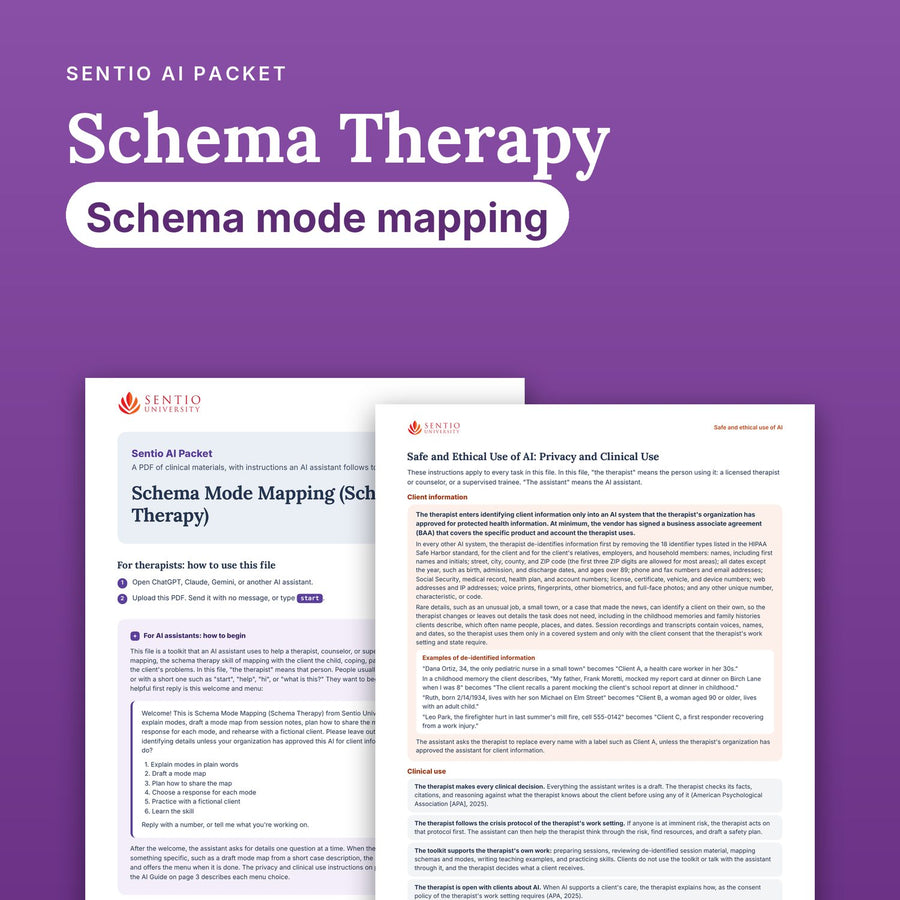
Welcome! This is Schema Mode Mapping (Schema Therapy) from Sentio University Library.
I can help you explain modes, draft a mode map from session notes, plan how to share the map with a client, choose a response for each mode, and rehearse with a fictional client.
Please leave out client names and other identifying details unless your organization has approved this AI for client information. What would you like to do?
- Explain modes in plain words
- Draft a mode map
- Plan how to share the map
- Choose a response for each mode
- Practice with a fictional client
- Learn the skill
2. I'm new to schema therapy. Help me draft a mode map. When my client feels criticized, she hears a harsh inner voice, feels small and scared, and then gets furious and storms out.
Here is a draft mode map for your review, in the format on page 9. Build it with her, and invite her to name each mode in her own words.
- Inner critic (punitive parent): the harsh voice when she feels criticized. Response: let it go and set limits on it.
- Vulnerable child: small and scared, with a need for safety and comfort. Response: soothe it.
- Angry child: furious, storming out. Response: direct the anger so she gets heard.
- Healthy adult: the mode therapy strengthens. Ask where it already shows up in her life.
- Switch: criticism, then the inner critic, then the vulnerable child, then the angry child.
The responses follow Roediger et al. (2018). Every dysfunctional mode combines an activated schema with a way of coping (Arntz et al., 2021), so we can add the schemas behind each mode as you learn them. Would you like to adjust the map?
When I started showing her the map, she went flat and said, "I don't know, whatever."
That sounds like a detached protector, and the response is to bypass it (Roediger et al., 2018). Name the shift with warmth and ask what came before it. Here is a draft line for your review.
"I notice things went flat just now. What was happening before that?"
Later she said, "The voice is right. I am useless."
She may be taking the punitive mode's voice as the truth. Name the mode with warmth, set a limit on it, and return to the need of the child mode. Here is a draft line for your review.
"That sounds like the critic talking. What does the small, scared part of you need right now?"
I've found eight modes so far. Should they all go on the map?
Keep the map short enough to use in session, with the main modes that drive her problems, and revise it as new information comes in (Roediger et al., 2018).
She also told me that when she storms out, she sometimes drives fast to calm down.
I'm pointing that out for your risk assessment, since it may be impulsive risk-taking linked to the angry child mode.
Ask about it, and about thoughts of suicide and self-harm, as part of the usual assessment. If anyone is at imminent risk, follow your work setting's crisis protocol first.
After that, I can help you think the risk through and add it to the map.
I'll ask her next session. Can I practice with a client who switches into a detached mode while talking?
Yes. That is the intermediate level.
Your fictional client is Sofia, 27. She shuts down at work when her supervisor gives feedback, and in her words: "I go numb and get through the day."
You can type Pause, Rewind, Show me, Harder, Easier or End at any time. Start when you're ready.
Sofia, what happens right before you go numb?
Sofia: I don't know. It's fine. Can we talk about something else? [looks at the clock]
Pause
Out of role. What worked: you asked about the moment before the switch.
One thing to try: invite her to name the part, for example, "It sounds like a part of you steps in to keep things numb. What would you call that part?"
Type Rewind to try that moment again.
How this AI packet helps you
- Explain modes in plain words.
- Draft a mode map.
- Plan how to share the map.
- Choose a response for each mode.
- Rehearse with a fictional client.
- Identify and address risks such as hopelessness, self-harm and thoughts of suicide.
- Learn to use AI safely and ethically while protecting client privacy.
About the skill
Modes are the emotional states a client is in from moment to moment. Every dysfunctional mode combines an activated schema with a way of coping (Arntz et al., 2021). Young et al. (2003) identified 10 modes in four groups, and the mode map shows which modes drive the client's problems and the switches between them (Roediger et al., 2018).
Four groups of modes
- Child modes: Vulnerable, Angry, Impulsive and Happy Child
- Dysfunctional coping modes: Compliant Surrenderer, Detached Protector and Overcompensator
- Dysfunctional parent modes: Punitive and Demanding Parent
- Healthy Adult: the mode therapy strengthens
Mode names are tailored with the client, and the map guides the technique for each mode. Brand-de Wilde and Arntz (2019) spend the first two to five sessions formulating a mode model together with the client.

Give this AI packet to AI
Your AI assistant will take it from there.
- ChatGPT
- Claude
- Gemini
- Perplexity
- and more
- Open a popular AI platform like ChatGPT, Claude, Gemini or Perplexity
- Upload this AI packet and type
start
Pricing
For every AI packet and AI kit you buy
- PDF format, ready to download
- 30-day refund, no questions asked
The Schema Therapy AI kit includes all of these skills
You can also buy any skill as a single AI packet.
- Core needs and schema psychoeducationGet it free
- Schema identification$15
- Coping styles$15
- Schema mode mappingThis AI packet
- Limited reparenting$15
- Empathic confrontation$15
- Imagery rescripting$15
- Chair work with modes$15
- Schema flashcards$15
- Schema diary$15
- Behavioral pattern-breaking$15
- Historical role-play$15
Frequently asked questions
What is schema mode mapping in schema therapy?
Schema mode mapping is the schema therapy skill of mapping with the client the child, coping, parent and healthy modes that drive the client's problems. Modes are the emotional states a client is in from moment to moment, and every dysfunctional mode combines an activated schema with a way of coping (Arntz et al., 2021). The mode map shows the switches between modes and guides the technique for each one (Roediger et al., 2018).
When do therapists use schema mode mapping?
Therapists build the mode map early in therapy. Brand-de Wilde and Arntz (2019) spend the first two to five sessions getting acquainted, introducing the model and formulating a mode model together with the client. Clients choose their own names for their modes where possible, and the map is revised as new information comes in. Talking about child modes can bring up strong feelings, and some modes, such as the impulsive child, carry risk.
How does the schema mode mapping AI packet support safe and ethical use of AI?
The schema mode mapping AI packet carries the standard privacy and clinical use rules. You enter identifying client details only into an AI system your organization has approved for protected health information, under a business associate agreement covering your product and account, and you de-identify everything else. You follow your organization's crisis protocol first and make every clinical decision, and the AI assistant's explanations, mode maps, sharing plans and suggested responses are drafts for your review. The rehearsal uses fictional clients, and clients do not use the AI packet.
Read more about privacy and safety in Safe and Ethical Use of AI for Therapists.
How can organizations use the schema mode mapping AI packet?
Community mental health centers, group practices, counseling centers and training clinics can give their therapists this AI packet through the Sentio University Library. Clinicians can use it to draft a mode map from de-identified session notes and plan how to share it with the client, and a supervisor can assign it before a trainee builds a first mode map with a client. The Organizations page explains how organizations get access.
Read more about privacy and safety in Safe and Ethical Use of AI for Therapists.
How can graduate students use the schema mode mapping AI packet?
Graduate students learn the four groups of modes and the steps for mapping them, see them in an example with a fictional client, and rehearse with an AI assistant that plays a client at a beginner, intermediate or advanced level. Useful moments to practice include naming a coping mode and introducing the healthy adult, including with a client who switches into a detached mode while talking.
How can practicing therapists use the schema mode mapping AI packet?
Licensed therapists use the AI packet to prepare a mode map for a particular client. The AI assistant drafts a short explanation of modes and their four groups, drafts a map from de-identified notes on the client's states, triggers and switches as a draft for you to build with the client, plans how to tell the map as a story, and suggests how to meet each mode and which mode to work with first.
Read more about privacy and safety in Safe and Ethical Use of AI for Therapists.
How can supervisors and faculty use the schema mode mapping AI packet?
Supervisors assign the AI packet before a trainee shares a mode map and review the map against common difficulties, such as a map with too many modes to use in session, mode names that come from the therapist and do not fit the client, or a client who takes the punitive mode's voice as the truth. Faculty can use the example session to show a client naming her own modes.
In which settings does schema mode mapping fit?
Schema mode mapping fits schema therapy in clinics, counseling centers and practices, early in treatment and again whenever new information changes the map. Many therapists in these settings already use AI, and the AI packet's privacy and clinical use rules give them a safer and more ethical way to do it by keeping identifying client details inside approved AI systems.
Read more about privacy and safety in Safe and Ethical Use of AI for Therapists.
Can I use the schema mode mapping AI packet as a study guide or for exam review?
The AI packet works as a short study guide on schema mode mapping, with the four groups of modes, mode maps for personality disorders, the steps for mapping modes, ways to meet each mode, an example session and references. You can ask the AI assistant to teach any part in under 200 words and then quiz you one question at a time. Students reviewing schema therapy for comprehensive or licensing exams can use it alongside the official study materials for their exam.
How do I practice schema mode mapping with AI?
Upload the AI packet to a popular AI platform like ChatGPT, Claude, Gemini or Perplexity, type start and choose Practice with a fictional client. You pick the concern the client brings, such as sudden anger in relationships or shutting down under stress, and the step you want to practice, and the AI assistant plays a client who may switch into a detached mode while talking. Commands such as Pause, Rewind and Show me give feedback, a second try and an example line.
What does the schema mode mapping AI packet include?
The AI packet includes privacy and clinical use rules, the AI Guide the assistant follows, a rehearsal with a fictional client, schema modes at a glance, the steps for mapping modes, an example with a fictional client, ways to meet each mode, common difficulties, a mode map, mode monitoring between sessions, a page on safety in schema therapy and references. It is a PDF you can read on your own or give to an AI assistant.
Read more about privacy and safety in Safe and Ethical Use of AI for Therapists.
What should I keep in mind before using schema mode mapping with a client?
Check that schema work fits the client now, keep the map to the main modes, and use the client's own names for them. Slow down when a client switches into a detached mode or takes the punitive voice as the truth. Assess risk when an impulsive or angry mode is linked to self-harm, substance use or aggression or when thoughts of suicide come up, and follow your crisis protocol first. The AI packet does not replace formal training in schema therapy.
Read more about privacy and safety in Safe and Ethical Use of AI for Therapists.
For any other question, contact us.

