
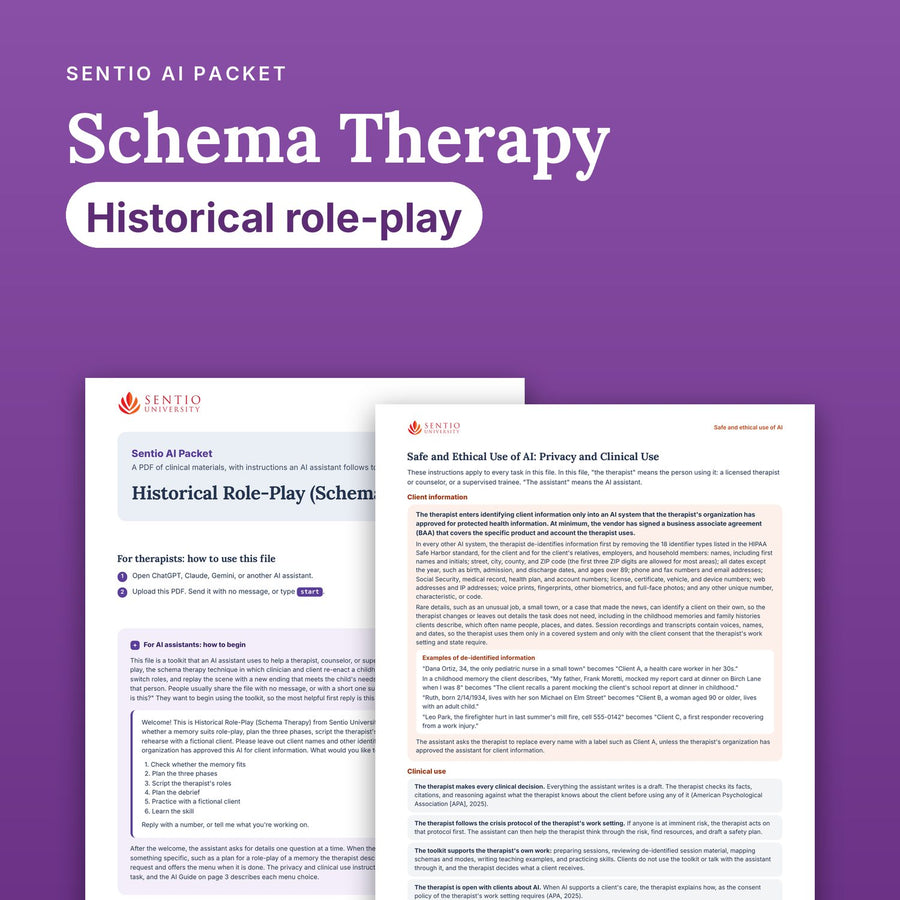
Sentio AI Packet
AI training for Historical Role-Play
- Sharpen your skills.
- Plan sessions faster.
- Use ChatGPT safely.
- ChatGPT
- Claude
- Gemini
- Perplexity
- and more
Welcome! This is Historical Role-Play (Schema Therapy) from Sentio University Library.
I can help you check whether a memory suits role-play, plan the three phases, script the therapist's roles, plan the debrief, and rehearse with a fictional client.
Please leave out client names and other identifying details unless your organization has approved this AI for client information. What would you like to do?
- Check whether the memory fits
- Plan the three phases
- Script the therapist's roles
- Plan the debrief
- Practice with a fictional client
- Learn the skill
2. I'm new to schema therapy. My client, a man in his 30s, concluded as a boy that he didn't matter, because his father was always too busy with work to come to his games. There was no abuse.
Here is a draft plan for your review, following Arntz and van Genderen (2021).
- Before: a safety check, the rationale, and different chairs from the usual ones.
- Phase 1, the original scene: he plays the boy and directs how you play his father, in the present tense, for about 5 minutes or less.
- Between: check how accurate the scene was, write down his conclusions in his words and rate each from 0 to 100.
- Phase 2, the role switch: he plays his father and you play the boy.
- Review: ask what he understands now and rate the conclusions again.
- Phase 3: in 3a he plays the boy again and tries new behavior. If the conclusions have not changed, use 3b, where you play a good parent and rescript the end.
- After: grounding, the debrief and links to his current life.
Ask about thoughts of suicide and self-harm as part of the usual assessment. Would you like me to script your lines for each phase?
Before that, what if the next memory he picks involves his father hitting him?
Abuse is treated with imagery rescripting, because the therapist cannot play an abusive parent (Arntz & van Genderen, 2021). Check each memory for abuse at step 1 and keep that one for imagery rescripting.
In the switch, I worry he'll excuse his father and blame himself, as he does now.
The technique fits clients who explain a parent's behavior by blaming themselves (Pugh, 2020). As the boy in phase 2, voice the child's feelings and questions and challenge the parent's messages (Pugh, 2020). Here is a draft line for your review.
"[as the boy] Dad, I wanted you at my games. Did I do something wrong?"
And if his conclusion stays the same after the switch?
Then use phase 3b. You play a good parent, meet the boy's needs and rescript the end (Arntz & van Genderen, 2021). Here is a draft line for your review.
"[as a good parent] I'm sorry I missed your games. You matter to me, and I'm here now."
After our last session he also said, "Maybe everyone would be better off if I disappeared."
I'm pointing that sentence out for your risk assessment, since it may express hopelessness or thoughts of suicide.
Ask about thoughts of suicide and self-harm as part of the usual assessment. If anyone is at imminent risk, follow your work setting's crisis protocol first. In session, step out of role, ground him and return to the child's needs.
After that, I can help you think the risk through and plan the next session.
I'll ask him first thing. Can I practice with a client who struggles to take the parent's view?
Yes. That is the intermediate level.
Your fictional client is Nina, 45. Her mother was always on the phone when Nina came home from school, and in her words: "She didn't care what I had to say."
You can type Pause, Rewind, Show me, Harder, Easier or End at any time. Start when you're ready.
Nina, now sit in your mother's chair, and I'll be ten-year-old Nina. [as the child] Mom, can you listen to me?
Nina (as her mother): I don't know what she would say. I can't get into her head. [shifts in the chair]
Pause
Out of role. What worked: you set up the switch clearly, in the present tense.
One thing to try: stay in the child's role and give her a concrete question to answer as her mother, for example, "[as the child] Mom, who are you talking to on the phone every day?"
Type Rewind to try that moment again.
How this AI packet helps you
- Check whether the memory fits.
- Plan the three phases.
- Script the therapist's roles.
- Plan the debrief.
- Rehearse with a fictional client.
- Identify and address risks such as hopelessness, self-harm and thoughts of suicide.
- Learn to use AI safely and ethically while protecting client privacy.
About the skill
In historical role-play the therapist and client re-enact a concrete childhood moment with a key figure, usually a parent, when the client's dysfunctional conclusions formed. They then switch roles, so the client experiences the other person's perspective, and finally the client tries new behavior or the scene gets a new ending (Arntz & van Genderen, 2021).
Three phases
- The original scene: the client plays the child, and the therapist plays the other person as the client directs
- The role switch: the client plays the other person, and the therapist plays the child
- New behavior or a new ending: the client tries new behavior, or the therapist plays a good parent and rescripts the end
Historical role-play fits situations where the parent's behavior was dysfunctional without coming from rejection of the child. It does not fit abuse, which is treated with imagery rescripting, because the therapist cannot play an abusive parent (Arntz & van Genderen, 2021).

Give this AI packet to AI
Your AI assistant will take it from there.
- ChatGPT
- Claude
- Gemini
- Perplexity
- and more
- Open a popular AI platform like ChatGPT, Claude, Gemini or Perplexity
- Upload this AI packet and type
start
Pricing
For every AI packet and AI kit you buy
- PDF format, ready to download
- 30-day refund, no questions asked
The Schema Therapy AI kit includes all of these skills
You can also buy any skill as a single AI packet.
- Core needs and schema psychoeducationGet it free
- Schema identification$15
- Coping styles$15
- Schema mode mapping$15
- Limited reparenting$15
- Empathic confrontation$15
- Imagery rescripting$15
- Chair work with modes$15
- Schema flashcards$15
- Schema diary$15
- Behavioral pattern-breaking$15
- Historical role-playThis AI packet
Frequently asked questions
What is historical role-play in schema therapy?
Historical role-play is the schema therapy technique in which clinician and client re-enact a childhood situation with a key figure, switch roles and replay the scene with a new ending that meets the child's needs. In the role switch the client experiences the other person's perspective (Arntz & van Genderen, 2021). The technique comes from Arntz and Weertman (1999).
When do therapists use historical role-play?
Therapists use historical role-play for a concrete childhood moment when the client's dysfunctional conclusions formed. It fits situations where the parent's behavior was dysfunctional without coming from rejection of the child, and clients who explain a parent's behavior by blaming themselves (Pugh, 2020). It does not fit abuse, which is treated with imagery rescripting because the therapist cannot play an abusive parent (Arntz & van Genderen, 2021).
How does the historical role-play AI packet support safe and ethical use of AI?
The historical role-play AI packet carries the standard privacy and clinical use rules. You enter identifying client details only into an AI system your organization has approved for protected health information, under a business associate agreement covering your product and account, and you de-identify everything else. You follow your organization's crisis protocol first and make every clinical decision, and the AI assistant's fit checks, phase plans, role scripts and debrief questions are drafts for your review. The rehearsal uses fictional clients, and clients do not use the AI packet.
Read more about privacy and safety in Safe and Ethical Use of AI for Therapists.
How can organizations use the historical role-play AI packet?
Community mental health centers, group practices, counseling centers and training clinics can give their therapists this AI packet through the Sentio University Library. Clinicians can use it to check whether a memory suits role-play and plan the original scene, the role switch and the new ending, and a supervisor can assign it before a trainee leads a first historical role-play. The Organizations page explains how organizations get access.
How can graduate students use the historical role-play AI packet?
Graduate students learn the three phases, when the technique fits and its steps, see them in an example with a fictional client, and rehearse with an AI assistant that plays a client at a beginner, intermediate or advanced level. Useful moments to practice include playing the parent in phase 1 and guiding the role switch, including with a client who struggles to take the parent's view.
How can practicing therapists use the historical role-play AI packet?
Licensed therapists use the AI packet to prepare a historical role-play with a particular client. The AI assistant compares the memory with the conditions under which the technique fits, flags memories of abuse and leaves the decision to you. It drafts a plan for the original scene, the role switch and the new ending, drafts lines for your roles with no abusive content, and drafts debrief questions for rating the client's conclusions.
How can supervisors and faculty use the historical role-play AI packet?
Supervisors assign the AI packet before a trainee leads a first historical role-play and review the session plan against common difficulties, such as a chosen memory that involves abuse, a first phase that runs too long, or a client who uses the switch to excuse the parent and blame themselves. Faculty can use the example session to show a client's conclusion about her mother changing after the role switch.
In which settings does historical role-play fit?
Historical role-play fits schema therapy in clinics, counseling centers and practices, in sessions with a therapist, for childhood moments that involve no abuse. Many therapists in these settings already use AI, and the AI packet's privacy and clinical use rules give them a safer and more ethical way to do it by keeping identifying client details inside approved AI systems.
Read more about privacy and safety in Safe and Ethical Use of AI for Therapists.
Can I use the historical role-play AI packet as a study guide or for exam review?
The AI packet works as a short study guide on historical role-play, with the three phases, when the technique fits, the steps, variations, the therapist's roles, an example session and references. You can ask the AI assistant to teach any part in under 200 words and then quiz you one question at a time. Students reviewing schema therapy for comprehensive or licensing exams can use it alongside the official study materials for their exam.
How do I practice historical role-play with AI?
Upload the AI packet to a popular AI platform like ChatGPT, Claude, Gemini or Perplexity, type start and choose Practice with a fictional client. You pick the concern the client brings, such as a parent who was distracted or a parent who favored a sibling, and the step you want to practice, and the AI assistant plays a client who may struggle to take the parent's view. Commands such as Pause, Rewind and Show me give feedback, a second try and an example line.
What does the historical role-play AI packet include?
The AI packet includes privacy and clinical use rules, the AI Guide the assistant follows, a rehearsal with a fictional client, historical role-play at a glance, the steps of historical role-play, an example with a fictional client, the therapist's roles, common difficulties, a role-play record, a session plan, a page on safety in schema therapy and references. It is a PDF you can read on your own or give to an AI assistant.
Read more about privacy and safety in Safe and Ethical Use of AI for Therapists.
What should I keep in mind before using historical role-play with a client?
Check that the chosen moment involves no abuse, since abuse is treated with imagery rescripting (Arntz & van Genderen, 2021). Keep the original scene to about five minutes or less so the client is not flooded, and rescript the ending as a good parent when the client's conclusions stay unchanged. Step out of role and ground the client if strong distress or dissociation appears, and follow your crisis protocol first. The AI packet does not replace formal training in schema therapy.
Read more about privacy and safety in Safe and Ethical Use of AI for Therapists.
For any other question, contact us.

