
Sentio AI Packet
AI training for Core Needs and Schema Psychoeducation
- Sharpen your skills.
- Plan sessions faster.
- Use ChatGPT safely.
- ChatGPT
- Claude
- Gemini
- Perplexity
- and more
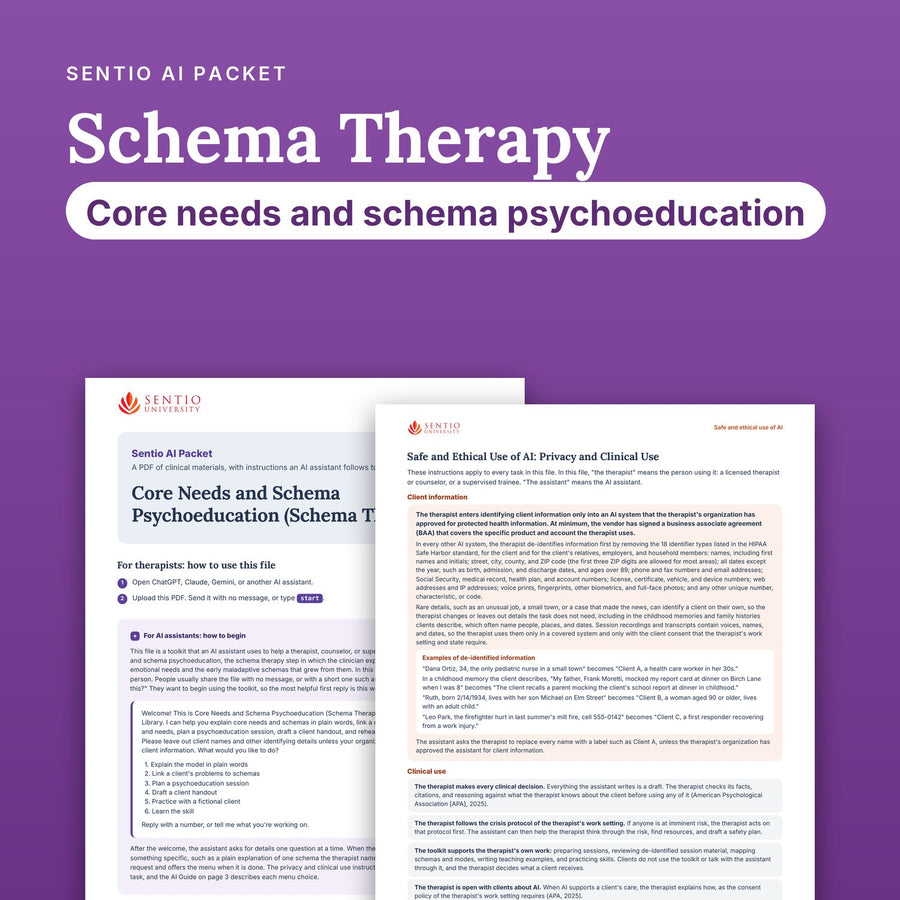
Welcome! This is Core Needs and Schema Psychoeducation (Schema Therapy) from Sentio University Library.
I can help you explain core needs and schemas in plain words, link a client's problems to schemas and needs, plan a psychoeducation session, draft a client handout, and rehearse with a fictional client.
Please leave out client names and other identifying details unless your organization has approved this AI for client information. What would you like to do?
- Explain the model in plain words
- Link a client's problems to schemas
- Plan a psychoeducation session
- Draft a client handout
- Practice with a fictional client
- Learn the skill
3. I'm new to schema therapy. Help me plan a psychoeducation session. My client keeps ending up with partners who leave, and his assessment points to Abandonment/Instability. His mother was in and out of his life when he was a child.
Here is a draft session plan for your review, following the steps on page 6. It uses the 18 schemas in five domains of Young et al. (2003).
- Start from the formulation: partners who leave, the history he has shared, and Abandonment/Instability as the most active schema (McGinn & Young, 1996).
- Explain core needs in plain words, starting with safety and nurturance, including safe attachment (Arntz et al., 2021): "Every child needs to feel safe and accepted."
- Explain how schemas form: when a need goes unmet, a child draws a conclusion to make sense of it, such as "people I love will leave."
- Link it to his life: "You mentioned that partners leave. Could that connect to what you learned about people staying?"
- Check understanding: "How would you say it in your own words?"
- Offer reading: Reinventing Your Life (Young & Klosko, 1993/1994), which describes lifetraps for general readers.
Explain this one schema first and add the rest of the model in later sessions. I can fill in the psychoeducation plan on page 9 next. Would you like to change any step?
When I tried this last week, he said, "So you're saying this is my mother's fault?"
Hearing the explanation as blame of a parent is a common difficulty. Describe unmet needs as the source of schemas without blaming any one person, and speak about the need. Here is a draft line for your review.
"Every child needs to feel safe, and a child draws conclusions when that need goes unmet. We're looking at what you needed and what you learned from it."
When I named the schema, he said, "Great, so I'm broken."
Use his own words for the pattern and offer each link as a hypothesis he can correct. Everyday words can help, such as lifetraps, patterns that start in childhood and repeat throughout life (Young & Klosko, 1993/1994). Here is a draft line for your review.
"Some people call these lifetraps: patterns that start in childhood and keep repeating. What fits for you, and what doesn't?"
He also said, "Maybe I'll always end up alone, so what's the point?"
I'm pointing that sentence out for your risk assessment, since it may express hopelessness.
Hopelessness or thoughts of suicide can come up while discussing unmet needs. Ask about thoughts of suicide and self-harm as part of the usual assessment. If anyone is at imminent risk, follow your work setting's crisis protocol first.
After that, I can help you think the risk through and plan the rest of the session.
I'll ask him this week. Can I practice with a client who worries the model blames the parents?
Yes. That is the intermediate level.
Your fictional client is Marcus, 41. He comes to therapy after a second divorce, and in his words: "My parents did their best. I don't see what my childhood has to do with this."
You can type Pause, Rewind, Show me, Harder, Easier or End at any time. Start when you're ready.
Marcus, every child needs a few things to grow up well, like feeling safe and accepted. Can we look at what you needed back then?
Marcus: My dad worked two jobs. We had what we needed. [frowns]
Pause
Out of role. What worked: you started from the needs in plain words.
One thing to try: acknowledge what his parents gave and link one need to a current problem, for example, "It sounds like they worked hard for you. When your marriages ended, which need felt most at stake?"
Type Rewind to try that moment again.
How this AI packet helps you
- Explain the model in plain words.
- Link a client's problems to schemas.
- Plan a psychoeducation session.
- Draft a client handout.
- Rehearse with a fictional client.
- Identify and address risks such as hopelessness, self-harm and thoughts of suicide.
- Learn to use AI safely and ethically while protecting client privacy.
About the skill
Early in schema therapy the clinician explains the schema model to the client. Children have core emotional needs, and when those needs go unmet, a child is at increased risk of forming early maladaptive schemas about the self, others and the world that interfere with healthy adaptation later in life (Arntz et al., 2021). Young et al. (2003) describe 18 schemas in five domains.
Five core emotional needs
- Safety and nurturance: including safe attachment
- Autonomy and competence: with a sense of identity
- Freedom to express: needs, opinions and emotions
- Spontaneity and play, and realistic limits: with self-control
In their book for general readers, Young and Klosko call schemas lifetraps. Psychoeducation links the client's current problems to schemas and the unmet needs behind them, in words the client can use.

Give this AI packet to AI
Your AI assistant will take it from there.
- ChatGPT
- Claude
- Gemini
- Perplexity
- and more
- Open a popular AI platform like ChatGPT, Claude, Gemini or Perplexity
- Upload this AI packet and type
start
Pricing
For every AI packet and AI kit you buy
- PDF format, ready to download
- 30-day refund, no questions asked
The Schema Therapy AI kit includes all of these skills
You can also buy any skill as a single AI packet.
- Core needs and schema psychoeducationThis AI packet
- Schema identification$15
- Coping styles$15
- Schema mode mapping$15
- Limited reparenting$15
- Empathic confrontation$15
- Imagery rescripting$15
- Chair work with modes$15
- Schema flashcards$15
- Schema diary$15
- Behavioral pattern-breaking$15
- Historical role-play$15
Frequently asked questions
What is core needs and schema psychoeducation in schema therapy?
Core needs and schema psychoeducation is the schema therapy step in which the clinician explains a client's unmet core emotional needs and the early maladaptive schemas that grew from them. When core emotional needs go unmet, a child is at increased risk of forming schemas about the self, others and the world that interfere with healthy adaptation later in life (Arntz et al., 2021).
When do therapists use core needs and schema psychoeducation?
Therapists explain the model early in treatment, drawing on what the assessment found. Brand-de Wilde and Arntz (2019) describe the first two to five sessions as getting acquainted, introducing the model and its aims, and formulating the model together with the client. Talking about childhood needs can bring up grief and strong feelings, so the therapist checks that schema work fits the client now and explains one or two schemas before the rest of the model.
How does the core needs and schema psychoeducation AI packet support safe and ethical use of AI?
This AI packet carries the standard privacy and clinical use rules. You enter identifying client details only into an AI system your organization has approved for protected health information, under a business associate agreement covering your product and account, and you de-identify everything else. You follow your organization's crisis protocol first and make every clinical decision, and the AI assistant's explanations, schema links, session plans and client handouts are drafts for your review. The rehearsal uses fictional clients, and clients do not use the AI packet.
Read more about privacy and safety in Safe and Ethical Use of AI for Therapists.
How can organizations use the core needs and schema psychoeducation AI packet?
Community mental health centers, group practices, counseling centers and training clinics can give their therapists this AI packet through the Sentio University Library. Clinicians can use it to explain core needs and schemas in plain words and draft a one-page client handout, and a supervisor can assign it before a trainee explains the schema model to a client. The Organizations page explains how organizations get access.
How can graduate students use the core needs and schema psychoeducation AI packet?
Graduate students learn the five core emotional needs, the eighteen schemas in five domains and the steps for explaining them, see them in an example with a fictional client, and rehearse with an AI assistant that plays a client at a beginner, intermediate or advanced level. Useful moments to practice include explaining the needs and naming a schema without sounding like a diagnosis, including with a client who worries the model blames the parents.
How can practicing therapists use the core needs and schema psychoeducation AI packet?
Licensed therapists use the AI packet to prepare psychoeducation for a particular client. The AI assistant drafts a short explanation of the core needs and of how unmet needs lead to schemas, suggests which needs and domains may be involved in the client's de-identified problems and labels every link a hypothesis for you to check with the client, drafts a session plan, and writes a one-page handout at the reading level you name.
Read more about privacy and safety in Safe and Ethical Use of AI for Therapists.
How can supervisors and faculty use the core needs and schema psychoeducation AI packet?
Supervisors assign the AI packet before a trainee explains the model and review the psychoeducation plan against common difficulties, such as explaining the whole model at once, terms that stay abstract, or a client who hears the explanation as blame of the parents. Faculty can use the example session to show core needs linked to a client's schemas in plain words.
In which settings does core needs and schema psychoeducation fit?
Core needs and schema psychoeducation fits schema therapy in clinics, counseling centers and practices, early in treatment once the assessment has suggested which schemas are most active. Many therapists in these settings already use AI, and the AI packet's privacy and clinical use rules give them a safer and more ethical way to do it by keeping identifying client details inside approved AI systems.
Read more about privacy and safety in Safe and Ethical Use of AI for Therapists.
Can I use the core needs and schema psychoeducation AI packet as a study guide or for exam review?
The AI packet works as a short study guide on core needs and schema psychoeducation, with the five core emotional needs, the schemas and their domains, the steps for explaining them, phrases for explaining the model, an example session and references. You can ask the AI assistant to teach any part in under 200 words and then quiz you one question at a time. Students reviewing schema therapy for comprehensive or licensing exams can use it alongside the official study materials for their exam.
How do I practice core needs and schema psychoeducation with AI?
Upload the AI packet to a popular AI platform like ChatGPT, Claude, Gemini or Perplexity, type start and choose Practice with a fictional client. You pick the concern the client brings, such as loneliness or harsh self-criticism, and the step you want to practice, and the AI assistant plays a client who may worry that the model blames the parents. Commands such as Pause, Rewind and Show me give feedback, a second try and an example line.
What does the core needs and schema psychoeducation AI packet include?
The AI packet includes privacy and clinical use rules, the AI Guide the assistant follows, a rehearsal with a fictional client, core needs and schemas at a glance, the steps for explaining needs and schemas, an example with a fictional client, phrases for explaining the model, common difficulties, a psychoeducation plan, a client handout outline, a page on safety in schema therapy and references. It is a PDF you can read on your own or give to an AI assistant.
Read more about privacy and safety in Safe and Ethical Use of AI for Therapists.
What should I keep in mind before using core needs and schema psychoeducation with a client?
Check that schema work fits the client now, since it may need to wait when the client is in a major life crisis or has an acute untreated disorder that needs attention first (Young et al., 2003). Explain one or two schemas before the rest of the model, and slow down when grief or anger about childhood comes up. Ask about thoughts of suicide and self-harm, and follow your crisis protocol first if risk appears. The AI packet does not replace formal training in schema therapy.
Read more about privacy and safety in Safe and Ethical Use of AI for Therapists.
For any other question, contact us.

