
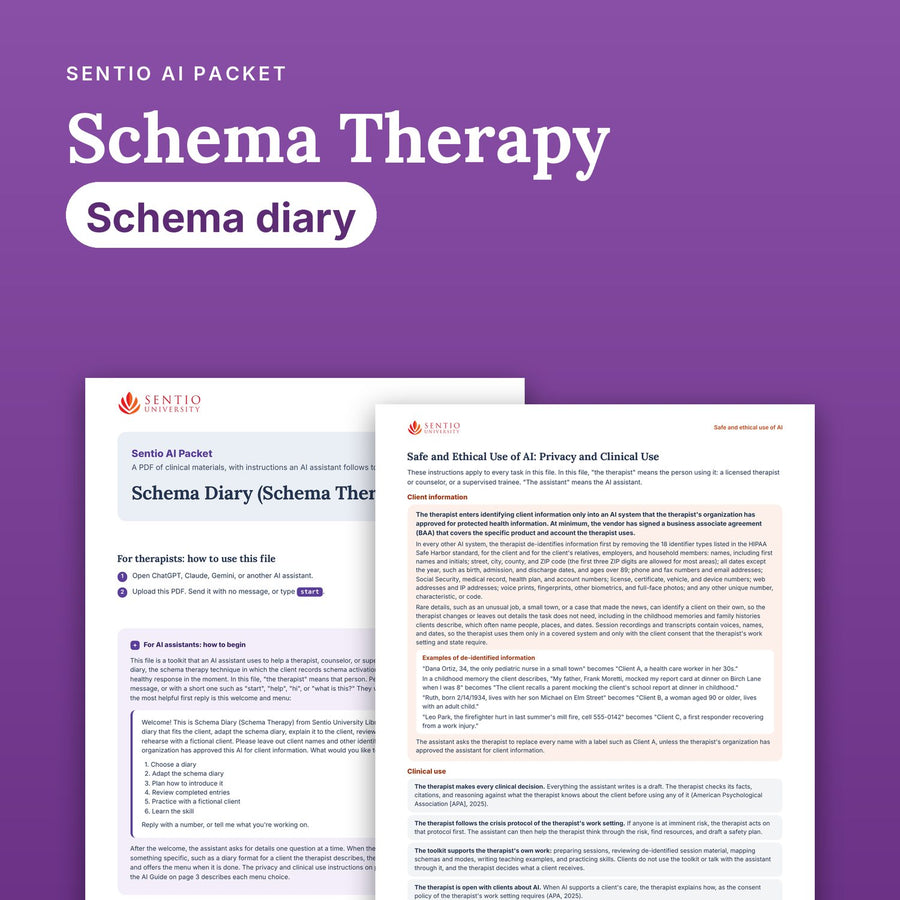
Sentio AI Packet
AI training for Schema Diary
- Sharpen your skills.
- Plan sessions faster.
- Use ChatGPT safely.
- ChatGPT
- Claude
- Gemini
- Perplexity
- and more
Welcome! This is Schema Diary (Schema Therapy) from Sentio University Library.
I can help you choose a diary that fits the client, adapt the schema diary, explain it to the client, review completed entries, and rehearse with a fictional client.
Please leave out client names and other identifying details unless your organization has approved this AI for client information. What would you like to do?
- Choose a diary
- Adapt the schema diary
- Plan how to introduce it
- Review completed entries
- Practice with a fictional client
- Learn the skill
1. I'm new to schema therapy. My client, a woman in her 20s, feels jealous when her partner goes out with friends. She started flashcards two weeks ago and says long forms overwhelm her. Which diary fits?
Here is a draft suggestion for your review. The full schema diary comes later in treatment, once the client uses flashcards well and knows the terms (Young et al., 2003), so a simpler diary fits her now.
- Diary: the talking-back diary, which pairs each inner critic thought with a healthy adult reply (Roediger et al., 2018).
- Why it fits: she is two weeks into flashcards, and it has two columns.
- Choose together: let her help choose the diary and agree how long to keep it (Roediger et al., 2018).
- First entry: fill in one row together in session, from a recent example.
- Next step: the full schema diary, once she uses flashcards well and knows the schema terms.
Ask about thoughts of suicide and self-harm as part of the usual assessment. Would you like me to adapt the columns to her words?
Yes, later. First, last week she came in ashamed because she missed most days.
Shame about missed entries is a common difficulty. Praise what she did, switch to a simpler diary if needed, and return to one entry. Here is a draft line for your review.
"You wrote something down on a hard week, and that counts. Let's look at that entry together."
When she does write, the real worries and the jealousy run together.
The full diary has separate fields for realistic concerns and overreactions (Young et al., 2003). Here are draft questions for your review.
- "What part of the worry fits the facts?"
- "What part is the schema talking?"
A reaction that feels bigger than the situation is a sign that a schema or mode has been triggered (Farrell & Shaw, 2018).
And if her entries turn into attacks on herself?
Praise the entry, return to one entry, and use the talking-back diary, so each critic thought gets a healthy adult reply (Roediger et al., 2018). A draft row for your review: "You're too much, and he'll leave" paired with "I felt jealous, and I can ask him about his plans calmly."
One entry also says, "Drank most of a bottle of wine and thought about hurting myself."
I'm pointing that entry out for your risk assessment, since it records heavy drinking and thoughts of self-harm.
Ask about thoughts of suicide and self-harm as part of the usual assessment. If anyone is at imminent risk, follow your work setting's crisis protocol first.
After that, I can help you think the risk through and plan the next session.
I'll ask her at the start. Can I practice with a client who didn't complete the diary?
Yes. That is the intermediate level.
Your fictional client is Sofia, 27. She works in retail and feels jealous when her boyfriend goes out with friends, and in her words: "I meant to do the diary, and then the week got away from me."
You can type Pause, Rewind, Show me, Harder, Easier or End at any time. Start when you're ready.
Sofia, let's look at your week together. Did anything get written down?
Sofia: One line on Thursday. It's barely anything. [looks away]
Pause
Out of role. What worked: you asked about the week with warmth.
One thing to try: praise the entry and fill in the rest together, for example, "One line is a real start. Let's go through it and fill in the other fields together."
Type Rewind to try that moment again.
How this AI packet helps you
- Choose a diary.
- Adapt the schema diary.
- Plan how to introduce it.
- Review completed entries.
- Rehearse with a fictional client.
- Identify and address risks such as hopelessness, self-harm and thoughts of suicide.
- Learn to use AI safely and ethically while protecting client privacy.
About the skill
In the schema diary the client builds a healthy response at the moment a schema is triggered in daily life. It is a more advanced technique than the flashcard, so the therapist introduces it later in treatment, once the client uses flashcards well and knows the terms (Young et al., 2003).
Diary fields
- Trigger and emotions: what happened and what the client felt
- Thoughts and actual behaviors: what the client thought and did
- Schemas and healthy view: which schemas were activated, and the healthy view of the situation
- Realistic concerns and healthy behavior: what is real, what is an overreaction, and what to do
Simpler diaries, such as a daily mood rating or a talking-back diary, can come first. Entries can record self-harm or thoughts of suicide, so the therapist reviews them for risk.

Give this AI packet to AI
Your AI assistant will take it from there.
- ChatGPT
- Claude
- Gemini
- Perplexity
- and more
- Open a popular AI platform like ChatGPT, Claude, Gemini or Perplexity
- Upload this AI packet and type
start
Pricing
For every AI packet and AI kit you buy
- PDF format, ready to download
- 30-day refund, no questions asked
The Schema Therapy AI kit includes all of these skills
You can also buy any skill as a single AI packet.
- Core needs and schema psychoeducationGet it free
- Schema identification$15
- Coping styles$15
- Schema mode mapping$15
- Limited reparenting$15
- Empathic confrontation$15
- Imagery rescripting$15
- Chair work with modes$15
- Schema flashcards$15
- Schema diaryThis AI packet
- Behavioral pattern-breaking$15
- Historical role-play$15
Frequently asked questions
What is the schema diary in schema therapy?
The schema diary is the schema therapy technique in which the client records schema activations as they happen and builds a healthy response in the moment. The client carries copies and fills one out when a schema is triggered, noting the trigger, emotions, thoughts, behavior, the schema, a healthy view, realistic concerns, overreactions and a healthy behavior (Young et al., 2003).
When do therapists use the schema diary?
Therapists introduce the full diary later in treatment, once the client uses flashcards well and knows the schema terms (Young et al., 2003). A simpler diary can come first if the full one is too much, and the client helps choose which diary to use and for how long (Roediger et al., 2018). Entries can record self-harm, risky behaviors or thoughts of suicide, so the therapist reviews entries for risk.
Read more about privacy and safety in Safe and Ethical Use of AI for Therapists.
How does the schema diary AI packet support safe and ethical use of AI?
The schema diary AI packet carries the standard privacy and clinical use rules. You enter identifying client details only into an AI system your organization has approved for protected health information, under a business associate agreement covering your product and account, and you de-identify everything else. You follow your organization's crisis protocol first and make every clinical decision, and the AI assistant's diary suggestions, adapted diaries, explanations, review questions and summaries are drafts for your review. The rehearsal uses fictional clients, and clients do not use the AI packet.
Read more about privacy and safety in Safe and Ethical Use of AI for Therapists.
How can organizations use the schema diary AI packet?
Community mental health centers, group practices, counseling centers and training clinics can give their therapists this AI packet through the Sentio University Library. Clinicians can use it to choose a diary that fits a client and adapt its columns to the client's words and reading level, and a supervisor can assign it before a trainee introduces a diary to a client. The Organizations page explains how organizations get access.
How can graduate students use the schema diary AI packet?
Graduate students learn the diary fields, the range of diaries from simple to complex and the steps for using the schema diary, see them in an example with a fictional client, and rehearse with an AI assistant that plays a client at a beginner, intermediate or advanced level. Useful moments to practice include separating realistic concerns from overreactions and finding a healthy behavior, including with a client who did not complete the diary.
How can practicing therapists use the schema diary AI packet?
Licensed therapists use the AI packet to prepare a diary for a particular client. The AI assistant suggests a diary that fits how far therapy has come and what the client is willing to do, adapts the diary columns to the client's words, reading level and schemas, drafts a short explanation and a practice entry for the session, and drafts review questions and a summary of patterns from de-identified entries without judging them.
Read more about privacy and safety in Safe and Ethical Use of AI for Therapists.
How can supervisors and faculty use the schema diary AI packet?
Supervisors assign the AI packet before a trainee introduces a diary and review the adapted diary against common difficulties, such as a full diary that comes too early, fields that feel like too much, or entries that turn into self-attack. Faculty can use the example session to show a first entry filled in together, with a realistic concern sorted from an overreaction.
In which settings does the schema diary fit?
The schema diary fits schema therapy in clinics, counseling centers and practices, later in treatment, with entries written in daily life and reviewed at the start of the next session. Many therapists in these settings already use AI, and the AI packet's privacy and clinical use rules give them a safer and more ethical way to do it by keeping identifying client details inside approved AI systems.
Read more about privacy and safety in Safe and Ethical Use of AI for Therapists.
Can I use the schema diary AI packet as a study guide or for exam review?
The AI packet works as a short study guide on the schema diary, with the diary fields, diaries from simple to complex, the steps for using the diary, questions for each field, an example session and references. You can ask the AI assistant to teach any part in under 200 words and then quiz you one question at a time. Students reviewing schema therapy for comprehensive or licensing exams can use it alongside the official study materials for their exam.
How do I practice the schema diary with AI?
Upload the AI packet to a popular AI platform like ChatGPT, Claude, Gemini or Perplexity, type start and choose Practice with a fictional client. You pick the concern the client brings, such as shame after criticism or jealousy in a relationship, and the step you want to practice, and the AI assistant plays a client who may not have completed the diary. Commands such as Pause, Rewind and Show me give feedback, a second try and an example line.
What does the schema diary AI packet include?
The AI packet includes privacy and clinical use rules, the AI Guide the assistant follows, a rehearsal with a fictional client, the schema diary at a glance, the steps for using the schema diary, an example with a fictional client, questions for each field, common difficulties, a schema diary for the client, a simpler talking-back diary, a page on safety in schema therapy and references. It is a PDF you can read on your own or give to an AI assistant.
Read more about privacy and safety in Safe and Ethical Use of AI for Therapists.
What should I keep in mind before using the schema diary with a client?
Introduce the full diary once the client uses flashcards well, and offer a simpler diary first if the fields feel like too much. Praise what the client did, since missed entries can bring shame and entries can turn into self-attack. Review entries for self-harm, heavy drinking or thoughts of suicide and for triggers that involve real danger, and follow your crisis protocol first. The AI packet does not replace formal training in schema therapy.
Read more about privacy and safety in Safe and Ethical Use of AI for Therapists.
For any other question, contact us.

