
Sentio AI Packet
AI training for Safe Place Imagery
- Sharpen your skills.
- Plan sessions faster.
- Use ChatGPT safely.
- ChatGPT
- Claude
- Gemini
- Perplexity
- and more
Welcome! This is Safe Place Imagery (Compassion Focused Therapy) from Sentio University Library.
I can help you plan how to introduce safe place imagery, write a guided imagery script, adapt the practice for a client who struggles with imagery, set up practice between sessions, and rehearse with a fictional client.
Please leave out client names and other identifying details unless your organization has approved this AI for client information. What would you like to do?
- Plan how to introduce the practice
- Write a guided imagery script
- Adapt the practice for a client
- Set up practice between sessions
- Practice guiding the imagery with a fictional client
- Learn the skill
1. I'm new to CFT. Help me plan how to introduce safe place imagery. My client, a woman in her 20s, criticizes herself harshly and can't settle at night.
Here is a draft plan for your review, following the eight steps of the practice.
- Introduce it: the practice trains the mind to bring up a sense of soothing, clear pictures aren't needed, and the place can be remembered or invented (Gilbert, 2010; Kolts et al., 2018).
- Settle the body with 30 seconds to a minute of soothing rhythm breathing, or a few quiet moments.
- Bring to mind a place that brings feelings of safeness, peace and contentment.
- Explore the senses in turn: what she sees, hears and smells and what her body feels, building on the details that bring the strongest feelings (Kolts et al., 2018).
- Add warmth: invite her body to relax and her face to form a soft smile (Gilbert, 2010).
- Add the welcome: any beings there are glad she is there, and the place itself welcomes her (Kolts, 2016; Kolts et al., 2018).
- Stay about five minutes, then ask what she noticed (Kolts, 2016).
- Set practice two or three times in the next week, first when calm and later at bedtime (Kolts, 2016).
Before imagery work, ask about panic, dissociation and trauma history, and ask about thoughts of suicide and self-harm as part of the usual assessment. Would you like me to write a script for you to read aloud?
What if she says she can't think of anywhere that has ever felt safe?
Clients without a place from memory work out with the therapist what such a place might be like (Kolts, 2016), and an invented place works as well as a remembered one (Kolts et al., 2018). Here is a draft line for your review.
"It can be somewhere you imagine. If you could build a place where you felt at ease, what might it have in it?"
Let her choose the name too, since some clients prefer soothing space (Kolts, 2016).
And if her place starts out calm and then someone who hurt her shows up in it?
Keep the place free of people or events tied to harm. Slow down, invite her to open her eyes, validate the feeling and offer to change the place (Gilbert, 2010).
Calm and welcome can also bring up sadness or grief (Gilbert, 2009), so give her time and ask what she noticed before you go on.
She also told me, "There's nowhere I feel safe, not even at home since my partner started shoving me."
I'm pointing that sentence out for your risk assessment, since it may describe violence at home, which calls for safety planning.
If anyone is at imminent risk, follow your work setting's crisis protocol first.
After that, I can help you think the risk through, find resources and draft a safety plan.
I'll start the next session with that. Can I practice with a client whose images are faint?
Yes. That is the intermediate level.
Your fictional client is Nadia, 33. She works night shifts in a hospital lab and comes home wired, and in her words: "My mind is always racing, even in bed."
You can type Pause, Rewind, Show me, Harder, Easier or End at any time. Start when you're ready.
Nadia, let a place come to mind where you might feel safe and at ease. What do you see there?
Nadia: It keeps changing. A beach, then my grandmother's porch. I'm probably doing this wrong. [frowns]
Pause
Out of role. What worked: you invited a place gently and asked about one sense.
One thing to try: tell her that moving between places is common and that trying is what matters, for example, "Moving between places is common at first. Pick the one that feels a little calmer, and notice one sound there."
Type Rewind to try that moment again.
How this AI packet helps you
- Plan how to introduce the practice.
- Write a guided imagery script.
- Adapt the practice for a client.
- Set up practice between sessions.
- Rehearse with a fictional client.
- Identify and address risks such as hopelessness, self-harm and thoughts of suicide.
- Learn to use AI safely and ethically while protecting client privacy.
About the skill
In safe place imagery the client creates a place in the mind that brings a feeling of safeness and calm, attends to each sense in turn and imagines that the place itself takes joy in the client being there (Gilbert, 2010). Gilbert presents the practice as training in bringing soothing to mind and calls it a useful first imagery exercise.
What the practice involves
- A settling start: about a minute of soothing rhythm breathing, or a few quiet moments
- A place: remembered or invented, that brings safeness, peace and contentment
- The senses: what the client sees, hears and smells, and what the body feels
- The welcome: the place itself values the client's presence
Compassion focused therapy (CFT) imagery aims at felt shifts in emotion and motivation, which does not require vivid pictures. Moving among several places at first is common (Kolts et al., 2018).

Give this AI packet to AI
Your AI assistant will take it from there.
- ChatGPT
- Claude
- Gemini
- Perplexity
- and more
- Open a popular AI platform like ChatGPT, Claude, Gemini or Perplexity
- Upload this AI packet and type
start
Pricing
For every AI packet and AI kit you buy
- PDF format, ready to download
- 30-day refund, no questions asked
The CFT AI kit includes all of these skills
You can also buy any skill as a single AI packet.
- The three emotion regulation systems$15
- Tricky brain$15
- Soothing rhythm breathing$15
- Safe place imageryThis AI packet
- The compassionate self$15
- The ideal compassionate other$15
- Flows of compassion$15
- Functional analysis of self-criticism$15
- Compassionate letter writing$15
- Multiple selves$15
- Compassionate chair work$15
- Fears, blocks and resistances to compassion$15
Frequently asked questions
What is safe place imagery in compassion focused therapy?
Safe place imagery is a compassion focused therapy (CFT) practice in which the client creates a place in the mind that brings a feeling of safeness and calm, attends to each sense in turn and imagines that the place itself takes joy in the client being there (Gilbert, 2010). Gilbert presents the practice as training in bringing soothing to mind and calls it a useful first imagery exercise.
When do therapists use safe place imagery?
Therapists use safe place imagery as a first imagery exercise, after a settling start of soothing rhythm breathing or a few quiet moments. Vivid pictures are not required, and an invented place works as well as a remembered one (Kolts et al., 2018). When a client is very anxious or agitated, physical activity may suit better (Gilbert, 2010). Kindness and soothing can bring up sadness and grief.
How does the safe place imagery AI packet support safe and ethical use of AI?
The safe place imagery AI packet carries the standard privacy and clinical use rules. You enter identifying client details only into an AI system your organization has approved for protected health information, under a business associate agreement covering your product and account, and you de-identify everything else. You follow your organization's crisis protocol first and make every clinical decision, and the AI assistant's introduction plans, imagery scripts, adaptations and practice instructions are drafts for your review. The rehearsal uses fictional clients, and clients do not use the AI packet.
Read more about privacy and safety in Safe and Ethical Use of AI for Therapists.
How can organizations use the safe place imagery AI packet?
Community mental health centers, group practices, counseling centers and training clinics that work with adults can give their therapists this AI packet through the Sentio University Library. Clinicians can use it to plan how to introduce the practice and write a guided imagery script to read aloud, and a supervisor can assign it before a trainee guides imagery with a client who has no place that feels safe. The Organizations page explains how organizations get access.
How can graduate students use the safe place imagery AI packet?
Graduate students learn what the practice involves, what to expect and the steps for guiding the imagery, see them in an example with a fictional client, and rehearse with an AI assistant that plays a client at a beginner, intermediate or advanced level. Useful moments to practice include guiding the senses and responding to faint images, including with a client who thinks they are doing it wrong.
How can practicing therapists use the safe place imagery AI packet?
Licensed therapists use the AI packet to prepare the imagery for a particular client. The AI assistant drafts a plan with the explanation, the breathing at the start, the prompts for each sense, the welcome and the debrief, writes a script you can read aloud, suggests changes for a client with no place from memory, faint images or reluctance to slow down, and adapts the practice log for the week.
How can supervisors and faculty use the safe place imagery AI packet?
Supervisors assign the AI packet before a trainee guides the imagery and review the plan against common difficulties, such as a client who expects vivid pictures, imagery that starts without a settling breath or quiet moment, or a client who cannot think of a place that feels safe. Faculty can use the example session to show a place brought to mind and explored one sense at a time.
In which settings does safe place imagery fit?
Safe place imagery fits therapy with adults in clinics, counseling centers and practices, in session and in practice two or three times in the following week. Many therapists in these settings already use AI, and the AI packet's privacy and clinical use rules give them a safer and more ethical way to do it by keeping identifying client details inside approved AI systems.
Read more about privacy and safety in Safe and Ethical Use of AI for Therapists.
Can I use the safe place imagery AI packet as a study guide or for exam review?
The AI packet works as a short study guide on safe place imagery, with what the practice involves, what to expect, the steps for guiding the imagery, prompts for the imagery, an example session and references. You can ask the AI assistant to teach any part in under 200 words and then quiz you one question at a time. Students reviewing compassion focused therapy for comprehensive or licensing exams can use it alongside the official study materials for their exam.
How do I practice safe place imagery with AI?
Upload the AI packet to a popular AI platform like ChatGPT, Claude, Gemini or Perplexity, type start and choose Practice guiding the imagery with a fictional client. You pick the concern the client brings, such as constant worry or trouble settling at night, and the step you want to practice, and the AI assistant plays a client who may have faint images and think they are doing it wrong. Commands such as Pause, Rewind and Show me give feedback, a second try and an example line.
What does the safe place imagery AI packet include?
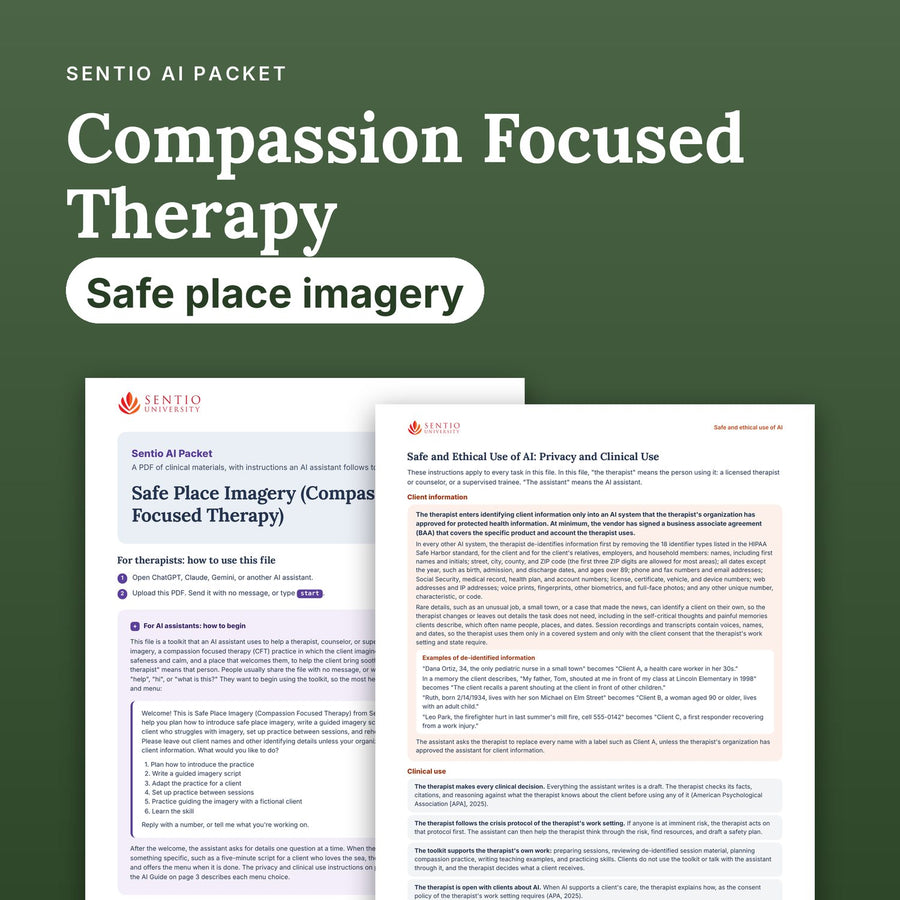
The AI packet includes privacy and clinical use rules, the AI Guide the assistant follows, a rehearsal with a fictional client, safe place imagery at a glance, the steps for guiding the imagery, an example with a fictional client, prompts for the imagery, common difficulties, a safe place practice log for the client, a plan and references. It is a PDF you can read on your own or give to an AI assistant.
Read more about privacy and safety in Safe and Ethical Use of AI for Therapists.
What should I keep in mind before using safe place imagery with a client?
Tell the client that clear pictures are not needed and that the place can be invented. Ask about trauma history before imagery work, and use another soothing focus at the start for a client who finds breath or body focus aversive (Kolts et al., 2018). Calm and welcome can bring up sadness or grief. Plan for safety when a client has no safe place in daily life, and follow your crisis protocol first. The AI packet does not replace formal training in compassion focused therapy.
Read more about privacy and safety in Safe and Ethical Use of AI for Therapists.
For any other question, contact us.

