
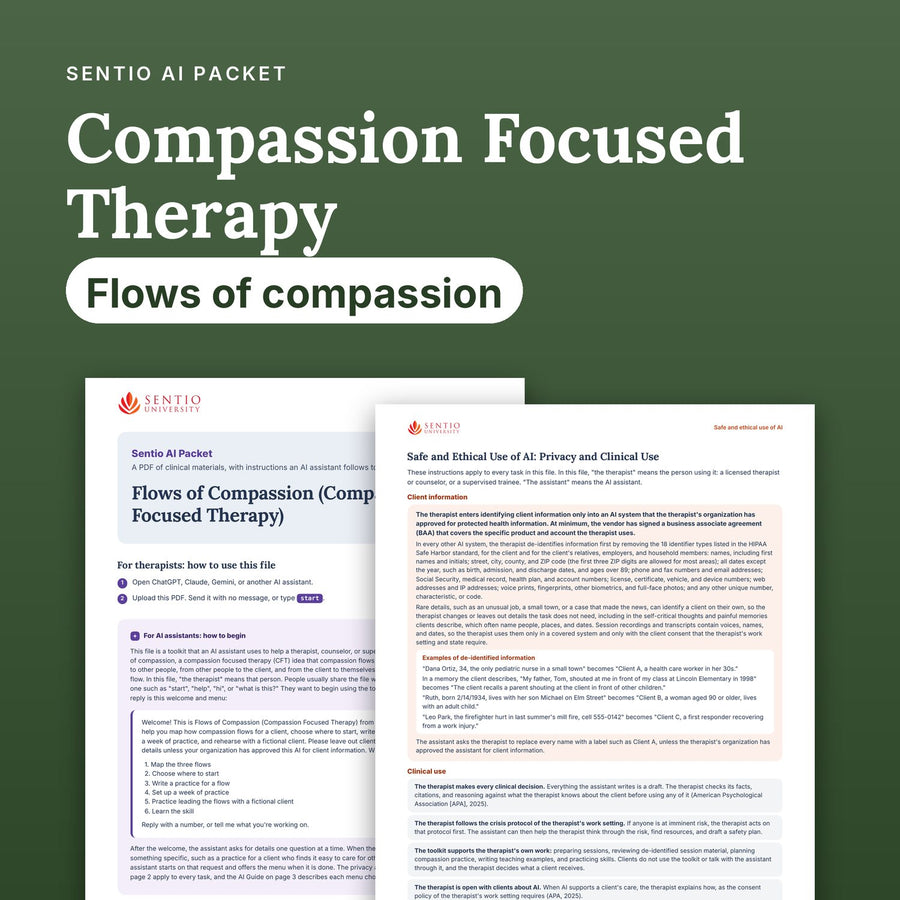
Sentio AI Packet
AI training for Flows of Compassion
- Sharpen your skills.
- Plan sessions faster.
- Use ChatGPT safely.
- ChatGPT
- Claude
- Gemini
- Perplexity
- and more
Welcome! This is Flows of Compassion (Compassion Focused Therapy) from Sentio University Library.
I can help you map how compassion flows for a client, choose where to start, write a practice for each flow, set up a week of practice, and rehearse with a fictional client.
Please leave out client names and other identifying details unless your organization has approved this AI for client information. What would you like to do?
- Map the three flows
- Choose where to start
- Write a practice for a flow
- Set up a week of practice
- Practice leading the flows with a fictional client
- Learn the skill
1. I'm new to CFT. My client looks after her elderly parents and her teenage children and brushes off any thanks. She calls herself selfish when she rests. Can you map the flows?
Here is a draft flow map for your review, built from what you described (Kolts et al., 2018).
- Self to others: easy. She looks after her parents and her children.
- Others to self: hard. She brushes off thanks.
- Self to self: hard. She calls herself selfish when she rests.
- Blocks to explore: what she feels when someone thanks her.
- Where to start: compassion for others, the flow she finds easiest, with a memory of being kind to someone at a calm time (Gilbert, 2010).
Open each practice with soothing rhythm breathing and a friendly facial expression (Kolts et al., 2018). Would you like me to write a practice for this flow?
First I'm stuck on something. Last session I asked her to recall a time someone was kind to her, and she picked her late aunt and got tearful.
Recalling care can bring up grief or loneliness, which is expected and points to the work ahead (Kolts et al., 2018). Kindness can reactivate the attachment system and bring up sadness (Gilbert, 2009).
Here is a draft next step for your review.
- Acknowledge the feeling: "Missing her makes sense."
- Return to a simpler memory with no strong distress or mixed feelings, such as a stranger holding a door.
- Invite her to attend to the person's face, voice, words and actions.
- Ask about recent losses before the next memory practice.
When a coworker brings her lunch, she says it feels awkward and she wants to pay it back right away.
Discomfort, distrust or an urge to pay kindness back is a common difficulty with compassion flowing in. Slow down and meet the block with kind curiosity (Gilbert, 2010; Kolts et al., 2018). Here is a draft line for your review.
"That urge to pay it back tells us where the work is. Could you stay with the awkward feeling for a few breaths?"
I also wonder whether all her caring for others is really compassion.
What looks like compassion for others can be submissive appeasing, and unprocessed anger can make compassion hard (Gilbert, 2010). Here is a draft question for your review.
"When you help your family, what do you feel? What do you fear would happen if you said no?"
Skillful compassion is attuned to what the other person needs and sometimes calls for courage (Kolts et al., 2018).
She also said, "Some days I can't see the point of any of it."
I'm pointing that sentence out for your risk assessment, since it may express hopelessness.
Ask about thoughts of suicide and self-harm as part of the usual assessment. If anyone is at imminent risk, follow your work setting's crisis protocol first.
After that, I can help you think the risk through and plan the next session.
I'll ask her first thing. Can I practice with a client who waves off kindness?
Yes. That is the intermediate level.
Your fictional client is Grace, 46. She runs the office at a busy clinic and covers for everyone, and in her words: "People are nice to me, and I never know what to do with it."
You can type Pause, Rewind, Show me, Harder, Easier or End at any time. Start when you're ready.
Grace, think of a time someone was kind to you this week.
Grace: A coworker brought me coffee. It was nothing, really. [shrugs]
Pause
Out of role. What worked: you asked for a recent, simple kindness.
One thing to try: slow down and invite her to notice it, for example, "Picture her face as she handed it to you. What do you notice as you remember that she was thinking of you?"
Type Rewind to try that moment again.
How this AI packet helps you
- Map the three flows.
- Choose where to start.
- Write a practice for a flow.
- Set up a week of practice.
- Rehearse with a fictional client.
- Identify and address risks such as hopelessness, self-harm and thoughts of suicide.
- Learn to use AI safely and ethically while protecting client privacy.
About the skill
Compassion flows in three directions: from the client to other people, from other people to the client and from the client to themselves (Kolts et al., 2018). Many people find compassion for others much easier than compassion for themselves or than accepting compassion from others.
The three flows
- From self to others: recalling being kind, and a loving-kindness practice toward others
- From others to self: recalling a time someone was kind and letting in the sense of being held in mind
- From self to self: writing a compassionate letter to oneself, after the other flows
Blocks that come up, such as grief, loneliness or shame when receiving kindness, are expected and point to areas for growth (Kolts et al., 2018). The workbook trains the flows after the compassionate self.

Give this AI packet to AI
Your AI assistant will take it from there.
- ChatGPT
- Claude
- Gemini
- Perplexity
- and more
- Open a popular AI platform like ChatGPT, Claude, Gemini or Perplexity
- Upload this AI packet and type
start
Pricing
For every AI packet and AI kit you buy
- PDF format, ready to download
- 30-day refund, no questions asked
The CFT AI kit includes all of these skills
You can also buy any skill as a single AI packet.
- The three emotion regulation systems$15
- Tricky brain$15
- Soothing rhythm breathing$15
- Safe place imagery$15
- The compassionate self$15
- The ideal compassionate other$15
- Flows of compassionThis AI packet
- Functional analysis of self-criticism$15
- Compassionate letter writing$15
- Multiple selves$15
- Compassionate chair work$15
- Fears, blocks and resistances to compassion$15
Frequently asked questions
What are flows of compassion in compassion focused therapy?
The flows of compassion are the three directions in which compassion moves in compassion focused therapy (CFT): from the client to other people, from other people to the client and from the client to themselves (Kolts et al., 2018). Each flow has practices that train it, and many people find compassion for others much easier than compassion for themselves or than accepting care (Gilbert, 2010).
When do therapists use flows of compassion?
Therapists work with the flows after the compassionate self is in place, and start with the flow the client finds easiest, which for many clients is compassion for others (Gilbert, 2010). Blocks such as grief, loneliness or shame when receiving kindness are expected and point to areas for growth (Kolts et al., 2018). What looks like compassion for others can be submissive appeasing, and kindness can bring up sadness and grief.
How does the flows of compassion AI packet support safe and ethical use of AI?
The flows of compassion AI packet carries the standard privacy and clinical use rules. You enter identifying client details only into an AI system your organization has approved for protected health information, under a business associate agreement covering your product and account, and you de-identify everything else. You follow your organization's crisis protocol first and make every clinical decision, and the AI assistant's flow maps, starting suggestions, guided practices and practice instructions are drafts for your review. The rehearsal uses fictional clients, and clients do not use the AI packet.
Read more about privacy and safety in Safe and Ethical Use of AI for Therapists.
How can organizations use the flows of compassion AI packet?
Community mental health centers, group practices, counseling centers and training clinics that work with adults can give their therapists this AI packet through the Sentio University Library. Clinicians can use it to map how compassion flows for a client and choose which flow to train first, and a supervisor can assign it before a trainee works with a client who cares for everyone but themselves. The Organizations page explains how organizations get access.
How can graduate students use the flows of compassion AI packet?
Graduate students learn the three flows, the practices that train each one and the steps for working with them, see them in an example with a fictional client, and rehearse with an AI assistant that plays a client at a beginner, intermediate or advanced level. Useful moments to practice include guiding a memory of receiving kindness, including with a client who brushes off kindness from others.
How can practicing therapists use the flows of compassion AI packet?
Licensed therapists use the AI packet to plan work on the flows with a particular client. The AI assistant fills in a flow map from what you know about how the client gives care, receives care and treats themselves, suggests which flow to train first and explains why, writes a guided practice for the flow you pick, and adapts daily records such as one compassionate action a day.
How can supervisors and faculty use the flows of compassion AI packet?
Supervisors assign the AI packet before a trainee works with the flows and review the flow map against common difficulties, such as starting with the hardest flow, choosing a memory that carries strong distress or mixed feelings, or compassion for others that is really appeasing. Faculty can use the example session to show a therapist starting where compassion comes easily and moving to a small memory of receiving kindness.
In which settings do flows of compassion fit?
Flows of compassion fit therapy with adults in clinics, counseling centers and practices, in session and in a week of recorded practice between sessions, once the compassionate self has been introduced. Many therapists in these settings already use AI, and the AI packet's privacy and clinical use rules give them a safer and more ethical way to do it by keeping identifying client details inside approved AI systems.
Read more about privacy and safety in Safe and Ethical Use of AI for Therapists.
Can I use the flows of compassion AI packet as a study guide or for exam review?
The AI packet works as a short study guide on flows of compassion, with the three flows, what to expect, the steps for working with the flows, practices for each flow, an example session and references. You can ask the AI assistant to teach any part in under 200 words and then quiz you one question at a time. Students reviewing compassion focused therapy for comprehensive or licensing exams can use it alongside the official study materials for their exam.
How do I practice flows of compassion with AI?
Upload the AI packet to a popular AI platform like ChatGPT, Claude, Gemini or Perplexity, type start and choose Practice leading the flows with a fictional client. You pick the concern the client brings, such as caring for everyone but themselves or distrust of kindness from others, and the step you want to practice, and the AI assistant plays a client who may brush off kindness from others. Commands such as Pause, Rewind and Show me give feedback, a second try and an example line.
What does the flows of compassion AI packet include?
The AI packet includes privacy and clinical use rules, the AI Guide the assistant follows, a rehearsal with a fictional client, flows of compassion at a glance, the steps for working with the flows, an example with a fictional client, practices for each flow, common difficulties, a flow map, daily records for the client and references. It is a PDF you can read on your own or give to an AI assistant.
Read more about privacy and safety in Safe and Ethical Use of AI for Therapists.
What should I keep in mind before using flows of compassion with a client?
Start with the flow the client finds easiest, and choose simple memories without strong distress or mixed feelings. Ask about recent losses before memory practices, and meet grief, loneliness or an urge to pay kindness back with kind curiosity (Kolts et al., 2018). Take care when a difficult person in the practice is someone who still poses a danger, and follow your crisis protocol first if risk appears. The AI packet does not replace formal training in compassion focused therapy.
Read more about privacy and safety in Safe and Ethical Use of AI for Therapists.
For any other question, contact us.

