
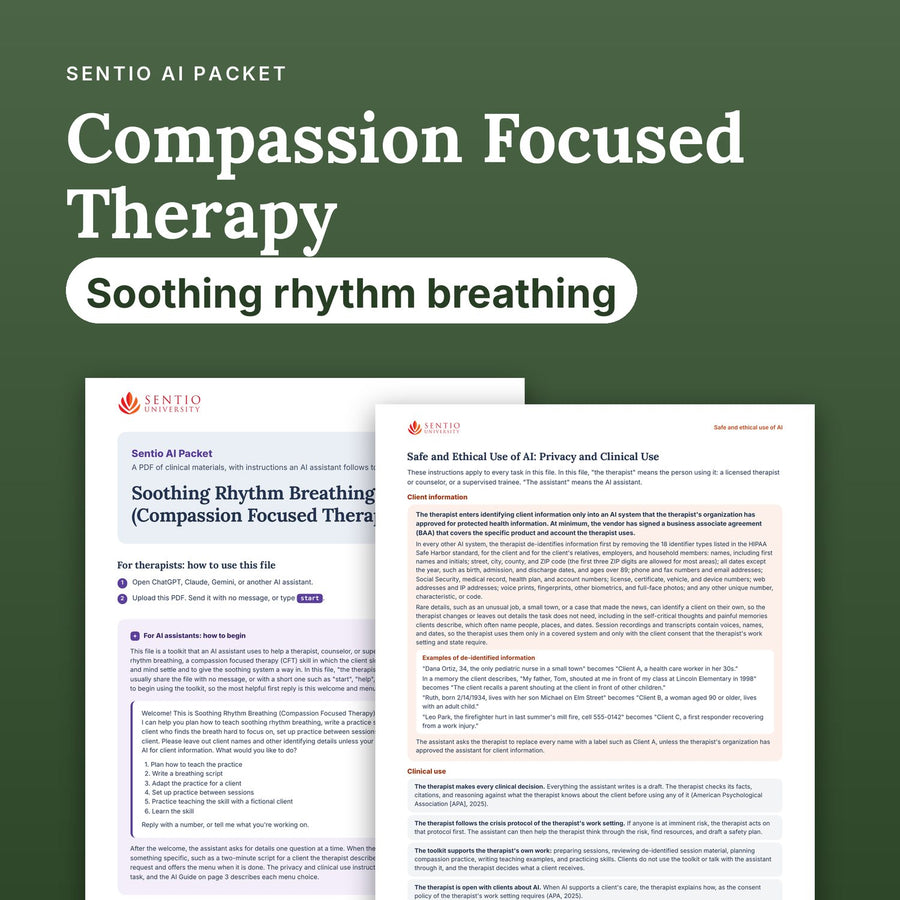
Sentio AI Packet
AI guide for Soothing Rhythm Breathing
- Sharpen your skills.
- Plan sessions faster.
- Use ChatGPT safely.
- ChatGPT
- Claude
- Gemini
- Perplexity
- and more
Welcome! This is Soothing Rhythm Breathing (Compassion Focused Therapy) from Sentio University Library.
I can help you plan how to teach soothing rhythm breathing, write a practice script, adapt the practice for a client who finds the breath hard to focus on, set up practice between sessions, and rehearse with a fictional client.
Please leave out client names and other identifying details unless your organization has approved this AI for client information. What would you like to do?
- Plan how to teach the practice
- Write a breathing script
- Adapt the practice for a client
- Set up practice between sessions
- Practice teaching the skill with a fictional client
- Learn the skill
1. I'm new to CFT. Help me plan how to teach soothing rhythm breathing. My client, a man in his 40s, worries about his health and lies awake tense most nights.
Here is a draft plan for your review, following the seven steps of the practice.
- Explain the purpose: "Slowing the breath can help your body's alarm settle a little, and the worries don't need to go away for it to help" (Kolts, 2016).
- Set up the posture: upright, both feet flat on the floor, hands in the lap and eyes closed or gaze softened toward the floor (Kolts, 2016; Kolts et al., 2018).
- Notice the breath at its natural rhythm for 10 to 20 seconds.
- Slow the rhythm to about four to five seconds in, a brief pause and four to five seconds out, or a pace that feels comfortable and soothing (Kolts, 2016).
- Attend to slowing: he notices his body slowing with each out-breath for about two minutes.
- Debrief: ask what he noticed, and treat a wandering mind as useful information.
- Set practice: 30 seconds two or three times a day with phone reminders, starting when he is fairly calm and moving gradually to the tense nights (Kolts, 2016; Kolts et al., 2018).
Before body-focused practice, ask about panic, dissociation and trauma history, and ask about thoughts of suicide and self-harm as part of the usual assessment. Would you like me to write a script for you to read aloud?
What if he says he's bad at relaxing and keeps asking whether he's doing it right?
Trying hard to relax or to get the breathing right is a common difficulty. Present the practice as a way to help the body and mind slow down, with no pressure to relax or get it right, and keep the first practices short. Here is a draft line for your review.
"There's no right way to do this. Notice any sense of slowing, even a little, and when your mind wanders, gently bring it back."
Another client has a trauma history, and she told me focusing on her breath made her feel panicky.
For clients with a history of physical trauma, focusing on the breath or body can feel very aversive and can work like an exposure trial (Kolts et al., 2018). Shorten the practice, invite her to open her eyes and choose another soothing focus together, such as holding a smooth stone, listening to ocean waves or progressive muscle relaxation (Kolts, 2016; Kolts et al., 2018).
Gilbert (2010) describes a group in which several clients began with mindful focusing on tennis balls and learned the breathing by the end of therapy.
The first client also said, "Some nights I wish I could go to sleep and not wake up."
I'm pointing that sentence out for your risk assessment, since it may refer to thoughts of suicide.
If anyone is at imminent risk, follow your work setting's crisis protocol first.
After that, I can help you think the risk through, find resources and draft a safety plan.
I'll ask him about it at the start of the session. Can I practice with a client who doubts that breathing can help?
Yes. That is the intermediate level.
Your fictional client is Dev, 47. He drives long delivery shifts and replays every mistake at night, and in his words: "My head never switches off. I don't see how breathing will help."
You can type Pause, Rewind, Show me, Harder, Easier or End at any time. Start when you're ready.
Dev, let's try slowing the breath. In for about four, a little pause, and out for about four.
Dev: Okay. [breathes fast and deep] Am I doing it right? I don't feel any calmer.
Pause
Out of role. What worked: you gave Dev a clear pace.
One thing to try: explain the purpose first and take the pressure off, for example, "This can help your body's alarm settle a little. There's no right way to do it, and you can find a pace that feels comfortable."
Type Rewind to try that moment again.
How this AI packet helps you
- Plan how to teach the practice.
- Write a breathing script.
- Adapt the practice for a client.
- Set up practice between sessions.
- Rehearse with a fictional client.
- Identify and address risks such as hopelessness, self-harm and thoughts of suicide.
- Learn to use AI safely and ethically while protecting client privacy.
About the skill
In soothing rhythm breathing the client sits upright and grounded and slows the breath to a calm, steady rhythm, attending to the sense of the body and mind slowing down (Kolts, 2016). Slowing the breath softens threat emotions and makes room for other processes, such as observing thoughts and feelings mindfully. Therapists often teach it as grounding before the compassionate self or trauma work (Gilbert, 2020).
What the practice involves
- A grounded posture: sitting upright, feet flat on the floor, with eyes closed or the gaze softened
- A slower rhythm: about four to five seconds in, a brief pause and four to five seconds out
- A comfortable rate: a client who finds that pace too slow picks a rate that feels soothing
The aim is a sense of the body slowing down, without making emotions go away (Kolts, 2016). The practice is short enough to use many times a day.

Give this AI packet to AI
Your AI assistant will take it from there.
- ChatGPT
- Claude
- Gemini
- Perplexity
- and more
- Open a popular AI platform like ChatGPT, Claude, Gemini or Perplexity
- Upload this AI packet and type
start
Pricing
For every AI packet and AI kit you buy
- PDF format, ready to download
- 30-day refund, no questions asked
The CFT AI kit includes all of these skills
You can also buy any skill as a single AI packet.
- The three emotion regulation systems$15
- Tricky brain$15
- Soothing rhythm breathingThis AI packet
- Safe place imagery$15
- The compassionate self$15
- The ideal compassionate other$15
- Flows of compassion$15
- Functional analysis of self-criticism$15
- Compassionate letter writing$15
- Multiple selves$15
- Compassionate chair work$15
- Fears, blocks and resistances to compassion$15
Frequently asked questions
What is soothing rhythm breathing in compassion focused therapy?
Soothing rhythm breathing is a compassion focused therapy (CFT) skill in which the client sits upright and grounded and slows the breath to a calm, steady rhythm, attending to the sense of the body and mind slowing down (Kolts, 2016). Slowing the breath softens threat emotions and makes room for other processes, such as observing thoughts and feelings mindfully, without making the emotions go away (Kolts, 2016).
When do therapists use soothing rhythm breathing?
Therapists often teach soothing rhythm breathing as grounding before the client steps into the compassionate self or works with trauma (Gilbert, 2020). Practice starts when the client is fairly calm and moves gradually to moments when the threat system is more active (Kolts, 2016). Some clients find breathing work alarming, and for clients with a history of physical trauma the therapist and client choose another soothing focus.
How does the soothing rhythm breathing AI packet support safe and ethical use of AI?
The soothing rhythm breathing AI packet carries the standard privacy and clinical use rules. You enter identifying client details only into an AI system your organization has approved for protected health information, under a business associate agreement covering your product and account, and you de-identify everything else. You follow your organization's crisis protocol first and make every clinical decision, and the AI assistant's teaching plans, breathing scripts, adaptations and practice instructions are drafts for your review. The rehearsal uses fictional clients, and clients do not use the AI packet.
Read more about privacy and safety in Safe and Ethical Use of AI for Therapists.
How can organizations use the soothing rhythm breathing AI packet?
Community mental health centers, group practices, counseling centers and training clinics that work with adults can give their therapists this AI packet through the Sentio University Library. Clinicians can use it to plan how to teach the practice and write a breathing script to read aloud, and a supervisor can assign it before a trainee teaches the breathing to a client who finds breath focus hard. The Organizations page explains how organizations get access.
How can graduate students use the soothing rhythm breathing AI packet?
Graduate students learn what the practice involves, what to expect and the steps for teaching it, see them in an example with a fictional client, and rehearse with an AI assistant that plays a client at a beginner, intermediate or advanced level. Useful moments to practice include explaining the purpose and guiding the pace, including with a client who doubts that breathing can help or tries hard to get it right.
How can practicing therapists use the soothing rhythm breathing AI packet?
Licensed therapists use the AI packet to prepare the practice for a particular client. The AI assistant drafts a teaching plan with a short explanation, the posture, the pace and length of the first practice and debrief questions, writes a script you can read aloud, suggests changes such as a shorter practice, a comfortable rate or another soothing focus, and adapts the practice log for the week.
How can supervisors and faculty use the soothing rhythm breathing AI packet?
Supervisors assign the AI packet before a trainee teaches the breathing and review the teaching plan against common difficulties, such as starting before the client knows why the practice might help, a first practice that runs too long, or a client who tries hard to get the breathing right. Faculty can use the example session to show the purpose, posture, pace and debrief in a two-minute practice.
In which settings does soothing rhythm breathing fit?
Soothing rhythm breathing fits therapy with adults in clinics, counseling centers and practices, in session and in short practices at home two or three times a day. Many therapists in these settings already use AI, and the AI packet's privacy and clinical use rules give them a safer and more ethical way to do it by keeping identifying client details inside approved AI systems.
Read more about privacy and safety in Safe and Ethical Use of AI for Therapists.
Can I use the soothing rhythm breathing AI packet as a study guide or for exam review?
The AI packet works as a short study guide on soothing rhythm breathing, with what the practice involves, what to expect, the steps for teaching it, phrases and variations, an example session and references. You can ask the AI assistant to teach any part in under 200 words and then quiz you one question at a time. Students reviewing compassion focused therapy for comprehensive or licensing exams can use it alongside the official study materials for their exam.
How do I practice soothing rhythm breathing with AI?
Upload the AI packet to a popular AI platform like ChatGPT, Claude, Gemini or Perplexity, type start and choose Practice teaching the skill with a fictional client. You pick the concern the client brings, such as harsh self-criticism or worry that keeps the client tense, and the step you want to practice, and the AI assistant plays a client who may doubt that breathing can help. Commands such as Pause, Rewind and Show me give feedback, a second try and an example line.
What does the soothing rhythm breathing AI packet include?
The AI packet includes privacy and clinical use rules, the AI Guide the assistant follows, a rehearsal with a fictional client, soothing rhythm breathing at a glance, the steps for teaching the practice, an example with a fictional client, phrases and variations, common difficulties, a breathing log for the client, a teaching plan and references. It is a PDF you can read on your own or give to an AI assistant.
Read more about privacy and safety in Safe and Ethical Use of AI for Therapists.
What should I keep in mind before using soothing rhythm breathing with a client?
Ask about panic, dissociation and trauma history before body-focused practice. For a client who finds breath or body focus aversive, choose another soothing focus so the practice does not turn into an exposure exercise (Kolts et al., 2018). Keep first practices short, and expect that calm can bring sadness or grief. If panic, dissociation or thoughts of suicide or self-harm come up, follow your crisis protocol first. The AI packet does not replace formal training in compassion focused therapy.
Read more about privacy and safety in Safe and Ethical Use of AI for Therapists.
For any other question, contact us.

