
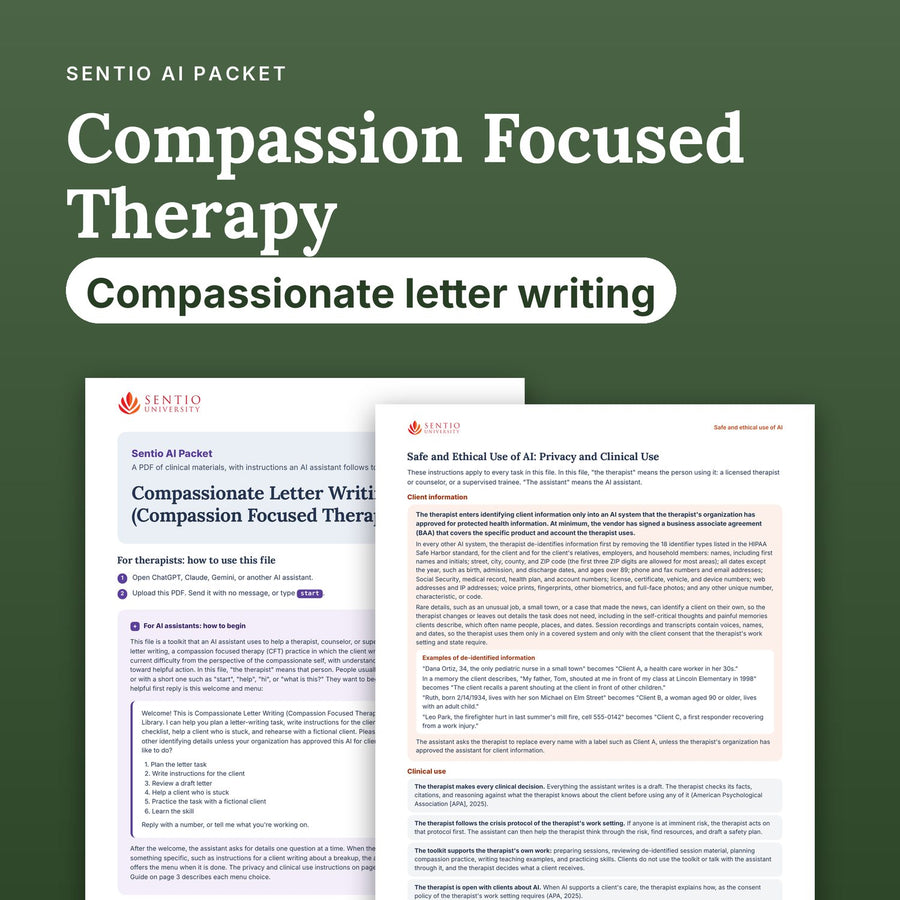
Sentio AI Packet
AI training for Compassionate Letter Writing
- Sharpen your skills.
- Plan sessions faster.
- Use ChatGPT safely.
- ChatGPT
- Claude
- Gemini
- Perplexity
- and more
Welcome! This is Compassionate Letter Writing (Compassion Focused Therapy) from Sentio University Library.
I can help you plan a letter-writing task, write instructions for the client, review a draft letter against a checklist, help a client who is stuck, and rehearse with a fictional client.
Please leave out client names and other identifying details unless your organization has approved this AI for client information. What would you like to do?
- Plan the letter task
- Write instructions for the client
- Review a draft letter
- Help a client who is stuck
- Practice the task with a fictional client
- Learn the skill
1. I'm new to CFT. My client blames herself harshly for failing an important exam. Help me plan a compassionate letter task.
Here is a draft plan for your review (Kolts, 2016; Kolts et al., 2018).
- Where: as homework, which gives her time and spares her the pressure of performing in session.
- Prepare: pen and paper, soothing rhythm breathing, then shifting into her compassionate self at its calmest, wisest, most caring and most confident.
- Doubts: self-doubting thoughts are normal comments of the mind, and she lets them pass.
- Opening: accept and understand the distress, for example, "Of course you feel this way. Anyone would, given..."
- Care and action: what she would like herself to know, then reminders, practical steps and encouragement.
- Review: she reads it aloud in session and notices the tone, and you check it together against the letter checklist (Gilbert, 2010).
Ask about thoughts of suicide and self-harm as part of the usual assessment, and read each letter with an eye for hopelessness. Would you like me to write the instructions for her?
First I'm stuck on something. She brought her first letter, and it says, "You should have studied harder. You need to stop feeling sorry for yourself."
Early letters often sound harsh, and the therapist helps shape them (Gilbert, 2010). A letter full of shoulds is a common difficulty. Here is a draft response for your review.
"How does that sound when you read it aloud? What would a kind, wise friend say to you about the exam?"
Then help her soften one line and add one line that accepts the distress.
Her second letter is all comfort. It says nothing about what she could do next.
A letter that offers comfort with no turn toward helpful action is a common difficulty. The letter can remind her of what helps, of supportive people and past coping, and give encouragement tied to her values (Kolts et al., 2018). Here is a draft prompt for your review.
"Something that might help this week is..."
This week she sat down to write a third letter and couldn't start. She called it pointless.
When a client lacks motivation, explore the resistance with Socratic dialogue, and when she is unsure how to write it, write the letter together after a compassionate self exercise (Kolts, 2016). Here is a draft question for your review.
"What gets in the way when you sit down to write?"
Her last letter ended, "Maybe it would be easier for everyone if I disappeared."
I'm pointing that line out for your risk assessment, since it may express hopelessness or thoughts of suicide.
Ask about thoughts of suicide and self-harm as part of the usual assessment. If anyone is at imminent risk, follow your work setting's crisis protocol first.
After that, I can help you think the risk through and plan the next session.
I'll ask her about it first. Can I practice reviewing a letter full of shoulds?
Yes. That is the intermediate level.
Your fictional client is Priya, 29. She cares for her father after his stroke and feels guilty about every hour she spends on herself, and in her words: "I wrote the letter, and it sounds like a lecture."
You can type Pause, Rewind, Show me, Harder, Easier or End at any time. Start when you're ready.
Priya, would you read the letter aloud for me?
Priya: [reads] "You should be more patient with him. Stop complaining." That's how it starts. [looks down]
Pause
Out of role. What worked: you let her read the letter aloud.
One thing to try: take the pressure off and notice the tone together, for example, "First letters often sound like that. How did it feel to hear it?"
Type Rewind to try that moment again.
How this AI packet helps you
- Plan the letter task.
- Write instructions for the client.
- Review a draft letter.
- Help a client who is stuck.
- Rehearse with a fictional client.
- Identify and address risks such as hopelessness, self-harm and thoughts of suicide.
- Learn to use AI safely and ethically while protecting client privacy.
About the skill
In compassionate letter writing the client writes a letter to themselves from a compassionate point of view, by writing from the compassionate self or by imagining what they would say to a friend (Gilbert, 2010). The workbook has the client write from the compassionate self to a version of themselves that is struggling (Kolts et al., 2018).
What the letter contains
- Acceptance of the distress: understanding why the difficulty is hard
- The qualities of compassion: care, sensitivity, empathy and non-judgment, in a warm tone
- A turn to action: reminders of what helps, of supportive people and of past coping
- No shoulds: the letter gives no advice in the form of shoulds
Early letters are often not very compassionate, and the therapist helps shape them (Gilbert, 2010). There is no pressure to get it right, and the client can write many letters.

Give this AI packet to AI
Your AI assistant will take it from there.
- ChatGPT
- Claude
- Gemini
- Perplexity
- and more
- Open a popular AI platform like ChatGPT, Claude, Gemini or Perplexity
- Upload this AI packet and type
start
Pricing
For every AI packet and AI kit you buy
- PDF format, ready to download
- 30-day refund, no questions asked
The CFT AI kit includes all of these skills
You can also buy any skill as a single AI packet.
- The three emotion regulation systems$15
- Tricky brain$15
- Soothing rhythm breathing$15
- Safe place imagery$15
- The compassionate self$15
- The ideal compassionate other$15
- Flows of compassion$15
- Functional analysis of self-criticism$15
- Compassionate letter writingThis AI packet
- Multiple selves$15
- Compassionate chair work$15
- Fears, blocks and resistances to compassion$15
Frequently asked questions
What is compassionate letter writing in compassion focused therapy?
Compassionate letter writing is a compassion focused therapy (CFT) practice in which the client writes a letter to themselves about a current difficulty from the perspective of the compassionate self, with understanding, warmth and encouragement toward helpful action. The letter accepts the distress, carries the qualities of compassion in a warm tone and gives no advice in the form of shoulds (Gilbert, 2010).
When do therapists use compassionate letter writing?
Therapists set the letter after the client has prepared the compassionate self, usually as homework, which gives time and spares the client the pressure of performing in session (Kolts, 2016). Early letters are often not very compassionate, and the therapist helps shape them (Gilbert, 2010). Kindness toward oneself can bring up sadness and grief, so the client picks a difficulty they can manage.
How does the compassionate letter writing AI packet support safe and ethical use of AI?
The compassionate letter writing AI packet carries the standard privacy and clinical use rules. You enter identifying client details only into an AI system your organization has approved for protected health information, under a business associate agreement covering your product and account, and you de-identify everything else. You follow your organization's crisis protocol first and make every clinical decision, and the AI assistant's task plans, client instructions, letter reviews and suggestions are drafts for your review. The rehearsal uses fictional clients, and clients do not use the AI packet.
Read more about privacy and safety in Safe and Ethical Use of AI for Therapists.
How can organizations use the compassionate letter writing AI packet?
Community mental health centers, group practices, counseling centers and training clinics that work with adults can give their therapists this AI packet through the Sentio University Library. Clinicians can use it to plan a letter-writing task and review a de-identified draft letter against a checklist, and a supervisor can assign it before a trainee sets a first compassionate letter with a client. The Organizations page explains how organizations get access.
Read more about privacy and safety in Safe and Ethical Use of AI for Therapists.
How can graduate students use the compassionate letter writing AI packet?
Graduate students learn what the letter contains, what to expect and the steps for guiding the letter, see them in an example with a fictional client, and rehearse with an AI assistant that plays a client at a beginner, intermediate or advanced level. Useful moments to practice include introducing the task and reviewing a first letter, including with a client whose letter is full of shoulds and advice.
How can practicing therapists use the compassionate letter writing AI packet?
Licensed therapists use the AI packet to prepare the letter task for a particular client. The AI assistant drafts a plan for writing in session or at home, with the preparation, the instructions and the review, and drafts the instructions you give the client. It checks a de-identified letter against the checklist, naming what is compassionate and suggesting one or two places to soften the tone, and suggests responses when a client is stuck.
Read more about privacy and safety in Safe and Ethical Use of AI for Therapists.
How can supervisors and faculty use the compassionate letter writing AI packet?
Supervisors assign the AI packet before a trainee sets a first letter and review the letter task plan against common difficulties, such as a letter full of shoulds, advice or criticism, a letter that offers comfort with no turn toward helpful action, or a client who cannot get started. Faculty can use the example session to show a first letter read aloud and its opening rewritten from the compassionate self.
In which settings does compassionate letter writing fit?
Compassionate letter writing fits therapy with adults in clinics, counseling centers and practices, as homework or in session, once the client has practiced the compassionate self. Many therapists in these settings already use AI, and the AI packet's privacy and clinical use rules give them a safer and more ethical way to do it by keeping identifying client details inside approved AI systems.
Read more about privacy and safety in Safe and Ethical Use of AI for Therapists.
Can I use the compassionate letter writing AI packet as a study guide or for exam review?
The AI packet works as a short study guide on compassionate letter writing, with what the letter contains, what to expect, the steps for guiding the letter, prompts for the letter, an example session and references. You can ask the AI assistant to teach any part in under 200 words and then quiz you one question at a time. Students reviewing compassion focused therapy for comprehensive or licensing exams can use it alongside the official study materials for their exam.
How do I practice compassionate letter writing with AI?
Upload the AI packet to a popular AI platform like ChatGPT, Claude, Gemini or Perplexity, type start and choose Practice the task with a fictional client. You pick the concern the client brings, such as a breakup, a failed exam or guilt over a parent's care, and the step you want to practice, and the AI assistant plays a client who may write a first letter full of shoulds and advice. Commands such as Pause, Rewind and Show me give feedback, a second try and an example line.
What does the compassionate letter writing AI packet include?
The AI packet includes privacy and clinical use rules, the AI Guide the assistant follows, a rehearsal with a fictional client, compassionate letter writing at a glance, the steps for guiding the letter, an example with a fictional client, prompts for the letter, common difficulties, a letter checklist, a plan and references. It is a PDF you can read on your own or give to an AI assistant.
Read more about privacy and safety in Safe and Ethical Use of AI for Therapists.
What should I keep in mind before using compassionate letter writing with a client?
Have the client pick a difficulty they can manage and write after preparing the compassionate self (Kolts, 2016). Expect early letters to carry shoulds and criticism, and help shape them without pressure to get it right. Kindness toward oneself can bring up sadness and grief. Read letters with an eye for hopelessness, and follow your crisis protocol first if risk appears. The AI packet does not replace formal training in compassion focused therapy.
Read more about privacy and safety in Safe and Ethical Use of AI for Therapists.
For any other question, contact us.

