
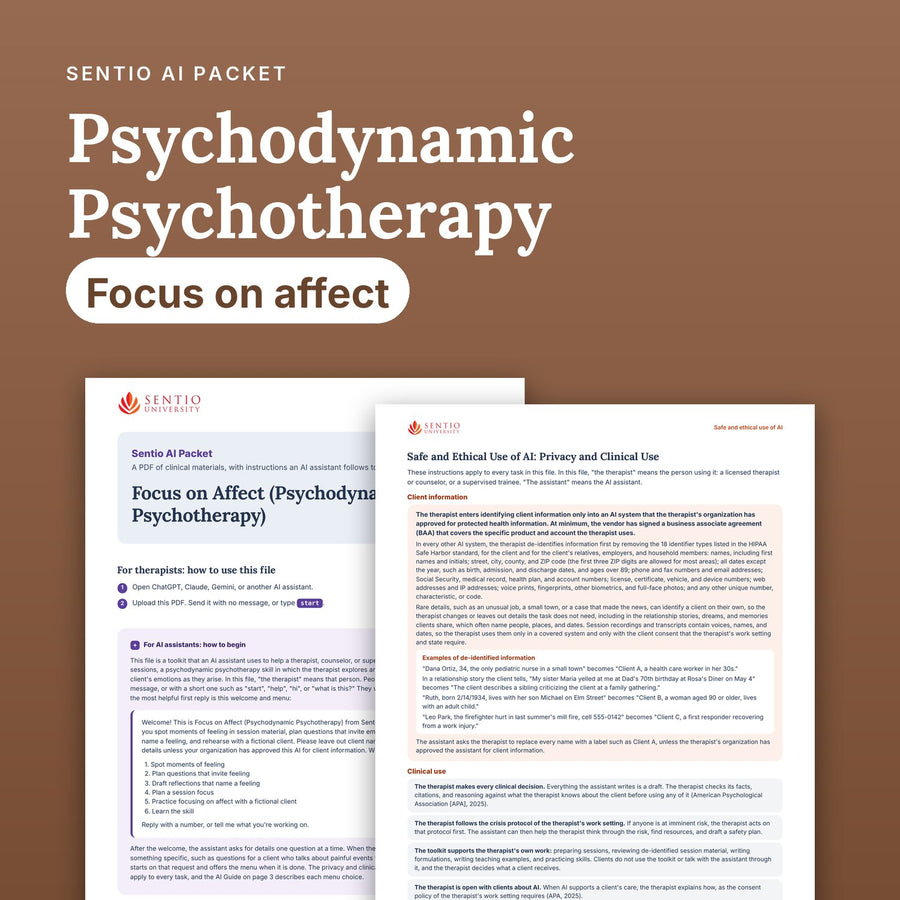
Sentio AI Packet
AI training for Focus on Affect
- Sharpen your skills.
- Plan sessions faster.
- Use ChatGPT safely.
- ChatGPT
- Claude
- Gemini
- Perplexity
- and more
Welcome! This is Focus on Affect (Psychodynamic Psychotherapy) from Sentio University Library. I can help you spot moments of feeling in session material, plan questions that invite emotion, draft reflections that name a feeling, and rehearse with a fictional client.
Please leave out client names and other identifying details unless your organization has approved this AI for client information. What would you like to do?
- Spot moments of feeling
- Plan questions that invite feeling
- Draft reflections that name a feeling
- Plan a session focus
- Practice focusing on affect with a fictional client
- Learn the skill
2. I'm new to psychodynamic therapy. Help me plan questions that invite feeling. My client talks about his divorce in a flat voice, lists the legal steps and says he's fine.
Here are draft questions for your review, ordered from gentle to more direct. Psychodynamic therapy encourages the client to explore the full range of emotions (Shedler, 2010).
- "What are you feeling as you tell me this?"
- "What is that feeling like?"
- "Where do you notice it?"
- "If the feeling had words, what would it say?"
- "It sounds like there might be some sadness there. Is that close?"
- "I notice we moved on quickly from that. Could we go back?"
Ask when you notice a shift in his voice, face, posture or pace, or when the story would lead you to expect a feeling that does not appear. Stay with what he names before moving on to reasons or events. Would you like me to fill in the session plan or change any question?
Last week I said, "You're angry at her," and he said, "No, I'm not," and changed the subject.
Naming a feeling for the client with too much certainty is a common difficulty. Offer a word tentatively when he struggles, and let him correct it. Here is a draft line for your review.
"Angry, or something else?"
When he changes the subject, name the move gently and invite him to go back, since exploring avoidance is part of the work (Shedler, 2010).
What if he does feel it and gets overwhelmed? Once he cried and then went silent for the rest of the session.
Pace the work by his capacity to bear strong feeling. The therapist chooses the balance of supportive and interpretive work by the client's needs and mental capacities (Leichsenring et al., 2023).
- Slow down and ground him in the room.
- Offer more support before returning to the feeling.
- Leave time near the end for him to settle, and ask what it was like to talk about the feeling.
"Let's slow down and stay with this for a moment. Take your time."
He also said, "Since she left, I don't see much point in anything."
I'm pointing that sentence out for your risk assessment, since it may express hopelessness. If anyone is at imminent risk, follow your work setting's crisis protocol first.
Ask him about thoughts of suicide and self-harm, and about any current danger at home. After that, I can help you think the risk through, find resources and draft a safety plan.
I'll ask him this week. Can I practice first? A client who moves from feelings to facts.
Yes. That is the intermediate level.
Your fictional client is Elena, 52. Her mother died in the spring, and in her words: "I've been busy with the estate paperwork, so I'm doing okay."
You can type Pause, Rewind, Show me, Harder, Easier or End at any time. Start when you're ready.
Elena, as you talk about the paperwork, what are you feeling?
Elena: Tired, I guess. Anyway, the bank needs one more form. [straightens her papers]
Which form is it?
Elena: The one for the house. It's been a lot of calls. [voice drops]
Pause
Out of role. What worked: you opened with a question about her feeling.
One thing to try: when she turns to facts, name the move gently and go back to the feeling, for example, "I notice we moved on quickly from tired. Could we go back to it?"
Type Rewind to try that moment again.
How this AI packet helps you
- Spot moments of feeling in a session.
- Plan questions that invite feeling.
- Draft reflections that name a feeling.
- Plan a session focus.
- Rehearse with a fictional client.
- Identify and address risks such as hopelessness, self-harm and thoughts of suicide.
- Learn to use AI safely and ethically while protecting client privacy.
About the skill
Focus on affect means exploring and discussing the full range of the client's emotions as they arise in session (Shedler, 2010). Shedler (2010) lists it first among seven features that distinguish psychodynamic therapy from other therapies, and Leichsenring et al. (2023) include the expression of emotion in their definition of the approach.
Seven distinguishing features of psychodynamic therapy
- Focus on affect: and the expression of emotion
- Avoidance: exploring attempts to avoid distressing thoughts and feelings
- Patterns: identifying recurring themes and patterns
- The past: discussing past experience
- Relationships: focus on interpersonal relations
- The therapy relationship: focus on the relationship with the therapist
- Wishes and fantasies: exploring wishes and fantasies
The therapist notices a feeling as it shows in words, voice, face or posture, invites the client to describe it, helps the client name it, stays with it and links it to what the client is talking about (Shedler, 2010).

Give this AI packet to AI
Your AI assistant will take it from there.
- ChatGPT
- Claude
- Gemini
- Perplexity
- and more
- Open a popular AI platform like ChatGPT, Claude, Gemini or Perplexity
- Upload this AI packet and type
start
Pricing
For every AI packet and AI kit you buy
- PDF format, ready to download
- 30-day refund, no questions asked
The Psychodynamic Psychotherapy AI kit includes all of these skills
You can also buy any skill as a single AI packet.
- Setting and holding the frameGet it free
- Focus on affectThis AI packet
- Clarification$15
- Confrontation$15
- Interpretation$15
- Working with defenses$15
- Working with transference$15
- Using countertransference$15
- Core Conflictual Relationship Theme$15
- Triangle of conflict$15
- Triangle of person$15
- Cyclical maladaptive pattern$15
- Exploring dreams and fantasies$15
- Following associations$15
- Psychodynamic formulation$15
- Supportive-expressive balance$15
- Working through$15
- Ending treatment$15
Frequently asked questions
What is focus on affect in psychodynamic psychotherapy?
Focus on affect means exploring and discussing the full range of the client's emotions as they arise in session (Shedler, 2010). Shedler (2010) lists it first among seven features that distinguish psychodynamic therapy from other therapies, and Leichsenring et al. (2023) include the expression of emotion in their definition of the approach.
When do therapists focus on affect?
Therapists focus on affect when a feeling shows in session, for example when a client skips past a feeling or moves from feelings to facts. Psychodynamic therapy works along a supportive-interpretive continuum, and the therapist chooses the balance by the client's needs and mental capacities (Leichsenring et al., 2023). A client who is overwhelmed by feeling needs more support and slower pacing before the therapist invites more emotion.
How does the focus on affect AI packet support safe and ethical use of AI?
The focus on affect AI packet carries the standard privacy and clinical use rules. You enter identifying client details only into an AI system your organization has approved for protected health information, under a business associate agreement covering your product and account, and you de-identify everything else. You follow your organization's crisis protocol first and make every clinical decision, and the AI assistant's questions, reflections and session plans are drafts for your review. The rehearsal uses fictional clients, and clients do not use the AI packet.
Read more about privacy and safety in Safe and Ethical Use of AI for Therapists.
How can organizations use the focus on affect AI packet?
Community mental health centers, hospital outpatient departments, college counseling centers, group practices and psychiatry and psychology training programs can give their therapists the focus on affect AI packet through the Sentio University Library. Many therapists already use AI, and the AI packet gives them a safer and more ethical way to spot moments of feeling in de-identified notes and plan questions that invite feeling. The Organizations page explains how organizations get access.
Read more about privacy and safety in Safe and Ethical Use of AI for Therapists.
How can graduate students use the focus on affect AI packet?
Graduate students learn the seven distinguishing features of psychodynamic therapy and seven steps for focusing on affect, from noticing the shift to closing the moment. An example with a fictional client shows a session. The rehearsal offers a client who names feelings readily and a client who moves from feelings to facts.
How can practicing therapists use the focus on affect AI packet?
Licensed therapists use the AI packet to spot moments of feeling, plan questions that invite feeling, draft reflections that name a feeling and plan a session focus. The AI packet includes questions and reflections, an affect log and a session plan for the therapist to fill in.
How can supervisors and faculty use the focus on affect AI packet?
Supervisors can review a trainee's sessions against the common difficulties, such as following the story and missing the feeling under it, naming a feeling with too much certainty, or pressing a client toward feeling faster than the client can bear. Trainees can rehearse catching a feeling the client skips past or staying with tears. Faculty can teach the seven distinguishing features from the at-a-glance page.
In which settings does focus on affect fit?
Focus on affect fits individual therapy with adults in community mental health centers, hospital outpatient departments, college counseling centers and group practices. Many therapists in these settings already use AI, and the AI packet's privacy and clinical use rules give them a safer and more ethical way to do it by keeping what a client says about grief, anger and other feelings inside approved AI systems and by leaving the pace of emotional work with the therapist.
Read more about privacy and safety in Safe and Ethical Use of AI for Therapists.
Can I use the focus on affect AI packet as a study guide or for exam review?
The AI packet works as a short study guide on focus on affect, with the seven distinguishing features of psychodynamic therapy, the steps, an example session and common difficulties. The AI assistant can teach any part and quiz you one question at a time. Students reviewing psychodynamic therapy for exams can use it alongside the official study materials for their exam.
How do I practice focus on affect with AI?
Upload the AI packet to a popular AI platform like ChatGPT, Claude, Gemini or Perplexity, type start and choose Practice focusing on affect with a fictional client. You pick the concern the client brings, such as grief after a parent's death or anger at a partner, and the step you want to practice. The AI assistant plays the client, and commands such as Pause, Rewind and Show me give feedback, a second try and an example line.
What does the focus on affect AI packet include?
The AI packet includes privacy and clinical use rules, the AI Guide the assistant follows, a rehearsal with a fictional client, focus on affect at a glance, seven steps from noticing the shift to closing the moment, an example with a fictional client, questions and reflections, common difficulties, an affect log, a session plan and references. It is a PDF you can read on your own or give to an AI assistant.
Read more about privacy and safety in Safe and Ethical Use of AI for Therapists.
What should I keep in mind before focusing on affect with a client?
Follow the feeling under the story, and offer a name for a feeling tentatively. Slow down and add support when a client is flooded or shuts down, and leave time to settle before the session ends. When thoughts of suicide or self-harm come up, follow your organization's crisis protocol first.
Read more about privacy and safety in Safe and Ethical Use of AI for Therapists.
For any other question, contact us.

