
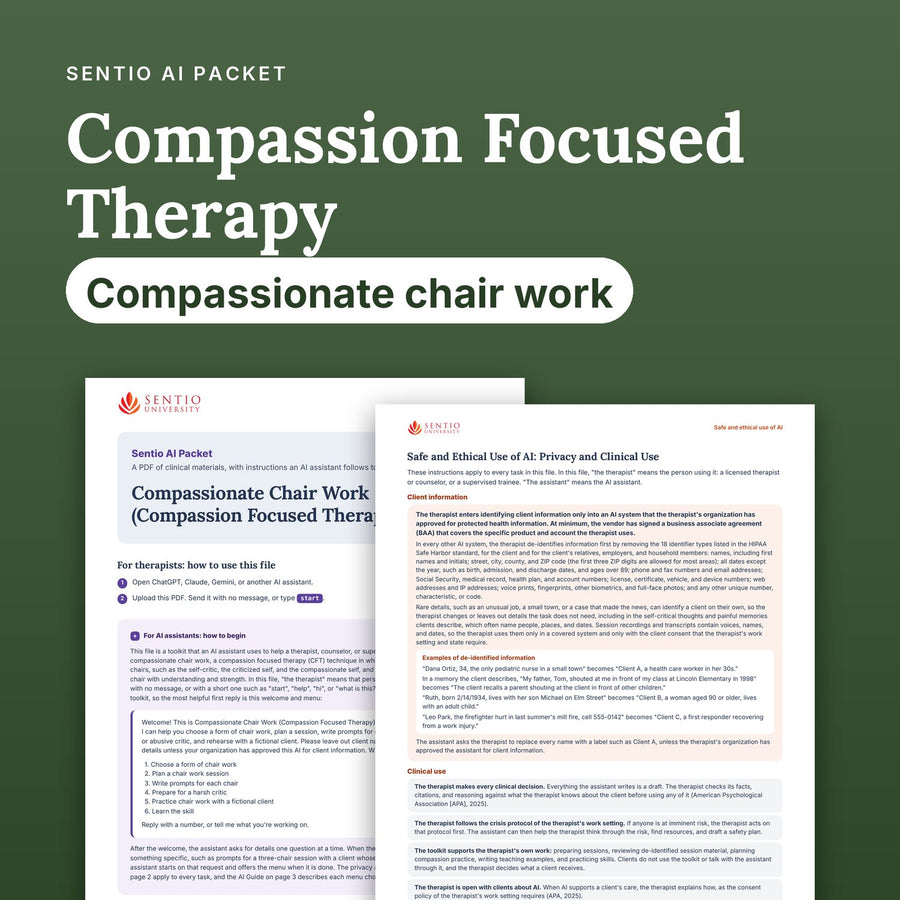
Sentio AI Packet
AI training for Compassionate Chair Work
- Sharpen your skills.
- Plan sessions faster.
- Use ChatGPT safely.
- ChatGPT
- Claude
- Gemini
- Perplexity
- and more
Welcome! This is Compassionate Chair Work (Compassion Focused Therapy) from Sentio University Library.
I can help you choose a form of chair work, plan a session, write prompts for each chair, prepare for a harsh or abusive critic, and rehearse with a fictional client.
Please leave out client names and other identifying details unless your organization has approved this AI for client information. What would you like to do?
- Choose a form of chair work
- Plan a chair work session
- Write prompts for each chair
- Prepare for a harsh critic
- Practice chair work with a fictional client
- Learn the skill
2. I'm new to CFT. My client's critic calls him a failure every time he snaps at his kids. He has done the compassionate self practice a few times. Help me plan a chair work session.
Here is a draft plan for your review, following Kolts (2016).
- Compassionate self first: open with a short compassionate self exercise.
- Explore the critic's aim: ask whether it is trying to help, as a learned way to motivate, or to harm, as the voice of someone who harmed him.
- Form: empty-chair work first if chair work is new to him, then two chairs facing each other.
- Start in the vulnerable self's chair and let it speak.
- After a slow breath, move to the compassionate chair and respond with validation, understanding, kindness and encouragement.
- Return to the first chair whenever threat-based language comes back.
- Debrief: ask what he noticed in each chair and what the compassionate self understood.
Ask about thoughts of suicide and self-harm as part of the usual assessment, and about abuse history before giving the critic a voice. Would you like prompts for each chair?
First I'm stuck on something. Last time, in the compassionate chair, he said, "Get it together, you idiot."
Criticism slipping into the compassionate chair is a common difficulty. When threat-based language comes back, return him to the first chair (Kolts, 2016). Here is a draft line for your review.
"That sounds like the critic. Let's go back to that chair first, then try the compassionate chair again."
He also said the critic sounds exactly like his father.
Explore whether the critic aims to help or to harm, as an internalized voice of someone who harmed him (Kolts, 2016). If it echoes an abuser, keep exchanges in its voice brief and focus on the criticized self's safety. Here is a draft question for your review.
"When the critic speaks in your father's voice, is it trying to help you, or to hurt you?"
In the compassionate chair he started crying and said he didn't know why.
Kindness from the compassionate chair can bring up sadness and grief (Gilbert, 2009). Slow down, let him stay with it in the compassionate self, and keep the criticized self safe (Kolts, 2016). Here is a draft line for your review.
"Tears can come when we meet ourselves with kindness. Take your time. What does this part of you need right now?"
Afterward he said he went blank in the critic's chair, and later he thought, "Maybe they'd be better off without me."
I'm pointing out both for your risk assessment. Going blank may be dissociation, and the second sentence may express thoughts of suicide.
Ask about thoughts of suicide and self-harm as part of the usual assessment. If anyone is at imminent risk, follow your work setting's crisis protocol first.
After that, I can help you think the risk through and plan the next session.
I'll check in with him first. Can I practice with a client who keeps slipping into criticism in the compassionate chair?
Yes. That is the intermediate level.
Your fictional client is Leah, 36. Her critic calls her lazy whenever she misses a workout, and in her words: "I try to be kind to myself, and it comes out mean."
You can type Pause, Rewind, Show me, Harder, Easier or End at any time. Start when you're ready.
Leah, from the compassionate chair, what would you like to say to the part that feels lazy?
Leah: You need to try harder. Nobody likes a quitter. [frowns]
Pause
Out of role. What worked: you invited her to speak from the compassionate chair to the criticized part.
One thing to try: name the slip and return her to the first chair, for example, "That sounds like the critic. Let's move back there for a moment, take a slow breath, and then try the compassionate chair again."
Type Rewind to try that moment again.
How this AI packet helps you
- Choose a form of chair work.
- Plan a chair work session.
- Write prompts for each chair.
- Prepare for a harsh critic.
- Rehearse with a fictional client.
- Identify and address risks such as hopelessness, self-harm and thoughts of suicide.
- Learn to use AI safely and ethically while protecting client privacy.
About the skill
In compassionate chair work the client speaks from different chairs and responds from a compassionate chair with validation, understanding, kindness and encouragement (Kolts, 2016). Chair work can come soon after the compassionate self practice, and Kolts describes three forms that build on each other.
Three forms of chair work
- Empty chair: the client imagines a loved person with a similar struggle in the opposite chair and relates to them compassionately
- Two chairs: the vulnerable self speaks, then the client moves to the compassionate chair and responds
- Three chairs: the self-critic, the criticized self and the compassionate self, which responds to both
With a critic that tries to motivate, the compassionate self acknowledges that it is trying to help and takes over the job of motivation (Kolts, 2016). The therapist prepares carefully before working with a harsh critic.

Give this AI packet to AI
Your AI assistant will take it from there.
- ChatGPT
- Claude
- Gemini
- Perplexity
- and more
- Open a popular AI platform like ChatGPT, Claude, Gemini or Perplexity
- Upload this AI packet and type
start
Pricing
For every AI packet and AI kit you buy
- PDF format, ready to download
- 30-day refund, no questions asked
The CFT AI kit includes all of these skills
You can also buy any skill as a single AI packet.
- The three emotion regulation systems$15
- Tricky brain$15
- Soothing rhythm breathing$15
- Safe place imagery$15
- The compassionate self$15
- The ideal compassionate other$15
- Flows of compassion$15
- Functional analysis of self-criticism$15
- Compassionate letter writing$15
- Multiple selves$15
- Compassionate chair workThis AI packet
- Fears, blocks and resistances to compassion$15
Frequently asked questions
What is compassionate chair work in compassion focused therapy?
Compassionate chair work is a compassion focused therapy (CFT) technique in which the client speaks from different chairs, such as the self-critic, the criticized self and the compassionate self, and responds from the compassionate chair with validation, understanding, kindness and encouragement (Kolts, 2016). Moving between chairs helps the criticized self feel safe and calms the critic.
When do therapists use compassionate chair work?
Chair work can come soon after the compassionate self practice, and Kolts (2016) describes three forms that build on each other: empty chair, two chairs and three chairs. Before three-chair work the therapist explores whether the critic aims to help, as a learned way to motivate, or to harm, as an internalized voice of an abuser. Giving voice to a harsh critic can stir strong feelings and memories.
How does the compassionate chair work AI packet support safe and ethical use of AI?
The compassionate chair work AI packet carries the standard privacy and clinical use rules. You enter identifying client details only into an AI system your organization has approved for protected health information, under a business associate agreement covering your product and account, and you de-identify everything else. You follow your organization's crisis protocol first and make every clinical decision, and the AI assistant's chair work suggestions, session plans, prompts and planned responses are drafts for your review. The rehearsal uses fictional clients, and clients do not use the AI packet.
Read more about privacy and safety in Safe and Ethical Use of AI for Therapists.
How can organizations use the compassionate chair work AI packet?
Community mental health centers, group practices, counseling centers and training clinics that work with adults can give their therapists this AI packet through the Sentio University Library. Clinicians can use it to choose a form of chair work and plan a session with prompts for each chair, and a supervisor can assign it before a trainee gives a client's critic a voice. The Organizations page explains how organizations get access.
How can graduate students use the compassionate chair work AI packet?
Graduate students learn the three forms of chair work and the steps for leading them, see them in an example with a fictional client, and rehearse with an AI assistant that plays a client at a beginner, intermediate or advanced level. Useful moments to practice include guiding the client between chairs and responding from the compassionate chair, including with a client who keeps slipping into criticism there.
How can practicing therapists use the compassionate chair work AI packet?
Licensed therapists use the AI packet to plan chair work with a particular client. The AI assistant suggests empty-chair, two-chair or three-chair work with a sentence on why, drafts a session plan that starts with the compassionate self, writes prompts for each chair in the client's words, and helps you explore whether the critic aims to help or to harm and how the compassionate self might respond in each case.
How can supervisors and faculty use the compassionate chair work AI packet?
Supervisors assign the AI packet before a trainee leads chair work and review the chair work plan against common difficulties, such as starting before the compassionate self is familiar, leaving the critic's aim unexplored, or a critic whose voice dominates while the criticized self shrinks. Faculty can use the example session to show three chairs set up after the critic's aim is explored.
In which settings does compassionate chair work fit?
Compassionate chair work fits therapy with adults in clinics, counseling centers and practices, in sessions that come after the client has practiced the compassionate self. Many therapists in these settings already use AI, and the AI packet's privacy and clinical use rules give them a safer and more ethical way to do it by keeping identifying client details inside approved AI systems.
Read more about privacy and safety in Safe and Ethical Use of AI for Therapists.
Can I use the compassionate chair work AI packet as a study guide or for exam review?
The AI packet works as a short study guide on compassionate chair work, with the three forms of chair work, what to expect, the steps for leading chair work, prompts for each chair, an example session and references. You can ask the AI assistant to teach any part in under 200 words and then quiz you one question at a time. Students reviewing compassion focused therapy for comprehensive or licensing exams can use it alongside the official study materials for their exam.
How do I practice compassionate chair work with AI?
Upload the AI packet to a popular AI platform like ChatGPT, Claude, Gemini or Perplexity, type start and choose Practice chair work with a fictional client. You pick the concern the client brings, such as a critic about appearance, work or parenting, and the step you want to practice, and the AI assistant plays a client who may keep slipping into criticism in the compassionate chair. Commands such as Pause, Rewind and Show me give feedback, a second try and an example line.
What does the compassionate chair work AI packet include?
The AI packet includes privacy and clinical use rules, the AI Guide the assistant follows, a rehearsal with a fictional client, compassionate chair work at a glance, the steps for leading chair work, an example with a fictional client, prompts for each chair, common difficulties, a chair work plan with notes and references. It is a PDF you can read on your own or give to an AI assistant.
Read more about privacy and safety in Safe and Ethical Use of AI for Therapists.
What should I keep in mind before using compassionate chair work with a client?
Build the compassionate self first, and explore whether the critic aims to help or to harm before giving it a voice (Kolts, 2016). Ask about abuse history, and if the critic echoes an abuser, keep exchanges in its voice brief and focus on the criticized self's safety. If trauma memories, dissociation or thoughts of suicide or self-harm come up, follow your crisis protocol first. The AI packet does not replace formal training in compassion focused therapy.
Read more about privacy and safety in Safe and Ethical Use of AI for Therapists.
For any other question, contact us.

