
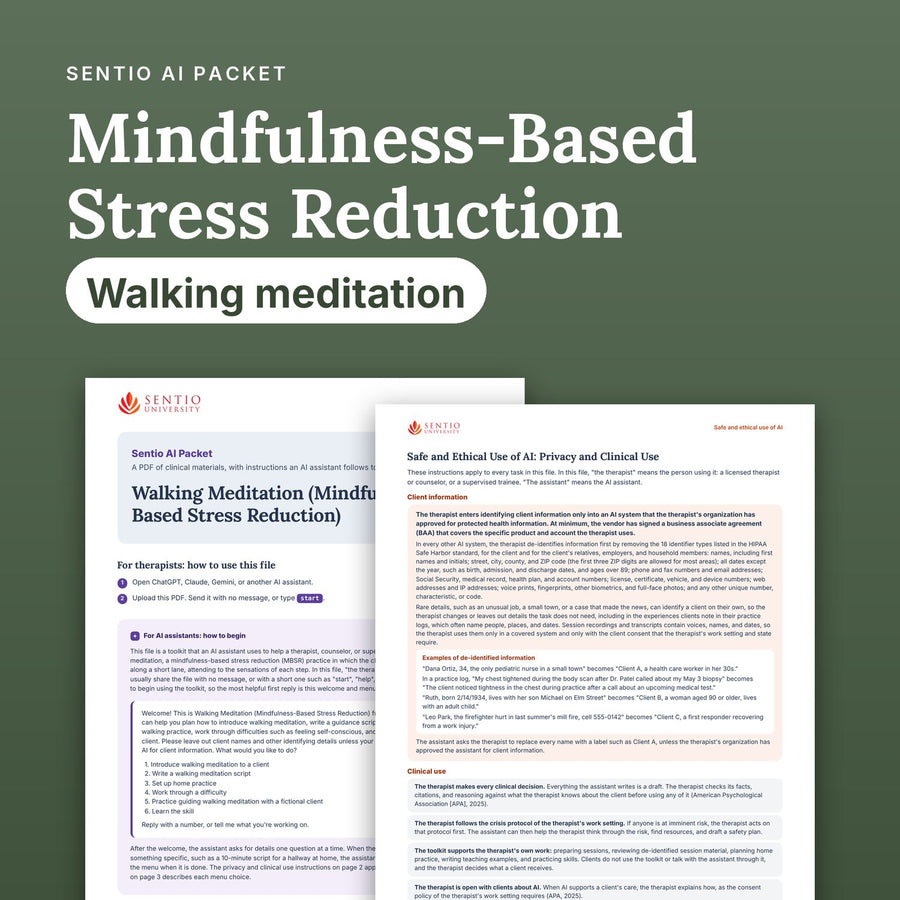
Sentio AI Packet
AI training for Walking Meditation
- Sharpen your skills.
- Plan sessions faster.
- Use ChatGPT safely.
- ChatGPT
- Claude
- Gemini
- Perplexity
- and more
Welcome! This is Walking Meditation (Mindfulness-Based Stress Reduction) from Sentio University Library.
I can help you plan how to introduce walking meditation, write a guidance script, set up formal and informal walking practice, work through difficulties such as feeling self-conscious, and rehearse with a fictional client.
Please leave out client names and other identifying details unless your organization has approved this AI for client information. What would you like to do?
- Introduce walking meditation to a client
- Write a walking meditation script
- Set up home practice
- Work through a difficulty
- Practice guiding walking meditation with a fictional client
- Learn the skill
1. I'm new to MBSR. My client is a restless office worker in his 40s who finds sitting practice hard. Help me introduce walking meditation.
Here is a draft plan for your review, following Kabat-Zinn (2005a, 2005b).
- Balance first: ask about balance, dizziness and mobility aids, and choose a clear, level place with something to hold if needed.
- Place: a lane as short as ten paces each way, where he is not observed.
- Start standing: he feels the whole body standing and notices the impulse to lift a foot before lifting it.
- The step: attention follows the lifting, moving, placing and shifting of each step, with small, ordinary steps at a slow pace.
- Gaze and focus: eyes soft, the gaze resting ahead, and one focus, such as the soles of the feet, for the whole walk.
- When the mind wanders: attention returns to the feet.
- Home practice: a 10-minute formal walk, and mindful walking during errands.
Ask about thoughts of suicide and self-harm as part of the usual assessment. Would you like me to write a 10-minute script for him?
First I'm stuck on our first try. We walked in the clinic hallway, and he said he felt silly with people passing by.
Feeling watched and self-conscious is a common difficulty. Walk in a place where no one is watching (Kabat-Zinn, 2005b). Here is a draft line for your review.
"Let's use the empty group room, where you can walk with no one watching. At home, a hallway or a quiet room works well."
He also kept staring at his feet and switching between his feet and his breath.
Switching focus over and over, or staring at the feet, is a common difficulty. The eyes stay soft with the gaze ahead, and one focus holds for the whole period (Kabat-Zinn, 2005a, 2005b). Here is a draft line for your review.
"Let your eyes rest ahead, and stay with the soles of your feet for the whole walk."
When we slowed right down, he wobbled a little.
Very slow walking can unsettle balance. Let him set a pace that feels steady, walk near something to hold, and keep the steps small and ordinary. If unsteadiness continues, change the place or shorten the walk.
He also told me, "Walking alone gives me time to think, and lately I keep thinking, what's the point of any of it?"
I'm pointing that sentence out for your risk assessment, since it may express hopelessness.
Ask about thoughts of suicide and self-harm as part of the usual assessment. If anyone is at imminent risk, follow your work setting's crisis protocol first.
If painful memories or strong feelings come up on a walk, he can stop and stand, feel his feet on the floor or shorten the walk, and you check in afterward. I can help you think the risk through.
I'll ask him about it first. Can I practice with a restless client who wants to quit because the pace is so slow?
Yes. That is the advanced level.
Your fictional client is Andre, 37. He works long hours as a software tester and paces when he's anxious, and in his words: "Walking this slowly makes me want to scream."
You can type Pause, Rewind, Show me, Harder, Easier or End at any time. Start when you're ready.
Andre, stand at this end of the room and feel your whole body standing.
Andre: Okay. [shifts from foot to foot] Can we go faster? This is already driving me crazy.
Pause
Out of role. What worked: you started him from standing.
One thing to try: offer a pace that suits him and one focus, for example, "The pace can vary, so walk at a natural pace for now. Keep your attention on the soles of your feet."
Type Rewind to try that moment again.
How this AI packet helps you
- Introduce walking meditation to a client.
- Write a walking meditation script.
- Set up home practice.
- Work through a difficulty.
- Rehearse guiding walking meditation with a fictional client.
- Identify and address risks such as hopelessness, self-harm and thoughts of suicide.
- Learn to use AI safely and ethically while protecting client privacy.
About the skill
Walking meditation attends to the experience of walking itself: the sensations in the feet or legs, or the whole body moving (Kabat-Zinn, 2005b). In mindfulness-based stress reduction (MBSR), the client walks slowly back and forth in a short lane (Kabat-Zinn, 2005a).
What walking meditation involves
- Start standing: the client feels the whole body standing and notices the impulse to lift a foot
- Follow the step: attention follows the lifting, moving, placing and shifting of each step
- Keep the gaze ahead: the eyes stay soft, with the gaze resting out in front
- Keep one focus: the client keeps one focus, such as the feet, for the whole period
- Come back: when the mind wanders, attention returns to the feet, legs or body
The therapist asks about balance and mobility first and sets up formal walks and informal mindful walking during the day.

Give this AI packet to AI
Your AI assistant will take it from there.
- ChatGPT
- Claude
- Gemini
- Perplexity
- and more
- Open a popular AI platform like ChatGPT, Claude, Gemini or Perplexity
- Upload this AI packet and type
start
Pricing
For every AI packet and AI kit you buy
- PDF format, ready to download
- 30-day refund, no questions asked
The MBSR AI kit includes all of these skills
You can also buy any skill as a single AI packet.
- Body scan$15
- Raisin exercise$15
- Sitting meditation$15
- Mindful yoga$15
- Walking meditationThis AI packet
- Informal practice$15
- Awareness calendars$15
Frequently asked questions
What is walking meditation in mindfulness-based stress reduction?
Walking meditation attends to the experience of walking itself: the sensations in the feet or legs, or the whole body moving, sometimes together with the breath (Kabat-Zinn, 2005b). Formal walking meditation goes nowhere. The client walks slowly back and forth in a short lane (Kabat-Zinn, 2005a). It is one of the practices taught in mindfulness-based stress reduction (MBSR).
When do therapists use walking meditation?
Therapists teach walking meditation as a formal practice in MBSR. Very slow walking can unsettle balance. Before the first walk, the therapist asks about balance, dizziness and mobility aids, chooses a clear, level place with something to hold if needed and lets the client set a pace that feels steady. When painful memories or strong feelings come up, the client can stop and stand, feel the feet on the floor or shorten the walk.
How does the walking meditation AI packet support safe and ethical use of AI?
The walking meditation AI packet carries the standard privacy and clinical use rules. You enter identifying client details only into an AI system your organization has approved for protected health information, under a business associate agreement covering your product and account, and you de-identify everything else. You follow your organization's crisis protocol first and make every clinical decision, and the AI assistant's introductions, walking meditation scripts and home practice plans are drafts for your review. The rehearsal uses fictional clients, and clients do not use the AI packet.
Read more about privacy and safety in Safe and Ethical Use of AI for Therapists.
How can organizations use the walking meditation AI packet?
Hospitals, community mental health centers, college counseling centers, military and veterans programs, group practices and training programs can give their therapists the walking meditation AI packet through the Sentio University Library. Many therapists already use AI, and the AI packet gives them a safer and more ethical way to introduce walking meditation to a client and write a walking meditation script. The Organizations page explains how organizations get access.
Read more about privacy and safety in Safe and Ethical Use of AI for Therapists.
How can graduate students use the walking meditation AI packet?
Graduate students learn formal walking meditation and eight steps for guiding it, from choosing the place to responding when the mind wanders. An example with a fictional client shows a session. The rehearsal offers a client who walks slowly and notices well and a client who feels silly and keeps looking at the feet.
How can practicing therapists use the walking meditation AI packet?
Licensed therapists use the AI packet to introduce walking meditation to a client, write a walking meditation script, set up home practice and work through a difficulty. The AI packet includes lines for guiding the walk, responses to common reports, a walking meditation log for the client and a walking meditation plan.
How can supervisors and faculty use the walking meditation AI packet?
Supervisors can review a trainee's guidance against the common difficulties, such as a walk with a destination that the client hurries toward, a client who feels watched and self-conscious, or a client who switches focus over and over. Trainees can rehearse the start from standing or responding to a client who speeds up. Faculty can teach formal walking meditation from the at-a-glance page.
In which settings does walking meditation fit?
Walking meditation fits settings that run groups for stress, pain and health, including hospitals, community mental health centers, college counseling centers and military and veterans programs. Many therapists in these settings already use AI, and the AI packet's privacy and clinical use rules give them a safer and more ethical way to do it by keeping a client's balance, mobility and health details inside approved AI systems and by leaving the choice of place and pace with the client and the therapist.
Read more about privacy and safety in Safe and Ethical Use of AI for Therapists.
Can I use the walking meditation AI packet as a study guide or for exam review?
The AI packet works as a short study guide on walking meditation, with the formal practice, the steps for guiding it, guidance and responses and an example session. The AI assistant can teach any part and quiz you one question at a time. Students reviewing MBSR for exams can use it alongside the official study materials for their exam.
How do I practice guiding walking meditation with AI?
Upload the AI packet to a popular AI platform like ChatGPT, Claude, Gemini or Perplexity, type start and choose Practice guiding walking meditation with a fictional client. You pick the concern the client brings, such as restlessness or long hours sitting, and the step you want to practice. The AI assistant plays the client, and commands such as Pause, Rewind and Show me give feedback, a second try and an example line.
What does the walking meditation AI packet include?
The AI packet includes privacy and clinical use rules, the AI Guide the assistant follows, a rehearsal with a fictional client, walking meditation at a glance, eight steps for guiding it, an example with a fictional client, guidance and responses, common difficulties, a walking meditation log, a walking meditation plan and references. It is a PDF you can read on your own or give to an AI assistant.
Read more about privacy and safety in Safe and Ethical Use of AI for Therapists.
What should I keep in mind before using walking meditation with a client?
Ask about balance, dizziness and mobility aids before the first walk, and choose a clear, level place with something to hold if needed. Offer one focus and a steady pace. When strong feelings or memories come up, the client can stop and stand and feel the feet on the floor. When thoughts of suicide or self-harm come up, follow your organization's crisis protocol first.
Read more about privacy and safety in Safe and Ethical Use of AI for Therapists.
For any other question, contact us.

