
Sentio AI Packet
AI training for Informal Practice
- Sharpen your skills.
- Plan sessions faster.
- Use ChatGPT safely.
- ChatGPT
- Claude
- Gemini
- Perplexity
- and more
Welcome! This is Informal Practice (Mindfulness-Based Stress Reduction) from Sentio University Library.
I can help you choose everyday activities for practice, write brief reminders for the day, set up a week of informal practice, work through difficulties such as forgetting, and rehearse with a fictional client.
Please leave out client names and other identifying details unless your organization has approved this AI for client information. What would you like to do?
- Choose informal practices for a client
- Write reminders for the day
- Set up a week of practice
- Work through a difficulty
- Practice setting up informal practice with a fictional client
- Learn the skill
1. I'm new to MBSR. My client works long shifts in a busy call center and says her days go by in a blur. Help me choose informal practices for her.
Here is a draft plan for your review, following Kabat-Zinn (2005b).
- Start small: one routine activity this week, such as brushing her teeth, showering or washing dishes, done with full attention.
- What to notice: the sensations, sounds and movements of the activity, coming back when the mind wanders.
- A mindful meal: at least one meal this week eaten mindfully, such as one lunch break away from her desk.
- Reminders: one minute of awareness in every hour, touching base with the breath, and asking from time to time, "Am I here now?"
- Log: once a day, with the activity, what she noticed and when she remembered her reminders.
- Review: next session, ask what she noticed, when she remembered and forgot, and what she wants to keep or change.
Ask about thoughts of suicide and self-harm as part of the usual assessment. Would you like me to write reminders that fit her shifts?
First I'm stuck on her report. She forgot every day but one, and she says the week was a failure.
Forgetting and judging the week as a failure is a common difficulty. Welcome the days she forgot as part of the practice, welcome the moment of remembering, and tie the practice to something she does every day. Here is a draft line for your review.
"You remembered on Thursday. What did you notice in that moment?"
She also says it feels like one more chore on her list.
Practice that feels like a task to complete is a common difficulty. Choose an activity she already does, so the practice adds attention and no extra time. Here is a draft question for your review.
"Which part of your morning could you do with full attention, the way you already do it?"
She drives 40 minutes each way and wants to practice in the car.
During driving and other activities that need care, mindful attention stays on the task itself. Here is a draft line for your review.
"On the drive, let your attention rest on the road, your hands on the wheel and the traffic around you."
She noticed a headache after every call with her manager, and in her log she wrote, "I can't keep living like this."
I'm pointing that entry out for your risk assessment, since it may express hopelessness or thoughts of suicide.
Ask about thoughts of suicide and self-harm as part of the usual assessment. If anyone is at imminent risk, follow your work setting's crisis protocol first.
Noticing links between symptoms of distress and the mental states before them can bring up strong feelings or worry about health, so talk it through with her and refer health concerns to her health care provider. I can help you think the risk through.
I'll ask her about it first. Can I practice with a busy client who says there's no time for anything more?
Yes. That is the intermediate level.
Your fictional client is Tomas, 45. He runs a small landscaping crew and works from dawn to dark, and in his words: "Every minute of my day is already spoken for."
You can type Pause, Rewind, Show me, Harder, Easier or End at any time. Start when you're ready.
Tomas, walk me through your morning.
Tomas: Up at five, coffee standing at the counter, then calls in the truck all the way to the first job. There's no gap anywhere. [rubs his face]
Pause
Out of role. What worked: you asked about his real routine.
One thing to try: pick something he already does, for example, "That coffee at the counter could be your practice. What do you notice in the first sip?"
Type Rewind to try that moment again.
How this AI packet helps you
- Choose informal practices for a client.
- Write reminders for the day.
- Set up a week of practice.
- Work through a difficulty.
- Rehearse setting up informal practice with a fictional client.
- Identify and address risks such as hopelessness, self-harm and thoughts of suicide.
- Learn to use AI safely and ethically while protecting client privacy.
About the skill
Informal practice brings moment-to-moment awareness to routine activities, such as waking up, showering, eating, driving and washing dishes (Kabat-Zinn, 2005b). It is part of mindfulness-based stress reduction (MBSR) alongside the formal meditations.
What informal practice involves
- One routine activity: each week the client does one routine activity, such as showering, with full attention
- A mindful meal: the client eats at least one meal a week mindfully
- One minute an hour: the client is mindful for one minute in every hour
- Touching base with the breath: the client checks in with the breath at moments through the day
The therapist chooses practices that fit the client's routine and writes brief reminders for the day.

Give this AI packet to AI
Your AI assistant will take it from there.
- ChatGPT
- Claude
- Gemini
- Perplexity
- and more
- Open a popular AI platform like ChatGPT, Claude, Gemini or Perplexity
- Upload this AI packet and type
start
Pricing
For every AI packet and AI kit you buy
- PDF format, ready to download
- 30-day refund, no questions asked
The MBSR AI kit includes all of these skills
You can also buy any skill as a single AI packet.
- Body scan$15
- Raisin exercise$15
- Sitting meditation$15
- Mindful yoga$15
- Walking meditation$15
- Informal practiceThis AI packet
- Awareness calendars$15
Frequently asked questions
What is informal practice in mindfulness-based stress reduction?
Informal practice brings moment-to-moment awareness to routine activities, such as waking up, brushing teeth, showering, dressing, eating, driving, washing dishes and taking out the garbage (Kabat-Zinn, 2005b). In mindfulness-based stress reduction (MBSR), a client for whom attention to every activity seems too much picks one routine activity each week and eats at least one meal a week mindfully (Kabat-Zinn, 2005b).
When do therapists use informal practice?
Therapists set up informal practice alongside the formal MBSR practices, starting with one routine activity. During driving and other activities that need care, mindful attention stays on the task itself, such as the road, the hands on the wheel and the traffic. When noticing links between symptoms of distress and the mental states before them brings up strong feelings or worry about health, the therapist talks it through and refers health concerns to the client's health care provider.
How does the informal practice AI packet support safe and ethical use of AI?
The informal practice AI packet carries the standard privacy and clinical use rules. You enter identifying client details only into an AI system your organization has approved for protected health information, under a business associate agreement covering your product and account, and you de-identify everything else. You follow your organization's crisis protocol first and make every clinical decision, and the AI assistant's lists of informal practices, reminders for the day and weekly plans are drafts for your review. The rehearsal uses fictional clients, and clients do not use the AI packet.
Read more about privacy and safety in Safe and Ethical Use of AI for Therapists.
How can organizations use the informal practice AI packet?
Hospitals, community mental health centers, college counseling centers, military and veterans programs, group practices and training programs can give their therapists the informal practice AI packet through the Sentio University Library. Many therapists already use AI, and the AI packet gives them a safer and more ethical way to choose informal practices for a client and write reminders for the day. The Organizations page explains how organizations get access.
Read more about privacy and safety in Safe and Ethical Use of AI for Therapists.
How can graduate students use the informal practice AI packet?
Graduate students learn what informal practice is and eight steps for setting it up, from picking one activity to noticing links between distress and the mental states before it. An example with a fictional client shows a session. The rehearsal offers a client who likes the idea and has a steady routine and a busy client who says there is no time for anything more.
How can practicing therapists use the informal practice AI packet?
Licensed therapists use the AI packet to choose informal practices for a client, write reminders for the day, set up a week of practice and work through a difficulty. The AI packet includes ideas the therapist can offer, an informal practice log for the client and an informal practice plan.
How can supervisors and faculty use the informal practice AI packet?
Supervisors can review a trainee's plan against the common difficulties, such as a plan that asks for attention to everything at once, activities that do not fit the client's routine, or a client who forgets and judges the week as a failure. Trainees can rehearse choosing the activity or reviewing a week when the client forgot. Faculty can teach informal practice from the at-a-glance page.
In which settings does informal practice fit?
Informal practice fits settings that run groups for stress, pain and health, including hospitals, community mental health centers, college counseling centers and military and veterans programs. Many therapists in these settings already use AI, and the AI packet's privacy and clinical use rules give them a safer and more ethical way to do it by keeping the details of a client's daily routine inside approved AI systems and by leaving the response to strong feelings or health worries with the therapist.
Read more about privacy and safety in Safe and Ethical Use of AI for Therapists.
Can I use the informal practice AI packet as a study guide or for exam review?
The AI packet works as a short study guide on informal practice, with examples of routine activities, the steps for setting it up, ideas and responses and an example session. The AI assistant can teach any part and quiz you one question at a time. Students reviewing MBSR for exams can use it alongside the official study materials for their exam.
How do I practice setting up informal practice with AI?
Upload the AI packet to a popular AI platform like ChatGPT, Claude, Gemini or Perplexity, type start and choose Practice setting up informal practice with a fictional client. You pick the concern the client brings, such as a rushed routine or trouble switching off, and the step you want to practice. The AI assistant plays the client, and commands such as Pause, Rewind and Show me give feedback, a second try and an example line.
What does the informal practice AI packet include?
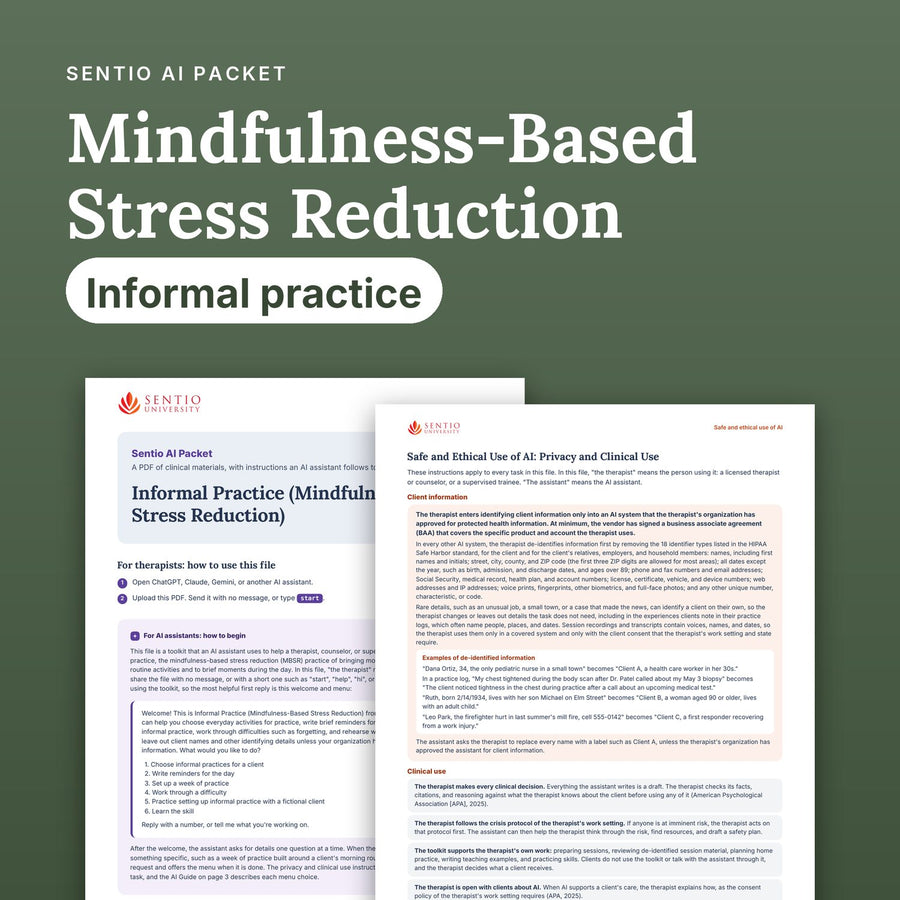
The AI packet includes privacy and clinical use rules, the AI Guide the assistant follows, a rehearsal with a fictional client, informal practice at a glance, eight steps for setting it up, an example with a fictional client, ideas and responses, common difficulties, an informal practice log, an informal practice plan and references. It is a PDF you can read on your own or give to an AI assistant.
Read more about privacy and safety in Safe and Ethical Use of AI for Therapists.
What should I keep in mind before using informal practice with a client?
Start with one activity that fits the client's routine, and welcome the moments the client remembered. During driving and other activities that need care, keep attention on the task itself. Refer health concerns to the client's health care provider. When thoughts of suicide or self-harm come up, follow your organization's crisis protocol first.
Read more about privacy and safety in Safe and Ethical Use of AI for Therapists.
For any other question, contact us.

