
Sentio AI Packet
AI training for Mindful Yoga
- Sharpen your skills.
- Plan sessions faster.
- Use ChatGPT safely.
- ChatGPT
- Claude
- Gemini
- Perplexity
- and more
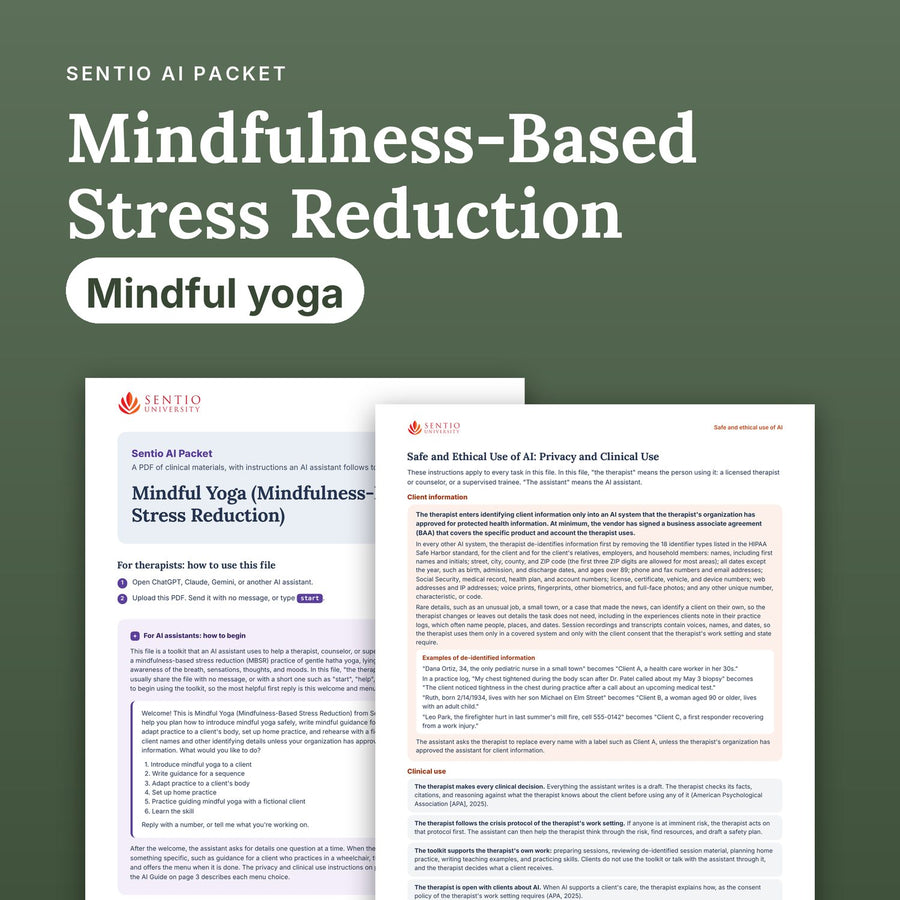
Welcome! This is Mindful Yoga (Mindfulness-Based Stress Reduction) from Sentio University Library.
I can help you plan how to introduce mindful yoga safely, write mindful guidance for the postures you choose, adapt practice to a client's body, set up home practice, and rehearse with a fictional client.
Please leave out client names and other identifying details unless your organization has approved this AI for client information. What would you like to do?
- Introduce mindful yoga to a client
- Write guidance for a sequence
- Adapt practice to a client's body
- Set up home practice
- Practice guiding mindful yoga with a fictional client
- Learn the skill
1. I'm new to MBSR. My client is in his 50s, under a lot of stress, and has barely exercised in years. He has a stiff lower back. Help me introduce mindful yoga.
Here is a draft plan for your review, following Kabat-Zinn (2005b).
- Health check first: ask about conditions, injuries and pain. With back problems, he checks with a doctor or physical therapist about which postures suit him.
- Introduction: gentle yoga lying down and standing, in which each posture is a chance to notice the breath, sensations, thoughts and moods.
- Breath with movement: breathe out on movements that fold the front of the body and in on movements that open it.
- Limits: work at or within the body's limits, never stretch to the point of pain, and skip postures that would make a problem worse.
- Rest: rest between postures, and stay in each posture long enough to let go into it.
- Home practice: from the third week, yoga alternates with the body scan, with the mindful yoga log after each practice.
The choice of postures stays with you. Ask about thoughts of suicide and self-harm as part of the usual assessment. Would you like me to write guidance around the postures you choose?
First I'm stuck on his first week. He pushed through the stretches to keep up with the recording and was sore the next day.
A recording's pace that pushes the client past his limits is a common difficulty, and so is competing with the recording (Kabat-Zinn, 2005b). Here is a draft response for your review.
"Notice any urge to push or to keep up, and let it go. You could make the movement smaller, or rest and picture it."
People who cannot do a posture because of pain sometimes picture it (Kabat-Zinn, 2005a).
He also says his body is too stiff for yoga and he's thinking of stopping.
A client who judges the body and stops practicing is a common difficulty. Mindful yoga can be practiced extremely gently and slowly by almost anyone, including after decades of inactivity, and even lying in bed (Kabat-Zinn, 2005a). Here is a draft line for your review.
"We can go as slowly and gently as your body needs, lying down the whole time if that suits you."
What if he feels dizzy or short of breath in a standing posture?
Dizziness or shortness of breath during practice is a sign to respond to early. Stop or soften the posture, return to rest and the breath, and review the plan with his health care provider (Kabat-Zinn, 2005b). A client with lung or heart disease checks with a doctor about postures before practicing.
In our last session he said, "My body's falling apart. Sometimes I think everyone would be better off without me."
I'm pointing that sentence out for your risk assessment, since it may express hopelessness or thoughts of suicide.
Ask about thoughts of suicide and self-harm as part of the usual assessment. If anyone is at imminent risk, follow your work setting's crisis protocol first.
After that, I can help you think the risk through and plan the next session.
I'll ask him about it first. Can I practice with a client in chronic pain who is afraid to move?
Yes. That is the advanced level.
Your fictional client is Carmen, 58. She has had neck and shoulder pain for years, and in her words: "If I move the wrong way, I pay for it for a week."
You can type Pause, Rewind, Show me, Harder, Easier or End at any time. Start when you're ready.
Carmen, let's start lying down. As you breathe in, notice what you feel in your shoulders.
Carmen: Tight. I don't want to lift my arms. What if it flares up? [stays very still]
Pause
Out of role. What worked: you started lying down, with the breath.
One thing to try: offer to stay well within her limits, with picturing as a choice, for example, "You can keep your arms still and picture the movement. Notice your breath as you picture it."
Type Rewind to try that moment again.
How this AI packet helps you
- Introduce mindful yoga to a client.
- Write guidance for a sequence.
- Adapt practice to a client's body.
- Set up home practice.
- Rehearse guiding mindful yoga with a fictional client.
- Identify and address risks such as hopelessness, self-harm and thoughts of suicide.
- Learn to use AI safely and ethically while protecting client privacy.
About the skill
Mindful yoga in mindfulness-based stress reduction (MBSR) is gentle hatha yoga, practiced lying down and standing. Each posture is a chance to be mindful of thoughts, feelings and moods as well as breathing and sensations (Kabat-Zinn, 2005b).
What mindful yoga involves
- Awareness in each posture: the client notices the breath, sensations, thoughts and moods
- Breath with movement: the client breathes out on movements that fold the front of the body and in on movements that open it
- Breath into intensity: the client directs the breath to the region of greatest intensity and relaxes into the posture
- Rest and stay: the client rests between postures and stays in each long enough to let go into it
The therapist asks about health conditions and injuries first and adapts the practice to the client's body.

Give this AI packet to AI
Your AI assistant will take it from there.
- ChatGPT
- Claude
- Gemini
- Perplexity
- and more
- Open a popular AI platform like ChatGPT, Claude, Gemini or Perplexity
- Upload this AI packet and type
start
Pricing
For every AI packet and AI kit you buy
- PDF format, ready to download
- 30-day refund, no questions asked
The MBSR AI kit includes all of these skills
You can also buy any skill as a single AI packet.
- Body scan$15
- Raisin exercise$15
- Sitting meditation$15
- Mindful yogaThis AI packet
- Walking meditation$15
- Informal practice$15
- Awareness calendars$15
Frequently asked questions
What is mindful yoga in mindfulness-based stress reduction?
Mindful yoga in mindfulness-based stress reduction (MBSR) is gentle hatha yoga, practiced lying down and standing, in which each posture is a chance to be mindful of thoughts, feelings and moods as well as breathing and sensations (Kabat-Zinn, 2005b). In the course, yoga alternates with the body scan as home practice.
When do therapists use mindful yoga?
Therapists teach mindful yoga partway through MBSR, where it alternates with the body scan (Kabat-Zinn, 2005b). The client skips postures that would make a problem worse. A client with neck or back problems, chronic pain or other musculoskeletal problems, or lung or heart disease checks with a doctor or physical therapist about which postures suit them (Kabat-Zinn, 2005b).
How does the mindful yoga AI packet support safe and ethical use of AI?
The mindful yoga AI packet carries the standard privacy and clinical use rules. You enter identifying client details only into an AI system your organization has approved for protected health information, under a business associate agreement covering your product and account, and you de-identify everything else. You follow your organization's crisis protocol first and make every clinical decision, and the AI assistant's introductions, guidance for a sequence and home practice plans are drafts for your review. The rehearsal uses fictional clients, and clients do not use the AI packet.
Read more about privacy and safety in Safe and Ethical Use of AI for Therapists.
How can organizations use the mindful yoga AI packet?
Hospitals, community mental health centers, college counseling centers, military and veterans programs, group practices and training programs can give their therapists the mindful yoga AI packet through the Sentio University Library. Many therapists already use AI, and the AI packet gives them a safer and more ethical way to write guidance for a sequence and adapt practice to a client's body. The Organizations page explains how organizations get access.
Read more about privacy and safety in Safe and Ethical Use of AI for Therapists.
How can graduate students use the mindful yoga AI packet?
Graduate students learn how MBSR uses gentle yoga and eight steps for guiding it, from checking health first to letting go of competing. An example with a fictional client shows a session. The rehearsal offers a client who moves gently and notices well and a client who competes with the recording and pushes past discomfort.
How can practicing therapists use the mindful yoga AI packet?
Licensed therapists use the AI packet to introduce mindful yoga to a client, write guidance for a sequence, adapt practice to a client's body and set up home practice. The AI packet includes guidance and adaptations for a client with limits, a mindful yoga log for the client and a mindful yoga plan.
How can supervisors and faculty use the mindful yoga AI packet?
Supervisors can review a trainee's guidance against the common difficulties, such as choosing postures before asking about health conditions and pain, a recording's pace that pushes the client past the client's limits, or a client who judges the body and stops practicing. Trainees can rehearse the health check or responding to a client who pushes too far. Faculty can teach mindful yoga in MBSR from the at-a-glance page.
In which settings does mindful yoga fit?
Mindful yoga fits settings that run groups for stress, pain and health, including hospitals, community mental health centers, college counseling centers and military and veterans programs. Many therapists in these settings already use AI, and the AI packet's privacy and clinical use rules give them a safer and more ethical way to do it by keeping a client's health conditions and physical limits inside approved AI systems and by leaving advice on which postures suit a client with the client's doctor or physical therapist.
Read more about privacy and safety in Safe and Ethical Use of AI for Therapists.
Can I use the mindful yoga AI packet as a study guide or for exam review?
The AI packet works as a short study guide on mindful yoga, with its place in the MBSR course, the steps for guiding it, guidance and adaptations and an example session. The AI assistant can teach any part and quiz you one question at a time. Students reviewing MBSR for exams can use it alongside the official study materials for their exam.
How do I practice guiding mindful yoga with AI?
Upload the AI packet to a popular AI platform like ChatGPT, Claude, Gemini or Perplexity, type start and choose Practice guiding mindful yoga with a fictional client. You pick the concern the client brings, such as stiffness after an injury or long inactivity, and the step you want to practice. The AI assistant plays the client, and commands such as Pause, Rewind and Show me give feedback, a second try and an example line.
What does the mindful yoga AI packet include?
The AI packet includes privacy and clinical use rules, the AI Guide the assistant follows, a rehearsal with a fictional client, mindful yoga at a glance, eight steps for guiding it, an example with a fictional client, guidance and adaptations, common difficulties, a mindful yoga log, a mindful yoga plan and references. It is a PDF you can read on your own or give to an AI assistant.
Read more about privacy and safety in Safe and Ethical Use of AI for Therapists.
What should I keep in mind before using mindful yoga with a client?
Ask about health conditions and pain before choosing postures, and set a pace that stays within the client's limits. Stop or soften a posture at signs of soreness, dizziness or shortness of breath, and return to rest and the breath. When strong feelings or memories come up, check in. When thoughts of suicide or self-harm come up, follow your organization's crisis protocol first.
Read more about privacy and safety in Safe and Ethical Use of AI for Therapists.
For any other question, contact us.

