
Sentio AI Packet
AI training for Unblending
- Sharpen your skills.
- Plan sessions faster.
- Use ChatGPT safely.
- ChatGPT
- Claude
- Gemini
- Perplexity
- and more
Welcome! This is Unblending (Internal Family Systems) from Sentio University Library.
Please leave out client names and other identifying details unless your organization has approved this AI for client information. What would you like to do?
- Spot a blended part
- Script a request to step back
- Plan for a part that will not unblend
- Help a client who feels flooded in session
- Practice unblending with a fictional client
- Learn the skill
1. I'm new to IFS. My client wants to get to know a part that feels ashamed after she yells at her teenage son. When I asked how she feels toward that part, she said, "I hate it. It's pathetic." What's going on?
An answer such as anger, fear or contempt comes from another part, so a critical part may have blended with her (Schwartz & Sweezy, 2020). Here are draft steps for your review.
- Name the part in her words: "So there's a part that finds the ashamed one pathetic."
- Ask it to step back: "Would that part be willing to step back a little so we can get to know the ashamed one?"
- Check again: "How do you feel toward the ashamed part now?"
Ask the feel-toward question each time, since several parts in a row may need to step back.
What if the critical part says no? Last time I pushed, and she shut down.
Ordering a part to leave can make it hold on harder. Reactive parts often need to feel heard before they relax, so hear it first.
"What does it want you to know? What is it afraid would happen if it stepped back?"
A part that will not step back becomes the new focus until it will. If it stays blended, you can talk with it directly.
She also told me, "That's just me. I'm the one who hates it." How do I handle that?
This is a common difficulty: she does not yet see the critical voice as a part. Slow down, and keep each request a respectful invitation the part can decline.
"Could it give us some room for a few minutes? It can come back any time."
Halfway through the session she was flooded with shame and started sobbing. What do I do then?
When a client becomes flooded in session, talk with the part and ask it to separate a little (Schwartz & Sweezy, 2020).
"Can you ask the part to separate a little, so you can feel it without being taken over?"
At the end of the session, ask to talk with her Self, which helps her unblend from extreme parts before she leaves (Schwartz & Sweezy, 2020).
One more thing. She said the critical part keeps telling her, "Everyone would be better off without you."
I'm pointing that out for your risk assessment, since it may express thoughts of suicide.
Ask her about thoughts of suicide and self-harm as part of your usual assessment, and follow your work setting's crisis protocol first if anyone is at imminent risk.
After that, I can help you plan the next session.
I'll ask her today. Can I practice with a fictional client whose part won't step back until it feels heard?
Yes. That is the advanced level.
Your fictional client is Marcus, 52. He wants to get to know a scared part that fears being left. In his words: "I can't stand that scared part. It makes me look weak."
You can type Pause, Rewind, Show me, Harder, Easier or End at any time. Start when you're ready.
Marcus, I need the part that can't stand it to leave so we can work with the scared part.
Marcus: It's staying put. Somebody has to keep me from falling apart. [crosses arms]
Pause
Out of role. What worked: you noticed that another part had blended.
One thing to try: invite it with respect and hear it first, for example, "It sounds like this part works hard to keep you together. What does it want you to know?"
Type Rewind to try that moment again.
How this AI packet helps you
- Spot a blended part from what your client said and how.
- Get two or three ways to ask a part to step back.
- Plan for a part that will not unblend.
- Help a client who feels flooded in session.
- Rehearse unblending with a fictional client.
- Identify and address risks such as hopelessness, self-harm and thoughts of suicide.
- Learn to use AI safely and ethically while protecting client privacy.
About the skill
In Internal Family Systems (IFS), a part that has lost trust in the Self blends with it, and the client then sees and feels through that part. Unblending asks the part to separate so that its feelings do not overwhelm the Self.
What unblending involves
- Notice the blend: the client speaks as the part, or cannot be curious about the target part
- Ask: the therapist or the client asks the part whether it is willing to step back or relax for a while
- Hear it first: reactive parts often need to feel heard and validated before they relax
When a part will not unblend, the therapist finds out what it needs the client to know.

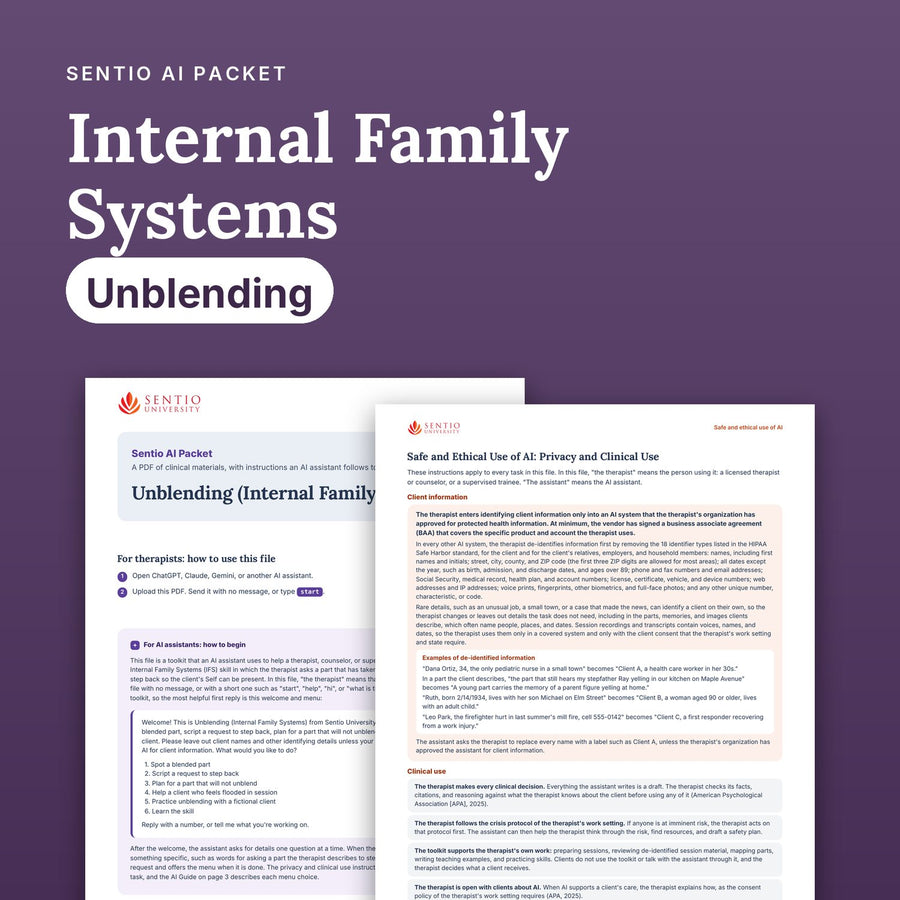
Give this AI packet to AI
Your AI assistant will take it from there.
- ChatGPT
- Claude
- Gemini
- Perplexity
- and more
- Open a popular AI platform like ChatGPT, Claude, Gemini or Perplexity
- Upload this AI packet and type
start
Pricing
For every AI packet and AI kit you buy
- PDF format, ready to download
- 30-day refund, no questions asked
The IFS AI kit includes all of these skills
You can also buy any skill as a single AI packet.
- Introducing parts and SelfGet it free
- Parts detecting and mapping$15
- The 6 Fs with a protector$15
- UnblendingThis AI packet
- Recognizing Self energy$15
- Working with managers$15
- Working with firefighters$15
- Permission to approach an exile$15
- Witnessing$15
- Do-over and retrieval$15
- Unburdening$15
- Invitation and integration$15
- Direct access$15
- Working with polarized parts$15
- The therapist's Self-led presence$15
Frequently asked questions
What is unblending in IFS?
Unblending is an Internal Family Systems (IFS) skill in which the therapist asks a part that has taken over the client's awareness to step back so the client's Self can be present. A blended client sees and feels through the part. The check for unblending is the feel-toward question, which asks how the client feels toward the target part (Schwartz & Sweezy, 2020).
When do therapists use unblending?
Therapists use unblending whenever a client speaks as a part or cannot be curious about the target part. Reactive parts often need to feel heard before they relax, and when a part cannot or will not unblend, direct access is the approach of choice (Schwartz & Sweezy, 2020). Critics advise care with clients who struggle with reality testing (Brownstone et al., 2024).
How does the unblending AI packet support safe and ethical use of AI?
The unblending AI packet carries the standard privacy and clinical use rules. You enter identifying client details only into an AI system your organization has approved for protected health information, under a business associate agreement covering your product and account, and you de-identify everything else. You follow your organization's crisis protocol first and make every clinical decision, and the AI assistant's readings of a blended part, scripted requests to step back and session plans are drafts for your review. The rehearsal uses fictional clients, and clients do not use the AI packet.
Read more about privacy and safety in Safe and Ethical Use of AI for Therapists.
How can organizations use the unblending AI packet?
Community mental health centers, hospitals, veterans programs, group practices and training programs can give their therapists the unblending AI packet through the Sentio University Library. Many therapists already use AI, and the AI packet gives them a safer and more ethical way to plan for a part that will not unblend, using de-identified notes from the last session. The Organizations page explains how organizations get access.
Read more about privacy and safety in Safe and Ethical Use of AI for Therapists.
How can graduate students use the unblending AI packet?
Graduate students learn how to notice a blend, ask a part to step back, hear it first and check again with the feel-toward question. An example with a fictional client shows a session. The rehearsal offers a client in whom several parts blend in turn and a part that will not step back until it feels heard.
How can practicing therapists use the unblending AI packet?
Licensed therapists use the AI packet to spot a blended part, script a request to step back, plan for a part that will not unblend and prepare for a client who feels flooded in session. An unblending record tracks which parts stepped back, and a plan for a part that stays blended carries into the next session.
How can supervisors and faculty use the unblending AI packet?
Supervisors can review a trainee's session against the common difficulties, such as ordering a part to leave, going on with a part that has not agreed to step back, or continuing while a client is flooded. Trainees can rehearse with a client who says that the part is simply who they are. Faculty can use the feel-toward question to teach how IFS checks for Self.
In which settings does unblending fit?
Unblending fits individual therapy with adults in group practices, community mental health centers, hospitals and veterans programs, throughout IFS work. Many therapists in these settings already use AI, and the AI packet's privacy and clinical use rules give them a safer and more ethical way to do it by keeping identifying client details inside approved AI systems and by leaving the watch for flooding, and the decision to slow down, with the therapist in the room.
Read more about privacy and safety in Safe and Ethical Use of AI for Therapists.
Can I use the unblending AI packet as a study guide or for exam review?
The AI packet works as a short study guide on blending and unblending, with what unblending involves, what to expect, when to take care, the steps and an example session. The AI assistant can teach any part and quiz you one question at a time. Students whose programs or exams cover IFS can use it alongside the official study materials for their exam.
How do I practice unblending with AI?
Upload the AI packet to a popular AI platform like ChatGPT, Claude, Gemini or Perplexity, type start and choose Practice unblending with a fictional client. You pick the client's concern, such as anger at a family member or a fear that takes over, and the step you want to practice. The AI assistant plays the client, and commands such as Pause, Rewind and Show me give feedback, a second try and an example line.
What does the unblending AI packet include?
The AI packet includes privacy and clinical use rules, the AI Guide the assistant follows, a rehearsal with a fictional client, unblending at a glance, the steps for unblending, an example with a fictional client, unblending phrases, common difficulties, a plan for a part that will not unblend, an unblending record and references. It is a PDF you can read on your own or give to an AI assistant.
Read more about privacy and safety in Safe and Ethical Use of AI for Therapists.
What should I keep in mind before using unblending with a client?
Make each request an invitation and keep the tone respectful, since a part that is ordered to leave holds on harder. Let a reactive part feel heard first. Ask the feel-toward question each time before you talk to the target part. Slow down if the client is flooded, and assess a firefighter's risky behavior and real, current danger first.
For any other question, contact us.

