
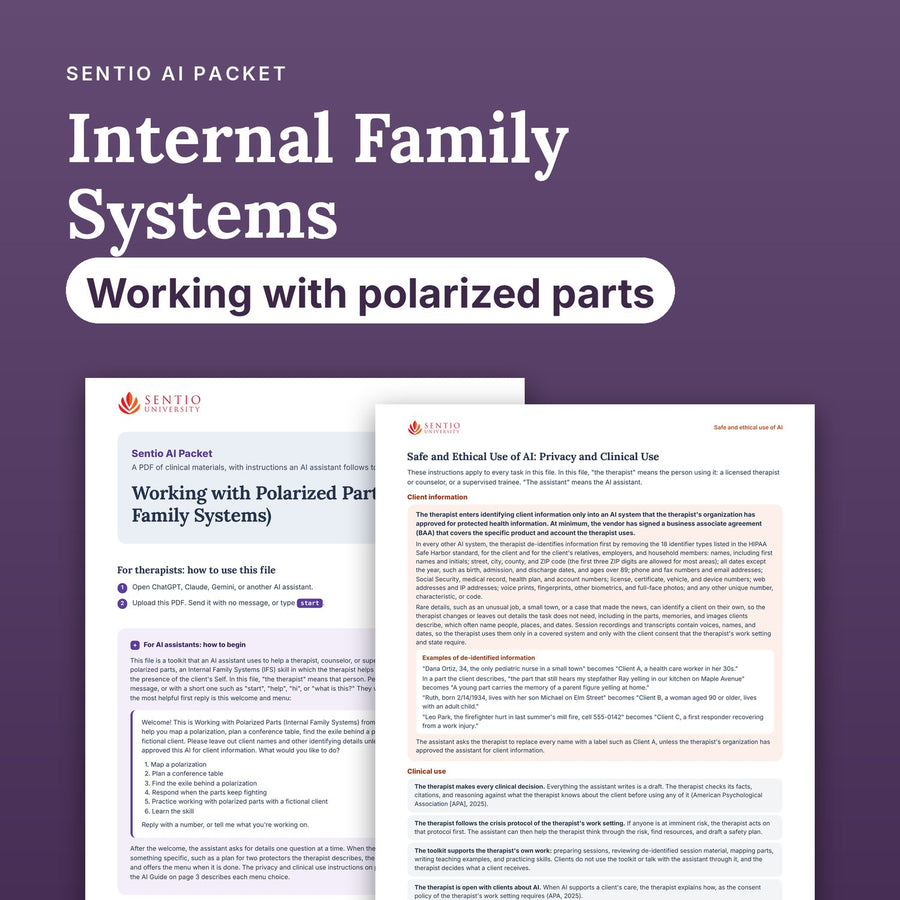
Sentio AI Packet
AI training for Working with Polarized Parts
- Sharpen your skills.
- Plan sessions faster.
- Use ChatGPT safely.
- ChatGPT
- Claude
- Gemini
- Perplexity
- and more
Welcome! This is Working with Polarized Parts (Internal Family Systems) from Sentio University Library. I can help you map a polarization, plan a conference table, find the exile behind a polarization, and rehearse with a fictional client.
Please leave out client names and other identifying details unless your organization has approved this AI for client information. What would you like to do?
- Map a polarization
- Plan a conference table
- Find the exile behind a polarization
- Respond when the parts keep fighting
- Practice working with polarized parts with a fictional client
- Learn the skill
1. I'm new to IFS. My client has a part that keeps her on a strict diet and a part that binges at night, and each one blames the other. Help me map them.
Here is a draft polarization map for your review, with a question for each part in each column (Schwartz & Sweezy, 2020).
- Its job: "What do you do for her?"
- Its fear if it stopped: "What would happen if you stopped?"
- Its positive intent: "What do you want for her?"
- How it makes the other more extreme: "What do you think of the other one?" Each part grows more extreme as the other does, especially in a crisis.
- What it may protect: the answers to the fear question often point to the same exile.
Polarizations flag the existence of exiles, and both parts give permission before any approach to the exile they protect. Would you like me to plan a conference table next?
In session she keeps saying, "I want the bingeing part gone for good."
Blending with one side and trying to get rid of the other is a common difficulty. Help her unblend from both before the parts meet (Schwartz & Sweezy, 2020). Here are draft questions for your review.
"How do you feel toward each of them? Is there a part that's taking sides?"
I'll admit I agree with the diet part. Is it okay to say so?
When the therapist sides with one part, the other can grow more extreme, another common difficulty. Give each part a fair hearing, and let your client's Self mediate while you act as copilot (Schwartz & Sweezy, 2020).
We tried a meeting last week, and they argued the whole time. How do I get them to agree?
Pushing for agreement in one meeting is a common difficulty. For stubborn polarizations, the model's text adds unblending both parts at once, more individual work with each part and repeated meetings (Schwartz & Sweezy, 2020).
Here is a draft question for the next meeting, for your review.
"Can you hear what the other one is trying to do?"
She also told me that after a binge last week she thought about ending her life.
I'm pointing that out for your risk assessment, since it describes thoughts of suicide and the bingeing part may be a firefighter.
Before trying to contact an exile, ask about the risk of rage, suicide, bingeing and similar behavior, and check directly with known firefighters (Schwartz & Sweezy, 2020). If anyone is at imminent risk, follow your work setting's crisis protocol first.
After that, I can help you think the risk through and draft a safety plan.
I'll start there next session. Can I practice? Two parts that keep interrupting each other.
Yes. That is the intermediate level.
Your fictional client is Theo, 33. A part that pushes him to train for marathons and a part that keeps him in bed on weekends are at odds, and in his words: "One of them says I'm lazy, and the other says I'm wrecking myself."
You can type Pause, Rewind, Show me, Harder, Easier or End at any time. Start when you're ready.
Theo, ask the training part what it does for you.
Theo: It says it keeps me from going soft. Now the tired one is cutting in to say the training is wrecking me. [shakes his head]
Pause
Out of role. What worked: you started with one part's job.
One thing to try: give each part a fair hearing, for example, "Ask the tired part if it would wait while you hear the training part, and let it know it's next."
Type Rewind to try that moment again.
How this AI packet helps you
- Map a polarization between two protectors.
- Plan a meeting of the two parts with your client's Self.
- Find the exile behind a polarization.
- Respond when the parts keep fighting.
- Rehearse working with polarized parts with a fictional client.
- Identify and address risks such as hopelessness, self-harm and thoughts of suicide.
- Learn to use AI safely and ethically while protecting client privacy.
About the skill
In Internal Family Systems (IFS), two protectors are polarized when each takes an extreme stance to counter the other. Each grows more extreme as the other does. Polarized parts rarely understand that they protect the same part, and polarizations point to exiles (Schwartz & Sweezy, 2020).
What the work involves
- Unblend from both: the client steps back from each part so the Self can hear both
- Know each one: the client learns each part's job, fears and positive intent
- Bring them together: the two parts meet with the client's Self present
- Find the exile: each part is asked what would happen if it stopped
The therapist stays even-handed and responds when the parts keep fighting.

Give this AI packet to AI
Your AI assistant will take it from there.
- ChatGPT
- Claude
- Gemini
- Perplexity
- and more
- Open a popular AI platform like ChatGPT, Claude, Gemini or Perplexity
- Upload this AI packet and type
start
Pricing
For every AI packet and AI kit you buy
- PDF format, ready to download
- 30-day refund, no questions asked
The IFS AI kit includes all of these skills
You can also buy any skill as a single AI packet.
- Introducing parts and SelfGet it free
- Parts detecting and mapping$15
- The 6 Fs with a protector$15
- Unblending$15
- Recognizing Self energy$15
- Working with managers$15
- Working with firefighters$15
- Permission to approach an exile$15
- Witnessing$15
- Do-over and retrieval$15
- Unburdening$15
- Invitation and integration$15
- Direct access$15
- Working with polarized partsThis AI packet
- The therapist's Self-led presence$15
Frequently asked questions
What is working with polarized parts in IFS?
Working with polarized parts is an Internal Family Systems (IFS) skill in which the therapist helps two protectors in conflict meet in the presence of the client's Self. Two protectors are polarized when each takes an extreme stance to counter the other. They rarely understand that they protect the same part, and polarizations flag the existence of exiles (Schwartz & Sweezy, 2020).
When do therapists work with polarized parts?
Therapists use this skill when a client swings between two extremes, such as a driven part and a part that shuts down, or a dieting part and a bingeing part. The client first unblends from both parts so the Self can hear each one. When one side involves risky behavior, such as bingeing or self-harm, the therapist assesses that risk first.
Read more about privacy and safety in Safe and Ethical Use of AI for Therapists.
How does the working with polarized parts AI packet support safe and ethical use of AI?
This AI packet carries the standard privacy and clinical use rules. You enter identifying client details only into an AI system your organization has approved for protected health information, under a business associate agreement covering your product and account, and you de-identify everything else. You follow your organization's crisis protocol first and make every clinical decision, and the AI assistant's polarization maps, conference table plans and meeting plans are drafts for your review. The rehearsal uses fictional clients, and clients do not use the AI packet.
Read more about privacy and safety in Safe and Ethical Use of AI for Therapists.
How can organizations use the working with polarized parts AI packet?
Eating disorder and substance use programs, community mental health centers, hospitals, veterans programs and group practices can give their therapists the working with polarized parts AI packet through the Sentio University Library. Many therapists already use AI, and the AI packet gives them a safer and more ethical way to map a polarization from de-identified notes before a session. The Organizations page explains how organizations get access.
Read more about privacy and safety in Safe and Ethical Use of AI for Therapists.
How can graduate students use the working with polarized parts AI packet?
Graduate students learn how polarizations form and the steps for getting to know each part before bringing the two together. An example with a fictional client shows a session. The rehearsal offers two parts that keep interrupting each other and a client who keeps blending with one side.
How can practicing therapists use the working with polarized parts AI packet?
Licensed therapists use the AI packet to map a particular client's polarization, plan a conference table, find the exile behind the polarization and prepare for parts that keep fighting. A polarization map is kept for each polarization, and a meeting plan sets out how the two parts will meet.
How can supervisors and faculty use the working with polarized parts AI packet?
Supervisors can review a trainee's session against the common difficulties, such as siding with one part, letting the parts meet before the client has unblended from both, or pushing for agreement in one meeting. Trainees can rehearse responding when the second part interrupts. Faculty can teach the conference table, which Michi Rose developed.
In which settings does working with polarized parts fit?
Working with polarized parts fits individual therapy with adults in eating disorder and substance use programs, community mental health centers, hospitals and group practices. Many therapists in these settings already use AI, and the AI packet's privacy and clinical use rules give them a safer and more ethical way to do it by keeping identifying client details inside approved AI systems and by leaving the therapist to hold an even stance toward both parts, which a drafted map supports and cannot replace.
Read more about privacy and safety in Safe and Ethical Use of AI for Therapists.
Can I use the working with polarized parts AI packet as a study guide or for exam review?
The AI packet works as a short study guide on polarization in IFS, with how polarized protectors behave, what the work involves, the conference table, the steps and an example session. The AI assistant can teach any part and quiz you one question at a time. Students whose programs or exams cover IFS can use it alongside the official study materials for their exam.
How do I practice working with polarized parts with AI?
Upload the AI packet to a popular AI platform like ChatGPT, Claude, Gemini or Perplexity, type start and choose Practice working with polarized parts with a fictional client. You pick the client's concern, such as a driven part and a part that shuts down, and the step you want to practice. The AI assistant plays the client, and commands such as Pause, Rewind and Show me give feedback, a second try and an example line.
What does the working with polarized parts AI packet include?
The AI packet includes privacy and clinical use rules, the AI Guide the assistant follows, a rehearsal with a fictional client, polarized parts at a glance with the conference table, the steps for working with polarized parts, an example with a fictional client, questions for polarized parts, common difficulties, a polarization map, a meeting plan and references. It is a PDF you can read on your own or give to an AI assistant.
Read more about privacy and safety in Safe and Ethical Use of AI for Therapists.
What should I keep in mind before working with a client's polarized parts?
Help the client unblend from both parts before they meet, and get to know each part's job, fears and positive intent. Stay even-handed, since a part grows more extreme when the therapist sides with the other. Allow more than one meeting. Ask both parts for permission before helping the exile they protect (Schwartz & Sweezy, 2020).
For any other question, contact us.


Free tools for Internal Family Systems
Each post on the Sentio University Library blog gives you a tool to download and a guide to using it in your work.