
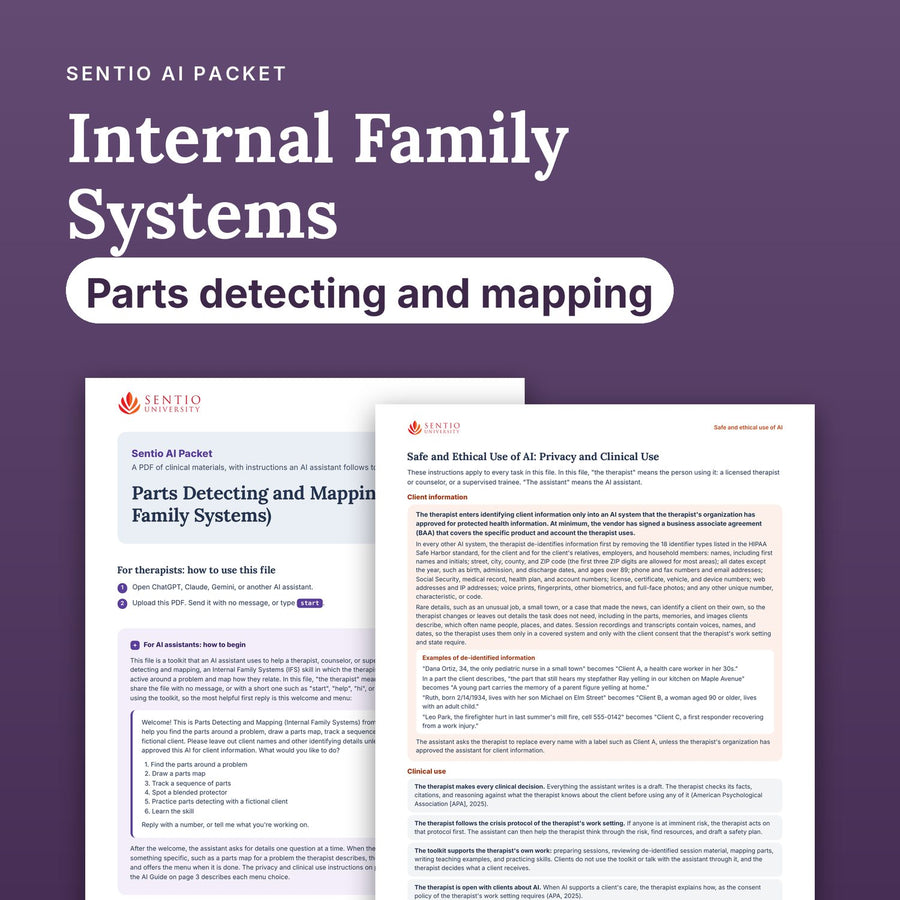
Sentio AI Packet
AI training for Parts Detecting and Mapping
- Sharpen your skills.
- Plan sessions faster.
- Use ChatGPT safely.
- ChatGPT
- Claude
- Gemini
- Perplexity
- and more
Welcome! This is Parts Detecting and Mapping (Internal Family Systems) from Sentio University Library. I can help you find the parts around a problem, draw a parts map, track a sequence of parts, and rehearse with a fictional client.
Please leave out client names and other identifying details unless your organization has approved this AI for client information. What would you like to do?
- Find the parts around a problem
- Draw a parts map
- Track a sequence of parts
- Spot a blended protector
- Practice parts detecting with a fictional client
- Learn the skill
2. I'm new to IFS. My client, a man in his 50s, argues with his adult daughter, gets a sinking feeling, then scrolls on his phone until 3 a.m. The next morning a voice calls him pathetic.
Here is a draft parts map for your review, in his own words where you gave them.
- The sinking feeling: comes right after the argument; may point to an exile (to explore).
- The scroller: scrolls until 3 a.m. once the sinking feeling comes; firefighter (uncertain); seems to protect him from the sinking feeling.
- The voice that calls him pathetic: shows up the next morning; manager (uncertain); pulls against the scroller.
- Sequence: argument, sinking feeling, scroller, critical voice the next morning.
A map is a working sketch, so I marked groups as uncertain until each part shows its job. Would you like a parts-detecting session plan for next week?
Yes, please. Before that, when I asked how he feels toward the scroller, he said, "I can't be curious about it. I hate it."
Hating a part points to another part, and saying he cannot be curious is a sign that a protector has blended (Schwartz & Sweezy, 2020). Note the part that hates the scroller, ask it to step back and return to the basic question. Here is a draft line for your review.
"Sounds like a part of you really hates the scrolling. Would that part be willing to step back a little, so we can get to know the scroller?"
Repeat until he is curious about the scroller (Sweezy, 2011).
Another time he spent half the session telling me about his week. How do I handle that?
Long accounts of the past week and intellectualizing are also signs of a blended protector, and tone of voice and posture can show it too (Schwartz & Sweezy, 2020). Here is a draft response for your review.
"I notice we've moved into the week's events. Let's check in with the scroller again. How do you feel toward it now?"
When new parts keep answering, write each one down and come back to the target part.
He also said, "Some nights I think everyone would be better off without me."
I'm pointing that sentence out for your risk assessment, since it may express thoughts of suicide.
Ask about thoughts of suicide and self-harm as part of your usual assessment, and about the late-night scrolling as a firefighter's behavior. If anyone is at imminent risk, follow your work setting's crisis protocol first. When a sign appears, slow down, return to the protectors and ask how he feels toward the part in focus.
After that, I can help you think the risk through and update the plan.
I'll ask him at the start of our next session. Can I practice with a client whose answers keep revealing new parts?
Yes. That is the intermediate level.
Your fictional client is Rosa, 38, a bookkeeper who freezes when her boss asks for updates. In her words: "I freeze, and then I'm furious at myself for freezing."
You can type Pause, Rewind, Show me, Harder, Easier or End at any time. Start when you're ready.
Rosa, how do you feel toward the part that freezes?
Rosa: I'm sick of it. And now I'm scared you'll think I'm hopeless. [looks down]
Pause
Out of role. What worked: you asked the basic question about the target part.
One thing to try: name each part that answered and ask it to step back, for example, "So there's a part that's sick of the freezing, and a part that's scared of what I think. Would they be willing to step back so we can get to know the freezing part?"
Type Rewind to try that moment again.
How this AI packet helps you
- Find the parts around your client's problem.
- Draw a parts map from the parts you have noticed.
- Track the order in which your client's parts act.
- Spot a blended protector from what your client said and did.
- Rehearse parts detecting with a fictional client.
- Identify and address risks such as hopelessness, self-harm and thoughts of suicide.
- Learn to use AI safely and ethically while protecting client privacy.
About the skill
In Internal Family Systems (IFS), parts detecting helps the client notice the parts that are active around a problem. Schwartz calls it parts detecting: asking how the client feels toward the target part, finding each part that answers and asking it to step back (Sweezy, 2011).
What parts detecting and mapping involve
- Ask the basic question: how the client feels toward the target part
- Read the answer: hating, fearing or pitying the part points to another part, and curiosity or feeling bad for the part shows the Self
- Track the sequence: which part acts just before, during and after the problem
- Draw the map: each part with its group, and the parts that protect, work together or pull in opposite directions
The map stays a working sketch, updated as parts reveal their jobs and fears.

Give this AI packet to AI
Your AI assistant will take it from there.
- ChatGPT
- Claude
- Gemini
- Perplexity
- and more
- Open a popular AI platform like ChatGPT, Claude, Gemini or Perplexity
- Upload this AI packet and type
start
Pricing
For every AI packet and AI kit you buy
- PDF format, ready to download
- 30-day refund, no questions asked
The IFS AI kit includes all of these skills
You can also buy any skill as a single AI packet.
- Introducing parts and SelfGet it free
- Parts detecting and mappingThis AI packet
- The 6 Fs with a protector$15
- Unblending$15
- Recognizing Self energy$15
- Working with managers$15
- Working with firefighters$15
- Permission to approach an exile$15
- Witnessing$15
- Do-over and retrieval$15
- Unburdening$15
- Invitation and integration$15
- Direct access$15
- Working with polarized parts$15
- The therapist's Self-led presence$15
Frequently asked questions
What is parts detecting and mapping in IFS?
Parts detecting and mapping is an Internal Family Systems (IFS) skill in which the therapist helps the client notice the parts that are active around a problem and records how they relate. Schwartz calls the process parts detecting: the therapist asks how the client feels toward the target part, finds each part that answers and asks it to step back (Sweezy, 2011). The map records each part, its group and the parts it works with or pulls against.
When do therapists use parts detecting and mapping?
Therapists use parts detecting when a client brings a problem, such as drinking after arguments, and they want to know which parts act around it and in what order. They return to the basic parts-detecting question whenever another part may have taken over. IFS studies have excluded people with psychosis, and critics advise care with clients who struggle with reality testing, dissociative disorders or complex trauma (Brownstone et al., 2024).
How does the parts detecting and mapping AI packet support safe and ethical use of AI?
The parts detecting and mapping AI packet carries the standard privacy and clinical use rules. You enter identifying client details only into an AI system your organization has approved for protected health information, under a business associate agreement covering your product and account, and you de-identify everything else. You follow your organization's crisis protocol first and make every clinical decision, and the AI assistant's parts-detecting questions, parts maps and sequences are drafts for your review. The rehearsal uses fictional clients, and clients do not use the AI packet.
Read more about privacy and safety in Safe and Ethical Use of AI for Therapists.
How can organizations use the parts detecting and mapping AI packet?
Community mental health centers, hospitals, veterans programs, group practices and training programs can give their therapists the parts detecting and mapping AI packet through the Sentio University Library. Many therapists already use AI, and the AI packet gives them a safer and more ethical way to draft a parts map from de-identified session notes before a case consultation. The Organizations page explains how organizations get access.
Read more about privacy and safety in Safe and Ethical Use of AI for Therapists.
How can graduate students use the parts detecting and mapping AI packet?
Graduate students learn how to ask the basic parts-detecting question, read the answer, note each part that answers and ask it to step back. An example with a fictional client shows a session in which a disgusted part steps back and the client becomes curious. The rehearsal offers a client whose answers keep revealing new parts and a client who drifts into long stories when a protector blends.
How can practicing therapists use the parts detecting and mapping AI packet?
Licensed therapists use the AI packet to find the parts around a client's problem, draw a parts map, track the order in which parts act and spot a blended protector from what a client said in session. The parts map keeps one row per part, in the client's own words, and the session plan sets out the target part and the safety checks for the next session.
How can supervisors and faculty use the parts detecting and mapping AI packet?
Supervisors can review a trainee's session against the common difficulties, such as going on as if the Self were present after a client says, "I can't be curious about it," or fixing a part in a group before its job is known. Trainees can rehearse with a client whose new parts keep answering. Faculty can use the parts map to teach how parts protect, work together and pull against each other.
In which settings does parts detecting and mapping fit?
Parts detecting and mapping fits individual therapy with adults in group practices, community mental health centers, hospitals and veterans programs, early in IFS work and whenever the target part changes. Many therapists in these settings already use AI, and the AI packet's privacy and clinical use rules give them a safer and more ethical way to do it, with client details de-identified and every decision about the map left with the therapist.
Read more about privacy and safety in Safe and Ethical Use of AI for Therapists.
Can I use the parts detecting and mapping AI packet as a study guide or for exam review?
The AI packet works as a short study guide on finding and mapping parts, with the basic parts-detecting question, the answers that come from a part or from the Self, the signs of a blended protector, the steps and an example session. The AI assistant can teach any part and quiz you one question at a time. Students whose programs or exams cover IFS can use it alongside the official study materials for their exam.
How do I practice parts detecting with AI?
Upload the AI packet to a popular AI platform like ChatGPT, Claude, Gemini or Perplexity, type start and choose Practice parts detecting with a fictional client. You pick the client's concern, such as drinking after arguments or freezing at work, and the step you want to practice. The AI assistant plays the client, and commands such as Pause, Rewind and Show me give feedback, a second try and an example line.
What does the parts detecting and mapping AI packet include?
The AI packet includes privacy and clinical use rules, the AI Guide the assistant follows, a rehearsal with a fictional client, parts detecting and mapping at a glance, the steps for parts detecting, an example with a fictional client, parts-detecting questions, common difficulties, a parts map, a session plan and references. It is a PDF you can read on your own or give to an AI assistant.
Read more about privacy and safety in Safe and Ethical Use of AI for Therapists.
What should I keep in mind before using parts detecting and mapping with a client?
Return to the feel-toward question whenever a protector may have blended, and keep the map a working sketch, with a group marked uncertain until the part's job is known and every label in the client's own words. Ask about thoughts of suicide and self-harm, and assess dangerous firefighter behavior, such as heavy drinking, and any real, current danger at home before going on.
Read more about privacy and safety in Safe and Ethical Use of AI for Therapists.
For any other question, contact us.

