
Sentio AI Packet
AI training for The Three-Pronged Protocol
- Sharpen your skills.
- Plan sessions faster.
- Use ChatGPT safely.
- ChatGPT
- Claude
- Gemini
- Perplexity
- and more
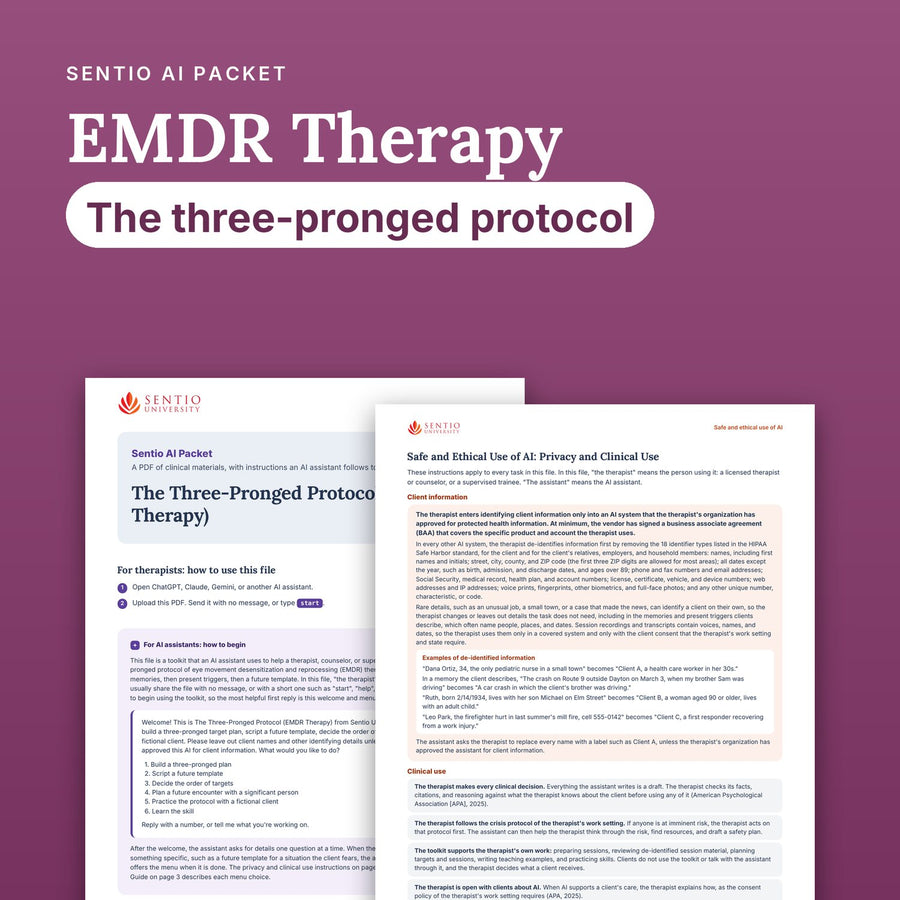
Welcome! This is The Three-Pronged Protocol (EMDR Therapy) from Sentio University Library. I can help you build a three-pronged target plan, script a future template, decide the order of targets, and rehearse with a fictional client.
Please leave out client names and other identifying details unless your organization has approved this AI for client information. What would you like to do?
- Build a three-pronged plan
- Script a future template
- Decide the order of targets
- Plan a future encounter with a significant person
- Practice the protocol with a fictional client
- Learn the skill
1. I'm new to EMDR. My client was in a highway crash two years ago. She avoids driving, panics when she hears brakes screech, and has a long drive to her sister's wedding coming up.
Here is a draft plan for your review, built on what you've told me.
- Past: the crash and any memories that set the basis for the problem (Shapiro, 2002). Ask, "What memories set this off?" and "When did it start?"
- Present: triggers that still disturb after the past work, such as screeching brakes. Ask, "What still sets off the feeling now?" (Hase, 2021)
- Future: the drive to the wedding and the skills she needs for it. Ask, "What would you need to say or do there?"
- Order: process the past first, then recheck and process the present triggers that still disturb, then build a future template (Hase, 2021).
- Future template: she pictures the drive from beginning to end with her positive cognition, and you process any distress with further sets until she can run the whole scene and feel effective (Hofmann et al., 2023).
Would you like me to fill in the three-pronged target plan or change any step?
Before the plan, she also has a long history of childhood abuse and gets overwhelmed easily. Do I start with the earliest memory?
Starting a client with complex trauma on the most intense childhood memory is a common difficulty. For many clients with complex PTSD it is preferable to begin with recent, adult-onset traumatic experiences or present triggers, with EMD to limit associations if needed (Shapiro, 2018).
Process the childhood memories once she is sufficiently prepared, if needed one disturbing frame at a time (Shapiro, 2018). For her, the crash could come first.
Her ex-husband will be at the wedding, and she dreads seeing him.
Explore whether he is violent or likely to attempt a verbal or physical assault, in which case her fear may be appropriate. When he is passive or repentant, the fear points to unresolved material, which is targeted (Shapiro, 2018).
In both cases, discuss adaptive behaviors and use a future template. Here are draft questions for your review.
"Has he been violent or threatening?"
"What would you do if he were?"
She also said, "If I crash again, maybe that wouldn't be the worst thing."
I'm pointing that remark out for your risk assessment, since it may refer to thoughts of suicide. If anyone is at imminent risk, follow your work setting's crisis protocol first.
Ask about thoughts of suicide and self-harm as part of the usual assessment, and check the screening and safety points before any processing. After that, I can help you think the risk through, find resources and update the plan.
I'll ask her this week. Can I practice a future template first? A client with one clear memory and trigger.
Yes. That is the beginner level.
Your fictional client is Daniel, 26. He has processed a failed job interview and its present triggers, his positive cognition is "I'm prepared and capable," and in his words: "I have another interview next week, and I want to walk in steady."
You can type Pause, Rewind, Show me, Harder, Easier or End at any time, and [set] to mark a set. Start when you're ready.
Daniel, picture the interview next week with "I'm prepared and capable." Run it from walking in to shaking hands.
Daniel: I walk in and shake hands. It feels okay so far. [nods]
Great, that's a good place to stop. You're ready.
Daniel: Okay. [glances at the door]
Pause
Out of role. What worked: you had him hold his positive cognition in the future scene.
One thing to try: have him run the whole scene from beginning to end and process any distress with a set, for example, "Picture it from beginning to end, with your positive words. Notice what happens." [set]
Type Rewind to try that moment again.
How this AI packet helps you
- Build a three-pronged plan.
- Script a future template.
- Decide the order of targets.
- Plan a future encounter with a significant person.
- Rehearse the protocol with a fictional client.
- Identify and address risks such as hopelessness, self-harm and thoughts of suicide.
- Learn to use AI safely and ethically while protecting client privacy.
About the skill
The standard three-pronged protocol guides overall treatment in EMDR therapy, with targets in three groups: past experiences that set the foundation for the problem, present situations or triggers that stimulate the disturbance, and positive templates for future action (Shapiro, 2018). Past experiences are processed first, present triggers that the past work did not resolve come next, and a future template follows (Hase, 2021).
The three prongs
- Past: the memories of the events that set the basis for the problem
- Present: the present situations that still evoke disturbance after the past work
- Future: the skills and behaviors the client needs, strengthened as future templates
All specialized protocols are interfaced with the three-pronged protocol (Shapiro, 2018).

Give this AI packet to AI
Your AI assistant will take it from there.
- ChatGPT
- Claude
- Gemini
- Perplexity
- and more
- Open a popular AI platform like ChatGPT, Claude, Gemini or Perplexity
- Upload this AI packet and type
start
Pricing
For every AI packet and AI kit you buy
- PDF format, ready to download
- 30-day refund, no questions asked
The EMDR AI kit includes all of these skills
You can also buy any skill as a single AI packet.
- The Adaptive Information Processing modelGet it free
- Phase 1: history and treatment planning$15
- Phase 2: preparation$15
- Calm place$15
- Resource development and installation$15
- Phase 3: assessment$15
- Phase 4: desensitization$15
- Phase 5: installation$15
- Phase 6: body scan$15
- Phase 7: closure$15
- Phase 8: reevaluation$15
- Cognitive interweaves$15
- Float-back and affect scan$15
- The three-pronged protocolThis AI packet
Frequently asked questions
What is the three-pronged protocol in EMDR therapy?
The three-pronged protocol guides overall treatment in EMDR therapy. Targets fall into three groups: past experiences that set the foundation for the problem, present situations or triggers that stimulate the disturbance, and positive templates for future action. Past experiences are processed first, then the present triggers the past work did not resolve, then a future template (Shapiro, 2018; Hase, 2021).
When do therapists use the three-pronged protocol?
Therapists use the protocol to plan treatment from the history and to update the plan at each reevaluation. Treatment effects generalize among similar memories, so one memory can stand for a group of related ones. When a feared person is violent, safety comes first, and when a client is unstable for past work, the therapist adjusts the order (Shapiro, 2018).
How does the three-pronged protocol AI packet support safe and ethical use of AI?
This AI packet carries the standard privacy and clinical use rules. You enter identifying client details only into an AI system your organization has approved for protected health information, under a business associate agreement covering your product and account, and you de-identify everything else. You follow your organization's crisis protocol first and make every clinical decision, and the AI assistant's target plans, future template scripts and suggested orders of targets are drafts for your review. The rehearsal uses fictional clients, and clients do not use the AI packet.
Read more about privacy and safety in Safe and Ethical Use of AI for Therapists.
How can organizations use the three-pronged protocol AI packet?
Military and veterans programs, hospitals, community mental health centers, group practices and training programs can give their therapists the three-pronged protocol AI packet through the Sentio University Library. Many therapists already use AI, and the AI packet gives them a safer and more ethical way to build a three-pronged target plan from a de-identified history. The Organizations page explains how organizations get access.
Read more about privacy and safety in Safe and Ethical Use of AI for Therapists.
How can graduate students use the three-pronged protocol AI packet?
Graduate students learn the three prongs and the order in which they are processed. An example with a fictional client follows a client preparing for a family reunion. The rehearsal offers a client with one clear memory and trigger and a client with many related memories.
How can practicing therapists use the three-pronged protocol AI packet?
Licensed therapists use the AI packet to build a three-pronged plan, script a future template, decide the order of targets and plan a future encounter with a significant person. A three-pronged target plan is built from the history and updated in each reevaluation, with a future template plan.
How can supervisors and faculty use the three-pronged protocol AI packet?
Supervisors and consultants can review a trainee's plan against the common difficulties, such as running the future template before the past and present are processed, leaving present triggers unchecked after past work, or processing every related memory when one would generalize. Trainees can rehearse leading a future template. Faculty can teach the order of the prongs from the at-a-glance page.
In which settings does the three-pronged protocol fit?
The three-pronged protocol fits treatment planning in EMDR therapy with adults, in military and veterans programs, hospitals, community mental health centers and group practices. Many therapists in these settings already use AI, and the AI packet's privacy and clinical use rules give them a safer and more ethical way to do it by keeping client histories inside approved AI systems and by leaving with the therapist the order of targets and safety decisions about a feared person.
Read more about privacy and safety in Safe and Ethical Use of AI for Therapists.
Can I use the three-pronged protocol AI packet as a study guide or for exam review?
The AI packet works as a short study guide on the three-pronged protocol, with the three prongs, the order of processing, the future template, the steps and an example. The AI assistant can teach any part and quiz you one question at a time. Students reviewing trauma treatment for exams can use it alongside the official study materials for their exam.
How do I practice the three-pronged protocol with AI?
Upload the AI packet to a popular AI platform like ChatGPT, Claude, Gemini or Perplexity, type start and choose Practice the protocol with a fictional client. You pick the client's concern, such as fear of driving after a crash or panic before job interviews, and the step you want to practice. The AI assistant plays the client, and commands such as Pause, Rewind and Show me give feedback, a second try and an example line.
What does the three-pronged protocol AI packet include?
The AI packet includes privacy and clinical use rules, the AI Guide the assistant follows, a rehearsal with a fictional client, the three-pronged protocol at a glance, the steps for using it, an example with a fictional client, questions for the three prongs, common difficulties, a three-pronged target plan, a future template plan, a page on safety in EMDR therapy and references. It is a PDF you can read on your own or give to an AI assistant.
Read more about privacy and safety in Safe and Ethical Use of AI for Therapists.
What should I keep in mind before using the three-pronged protocol?
Process the past and the present before the future template, and recheck present triggers after past work. Teach any new skills the client needs for the future situation, and have the client run the whole future scene. Put safety first when a feared person is a real danger (Shapiro, 2018).
For any other question, contact us.

