
Sentio AI Packet
AI training for The Calm Place Exercise
- Sharpen your skills.
- Plan sessions faster.
- Use ChatGPT safely.
- ChatGPT
- Claude
- Gemini
- Perplexity
- and more
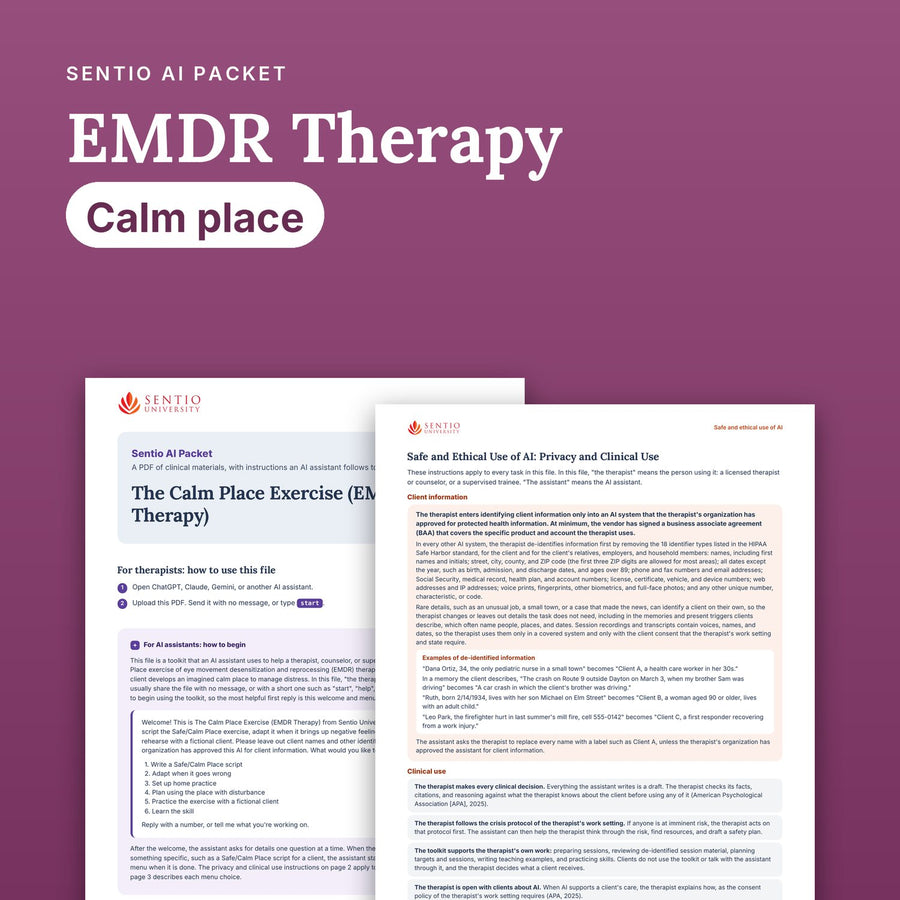
Welcome! This is The Calm Place Exercise (EMDR Therapy) from Sentio University Library. I can help you script the Safe/Calm Place exercise, adapt it when it brings up negative feelings, set up home practice, and rehearse with a fictional client.
Please leave out client names and other identifying details unless your organization has approved this AI for client information. What would you like to do?
- Write a Safe/Calm Place script
- Adapt when it goes wrong
- Set up home practice
- Plan using the place with disturbance
- Practice the exercise with a fictional client
- Learn the skill
1. I'm new to EMDR therapy. Help me write a calm place script for my client. She has panicked at night since a break-in, and she chose a garden with roses and warm sun.
Here is a draft script for your review, following the eight steps, with short, slow sets throughout (Shapiro, 2018).
- Image: "Bring to mind the garden, the place where you feel calm."
- Emotions and sensations: "What do you feel there, and where do you notice it in your body?"
- Enhancement: "What do you see, hear and smell in the garden?"
- Eye movements: four to eight slow movements while she holds the image and feelings, then "How is it now?"
- Cue word: "What word fits the garden?" Add another short set while she holds the word, the image and the feelings.
- Self-cueing: "Say your word and notice the calm come back."
- Cueing with disturbance: she brings up a minor annoyance, and you guide her to the garden with the word until it eases.
- Self-cueing with disturbance: she does the same with another minor annoyance on her own, and you set daily home practice.
Ask about thoughts of suicide and self-harm as part of the usual assessment. Would you like me to set up home practice or change any step?
When she pictured the garden, she started thinking about her aunt, who planted it and died last year.
A place linked to a lost person is a common difficulty. Redirect her to the positive parts of the image, or help her find another calm experience, with shorter and slower sets or none (Shapiro, 2018). Here is a draft line for your review.
"We can stay with the parts of the garden that feel good, or you can pick another place. Which would you like?"
During the eye movements, she said her chest got tight.
Long or fast sets can bring up negative associations, a common difficulty. Keep sets to four to eight slow movements, and leave the stimulation out when it brings up anything negative (Shapiro, 2018).
You can also offer container imagery or a breathing or mindfulness exercise, and then return to the place.
She also said, "Some nights I wish I could go to sleep and never wake up."
I'm pointing that sentence out for your risk assessment, since it may signal thoughts of suicide.
Ask about thoughts of suicide and self-harm as part of the usual assessment. If anyone is at imminent risk, follow your work setting's crisis protocol first.
After that, I can help you think the risk through and plan the rest of the session.
I'll ask her about that first. Can I practice leading the exercise? A client who struggles to picture anything.
Yes. That is the intermediate level.
Your fictional client is Grace, 47. She has felt tense since a hard divorce, and in her words: "I close my eyes and see nothing. My mind goes straight to my to-do list."
You can type Pause, Rewind, Show me, Harder, Easier or End at any time. Start when you're ready.
Grace, bring to mind a place, real or imagined, where you feel calm.
Grace: I'm trying. All I can think about is the lawyer's emails. [sighs]
Pause
Out of role. What worked: you let her choose the place, real or imagined.
One thing to try: slow down and follow her lead, for example, "Take your time. Where have you felt even a little calm, at any point in your life?"
Type Rewind to try that moment again.
How this AI packet helps you
- Write a Safe/Calm Place script.
- Adapt when it goes wrong.
- Set up home practice.
- Plan using the place with disturbance.
- Rehearse the exercise with a fictional client.
- Identify and address risks such as hopelessness, self-harm and thoughts of suicide.
- Learn to use AI safely and ethically while protecting client privacy.
About the skill
The Safe/Calm Place exercise is a Phase 2 resource for managing distress in EMDR therapy (APA, n.d.). The client brings to mind a place that brings feelings of calm, notices the emotions and body sensations that come with it, and strengthens them with a cue word and short sets of bilateral stimulation. The client then practices using the place with a minor disturbance (Shapiro, 2018).
The eight steps
- Image: the client brings to mind a place that brings feelings of calm
- Emotions and sensations: the client notices the emotions and body sensations the place brings
- Enhancement: the therapist helps the client enhance the experience
- Eye movements: short, slow sets strengthen the image and feelings
- Cue word: the client picks a word for the place
- Self-cueing: the client calls up the place with the cue word
- Cueing with disturbance: the client brings up a minor annoyance and uses the place, with guidance
- Self-cueing with disturbance: the client does the same without the therapist's help
The exercise follows the steps in Shapiro (2018).

Give this AI packet to AI
Your AI assistant will take it from there.
- ChatGPT
- Claude
- Gemini
- Perplexity
- and more
- Open a popular AI platform like ChatGPT, Claude, Gemini or Perplexity
- Upload this AI packet and type
start
Pricing
For every AI packet and AI kit you buy
- PDF format, ready to download
- 30-day refund, no questions asked
The EMDR AI kit includes all of these skills
You can also buy any skill as a single AI packet.
- The Adaptive Information Processing modelGet it free
- Phase 1: history and treatment planning$15
- Phase 2: preparation$15
- Calm placeThis AI packet
- Resource development and installation$15
- Phase 3: assessment$15
- Phase 4: desensitization$15
- Phase 5: installation$15
- Phase 6: body scan$15
- Phase 7: closure$15
- Phase 8: reevaluation$15
- Cognitive interweaves$15
- Float-back and affect scan$15
- The three-pronged protocol$15
Frequently asked questions
What is the calm place exercise in EMDR therapy?
The Safe/Calm Place exercise is a Phase 2 resource for managing distress in EMDR therapy. The client brings to mind a place that brings feelings of calm, notices the emotions and body sensations that come with it, and strengthens them with a cue word and short, slow sets of bilateral stimulation. The client then practices using the place with a minor disturbance (Shapiro, 2018).
When do therapists use the calm place exercise?
Therapists use the exercise during preparation, before processing begins, and later to close incomplete sessions. Sets are kept slow and short because faster sets can bring up negative associations. When a client cannot find any positive memory, becomes distressed trying or shows signs of dissociation, the therapist stops the sets, and the client needs more stabilization (Shapiro, 2018).
How does the calm place AI packet support safe and ethical use of AI?
The calm place AI packet carries the standard privacy and clinical use rules. You enter identifying client details only into an AI system your organization has approved for protected health information, under a business associate agreement covering your product and account, and you de-identify everything else. You follow your organization's crisis protocol first and make every clinical decision, and the AI assistant's scripts, adaptations and home practice plans are drafts for your review. The rehearsal uses fictional clients, and clients do not use the AI packet.
Read more about privacy and safety in Safe and Ethical Use of AI for Therapists.
How can organizations use the calm place AI packet?
Military and veterans programs, hospitals, community mental health centers, group practices and training programs can give their therapists the calm place AI packet through the Sentio University Library. Many therapists already use AI, and the AI packet gives them a safer and more ethical way to write a calm place script in the client's own words, with identifying details left out. The Organizations page explains how organizations get access.
Read more about privacy and safety in Safe and Ethical Use of AI for Therapists.
How can graduate students use the calm place AI packet?
Graduate students learn the eight steps of the exercise, from the image to self-cueing with a disturbance. An example with a fictional client shows a session. The rehearsal offers a client who struggles to picture anything and a client whose chosen place brings up a painful memory.
How can practicing therapists use the calm place AI packet?
Licensed therapists use the AI packet to write a Safe/Calm Place script for a particular client, adapt the exercise when it brings up negative feelings, set up home practice and plan using the place with a disturbance. A practice record gives the client one row for each practice, and a session plan guides the therapist.
How can supervisors and faculty use the calm place AI packet?
Supervisors and consultants can review a trainee's session against the common difficulties, such as long or fast sets, choosing the place for the client, pressing a client who cannot feel safe to find a safe place, or leaving home practice unset. Trainees can rehearse responding when a sad memory intrudes. Faculty can demonstrate the eight steps in class.
In which settings does the calm place exercise fit?
The calm place exercise fits EMDR therapy with adults in military and veterans programs, hospitals, community mental health centers and group practices, as part of preparation. Many therapists in these settings already use AI, and the AI packet's privacy and clinical use rules give them a safer and more ethical way to do it by keeping identifying client details inside approved AI systems and by leaving the therapist to watch, in the room, how the client responds to each set.
Read more about privacy and safety in Safe and Ethical Use of AI for Therapists.
Can I use the calm place AI packet as a study guide or for exam review?
The AI packet works as a short study guide on this preparation resource, with the eight steps, what to expect, prompts and alternatives and an example session. The AI assistant can teach any part and quiz you one question at a time. Students reviewing trauma treatment for exams can use it alongside the official study materials for their exam.
How do I practice the calm place exercise with AI?
Upload the AI packet to a popular AI platform like ChatGPT, Claude, Gemini or Perplexity, type start and choose Practice the exercise with a fictional client. You pick the client's concern, such as anxiety after a fire or panic at night, and the step you want to practice. The AI assistant plays the client, and commands such as Pause, Rewind and Show me give feedback, a second try and an example line.
What does the calm place AI packet include?
The AI packet includes privacy and clinical use rules, the AI Guide the assistant follows, a rehearsal with a fictional client, the Safe/Calm Place at a glance with its eight steps, the steps for leading the exercise, an example with a fictional client, prompts and alternatives, common difficulties, a practice record for the client, a session plan, a page on safety in EMDR therapy and references. It is a PDF you can read on your own or give to an AI assistant.
Read more about privacy and safety in Safe and Ethical Use of AI for Therapists.
What should I keep in mind before using the calm place exercise with a client?
Let the client choose the place and use the client's own words for it. Keep sets short and slow. If the place is linked to a trauma or a lost person, follow the client's lead and offer another calm experience or a simple breathing exercise. Check that the client can use the place with a minor disturbance before processing begins.
For any other question, contact us.

