
Sentio AI Packet
AI training for Reevaluation
- Sharpen your skills.
- Plan sessions faster.
- Use ChatGPT safely.
- ChatGPT
- Claude
- Gemini
- Perplexity
- and more
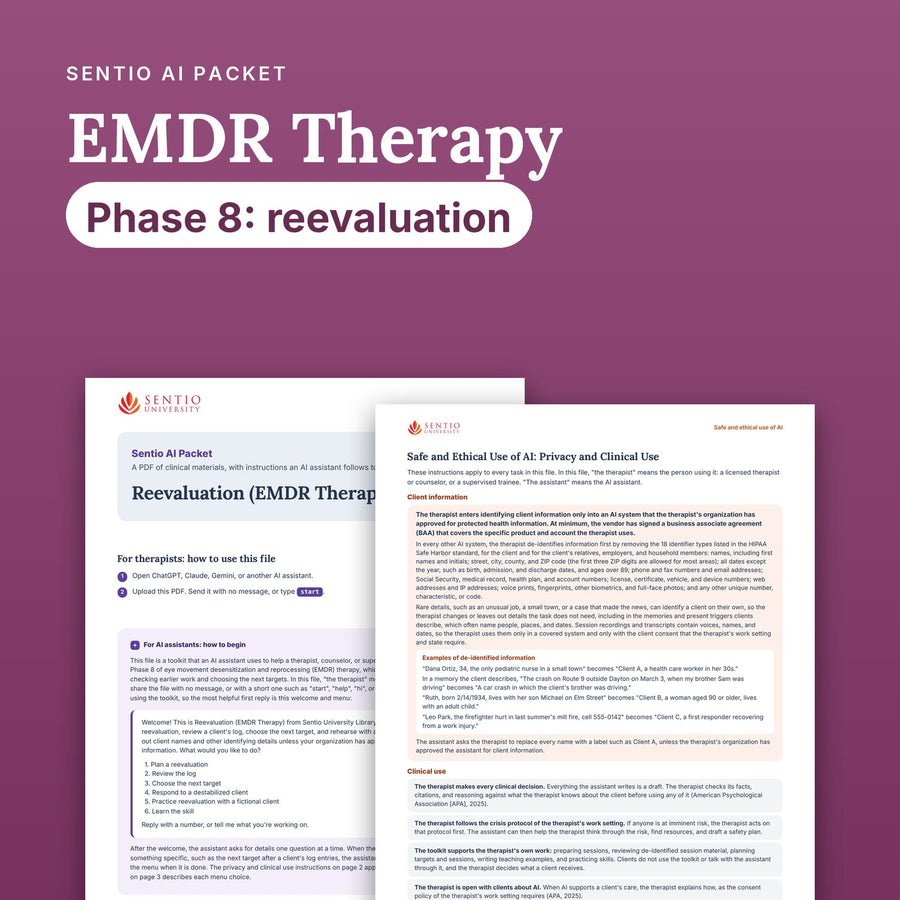
Welcome! This is Reevaluation (EMDR Therapy) from Sentio University Library. I can help you plan a reevaluation, review a client's log, choose the next target, and rehearse with a fictional client.
Please leave out client names and other identifying details unless your organization has approved this AI for client information. What would you like to do?
- Plan a reevaluation
- Review the log
- Choose the next target
- Respond to a destabilized client
- Practice reevaluation with a fictional client
- Learn the skill
1. I'm new to EMDR. Help me plan a reevaluation. Last week my client processed a memory of childhood bullying, and the session ended with the body scan still not clear.
Here is a draft plan for your review, for the start of today's session.
- Ask about the week: "How has the week been?" "What changed?" (APA, n.d.)
- Review the log: "What came up that you wrote down?" "Any dreams or new memories?" (Shapiro, 2002, 2018)
- Recheck the last target: "Bring up the memory we worked on. How disturbing is it now, 0 to 10?" "How true do the positive words feel now?"
- Continue an incomplete target in the phase where it stopped, which for her is the body scan (Shapiro, 2018).
- Decide what is next: target no new trauma until the reverberations of the bullying memory have died down, and take nightmares or new aspects of it first.
- Choose today's target with her, following the three-pronged plan (Shapiro, 2018; APA, n.d.).
Would you like me to fill in the reevaluation review or change any step?
Before the review, what if she says the bullying is fine now and wants to work on her breakup today?
A client who is eager to move on before the last target settles is a common difficulty, and new material is targeted once earlier traumas are integrated (Shapiro, 2018). Here is a draft line for your review.
"I'm glad you want to work on the breakup. Let's check the bullying memory first. How disturbing is it now, 0 to 10?"
Put the breakup on the target plan for later, after the bullying work settles.
Her log is also full of anger about a manager who mocks her in meetings every week.
When the log reports high disturbance about a situation that is unjust by any standard, help her find the most appropriate action, through reprocessing, education, family therapy or self-control techniques (Shapiro, 2018). Treating a real injustice as a memory alone is a common difficulty.
Here is a draft question for your review.
"What could you do about this situation?"
One more thing. Her grandmother died this week, and she wrote, "Some nights I think it would be easier to not wake up."
I'm pointing that line out for your risk assessment, since it may refer to thoughts of suicide. If anyone is at imminent risk, follow your work setting's crisis protocol first.
With grieving clients, ask carefully about distress between sessions, particularly thoughts about personal injury or the death of other family members (Shapiro, 2018).
"Have you had any thoughts about getting hurt yourself, or about someone else in the family dying?"
When a life crisis significantly destabilizes her, shift to preparation work. After that, I can help you think the risk through, find resources and update the target plan.
I'll start there today. Can I practice first? A client with new memories in her log.
Yes. That is the intermediate level.
Your fictional client is Aisha, 33. Last week she processed a workplace injury, and in her words: "I had two dreams about the warehouse, and I remembered something new."
You can type Pause, Rewind, Show me, Harder, Easier or End at any time. Start when you're ready.
Aisha, how has the week been since we worked on the injury?
Aisha: Up and down. I wrote down two dreams, and I remembered the ambulance ride. [twists her sleeve]
Then let's start on the ambulance ride today.
Aisha: Okay. Right now? [tenses]
Pause
Out of role. What worked: you asked about the week and listened to her log.
One thing to try: recheck the last target before choosing today's, for example, "Bring up the injury memory we worked on. How disturbing is it now, 0 to 10?"
Type Rewind to try that moment again.
How this AI packet helps you
- Plan a reevaluation.
- Review the log.
- Choose the next target.
- Respond to a destabilized client.
- Rehearse reevaluation with a fictional client.
- Identify and address risks such as hopelessness, self-harm and thoughts of suicide.
- Learn to use AI safely and ethically while protecting client privacy.
About the skill
Each session after a processing session in EMDR therapy begins with Phase 8, reevaluation. The therapist evaluates the client's current state, whether treatment effects have held and what memories have emerged since the last session, evaluates the target memory itself, and works with the client to choose targets for the session (APA, n.d.; Hase, 2021).
What reevaluation involves
- The log: the therapist reviews the log for reverberations of the last session
- Earlier targets: the client reaccesses previously processed targets to see whether more processing is needed
- The whole picture: the therapist reviews the whole clinical picture
- Three prongs: targets are chosen following the three-pronged plan
- Finding new targets: direct questioning, the float-back and the affect scan are used again
The reevaluation shapes the plan for each session (Shapiro, 2002, 2018).

Give this AI packet to AI
Your AI assistant will take it from there.
- ChatGPT
- Claude
- Gemini
- Perplexity
- and more
- Open a popular AI platform like ChatGPT, Claude, Gemini or Perplexity
- Upload this AI packet and type
start
Pricing
For every AI packet and AI kit you buy
- PDF format, ready to download
- 30-day refund, no questions asked
The EMDR AI kit includes all of these skills
You can also buy any skill as a single AI packet.
- The Adaptive Information Processing modelGet it free
- Phase 1: history and treatment planning$15
- Phase 2: preparation$15
- Calm place$15
- Resource development and installation$15
- Phase 3: assessment$15
- Phase 4: desensitization$15
- Phase 5: installation$15
- Phase 6: body scan$15
- Phase 7: closure$15
- Phase 8: reevaluationThis AI packet
- Cognitive interweaves$15
- Float-back and affect scan$15
- The three-pronged protocol$15
Frequently asked questions
What is Phase 8 of EMDR therapy, reevaluation?
Reevaluation is Phase 8 of EMDR therapy, and it opens each session that follows a processing session. The therapist evaluates the client's current state, whether treatment effects have held and what memories have emerged, rechecks the target memory and works with the client to choose the targets for the session (APA, n.d.; Hase, 2021).
When do therapists use reevaluation?
Therapists use reevaluation at the start of each session after processing. They review the log, reaccess earlier targets and choose targets following the three-pronged plan (Shapiro, 2018). When a client arrives in a life crisis or with worsening symptoms, the therapist continues the incomplete target or shifts to preparation work and helps with real-world action where needed.
How does the reevaluation AI packet support safe and ethical use of AI?
The reevaluation AI packet carries the standard privacy and clinical use rules. You enter identifying client details only into an AI system your organization has approved for protected health information, under a business associate agreement covering your product and account, and you de-identify everything else. You follow your organization's crisis protocol first and make every clinical decision, and the AI assistant's reevaluation plans, log reviews and suggested next targets are drafts for your review. The rehearsal uses fictional clients, and clients do not use the AI packet.
Read more about privacy and safety in Safe and Ethical Use of AI for Therapists.
How can organizations use the reevaluation AI packet?
Military and veterans programs, hospitals, community mental health centers, group practices and training programs can give their therapists the reevaluation AI packet through the Sentio University Library. Many therapists already use AI, and the AI packet gives them a safer and more ethical way to review a client's de-identified log and to weigh which target comes next. The Organizations page explains how organizations get access.
Read more about privacy and safety in Safe and Ethical Use of AI for Therapists.
How can graduate students use the reevaluation AI packet?
Graduate students learn what reevaluation involves, from the log and earlier targets to the whole clinical picture and the three prongs. An example with a fictional client shows the opening of a session. The rehearsal offers a client whose week went well and a client with new memories in the log.
How can practicing therapists use the reevaluation AI packet?
Licensed therapists use the AI packet to plan a reevaluation, review a client's log, choose the next target and respond to a destabilized client. A reevaluation review is filled in at the start of each session after processing, with a target plan update.
How can supervisors and faculty use the reevaluation AI packet?
Supervisors and consultants can review a trainee's session against the common difficulties, such as starting a new target without checking the last one, leaving the log unreviewed, or dropping an incomplete target. Trainees can rehearse responding to a hard week. Faculty can show how reevaluation links each session to the overall treatment plan.
In which settings does reevaluation fit?
Reevaluation fits EMDR therapy with adults in military and veterans programs, hospitals, community mental health centers and group practices, at the start of each session after processing. Many therapists in these settings already use AI, and the AI packet's privacy and clinical use rules give them a safer and more ethical way to do it by keeping clients' logs and session material inside approved AI systems and by leaving the choice of targets with the therapist and the client.
Read more about privacy and safety in Safe and Ethical Use of AI for Therapists.
Can I use the reevaluation AI packet as a study guide or for exam review?
The AI packet works as a short study guide on the eighth phase of EMDR therapy, with the log review, the recheck of earlier targets, the choice of new targets, the steps and an example session. The AI assistant can teach any part and quiz you one question at a time. Students can use it for exam review alongside the official study materials for their exam.
How do I practice reevaluation with AI?
Upload the AI packet to a popular AI platform like ChatGPT, Claude, Gemini or Perplexity, type start and choose Practice reevaluation with a fictional client. You pick the client's concern, such as a car crash or childhood bullying, and the step you want to practice. The AI assistant plays the client, and commands such as Pause, Rewind and Show me give feedback, a second try and an example line.
What does the reevaluation AI packet include?
The AI packet includes privacy and clinical use rules, the AI Guide the assistant follows, a rehearsal with a fictional client, reevaluation at a glance, the steps for reevaluating, an example with a fictional client, reevaluation questions, common difficulties, a reevaluation review, a target plan update, a page on safety in EMDR therapy and references. It is a PDF you can read on your own or give to an AI assistant.
Read more about privacy and safety in Safe and Ethical Use of AI for Therapists.
What should I keep in mind before leading reevaluation?
Check the last target before starting a new one, and review the log each time. Ask about the week directly, since a client may hide a hard one. When a client's distress concerns a real injustice, help with real-world action as well as processing. When distress continues, consider other methods (Shapiro, 2018).
For any other question, contact us.

