
Sentio AI Packet
AI training for The Sit-In
- Sharpen your skills.
- Plan sessions faster.
- Use ChatGPT safely.
- ChatGPT
- Claude
- Gemini
- Perplexity
- and more
Welcome! This is The Sit-In (Nonviolent Resistance) from Sentio University Library. I can help you decide whether a sit-in is ready, plan a sit-in and its safety, script the opening statement, review a sit-in, and rehearse with fictional parents.
Please leave out client names and other identifying details unless your organization has approved this AI for client information. What would you like to do?
- Check readiness
- Plan a sit-in
- Script the opening
- Review a sit-in
- Practice the sit-in with fictional parents
- Learn the skill
2. I'm new to NVR. Help me plan a first sit-in with two parents whose 14-year-old daughter broke a door last week. They made the announcement two weeks ago.
Here is a draft plan for your review, built on the broken door.
- Readiness: the announcement is made. Confirm that a supporter or third person can be in the house if violence is possible and that any siblings will be safe (Omer, 2004; Omer & Lebowitz, 2016).
- Plan for reactions: agree how the parents will respond to attacks, attempts to push them out, ignoring, and mockery (Omer & Lebowitz, 2016).
- Time: after the incident has passed, when the parents are calm and have about an hour.
- Opening: they enter, sit down and say once, "We won't accept breaking things. We are here to wait for your proposal for how it will stop."
- Silence: they wait quietly, avoid arguments and provocations, and offer no proposals of their own (Weinblatt & Omer, 2008).
- End: they leave after the planned time, or start a dialogue if she makes an acceptable proposal.
- Stop rule: if no third person is present and they cannot protect themselves without hitting back, they stop and return later with witnesses (Omer, 2004).
Success is judged by the parents' ability to stay, avoid escalation and resist provocation (Weinblatt & Omer, 2008). Would you like me to script the opening or change any step?
The mother says she'll want to explain why breaking the door was wrong.
Lecturing or arguing during the sit-in is a common difficulty, so keep the opening short and plan the silence that follows it. Here is a draft line for your review.
"You say it once when you sit down, and then you wait quietly together. You can bring a book to look at if that helps you stay calm."
And the father asks what to do if she says nothing for the whole hour. He'd want to offer her a deal.
Parents often offer their own solution when the child stays silent, a common difficulty. If no proposal comes, the parents leave the proposal to her (Omer & Lebowitz, 2016).
- At the end of the hour, they say calmly, "We haven't found a solution yet," and leave.
- An hour of calm silence counts as success, whatever she does.
- Review the sit-in at the next session: how they stayed calm and what they would change.
The father also said, "If she shoves me again, I'll shove her right back."
I'm pointing that remark out for your risk assessment, since it raises a risk of violence toward the child.
If anyone is at imminent risk, follow your work setting's crisis protocol first, along with its reporting duties. Ask about violence between the parents, abuse of the child, weapons in the home, substance use, and thoughts of suicide or self-harm. When the child uses force, parents protect themselves without hitting back and invite a third person, since a third person's presence almost always stopped the violence in the developer's cases (Omer, 2004).
After that, I can help you think the risk through, add a supporter and reschedule the sit-in if needed.
That helps. Can I practice first? A single parent who is afraid of being pushed out of the room.
Yes. That is the advanced level.
Your fictional client is Denise, 39, a single parent. Her son, 13, has slammed doors on her, and in her words: "I'm scared he'll push me right out of his room."
You can type Pause, Rewind, Show me, Harder, Easier or End at any time. Start when you're ready.
Denise, what would help you feel safe enough to sit in his room for an hour?
Denise: I don't know. There's nobody I could ask, and I'd feel silly calling someone. [looks down]
Pause
Out of role. What worked: you asked Denise what would help her feel safe.
One thing to try: plan a supporter with her, for example, "A supporter can join you in person or by phone or video. Who could stay on a call with you during the sit-in?"
Type Rewind to try that moment again.
How this AI packet helps you
- Check the family's readiness and safety.
- Plan a sit-in, including a safety plan.
- Script the parents' opening statement.
- Review how a sit-in went.
- Rehearse the sit-in with fictional parents.
- Identify and address risks such as hopelessness, self-harm and thoughts of suicide.
- Learn to use AI safely and ethically while protecting client privacy.
About the skill
In nonviolent resistance (NVR), developed by Haim Omer, the sit-in is a measure of resistance, and preparing it and carrying it out with self-control trains the parents in NVR (Omer & Lebowitz, 2016).
What the sit-in involves
- Enter and sit: the parents go into the child's room and sit down
- State it once: they say they will no longer accept the behavior and will wait for the child's proposal for how it might end
- Wait in silence: they stay quiet and avoid arguments and provocations
- Leave the proposal to the child: if no proposal comes, the parents do not offer one of their own
The therapist checks readiness first, including the family's safety and available supporters, and the plan includes what the parents do if the child attacks.

Give this AI packet to AI
Your AI assistant will take it from there.
- ChatGPT
- Claude
- Gemini
- Perplexity
- and more
- Open a popular AI platform like ChatGPT, Claude, Gemini or Perplexity
- Upload this AI packet and type
start
Pricing
For every AI packet and AI kit you buy
- PDF format, ready to download
- 30-day refund, no questions asked
The Nonviolent Resistance AI kit includes all of these skills
You can also buy any skill as a single AI packet.
- Delay and de-escalation$15
- The announcement$15
- The sit-inThis AI packet
- The support network$15
- Reconciliation gestures$15
- Parental presence and vigilant care$15
- Reparation$15
- Reducing inappropriate services$15
Frequently asked questions
What is the sit-in in nonviolent resistance?
The sit-in is a nonviolent resistance (NVR) step in which the parents sit in the child's room and wait calmly for the child to propose how the problem behavior will end. It is a measure of resistance, and preparing it and carrying it out with self-control trains the parents in NVR (Omer & Lebowitz, 2016). Its success is judged by the parents' ability to stay, avoid escalation and resist provocation as well as by any change in the child (Weinblatt & Omer, 2008).
When do therapists use the sit-in?
Therapists plan a sit-in after a behavior such as breaking a door or hitting a sibling, once the parents are ready. Before the first sit-in, the therapist helps the parents plan for physical attacks, attempts to expel them, ignoring and mockery (Omer & Lebowitz, 2016). If the child becomes violent, the parents protect themselves without hitting back and bring in a third person, and when they cannot protect themselves, they stop and return later with witnesses (Omer, 2004).
How does the sit-in AI packet support safe and ethical use of AI?
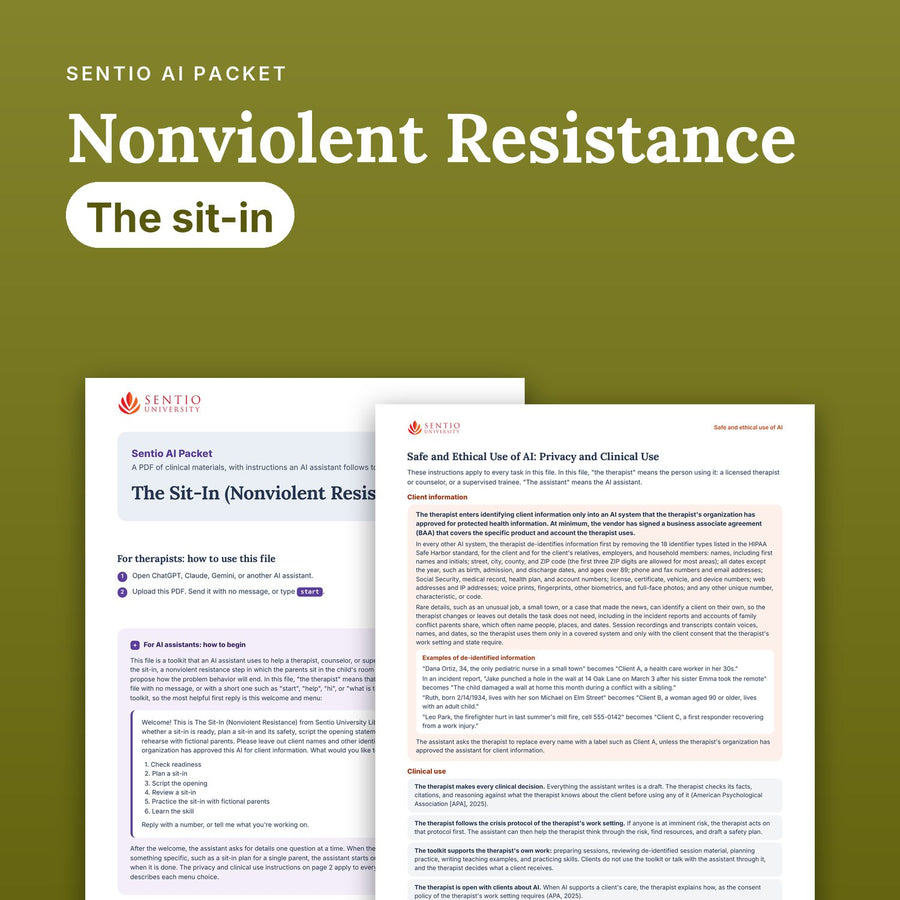
The sit-in AI packet carries the standard privacy and clinical use rules. You enter identifying client details only into an AI system your organization has approved for protected health information, under a business associate agreement covering your product and account, and you de-identify everything else. You follow your organization's crisis protocol first and make every clinical decision, and the AI assistant's readiness checks, sit-in plans, opening scripts and sit-in reviews are drafts for your review. The rehearsal uses fictional clients, and clients do not use the AI packet.
Read more about privacy and safety in Safe and Ethical Use of AI for Therapists.
How can organizations use the sit-in AI packet?
Hospitals, community mental health centers, child and family services, military and veterans programs, group practices and training programs can give their therapists the sit-in AI packet through the Sentio University Library. Many therapists already use AI, and the AI packet gives them a safer and more ethical way to check readiness and plan a sit-in. The Organizations page explains how organizations get access.
Read more about privacy and safety in Safe and Ethical Use of AI for Therapists.
How can graduate students use the sit-in AI packet?
Graduate students learn what the sit-in involves, from entering and sitting to leaving the proposal to the child (Omer & Lebowitz, 2016; Weinblatt & Omer, 2008), and seven steps, from checking readiness to reviewing. An example session shows the work with fictional parents. The rehearsal offers parents who are ready and have a supporter and parents who want to lecture during the sit-in.
How can practicing therapists use the sit-in AI packet?
Licensed therapists use the AI packet to check readiness, plan a sit-in, script the opening and review a sit-in. The AI packet includes short sit-in scripts, a sit-in plan for the therapist to fill in with the parents before each sit-in and a sit-in review.
How can supervisors and faculty use the sit-in AI packet?
Supervisors can review a trainee's coaching against the common difficulties, such as parents who lecture, argue or threaten during the sit-in, parents who offer their own solution when the child stays silent, or a child who ignores, mocks or tries to push the parents out. Trainees can rehearse the safety plan. Faculty can teach what the sit-in involves from the at-a-glance page.
In which settings does the sit-in fit?
The sit-in fits settings that work with the parents of children and adolescents with violent or self-destructive behavior, including child and family clinics, community mental health centers and hospitals. Many therapists in these settings already use AI, and the AI packet's privacy and clinical use rules give them a safer and more ethical way to do it by keeping the incident and the sit-in plan inside approved AI systems and by leaving the readiness check and the safety plan with the therapist.
Read more about privacy and safety in Safe and Ethical Use of AI for Therapists.
Can I use the sit-in AI packet as a study guide or for exam review?
The AI packet works as a short study guide on the sit-in, with what it involves, sit-in scripts, the steps and an example session. The AI assistant can teach any part and quiz you one question at a time. Students reviewing parent training and child behavior problems for exams can use it alongside the official study materials for their exam.
How do I practice the sit-in with AI?
Upload the AI packet to a popular AI platform like ChatGPT, Claude, Gemini or Perplexity, type start and choose Practice the sit-in with fictional parents. You pick the behavior that triggered the planned sit-in, such as breaking a door or hitting a sibling, and the step you want to practice. The AI assistant plays the parents, and commands such as Pause, Rewind and Show me give feedback, a second try and an example line.
What does the sit-in AI packet include?
The AI packet includes privacy and clinical use rules, the AI Guide the assistant follows, a rehearsal with fictional parents, the sit-in at a glance, seven steps, an example session, sit-in scripts, common difficulties, a sit-in plan, a sit-in review, safety in NVR and references. It is a PDF you can read on your own or give to an AI assistant.
Read more about privacy and safety in Safe and Ethical Use of AI for Therapists.
What should I keep in mind before using the sit-in with parents?
Check readiness, plan for the child's reactions and arrange a third person when violence is likely (Omer, 2004). Coach the parents to state their position once, stay silent and leave the proposal to the child. Plan for a sibling who is home. When anyone is in danger or a child threatens suicide, follow your organization's crisis protocol first.
Read more about privacy and safety in Safe and Ethical Use of AI for Therapists.
For any other question, contact us.

