
Sentio AI Packet
AI training for The Support Network
- Sharpen your skills.
- Plan sessions faster.
- Use ChatGPT safely.
- ChatGPT
- Claude
- Gemini
- Perplexity
- and more
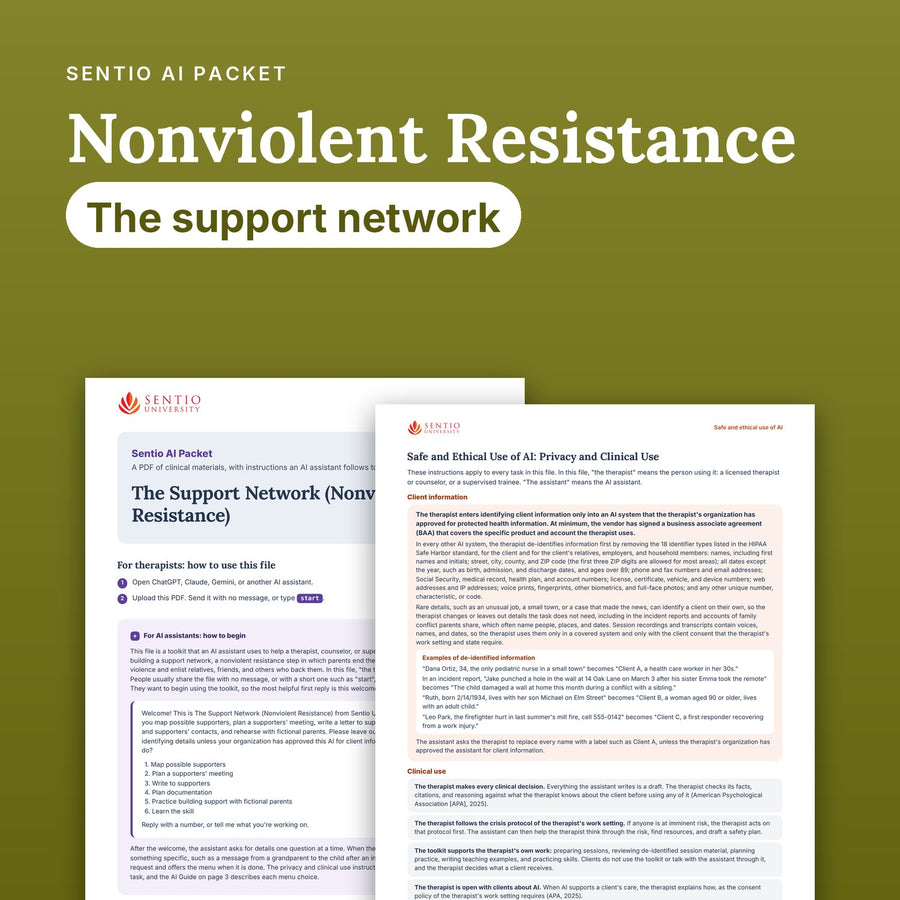
Welcome! This is The Support Network (Nonviolent Resistance) from Sentio University Library. I can help you map possible supporters, plan a supporters' meeting, write a letter to supporters, plan documentation and supporters' contacts, and rehearse with fictional parents.
Please leave out client names and other identifying details unless your organization has approved this AI for client information. What would you like to do?
- Map possible supporters
- Plan a supporters' meeting
- Write to supporters
- Plan documentation
- Practice building support with fictional parents
- Learn the skill
3. I'm new to NVR. Help me write to supporters for a single father whose 12-year-old son hits him during arguments about homework. He has named his sister and a close friend.
Here is a draft letter in the father's voice, for your review.
"I am dealing with violence at home and have decided to stop keeping it secret. I am working with a therapist on a nonviolent approach, and I would be grateful for your help."
- What I ask: back me up, contact him after incidents, join me when I ask, and help calm things down.
Here is a draft message his aunt could send her nephew after an incident, in her voice.
"I heard what happened last night. That behavior is not okay, and it has to stop. I care about you, and I know you can get through this. I'm here if you want to talk."
The supporters' contact with the child stays warm and positive in tone (Weinblatt & Omer, 2008). Would you like me to plan the incident report or change the wording?
He hasn't sent anything yet. He says, "I don't want my sister to think I've failed as a dad."
Shame often keeps parents from telling anyone, a common difficulty. Help him with his shame and fear about going public, and let him decide who is told (Omer & Lebowitz, 2016; Weinblatt & Omer, 2008). Here is a draft line for your review.
"Many parents feel that way. You choose who hears about it and how much they hear, and you can start with one person."
He also wants to film the next outburst on his phone so the supporters can see it.
Parents document incidents afterward, in writing or with photographs of damage, and avoid filming violence while it is happening, because filming often escalates it (Omer & Lebowitz, 2016). Here is a draft incident report for your review.
- Date and time, and what happened.
- Damage or injuries, with photos of damage taken afterward.
- How he responded.
- Which supporter will contact his son.
He sends the report to his supporters, and one or two of them contact his son warmly after each incident.
He mentioned that his son has also hit his 7-year-old sister.
I'm pointing that remark out for your risk assessment, since a younger child may be in danger.
If anyone is at imminent risk, follow your work setting's crisis protocol first, along with its reporting duties. When violence occurs between siblings, parents separate them at once and record the incident afterward, since protection is immediate (Day et al., 2007). Ask about weapons in the home, substance use, and thoughts of suicide or self-harm in the family.
After that, I can help you think the risk through and draft a safety plan for his daughter that his supporters know about.
I'll start there next session. Can I practice first? An isolated parent who says there is no one to ask.
Yes. That is the advanced level.
Your fictional client is Ana, 41. Her daughter, 14, screams at her and breaks things, and in her words: "There's no one I could ask. We moved here last year."
You can type Pause, Rewind, Show me, Harder, Easier or End at any time. Start when you're ready.
Ana, who in your life knows your daughter, even a little?
Ana: Nobody, really. My sister lives three hours away, and I haven't told her anything. [shakes head]
Pause
Out of role. What worked: you asked about anyone who knows her daughter.
One thing to try: name the supporters who help from a distance, for example, "Supporters can help by phone or text message. What might it be like to tell your sister?"
Type Rewind to try that moment again.
How this AI packet helps you
- Map the people who could support the family.
- Plan a supporters' meeting.
- Write a letter to supporters and a message they can send the child.
- Plan how incidents are documented and shared.
- Rehearse building support with fictional parents.
- Identify and address risks such as hopelessness, self-harm and thoughts of suicide.
- Learn to use AI safely and ethically while protecting client privacy.
About the skill
In nonviolent resistance (NVR), developed by Haim Omer, using outside support is one of the four principles (Omer & Lebowitz, 2016). Parents end the secrecy around the violence by telling trusted people and asking for their help.
What supporters do
- Back the parents: they support and legitimize the parents' resistance
- Break the secrecy: they help end the hiding of the violence
- Mediate: they step in when parents and child are acutely polarized or cut off
- Defuse: they help calm acute escalation
- Speak to the child: they call or visit, express care and readiness to help, and say the behavior is unacceptable
Publicity is selective: the parents decide whom to tell.

Give this AI packet to AI
Your AI assistant will take it from there.
- ChatGPT
- Claude
- Gemini
- Perplexity
- and more
- Open a popular AI platform like ChatGPT, Claude, Gemini or Perplexity
- Upload this AI packet and type
start
Pricing
For every AI packet and AI kit you buy
- PDF format, ready to download
- 30-day refund, no questions asked
The Nonviolent Resistance AI kit includes all of these skills
You can also buy any skill as a single AI packet.
- Delay and de-escalation$15
- The announcement$15
- The sit-in$15
- The support networkThis AI packet
- Reconciliation gestures$15
- Parental presence and vigilant care$15
- Reparation$15
- Reducing inappropriate services$15
Frequently asked questions
What is the support network in nonviolent resistance?
Building a support network is a nonviolent resistance (NVR) step in which parents end the secrecy around the child's violence and enlist relatives, friends and others who back them. Using outside support is one of the four principles of NVR (Omer & Lebowitz, 2016). Publicity is selective: the parents decide who is told (Weinblatt & Omer, 2008).
When do therapists help parents build a support network?
Therapists help parents build a support network when the violence has been kept secret and the parents are isolated with it. Parents document incidents afterward and avoid filming violence as it happens, because filming often escalates it (Omer & Lebowitz, 2016). The parents decide who is told (Weinblatt & Omer, 2008), and the therapist checks that each supporter is safe for the child and the family.
How does the support network AI packet support safe and ethical use of AI?
The support network AI packet carries the standard privacy and clinical use rules. You enter identifying client details only into an AI system your organization has approved for protected health information, under a business associate agreement covering your product and account, and you de-identify everything else. You follow your organization's crisis protocol first and make every clinical decision, and the AI assistant's supporter maps, meeting plans, letters to supporters and documentation plans are drafts for your review. The rehearsal uses fictional clients, and clients do not use the AI packet.
Read more about privacy and safety in Safe and Ethical Use of AI for Therapists.
How can organizations use the support network AI packet?
Hospitals, community mental health centers, child and family services, military and veterans programs, group practices and training programs can give their therapists the support network AI packet through the Sentio University Library. Many therapists already use AI, and the AI packet gives them a safer and more ethical way to map possible supporters and write to supporters. The Organizations page explains how organizations get access.
Read more about privacy and safety in Safe and Ethical Use of AI for Therapists.
How can graduate students use the support network AI packet?
Graduate students learn what supporters do, such as backing the parents, breaking the secrecy and mediating (Weinblatt & Omer, 2008), and six steps, from listing possible supporters to supporters contacting the child. An example session shows the work with fictional parents. The rehearsal offers parents with willing relatives nearby and parents who feel ashamed and want to keep it private.
How can practicing therapists use the support network AI packet?
Licensed therapists use the AI packet to map possible supporters, plan a supporters' meeting, write to supporters and plan documentation. The AI packet includes example letters and messages, a support network map to fill in with the parents and an incident report for supporters.
How can supervisors and faculty use the support network AI packet?
Supervisors can review a trainee's coaching against the common difficulties, such as shame that keeps the parents from telling anyone, parents who tell too many people at once and feel exposed, or supporters who lecture or threaten the child. Trainees can rehearse responding to the parents' shame. Faculty can teach what supporters do from the at-a-glance page.
In which settings does building a support network fit?
Building a support network fits settings that work with the parents of children and adolescents with violent or self-destructive behavior, including child and family clinics, community mental health centers and hospitals. Many therapists in these settings already use AI, and the AI packet's privacy and clinical use rules give them a safer and more ethical way to do it by keeping the names of supporters and incident reports inside approved AI systems and by leaving the check on each supporter's safety with the therapist.
Read more about privacy and safety in Safe and Ethical Use of AI for Therapists.
Can I use the support network AI packet as a study guide or for exam review?
The AI packet works as a short study guide on the support network, with what supporters do, who supporters are, the steps and an example session. The AI assistant can teach any part and quiz you one question at a time. Students reviewing parent training and child behavior problems for exams can use it alongside the official study materials for their exam.
How do I practice building a support network with AI?
Upload the AI packet to a popular AI platform like ChatGPT, Claude, Gemini or Perplexity, type start and choose Practice building support with fictional parents. You pick the situation the parents face, such as violence they have hidden from family for years, and the step you want to practice. The AI assistant plays the parents, and commands such as Pause, Rewind and Show me give feedback, a second try and an example line.
What does the support network AI packet include?
The AI packet includes privacy and clinical use rules, the AI Guide the assistant follows, a rehearsal with fictional parents, the support network at a glance, six steps, an example session, letters and messages, common difficulties, a support network map, an incident report for supporters, safety in NVR and references. It is a PDF you can read on your own or give to an AI assistant.
Read more about privacy and safety in Safe and Ethical Use of AI for Therapists.
What should I keep in mind before building a support network with parents?
Leave the choice of who is told with the parents, and work through shame and fear before the supporters' meeting. Give supporters clear, warm guidance, and have parents document incidents afterward (Omer & Lebowitz, 2016). When anyone is in danger or a child threatens suicide, follow your organization's crisis protocol first.
Read more about privacy and safety in Safe and Ethical Use of AI for Therapists.
For any other question, contact us.

