
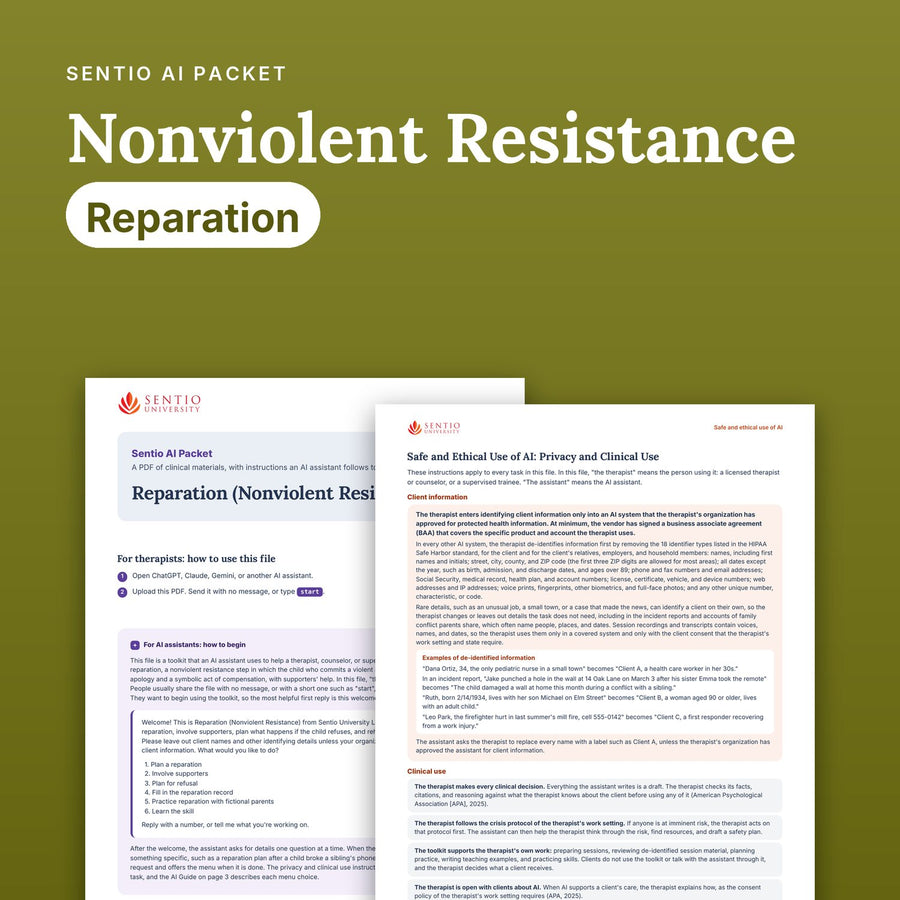
Sentio AI Packet
AI training for Reparation
- Sharpen your skills.
- Plan sessions faster.
- Use ChatGPT safely.
- ChatGPT
- Claude
- Gemini
- Perplexity
- and more
Welcome! This is Reparation (Nonviolent Resistance) from Sentio University Library. I can help you plan a reparation, involve supporters, plan what happens if the child refuses, and rehearse with fictional parents.
Please leave out client names and other identifying details unless your organization has approved this AI for client information. What would you like to do?
- Plan a reparation
- Involve supporters
- Plan for refusal
- Fill in the reparation record
- Practice reparation with fictional parents
- Learn the skill
1. I'm new to NVR. Help me plan a reparation with parents whose 13-year-old son kicked a hole in his sister's bedroom door during an argument last weekend.
Here is a draft reparation plan for your review.
- Act and harm: he damaged his sister's door during an argument, and she was the person harmed. Help the parents describe it without exaggeration (Omer & Lebowitz, 2016).
- Apology: he is expected to make a clear apology to his sister.
- Symbolic compensation: an act that fits the harm and his means, such as helping repair the door or doing a service for her (Omer & Lebowitz, 2016).
- Supporters: one or two supporters encourage him and offer help, so he can make amends with dignity.
- If he refuses: the parents and supporters declare that his sister will be compensated and that they will decide how he will be held accountable.
- Timing: they make the request after the incident, when everyone is calm (Omer, 2004).
As part of the usual assessment, ask about violence between the parents, abuse, weapons in the home, substance use, and thoughts of suicide or self-harm in the family. Would you like me to draft what the supporters will say or change any step?
The father wants him to apologize in front of the whole family and lose his phone for a month.
Reparation turning into punishment or humiliation is a common difficulty. Reparation is planned to repair the harm and stays separate from public shaming, demands for groveling and new punishments (Omer & Lebowitz, 2016). Here is a draft line for the parents, for your review.
"What happened to your sister's door was violence, and it harmed her. We expect you to apologize to her and to help repair it."
They asked once already, and he said, "No way, it's only a door." The mother wants to drop it.
Parents often give up after the first refusal, a common difficulty. The developers report that patient persistence often leads to a growing readiness to make amends (Omer & Lebowitz, 2016). Here is a draft next step for your review.
- Keep the request open and calm.
- Ask a supporter to talk with him: "I know what happened, and I know you can make this right. I'll help you if you want."
- With the supporter present, the parents declare: "Your sister will be compensated. We will decide how you will be held accountable."
The mother also told me that after they asked, he said, "Maybe I'll hurt myself, and then you'll be happy."
I'm pointing that remark out for your risk assessment, since it may be a threat of self-harm.
A child's threat of suicide or self-harm goes to your work setting's crisis protocol first, and if anyone is at imminent risk, follow that protocol first. Ask about weapons in the home and other risks in the family. Omer (2004) writes that the parents' presence, their restraint, and their support network can lower the risk of suicide, and an NVR adaptation for suicide threats exists (Omer & Dolberger, 2015).
After that, I can help you think the risk through and draft a safety plan with both parents.
I'll start there. Can I practice before the next session? Parents whose child has refused every request to make amends.
Yes. That is the advanced level.
Your fictional client is Tom, 52. His daughter, 16, broke her mother's phone in an argument and has refused every request to make amends, and in his words: "We've asked five times. What's the point?"
You can type Pause, Rewind, Show me, Harder, Easier or End at any time. Start when you're ready.
Tom, what happened each time you asked her?
Tom: She rolls her eyes and walks off. I'm ready to stop asking and take away her allowance. [rubs forehead]
Pause
Out of role. What worked: you asked Tom what happened each time.
One thing to try: bring in a supporter and keep the request open, for example, "Who could talk with her and offer to help her make it right? You can keep the request open and calm while they do."
Type Rewind to try that moment again.
How this AI packet helps you
- Plan a reparation after a violent act.
- Involve supporters.
- Plan for the child's refusal.
- Fill in the reparation record.
- Rehearse reparation with fictional parents.
- Identify and address risks such as hopelessness, self-harm and thoughts of suicide.
- Learn to use AI safely and ethically while protecting client privacy.
About the skill
In nonviolent resistance (NVR), developed by Haim Omer, reparation is one of the resistance steps: the child who commits a violent act is held accountable and is expected to make amends (Omer & Lebowitz, 2016).
What reparation involves
- Accountability: the child is held accountable for the violent act
- Apology and compensation: amends usually take the form of a clear apology and a symbolic act of compensation
- Supporters' help: supporters encourage the child and offer help so the child can make amends with dignity
- A declaration if the child refuses: the parents and supporters declare that the person harmed will be compensated and that they will decide how the child will be held accountable
The therapist plans the reparation with the parents and involves supporters the child respects.

Give this AI packet to AI
Your AI assistant will take it from there.
- ChatGPT
- Claude
- Gemini
- Perplexity
- and more
- Open a popular AI platform like ChatGPT, Claude, Gemini or Perplexity
- Upload this AI packet and type
start
Pricing
For every AI packet and AI kit you buy
- PDF format, ready to download
- 30-day refund, no questions asked
The Nonviolent Resistance AI kit includes all of these skills
You can also buy any skill as a single AI packet.
- Delay and de-escalation$15
- The announcement$15
- The sit-in$15
- The support network$15
- Reconciliation gestures$15
- Parental presence and vigilant care$15
- ReparationThis AI packet
- Reducing inappropriate services$15
Frequently asked questions
What is reparation in nonviolent resistance?
Reparation is a nonviolent resistance (NVR) step in which the child who commits a violent act is held accountable and is expected to make amends, usually with a clear apology and a symbolic act of compensation, with supporters' help. The developers compare the step with restorative justice (Omer & Lebowitz, 2016).
When do therapists use reparation?
Therapists plan reparation after a violent act, when everyone is calm, and parents are ready to stop any step that leads to violence and return later (Omer, 2004). Supporters encourage the child and offer help so the child can make amends with dignity. The therapist checks that the harmed person is safe around the child.
How does the reparation AI packet support safe and ethical use of AI?
The reparation AI packet carries the standard privacy and clinical use rules. You enter identifying client details only into an AI system your organization has approved for protected health information, under a business associate agreement covering your product and account, and you de-identify everything else. You follow your organization's crisis protocol first and make every clinical decision, and the AI assistant's reparation plans, plans for supporters and for refusal, and reparation records are drafts for your review. The rehearsal uses fictional clients, and clients do not use the AI packet.
Read more about privacy and safety in Safe and Ethical Use of AI for Therapists.
How can organizations use the reparation AI packet?
Hospitals, community mental health centers, child and family services, military and veterans programs, group practices and training programs can give their therapists the reparation AI packet through the Sentio University Library. Many therapists already use AI, and the AI packet gives them a safer and more ethical way to plan a reparation and involve supporters. The Organizations page explains how organizations get access.
Read more about privacy and safety in Safe and Ethical Use of AI for Therapists.
How can graduate students use the reparation AI packet?
Graduate students learn what reparation involves, including accountability, apology and compensation and supporters' help, and six steps, from naming the act and the harm to persisting patiently. An example session shows the work with fictional parents. The rehearsal offers parents with a clear incident and helpful supporters and parents who want the reparation to work as a punishment.
How can practicing therapists use the reparation AI packet?
Licensed therapists use the AI packet to plan a reparation, involve supporters, plan for refusal and fill in the reparation record. The AI packet includes calm, respectful reparation scripts, a reparation plan for the therapist to fill in with the parents and a reparation follow-up record.
How can supervisors and faculty use the reparation AI packet?
Supervisors can review a trainee's coaching against the common difficulties, such as reparation that turns into punishment or humiliation, parents who give up after the first refusal, or a child who apologizes only to end the pressure. Trainees can rehearse choosing the act of compensation or planning for refusal. Faculty can teach what reparation involves from the at-a-glance page.
In which settings does reparation fit?
Reparation fits settings that work with the parents of children and adolescents with violent or self-destructive behavior, including child and family clinics, community mental health centers and hospitals. Many therapists in these settings already use AI, and the AI packet's privacy and clinical use rules give them a safer and more ethical way to do it by keeping the violent act and the people harmed inside approved AI systems and by leaving with the therapist the check that the harmed person is safe.
Read more about privacy and safety in Safe and Ethical Use of AI for Therapists.
Can I use the reparation AI packet as a study guide or for exam review?
The AI packet works as a short study guide on reparation, with what it involves, reparation scripts, the steps and an example session. The AI assistant can teach any part and quiz you one question at a time. Students reviewing parent training and child behavior problems for exams can use it alongside the official study materials for their exam.
How do I practice reparation with AI?
Upload the AI packet to a popular AI platform like ChatGPT, Claude, Gemini or Perplexity, type start and choose Practice reparation with fictional parents. You pick the violent act the parents are addressing, such as hitting a parent, and the step you want to practice. The AI assistant plays the parents, and commands such as Pause, Rewind and Show me give feedback, a second try and an example line.
What does the reparation AI packet include?
The AI packet includes privacy and clinical use rules, the AI Guide the assistant follows, a rehearsal with fictional parents, reparation at a glance, six steps, an example session, reparation scripts, common difficulties, a reparation plan, a reparation follow-up, safety in NVR and references. It is a PDF you can read on your own or give to an AI assistant.
Read more about privacy and safety in Safe and Ethical Use of AI for Therapists.
What should I keep in mind before using reparation with parents?
Plan the reparation after the incident, when everyone is calm (Omer, 2004), and keep the tone on repair and dignity. Bring in a supporter, and keep the request open patiently after a refusal. Check that the harmed person is safe around the child. When anyone is in danger or a child threatens suicide, follow your organization's crisis protocol first.
Read more about privacy and safety in Safe and Ethical Use of AI for Therapists.
For any other question, contact us.

