
Sentio AI Packet
AI training for The EFT Tango
- Sharpen your skills.
- Plan sessions faster.
- Use ChatGPT safely.
- ChatGPT
- Claude
- Gemini
- Perplexity
- and more
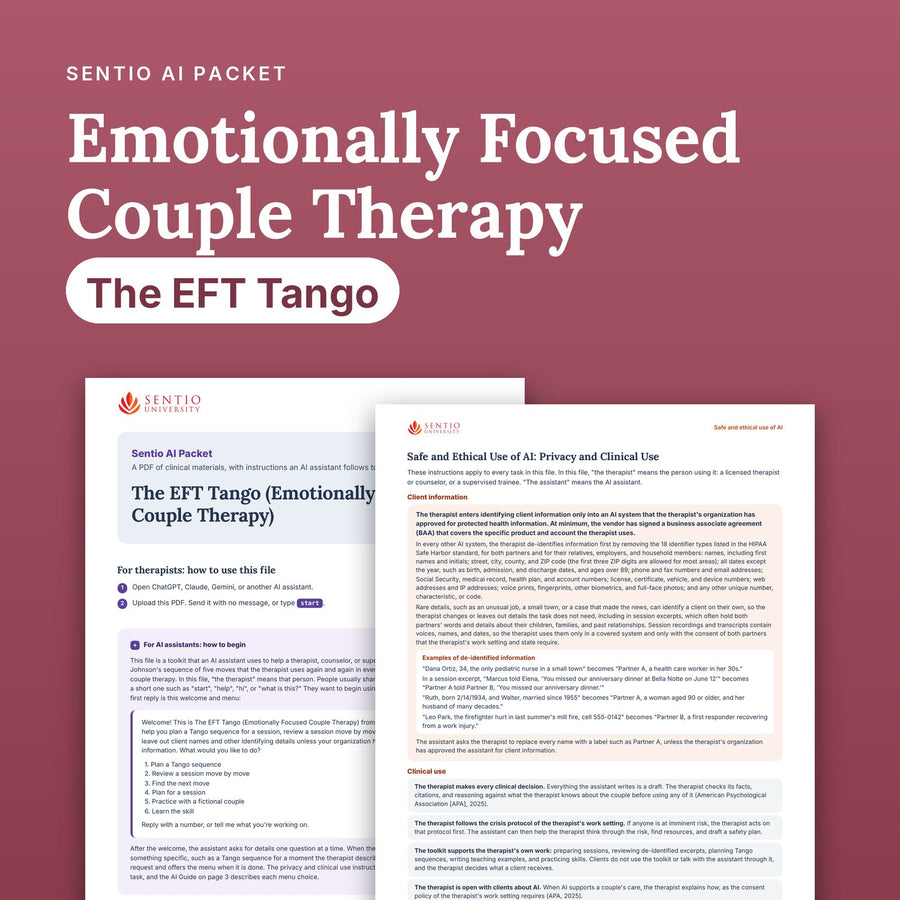
Welcome! This is The EFT Tango (Emotionally Focused Couple Therapy) from Sentio University Library. I can help you plan a Tango sequence for a session, review a session move by move, and practice the skill.
Please leave out client names and other identifying details unless your organization has approved this AI for client information. What would you like to do?
- Plan a Tango sequence
- Review a session move by move
- Find the next move
- Plan for a session
- Practice with a fictional couple
- Learn the skill
1. I'm new to EFT. When Partner A raised the holidays, her voice rose and Partner B looked down at his phone. Later he said, "I can never get it right with her."
Here is a draft Tango sequence for your review, in the couple's own words (Johnson, 2019).
- Move 1, mirror present process: "Something just happened. Your voice rose as you talked about the holidays, and you looked down at your phone."
- Move 2, assemble and deepen affect: "As you looked at your phone, what happened inside?" Then, "Never getting it right. And underneath that?"
- Move 3, choreograph an engaged encounter: once he names the feeling, "Could you tell her that? Just those words."
- Move 4, process the encounter: ask her, "What's it like to hear that?" and him, "What was it like to say it?"
- Move 5, integrate and validate: "Look what you just did together. That took courage from you both."
Let their emotional processing set the pace, and expect to repeat moves (Johnson, 2019). Would you like me to adjust any move or plan the session?
Before the plan, a question. Last week I asked him to tell her he was scared, and he froze.
Moving to an encounter before emotion is assembled is a common difficulty. Go back to Move 2 and piece together the trigger, perception, body response, meaning and action tendency, then deepen the core emotion (Johnson, 2019). Here is a draft line for your review.
"When she raised the holidays, what did you notice in your body?"
When he did say something soft, she answered, "You always say that," and I moved on.
Skipping processing after an encounter is a common difficulty. When a partner dismisses the other's vulnerable message in Move 4, catch the bullet and protect the partner who took the risk (Johnson, 2019). Here is a draft line for your review.
"Let's slow down. He took a risk and told you something tender. Can we stay with what he said?"
I also try to get through all five moves in order every session.
Following the moves mechanically, against the couple's pace, is a common difficulty (Johnson, 2019). A session may play out some of the moves, and one move can take up much of an intense session (Johnson, 2020).
At the end he said, "Some days I feel like nothing will ever get better, for me or for us."
I'm pointing that sentence out for your risk assessment, since it may express hopelessness.
Ask about thoughts of suicide or self-harm when a partner speaks of hopelessness. If anyone is at imminent risk, follow your work setting's crisis protocol first.
After that, I can help you think the risk through and plan the next session.
I'll ask him about that at the start of our next session. Can I practice first? Mirroring a flare-up.
Yes. That is the intermediate level.
Your fictional couple is Nora, 33, and Kofi, 35, together for six years. They came in after months of fighting about how often Kofi's family visits.
You can type Pause, Rewind, Show me, Harder, Easier or End at any time. Start when you're ready.
Something just happened. Nora, your voice got louder, and Kofi, you turned toward the window.
Nora: [to the therapist] Because he never backs me up. Kofi: [shrugs] Here we go again.
Pause
Out of role. What worked: you mirrored what both partners did, simply and without judging.
One thing to try: move into one partner's inner world, for example, "Kofi, as you turned to the window, what happened inside?"
Type Rewind to try that moment again.
How this AI packet helps you
- Plan a Tango sequence for what is happening between the partners.
- Review a session move by move.
- Find the next move when a session stalls.
- Plan for a session.
- Rehearse with a fictional couple.
- Identify and address risks such as hopelessness, self-harm and thoughts of suicide.
- Learn to use AI safely and ethically while protecting client privacy.
About the skill
The EFT Tango is the basic set of five moves that the therapist uses again and again in all stages of emotionally focused couple therapy (EFT) (Johnson, 2019).
The five moves
- Mirroring present process: reflect, within each partner and between them, what is happening now
- Affect assembly and deepening: piece together the elements of emotion and deepen it
- Choreographing engaged encounters: have one partner share the new experience with the other
- Processing the encounter: explore what it was like to share and to hear
- Integrating and validating: tie the moment together and affirm the couple
The therapist can plan a sequence, review a session move by move and find the next move when a session stalls.

Give this AI packet to AI
Your AI assistant will take it from there.
- ChatGPT
- Claude
- Gemini
- Perplexity
- and more
- Open a popular AI platform like ChatGPT, Claude, Gemini or Perplexity
- Upload this AI packet and type
start
Pricing
For every AI packet and AI kit you buy
- PDF format, ready to download
- 30-day refund, no questions asked
The Emotionally Focused Couple Therapy AI kit includes all of these skills
You can also buy any skill as a single AI packet.
- Stages and steps of EFTGet it free
- Assessment and alliance$15
- Tracking the negative cycle$15
- Reframing the cycle as the problem$15
- Accessing underlying emotions$15
- Empathic reflection$15
- Validation$15
- Evocative responding$15
- Heightening$15
- Empathic conjecture$15
- Restructuring interactions (enactments)$15
- The EFT TangoThis AI packet
- Withdrawer re-engagement$15
- Pursuer softening (blamer softening)$15
- RISSSC$15
- Catching the bullet$15
- Attachment injury resolution$15
- Consolidation$15
- Slicing it thinner$15
Frequently asked questions
What is the EFT Tango in Emotionally Focused Couple Therapy?
The EFT Tango is the basic set of five moves that the therapist uses again and again in all stages and forms of emotionally focused couple therapy (EFT), and Johnson calls it the heart of intervention (Johnson, 2019). The moves run from mirroring present process and deepening affect to choreographing an encounter, processing it and integrating.
When do therapists use the EFT Tango?
Therapists use the Tango in every session and every stage of EFT, repeating and improvising the moves at the couple's pace (Johnson, 2019). The Tango invites partners to share new, vulnerable experience with each other, so the therapist makes sure that doing so is safe for both. When a partner dismisses the other's message, the therapist protects the partner who took the risk.
How does the EFT Tango AI packet support safe and ethical use of AI?
The EFT Tango AI packet carries the standard privacy and clinical use rules. You enter identifying client details only into an AI system your organization has approved for protected health information, under a business associate agreement covering your product and account, and you de-identify everything else. You follow your organization's crisis protocol first and make every clinical decision, and the AI assistant's Tango sequences, move-by-move session reviews and plans are drafts for your review. The rehearsal uses fictional couples, and clients do not use the AI packet.
Read more about privacy and safety in Safe and Ethical Use of AI for Therapists.
How can organizations use the EFT Tango AI packet?
Family service agencies, community mental health centers, military and veterans programs, group practices and marriage and family therapy programs can give their therapists the EFT Tango AI packet through the Sentio University Library. Many therapists already use AI, and the AI packet gives them a safer and more ethical way to plan a Tango sequence and review a session move by move. The Organizations page explains how organizations get access.
Read more about privacy and safety in Safe and Ethical Use of AI for Therapists.
How can graduate students use the EFT Tango AI packet?
Graduate students learn the five moves of the Tango and seven steps for using it, from mirroring present process to repeating and improvising. An example with a fictional couple shows a session. The rehearsal offers moments such as mirroring a flare-up, deepening one partner's emotion, choreographing an encounter or integrating at the end.
How can practicing therapists use the EFT Tango AI packet?
Licensed therapists use the AI packet to plan a Tango sequence, review a session move by move, find the next move and plan for a session. The AI packet includes phrases for each move, a checklist, a page on safety in couple sessions and a Tango plan.
How can supervisors and faculty use the EFT Tango AI packet?
Supervisors can review a trainee's session against the common difficulties, such as moving to an encounter before emotion is assembled, skipping processing after an encounter, or following the moves mechanically, against the couple's pace (Johnson, 2019). Trainees can rehearse choreographing an encounter. Faculty can teach the moves from the at-a-glance page.
In which settings does the EFT Tango fit?
The EFT Tango fits couple therapy in group practices, family service agencies, community mental health centers and military and veterans programs. Many therapists in these settings already use AI, and the AI packet's privacy and clinical use rules give them a safer and more ethical way to do it by keeping a session's moment-by-moment details inside approved AI systems and by leaving the choice of the next move with the therapist.
Read more about privacy and safety in Safe and Ethical Use of AI for Therapists.
Can I use the EFT Tango AI packet as a study guide or for exam review?
The AI packet works as a short study guide on the EFT Tango, with the five moves, the steps for using them, phrases for each move, a page on safety in couple sessions and an example session. The AI assistant can teach any part and quiz you one question at a time. Students reviewing emotionally focused couple therapy for exams can use it alongside the official study materials for their exam.
How do I practice the EFT Tango with AI?
Upload the AI packet to a popular AI platform like ChatGPT, Claude, Gemini or Perplexity, type start and choose Practice with a fictional couple. You pick what the couple argues about, the pattern they fall into and the step you want to practice, with moments such as mirroring a flare-up or choreographing an encounter. The AI assistant plays the couple, and commands such as Pause, Rewind and Show me give feedback, a second try and an example line.
What does the EFT Tango AI packet include?
The AI packet includes privacy and clinical use rules, the AI Guide the assistant follows, a rehearsal with a fictional couple, the Tango at a glance with its five moves, seven steps, an example with a fictional couple, phrases for each move and a checklist, common difficulties, a page on safety in couple sessions, a Tango plan and references. It is a PDF you can read on your own or give to an AI assistant.
Read more about privacy and safety in Safe and Ethical Use of AI for Therapists.
What should I keep in mind before using the EFT Tango with a couple?
Follow the couple's pace, assemble the emotion before an encounter and process and integrate afterward, so the couple sees what they achieved. When a partner dismisses the other's message, protect the partner who took the risk. Assess safety with each partner separately when there are threats or violence, and when anyone is at imminent risk, follow your organization's crisis protocol first.
Read more about privacy and safety in Safe and Ethical Use of AI for Therapists.
For any other question, contact us.

