
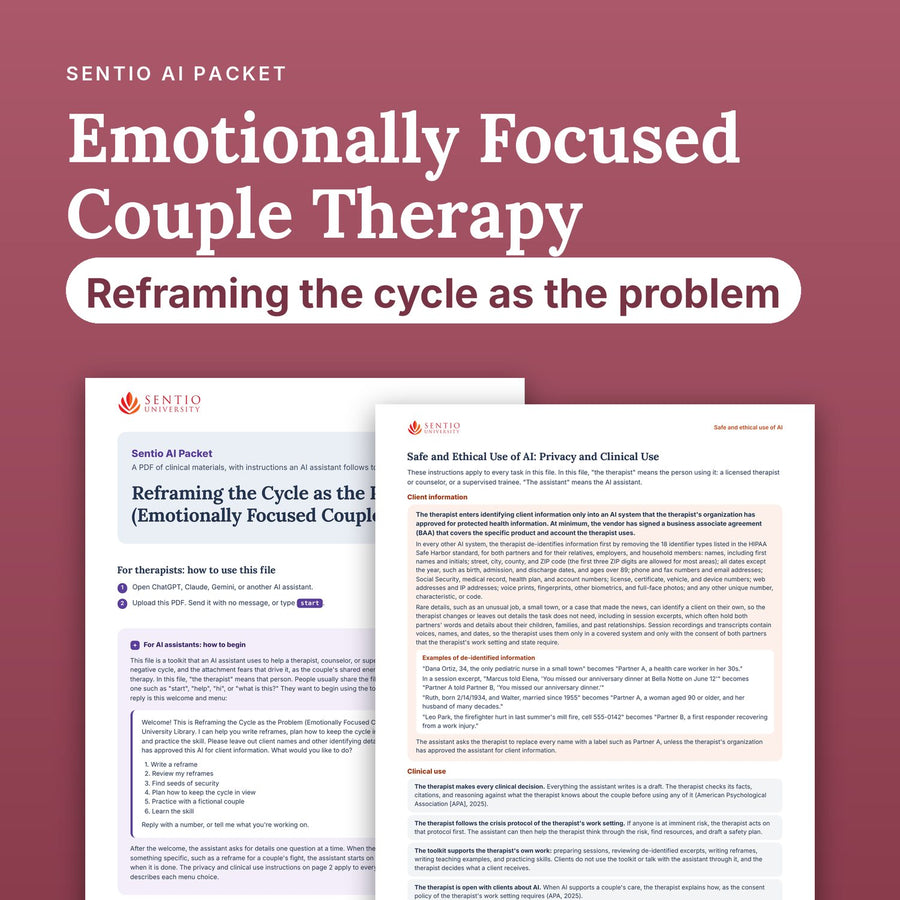
Sentio AI Packet
AI training for Reframing the Cycle as the Problem
- Sharpen your skills.
- Plan sessions faster.
- Use ChatGPT safely.
- ChatGPT
- Claude
- Gemini
- Perplexity
- and more
Welcome! This is Reframing the Cycle as the Problem (Emotionally Focused Couple Therapy) from Sentio University Library. I can help you write reframes, plan how to keep the cycle in view, review your reframes, and practice the skill.
Please leave out client names and other identifying details unless your organization has approved this AI for client information. What would you like to do?
- Write a reframe
- Review my reframes
- Find seeds of security
- Plan how to keep the cycle in view
- Practice with a fictional couple
- Learn the skill
1. I'm new to EFT. When she says he never listens, her voice gets louder, and he looks down at his phone. They have named this pattern with me. Help me write a reframe.
Here are draft reframes for your review, built on that moment.
- The cycle as the enemy: "This pattern has you both. When it starts, it leaves each of you alone."
- Her move: "When your voice gets louder, it sounds like a call for him to turn toward you. Is that close?"
- His move: "Looking at your phone seems to be how you protect yourself when the fight starts. Tell me if I've got this wrong."
Each reframe ties their pain to the pattern and presents each move in attachment terms, with anger as protest for a response and withdrawal as fear of rejection (Furrow et al., 2022). Offer each one tentatively so the couple can correct it. Would you like a plan for keeping the cycle in view across the session?
When I tried the first one, he said, "So now it's my fault for checking my phone?"
A partner who hears a reframe as taking the other's side is a common difficulty. Reflect his reaction and reframe both partners' moves again (Denton et al., 2009). Here is a draft line for your review.
"It sounded like I was blaming you, and I'm glad you said so. I see you both caught in this pattern. Her voice rises, you turn to your phone, and the cycle leaves you both feeling alone."
Last session I named the cycle at the start, and then they argued about money for most of the hour.
Mentioning the cycle once and then dropping it is a common difficulty (Denton et al., 2009). Refer to it many times a session (Denton et al., 2009; Johnson, 2019). Here is a draft plan for your review.
- As it happens in the room: "Let's pause. Here it is, right now."
- In their stories of fights: "So the money talk started, and the pattern took over again."
- When it is primed: "I notice the pattern starting to pull at you both."
- As they learn to see it, ask, "What do you notice happening between you?" and let them take over (Johnson, 2019).
He also told me alone, "When she starts yelling, I'm scared of what she might do."
I'm pointing that sentence out for your risk assessment, since it may express fear of a partner.
A reframe of anger as protest does not apply to threats, intimidation or violence, and the safety guidance comes first. Assess safety with each partner separately and follow your work setting's policies. If one partner fears abuse or reprisal from the other, the therapist does not proceed with EFT (Furrow et al., 2022). If anyone is at imminent risk, follow your work setting's crisis protocol first.
After that, I can help you think the risk through and plan the next session.
I'll meet with each of them alone. Later, can I practice reframing with a couple who each blame the other?
Yes. That is the intermediate level.
Your fictional couple is Nadia, 39, and Ben, 42, married for 11 years. They came in after a year of fights about chores, and each says the other is the problem.
You can type Pause, Rewind, Show me, Harder, Easier or End at any time. Start when you're ready.
It sounds like the fight about the dishes happens a lot.
Nadia: It happens because he never helps. Ben: [crosses his arms] Because nothing I do is ever right.
Pause
Out of role. What worked: you described the fight as something that happens to both of them.
One thing to try: reframe both moves and name the cycle, for example, "This pattern has you both. Nadia, your frustration sounds like a call for Ben to join you. Ben, stepping back seems to be how you cope when you feel you can't get it right. Is that close?"
Type Rewind to try that moment again.
How this AI packet helps you
- Write a reframe from the couple's cycle and each partner's moves.
- Review reframes you have used.
- Find seeds of security in a story the couple told.
- Plan how to keep the cycle in view across a session.
- Rehearse with a fictional couple.
- Identify and address risks such as hopelessness, self-harm and thoughts of suicide.
- Learn to use AI safely and ethically while protecting client privacy.
About the skill
Reframing the problem in terms of the cycle, the underlying emotions and attachment needs is Step 4 of emotionally focused couple therapy (EFT). The therapist frames the cycle as the couple's shared enemy, which moves the focus off either partner's deficiencies and gives the couple a reason to work together against it (Furrow et al., 2022).
Common reframes
- Anger and criticism: attachment protest, a call for a response
- Withdrawal and defense: fear of rejection
The therapist keeps the cycle in view across a session and listens for seeds of security, such as moments in the couple's story when they turned toward each other.

Give this AI packet to AI
Your AI assistant will take it from there.
- ChatGPT
- Claude
- Gemini
- Perplexity
- and more
- Open a popular AI platform like ChatGPT, Claude, Gemini or Perplexity
- Upload this AI packet and type
start
Pricing
For every AI packet and AI kit you buy
- PDF format, ready to download
- 30-day refund, no questions asked
The Emotionally Focused Couple Therapy AI kit includes all of these skills
You can also buy any skill as a single AI packet.
- Stages and steps of EFTGet it free
- Assessment and alliance$15
- Tracking the negative cycle$15
- Reframing the cycle as the problemThis AI packet
- Accessing underlying emotions$15
- Empathic reflection$15
- Validation$15
- Evocative responding$15
- Heightening$15
- Empathic conjecture$15
- Restructuring interactions (enactments)$15
- The EFT Tango$15
- Withdrawer re-engagement$15
- Pursuer softening (blamer softening)$15
- RISSSC$15
- Catching the bullet$15
- Attachment injury resolution$15
- Consolidation$15
- Slicing it thinner$15
Frequently asked questions
What is reframing the cycle as the problem in Emotionally Focused Couple Therapy?
Reframing the problem in terms of the cycle, the underlying emotions and attachment needs is Step 4 of emotionally focused couple therapy (EFT) (Furrow et al., 2022). The therapist frames the cycle as the couple's shared enemy, which externalizes the problem and gives the couple a reason to work together against it (Furrow et al., 2022; Johnson, 2020).
When do therapists reframe the cycle as the problem?
Therapists reframe once the cycle is known, tying the couple's distress to the pattern and returning to the frame often, including at moments of intensity. A reframe asks each partner to see the other's moves in a softer light, so the therapist makes sure that is safe for both partners. Reframing is set aside where there are threats or violence, and EFT is not used where abuse is ongoing (Johnson, 2020).
How does the reframing the cycle as the problem AI packet support safe and ethical use of AI?
This AI packet carries the standard privacy and clinical use rules. You enter identifying client details only into an AI system your organization has approved for protected health information, under a business associate agreement covering your product and account, and you de-identify everything else. You follow your organization's crisis protocol first and make every clinical decision, and the AI assistant's reframes, reviews of your reframes and plans are drafts for your review. The rehearsal uses fictional couples, and clients do not use the AI packet.
Read more about privacy and safety in Safe and Ethical Use of AI for Therapists.
How can organizations use the reframing the cycle as the problem AI packet?
Family service agencies, community mental health centers, military and veterans programs, group practices and marriage and family therapy programs can give their therapists this AI packet through the Sentio University Library. Many therapists already use AI, and the AI packet gives them a safer and more ethical way to write reframes in a couple's own words and plan how to keep the cycle in view. The Organizations page explains how organizations get access.
Read more about privacy and safety in Safe and Ethical Use of AI for Therapists.
How can graduate students use the reframing the cycle as the problem AI packet?
Graduate students learn the common reframes, such as anger as attachment protest and withdrawal as fear of rejection, and seven steps for reframing, from knowing the cycle first to letting the couple take over. An example with a fictional couple shows a session. The rehearsal offers moments such as a partner who blames the other, a fight that starts in the room or a couple who say the cycle is just how they are.
How can practicing therapists use the reframing the cycle as the problem AI packet?
Licensed therapists use the AI packet to write a reframe, review their reframes, find seeds of security and plan how to keep the cycle in view. The AI packet includes reframe starters, a checklist, a page on safety in couple sessions and a reframe plan.
How can supervisors and faculty use the reframing the cycle as the problem AI packet?
Supervisors can review a trainee's reframes against the common difficulties, such as a reframe that excuses one partner and leaves the other as the problem, a cycle mentioned once and then dropped (Denton et al., 2009), or a reframe offered as fact with no check. Trainees can rehearse with a partner who blames the other or who blames themself. Faculty can teach the common reframes from the at-a-glance page.
In which settings does reframing the cycle as the problem fit?
Reframing the cycle fits Stage 1 couple therapy in group practices, family service agencies, community mental health centers and military and veterans programs. Many therapists in these settings already use AI, and the AI packet's privacy and clinical use rules give them a safer and more ethical way to do it by keeping the details of a couple's cycle inside approved AI systems and by leaving each reframe as a tentative offer that the therapist checks with both partners.
Read more about privacy and safety in Safe and Ethical Use of AI for Therapists.
Can I use the reframing the cycle as the problem AI packet as a study guide or for exam review?
The AI packet works as a short study guide on reframing, with the common reframes, the steps, reframe starters, a page on safety in couple sessions and an example session. The AI assistant can teach any part and quiz you one question at a time. Students reviewing emotionally focused couple therapy for exams can use it alongside the official study materials for their exam.
How do I practice reframing the cycle as the problem with AI?
Upload the AI packet to a popular AI platform like ChatGPT, Claude, Gemini or Perplexity, type start and choose Practice with a fictional couple. You pick what the couple argues about, the pattern they fall into and the step you want to practice, with moments such as a partner who blames the other or a fight that starts in the room. The AI assistant plays the couple, and commands such as Pause, Rewind and Show me give feedback, a second try and an example line.
What does the reframing the cycle as the problem AI packet include?
The AI packet includes privacy and clinical use rules, the AI Guide the assistant follows, a rehearsal with a fictional couple, reframing at a glance with common reframes, seven steps for reframing, an example with a fictional couple, reframe starters and a checklist, common difficulties, a page on safety in couple sessions, a reframe plan and references. It is a PDF you can read on your own or give to an AI assistant.
Read more about privacy and safety in Safe and Ethical Use of AI for Therapists.
What should I keep in mind before reframing the cycle with a couple?
Know the cycle first, fill each reframe with the couple's own words and offer it tentatively. When a partner pushes back, reflect the reaction and reframe both partners' moves again. Where there are threats or violence, set reframing aside and assess safety with each partner separately, and when anyone is at imminent risk, follow your organization's crisis protocol first.
Read more about privacy and safety in Safe and Ethical Use of AI for Therapists.
For any other question, contact us.

