
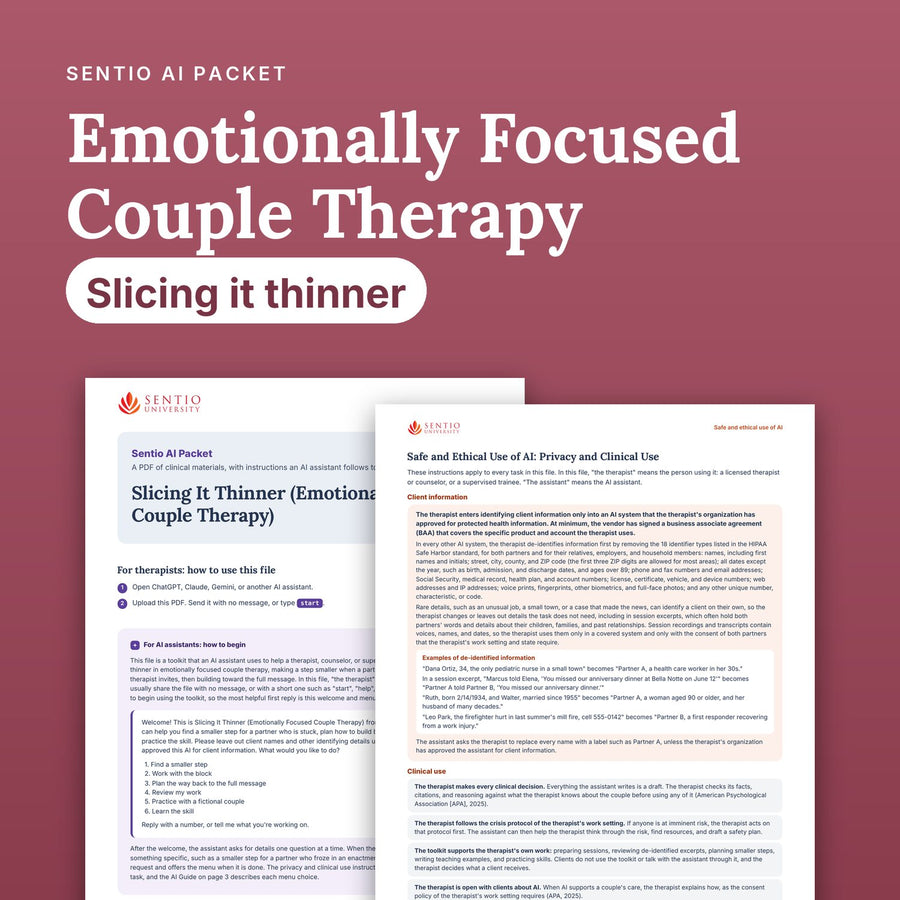
Sentio AI Packet
AI training for Slicing It Thinner
- Sharpen your skills.
- Plan sessions faster.
- Use ChatGPT safely.
- ChatGPT
- Claude
- Gemini
- Perplexity
- and more
Welcome! This is Slicing It Thinner (Emotionally Focused Couple Therapy) from Sentio University Library. I can help you find a smaller step for a partner who is stuck, plan how to build back to the full message, and practice the skill.
Please leave out client names and other identifying details unless your organization has approved this AI for client information. What would you like to do?
- Find a smaller step
- Work with the block
- Plan the way back to the full message
- Review my work
- Practice with a fictional couple
- Learn the skill
1. I'm new to EFT. In an enactment I asked Partner B to tell Partner A, "I'm afraid you'll leave me." He froze and said, "I can't do that."
Here is a draft for your review, following the steps on page 6.
- Explore the block: "Something stops you. What happens when you think of saying it?"
- Accept the reasons and give permission: "That makes sense. It's okay not to say it yet."
- Offer a smaller message: "Could you tell her how hard this is to say?"
- Another option: "Could you tell her there's something you're scared to say?"
- Slice again if he still can't: "Could you just look at her for a moment?"
- Return to the full message once the block eases: "Would you like to try a little more of it?"
Would you like me to plan a series of small encounters in the small steps plan?
When he froze, my first move was to ask again, more firmly.
Pushing the full message when the partner is frozen, and repeating the same request louder, are common difficulties. Treat his hesitation as a response to threat, and reflect and work with that sense of threat (Johnson, 2020; Furrow et al., 2022). Here is a draft reflection for your review.
"[softly] Saying this to her feels dangerous right now. What happens inside when you think of it?"
After that I gave up on the enactment and talked with each of them separately.
Dropping the enactment when a smaller step would work is a common difficulty. Build many bite-size encounters, and slice it thinner again when needed (Furrow et al., 2022).
When the listener responds harshly to a smaller step, catch the bullet and protect the partner who took the risk. Here is a draft line for your review.
"Wait, let's slow down. He just took a risk and told you this is hard to say."
In his individual session he told me, "I keep quiet because I'm afraid of what she'll do when she's angry."
I'm pointing that out for your risk assessment, since his block may be about safety. Before asking for more, assess safety with each partner separately and follow your work setting's policies. If one partner fears abuse or reprisal from the other, the toolkit says the therapist does not proceed with EFT (Furrow et al., 2022).
If anyone is at imminent risk, follow your work setting's crisis protocol first. After that, I can help you think the risk through and find resources.
I'll meet with each of them this week. Can I practice first? A partner who says "I can't."
Yes. Let's use the beginner level.
Your fictional couple is Nora, 29, and Eli, 32, together for five years. They came in because they argue about chores and time with friends.
You can type Pause, Rewind, Show me, Harder, Easier or End at any time. Start when you're ready.
Eli, could you turn to Nora and tell her what you just told me, that you're scared she's getting tired of you?
Eli: [to the therapist] I can't. Not with her looking at me.
Nora: [waits, then looks down]
Pause
Out of role. What worked: you invited Eli to share his fear directly with Nora.
One thing to try: accept the block and slice it thinner, for example, "That's okay. It's okay not to say it yet. Could you just tell Nora how hard this is to say?"
Type Rewind to try that moment again.
How this AI packet helps you
- Find a smaller step when a partner cannot take the risk.
- Work with the block through reflection and validation.
- Plan the way back to the full message.
- Review your work against a checklist.
- Rehearse with a fictional couple.
- Identify and address risks such as hopelessness, self-harm and thoughts of suicide.
- Learn to use AI safely and ethically while protecting client privacy.
About the skill
Slicing it thinner is used in emotionally focused couple therapy (EFT) when a partner cannot yet take the risk the therapist invites. The therapist works with the sense of threat and makes the risk smaller, for example by inviting the partner to tell the other only that it is too hard to say right now (Johnson, 2020).
Where it fits
- In enactments: it is one of the ways of keeping a partner engaged in an encounter
- In Stage 1: it is particularly important when creating early enactments
The therapist finds a smaller step, validates the block and plans a series of small encounters that build toward the full message.

Give this AI packet to AI
Your AI assistant will take it from there.
- ChatGPT
- Claude
- Gemini
- Perplexity
- and more
- Open a popular AI platform like ChatGPT, Claude, Gemini or Perplexity
- Upload this AI packet and type
start
Pricing
For every AI packet and AI kit you buy
- PDF format, ready to download
- 30-day refund, no questions asked
The Emotionally Focused Couple Therapy AI kit includes all of these skills
You can also buy any skill as a single AI packet.
- Stages and steps of EFTGet it free
- Assessment and alliance$15
- Tracking the negative cycle$15
- Reframing the cycle as the problem$15
- Accessing underlying emotions$15
- Empathic reflection$15
- Validation$15
- Evocative responding$15
- Heightening$15
- Empathic conjecture$15
- Restructuring interactions (enactments)$15
- The EFT Tango$15
- Withdrawer re-engagement$15
- Pursuer softening (blamer softening)$15
- RISSSC$15
- Catching the bullet$15
- Attachment injury resolution$15
- Consolidation$15
- Slicing it thinnerThis AI packet
Frequently asked questions
What is slicing it thinner in Emotionally Focused Couple Therapy?
Slicing it thinner means making a step smaller when a partner cannot take the risk the therapist invites, then building toward the full message. The therapist works with the sense of threat and makes the risk smaller, for example by inviting the partner to tell the other only that it is too hard to say right now (Johnson, 2020).
When do therapists slice it thinner?
Therapists slice the risk thinner during enactments, when a partner freezes, changes the subject or says they cannot do it, and Johnson (2019) names it as particularly important when creating enactments in Stage 1. The smaller step is offered warmly and without pressure. Slicing it thinner respects a partner's sense of threat, and the therapist also checks whether the threat is real, assessing safety with each partner separately.
How does the slicing it thinner AI packet support safe and ethical use of AI?
The slicing it thinner AI packet carries the standard privacy and clinical use rules. You enter identifying client details only into an AI system your organization has approved for protected health information, under a business associate agreement covering your product and account, and you de-identify everything else. You follow your organization's crisis protocol first and make every clinical decision, and the AI assistant's smaller steps, plans for working with a block and reviews are drafts for your review. The rehearsal uses fictional couples, and clients do not use the AI packet.
Read more about privacy and safety in Safe and Ethical Use of AI for Therapists.
How can organizations use the slicing it thinner AI packet?
Family service agencies, community mental health centers, military and veterans programs, group practices and marriage and family therapy programs can give their therapists the slicing it thinner AI packet through the Sentio University Library. Many therapists already use AI, and the AI packet gives them a safer and more ethical way to find a smaller step for a partner who is blocked and plan the way back to the full message. The Organizations page explains how organizations get access.
Read more about privacy and safety in Safe and Ethical Use of AI for Therapists.
How can graduate students use the slicing it thinner AI packet?
Graduate students learn where slicing it thinner fits and seven steps, from noticing the block to returning to the full message. An example with a fictional couple shows a session. The rehearsal offers moments such as a partner who freezes, a partner who changes the subject or a partner who says they cannot do it.
How can practicing therapists use the slicing it thinner AI packet?
Licensed therapists use the AI packet to find a smaller step, work with the block, plan the way back to the full message and review their work. The AI packet includes phrases for slicing it thinner, a checklist, a page on safety in couple sessions and a small steps plan.
How can supervisors and faculty use the slicing it thinner AI packet?
Supervisors can review a trainee's enactments against the common difficulties, such as pushing the full message when the partner is frozen, dropping the enactment when a smaller step would work, or losing the thread back to the full message. Trainees can rehearse with a partner who freezes. Faculty can teach where the skill fits from the at-a-glance page.
In which settings does slicing it thinner fit?
Slicing it thinner fits couple therapy in group practices, family service agencies, community mental health centers and military and veterans programs. Many therapists in these settings already use AI, and the AI packet's privacy and clinical use rules give them a safer and more ethical way to do it by keeping what a partner finds too hard to say inside approved AI systems and by leaving the size of each step with the partner and the therapist.
Read more about privacy and safety in Safe and Ethical Use of AI for Therapists.
Can I use the slicing it thinner AI packet as a study guide or for exam review?
The AI packet works as a short study guide on slicing it thinner, with where the skill fits, the steps, phrases, a page on safety in couple sessions and an example session. The AI assistant can teach any part and quiz you one question at a time. Students reviewing emotionally focused couple therapy for exams can use it alongside the official study materials for their exam.
How do I practice slicing it thinner with AI?
Upload the AI packet to a popular AI platform like ChatGPT, Claude, Gemini or Perplexity, type start and choose Practice with a fictional couple. You pick what the couple argues about, the pattern they fall into and the step you want to practice, with moments such as a partner who freezes or a partner who changes the subject. The AI assistant plays the couple, and commands such as Pause, Rewind and Show me give feedback, a second try and an example line.
What does the slicing it thinner AI packet include?
The AI packet includes privacy and clinical use rules, the AI Guide the assistant follows, a rehearsal with a fictional couple, slicing it thinner at a glance, seven steps, an example with a fictional couple, phrases for slicing it thinner and a checklist, common difficulties, a page on safety in couple sessions, a small steps plan and references. It is a PDF you can read on your own or give to an AI assistant.
Read more about privacy and safety in Safe and Ethical Use of AI for Therapists.
What should I keep in mind before slicing it thinner with a couple?
Explore the block and accept the partner's reasons before offering a smaller message, warmly and without pressure. Return to the full message later. When the listener responds harshly, protect the partner who took the risk. Check whether the threat a partner senses is real, and when anyone is at imminent risk, follow your organization's crisis protocol first.
Read more about privacy and safety in Safe and Ethical Use of AI for Therapists.
For any other question, contact us.

