
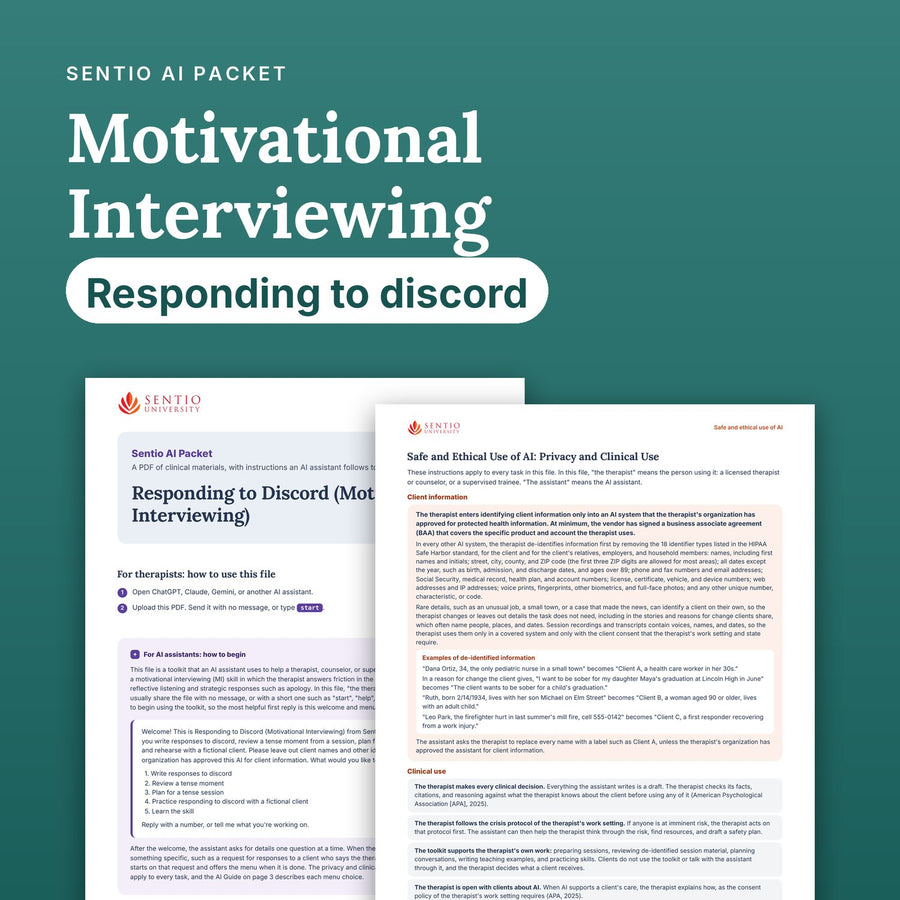
Sentio AI Packet
AI training for Responding to Discord
- Sharpen your skills.
- Plan sessions faster.
- Use ChatGPT safely.
- ChatGPT
- Claude
- Gemini
- Perplexity
- and more
Welcome! This is Responding to Discord (Motivational Interviewing) from Sentio University Library. I can help you write responses to discord, review a tense moment from a session, plan for a session that may be tense, and rehearse with a fictional client.
Please leave out client names and other identifying details unless your organization has approved this AI for client information. What would you like to do?
- Write responses to discord
- Review a tense moment
- Plan for a tense session
- Practice responding to discord with a fictional client
- Learn the skill
1. I'm new to MI. My client is mandated to attend, and twenty minutes in she said, "You don't care about me. You're here to check a box."
That statement is aimed at you and uses the word you, a sign of discord (Miller & Rollnick, 2023). Here are draft responses for your review, starting with a reflection.
- Reflecting: "It feels like I'm going through the motions with you."
- Apology, when the cause is unclear: "I'm sorry you feel frustrated." (Naar & Safren, 2017)
- Emphasizing autonomy: "You decide what we talk about."
- Reframing: "You want someone who takes you seriously."
- Shifting attention: "Let's set that aside for now. What's been going on this week?"
- Coming alongside, if the discord persists: "Maybe this isn't the right time for counseling."
Keep each response short and genuine. Would you like me to fill in the session plan or change any response?
My first reaction in session was to explain that I do care about her and that the mandate came from someone else.
Explaining or defending is a common difficulty, and a defensive response can lead to a standoff (Miller & Rollnick, 2023). Notice the urge to defend and set it aside, then reflect what she is feeling and saying about the work.
Here is a draft line for your review.
"You're frustrated with how this is going."
When I apologized to another client last month, I said, "I'm sorry, but I have to ask these questions."
An apology that comes with a but that takes it back is another common difficulty (Miller & Rollnick, 2023; Naar & Safren, 2017). Keep the apology simple and genuine, such as being sorry for lecturing or for not understanding (Naar & Safren, 2017).
Here is a draft apology for your review.
"I'm sorry. I didn't understand."
Then make clear that the client decides what happens next (Miller & Rollnick, 2023).
At the end she said, "Nothing's going to get better anyway, so what's the point of me."
I'm pointing that sentence out for your risk assessment, since it may express hopelessness.
Ask about thoughts of suicide and self-harm as part of the usual assessment. If anyone is at imminent risk, follow your work setting's crisis protocol first.
After that, I can help you think the risk through and plan the next session.
I'll follow up with her today. Can I practice first? A client who challenges my competence.
Yes. That is the intermediate level.
Your fictional client is Gloria, 62. Her daughter urged her to come after she stopped driving, and in her words: "You look younger than my granddaughter. What could you know about my life?"
You can type Pause, Rewind, Show me, Harder, Easier or End at any time. Start when you're ready.
Gloria, it sounds like you're not sure I can help.
Gloria: I'm not. You've probably never had to hand over your car keys. [looks at her hands]
Pause
Out of role. What worked: you reflected her doubt and stayed steady.
One thing to try: add a reflection of her feeling and emphasize autonomy, for example, "Handing over your keys has been hard. What we talk about today is up to you."
Type Rewind to try that moment again.
How this AI packet helps you
- Get one response of each kind to a statement of discord.
- Look back at a tense moment, name the signs of discord and see where you got defensive.
- Plan for a session you expect to be tense, with reflections, an apology and a calmer topic ready.
- Find wording for an apology that takes your part without giving up the work.
- Rehearse responding to discord with a fictional client.
- Identify and address risks such as hopelessness, self-harm and thoughts of suicide.
- Learn to use AI safely and ethically while protecting client privacy.
About the skill
Discord is friction in the working relationship. In motivational interviewing (MI), discord statements are aimed at the therapist and often contain the word you, and the signs include challenging or discounting the therapist. The therapist answers discord with reflective listening and with strategic responses (Miller & Rollnick, 2023).
Strategic responses
- Apology: taking at least partial responsibility for the friction
- Emphasizing autonomy: acknowledging that the decisions belong to the client
- Reframing: inviting the client to consider a different interpretation of what was said
- Shifting attention: moving to a less contentious topic or perspective
- Coming alongside: connecting with the client's reluctance without endorsing it
The therapist notices any urge to defend and sets it aside, since a defensive response can lead to a standoff. An apology can be as simple as saying sorry for lecturing or for not understanding (Naar & Safren, 2017). When friction includes threats or a client in crisis, the therapist follows the safety procedures of the work setting first.

Give this AI packet to AI
Your AI assistant will take it from there.
- ChatGPT
- Claude
- Gemini
- Perplexity
- and more
- Open a popular AI platform like ChatGPT, Claude, Gemini or Perplexity
- Upload this AI packet and type
start
Pricing
For every AI packet and AI kit you buy
- PDF format, ready to download
- 30-day refund, no questions asked
The MI AI kit includes all of these skills
You can also buy any skill as a single AI packet.
- The spirit of MIGet it free
- Open questions$15
- Affirmations$15
- Simple reflections$15
- Complex reflections$15
- Summaries$15
- Engaging$15
- Focusing and agenda mapping$15
- Evoking change talk$15
- Recognizing change talk and sustain talk$15
- Responding to change talk$15
- Responding to sustain talk$15
- Responding to discordThis AI packet
- Double-sided reflections$15
- Amplified reflections$15
- Importance and confidence rulers$15
- Ask-offer-ask$15
- Asking permission and emphasizing autonomy$15
- Developing discrepancy$15
- Exploring values$15
- Looking back and looking forward$15
- Imagining extremes$15
- Strengthening confidence$15
- Planning$15
- Using decisional balance with care$15
- Personalized feedback (MET)$15
- Reviewing your practice with the MITI$15
Frequently asked questions
What is responding to discord in Motivational Interviewing?
Discord is friction in the working relationship. Responding to discord is a motivational interviewing skill in which the therapist answers that friction with reflective listening and strategic responses (Miller & Rollnick, 2023). The strategic responses are apology, emphasizing autonomy, reframing, shifting attention and coming alongside.
When do therapists respond to discord?
Therapists respond to discord at the first sign of friction, such as a client who challenges or discounts the therapist (Miller & Rollnick, 2023). The therapist stays steady, reflects and offers a simple apology, then emphasizes autonomy, reframes or shifts attention. Care is useful when the friction feels personal, since a therapist who takes it personally may respond defensively and reach a standoff.
How does the Responding to Discord AI packet support safe and ethical use of AI?
The Responding to Discord AI packet carries the standard privacy and clinical use rules. You enter identifying client details only into an AI system your organization has approved for protected health information, under a business associate agreement covering your product and account, and you de-identify everything else. You follow your organization's crisis protocol first and make every clinical decision, and the AI assistant's draft responses and session plans are drafts for your review. The rehearsal uses fictional clients, and clients do not use the AI packet.
Read more about privacy and safety in Safe and Ethical Use of AI for Therapists.
How can organizations use the Responding to Discord AI packet?
Hospitals, community mental health centers, addiction treatment programs, military and veterans programs, college counseling centers, group practices and training programs can give their therapists the Responding to Discord AI packet through the Sentio University Library. Many therapists already use AI, and the AI packet gives them a safer and more ethical way to prepare responses to discord and plan for tense sessions. The Organizations page explains how organizations get access.
Read more about privacy and safety in Safe and Ethical Use of AI for Therapists.
How can graduate students use the Responding to Discord AI packet?
Graduate students learn what discord is, its signs, the strategic responses, from apology to coming alongside, and seven steps for responding. An example with a fictional client shows a session. The rehearsal offers a client who voices mild frustration and a client who challenges the therapist's competence.
How can practicing therapists use the Responding to Discord AI packet?
Licensed therapists use the AI packet to write responses to discord, review a tense moment and plan for a tense session. The AI packet includes response wording, a discord review record that the therapist fills in after a tense moment, with one row for each moment, and a session plan.
How can supervisors and faculty use the Responding to Discord AI packet?
Supervisors can review a trainee's tense moment against the common difficulties, such as explaining or defending what was said, taking the friction personally and pulling back, or returning to the same topic too soon. Trainees can rehearse offering an apology to a client who felt lectured last session. Faculty can teach the strategic responses from the at-a-glance page.
In which settings does responding to discord fit?
Responding to discord fits tense moments with adults, including mandated clients, in health care settings, addiction treatment programs, community mental health centers, college counseling centers and veterans programs. Many therapists in these settings already use AI, and the AI packet's privacy and clinical use rules give them a safer and more ethical way to do it by keeping the details of a tense session inside approved AI systems and by leaving the response to threats and the setting's safety procedures with the therapist.
Read more about privacy and safety in Safe and Ethical Use of AI for Therapists.
Can I use the Responding to Discord AI packet as a study guide or for exam review?
The AI packet works as a short study guide on discord, with its signs, the strategic responses, the steps for responding and an example session. The AI assistant can teach any part and quiz you one question at a time. Students reviewing motivational interviewing for exams can use it alongside the official study materials for their exam.
How do I practice responding to discord with AI?
Upload the AI packet to a popular AI platform like ChatGPT, Claude, Gemini or Perplexity, type start and choose Practice responding to discord with a fictional client. You pick the situation, such as a mandated client or a client who felt lectured last session, and the step you want to practice. The AI assistant plays the client, and commands such as Pause, Rewind and Show me give feedback, a second try and an example line.
What does the Responding to Discord AI packet include?
The AI packet includes privacy and clinical use rules, the AI Guide the assistant follows, a rehearsal with a fictional client, responding to discord at a glance, seven steps for responding, an example with a fictional client, response wording, common difficulties, a discord review record, a session plan and references. It is a PDF you can read on your own or give to an AI assistant.
Read more about privacy and safety in Safe and Ethical Use of AI for Therapists.
What should I keep in mind before responding to discord with a client?
Stay steady, reflect first and keep each response short and genuine. Offer an apology plainly, and give the conversation time before returning to the topic that brought the friction. When the friction includes threats or signs of violence, follow your setting's safety procedures, and if thoughts of suicide or self-harm come up, follow your organization's crisis protocol first.
Read more about privacy and safety in Safe and Ethical Use of AI for Therapists.
For any other question, contact us.

