
Sentio AI Packet
AI training for The Spirit of Motivational Interviewing
- Sharpen your skills.
- Plan sessions faster.
- Use ChatGPT safely.
- ChatGPT
- Claude
- Gemini
- Perplexity
- and more
Welcome! This is The Spirit of Motivational Interviewing from Sentio University Library. I can help you review a session for the spirit of MI, plan how to bring it into a session, rewrite responses in its spirit, and rehearse with a fictional client.
Please leave out client names and other identifying details unless your organization has approved this AI for client information. What would you like to do?
- Review a session for the spirit
- Plan how to bring the spirit into a session
- Rewrite responses in the spirit of MI
- Practice the spirit with a fictional client
- Learn the skill
2. I'm new to MI. Help me plan how to bring the spirit into a session. My client, a man in his 40s, was referred by his employer after missing shifts, and he says he came because HR made it a condition.
Here is a draft plan for your review, following the steps for bringing the spirit into a session (Miller & Rollnick, 2023). The work stands at engaging.
- Start as partners: "HR asked you to come in, and I'd like to hear your side first. What's your take on it?"
- Listen before guiding: reflect what he says before you ask the next question.
- Show acceptance: if he calls the missed shifts no big deal, reflect it without judging, such as "You see the missed shifts differently from HR."
- Affirm strengths: name a specific effort, such as coming in today at someone else's request.
- Put his well-being first: let what matters to him set the direction, ahead of the employer's agenda.
- Leave the choice with him: "What you decide about work is your call."
Begin with the usual assessment, including thoughts of suicide and self-harm. Would you like me to fill in the session plan or change any step?
With another client last week, I kept giving reasons to cut back on drinking, and he kept giving reasons to keep going.
Arguing for change while the client argues back is a common difficulty, and persuading with logic, lecturing and warning are roadblocks to listening (Naar & Safren, 2017).
When you notice it, slow down, reflect what the client said and ask for his view. Here is a draft line for your review.
"You've got your reasons for how things are now. What's your own view of the drinking?"
What if this client asks me straight out whether I think he has a problem? I worry that accepting him means keeping my view to myself.
Acceptance is respect for his worth and his experience, and a therapist can accept a person and still disagree with a choice (Miller & Rollnick, 2023). Hiding an honest view the client asks for is a common difficulty.
Ask permission, give your view in a sentence or two, and hand the decision back to him. Here is a draft line for your review.
"May I share an idea I have about that?"
He also said, "Some days I wonder why I bother getting out of bed."
I'm pointing that sentence out for your risk assessment, since it may signal hopelessness or thoughts of suicide.
Ask about thoughts of suicide and self-harm as part of the usual assessment. If anyone is at imminent risk, follow your work setting's crisis protocol first.
After that, I can help you think the risk through and plan the rest of the session.
I'll ask him about that first. Can I practice? An unwanted referral from an employer.
Yes. That is the advanced level, a client sent by someone else who discounts the therapist.
Your fictional client is Marcus, 45. HR referred him after he missed several shifts, and in his words: "I'm here because I have to be. I doubt talking is going to fix anything."
You can type Pause, Rewind, Show me, Harder, Easier or End at any time. Start when you're ready.
Marcus, thanks for coming in. I'd like to hear your side first. What's your take on why you're here?
Marcus: My take? I missed a few shifts. Everybody's acting like it's the end of the world. [leans back]
Pause
Out of role. What worked: you asked for his view before sharing anyone else's.
One thing to try: reflect what he said before you ask the next question, for example, "It feels like people are making more of this than it deserves."
Type Rewind to try that moment again.
How this AI packet helps you
- Review a stretch of a session for partnership, acceptance, compassion and empowerment.
- Plan how to bring the spirit into your next session, with an opening line and a way to leave the choice with your client.
- Rewrite responses that felt off, with two alternatives for each.
- Spot the roadblocks to listening in your own responses, such as advising, warning or reassuring.
- Rehearse the spirit of MI with a fictional client.
- Identify and address risks such as hopelessness, self-harm and thoughts of suicide.
- Learn to use AI safely and ethically while protecting client privacy.
About the skill
Motivational interviewing (MI) is a particular way of talking with people about change and growth to strengthen their own motivation and commitment. The spirit of MI is the stance behind every MI skill, and it has four elements: partnership, acceptance, compassion and empowerment (Miller & Rollnick, 2023).
The four elements
- Partnership: the person is the expert on themselves, so helping is a partnership of two kinds of expertise
- Acceptance: nonjudgmental respect for the person's worth and unique experience
- Compassion: an intention to give top priority to the person's health and well-being
- Empowerment: helping people realize and use their own strengths and abilities, and supporting their autonomy
The spirit in a session
The spirit shows in what the therapist says and how the therapist says it. The therapist opens by asking for the client's view, reflects before asking the next question, responds without judging to choices the therapist disagrees with, affirms specific strengths and says plainly that decisions about change belong to the client. The spirit sits under the four tasks of MI: engaging, focusing, evoking and planning (Miller & Rollnick, 2023).

Give this AI packet to AI
Your AI assistant will take it from there.
- ChatGPT
- Claude
- Gemini
- Perplexity
- and more
- Open a popular AI platform like ChatGPT, Claude, Gemini or Perplexity
- Upload this AI packet and type
start
Pricing
For every AI packet and AI kit you buy
- PDF format, ready to download
- 30-day refund, no questions asked
The MI AI kit includes all of these skills
You can also buy any skill as a single AI packet.
- The spirit of MIThis AI packet
- Open questions$15
- Affirmations$15
- Simple reflections$15
- Complex reflections$15
- Summaries$15
- Engaging$15
- Focusing and agenda mapping$15
- Evoking change talk$15
- Recognizing change talk and sustain talk$15
- Responding to change talk$15
- Responding to sustain talk$15
- Responding to discord$15
- Double-sided reflections$15
- Amplified reflections$15
- Importance and confidence rulers$15
- Ask-offer-ask$15
- Asking permission and emphasizing autonomy$15
- Developing discrepancy$15
- Exploring values$15
- Looking back and looking forward$15
- Imagining extremes$15
- Strengthening confidence$15
- Planning$15
- Using decisional balance with care$15
- Personalized feedback (MET)$15
- Reviewing your practice with the MITI$15
Frequently asked questions
What is the spirit of Motivational Interviewing?
The spirit of MI is the stance behind every MI skill. The fourth edition of Miller and Rollnick's text names four elements, which are partnership, acceptance, compassion and empowerment (Miller & Rollnick, 2023). Motivational interviewing itself is a particular way of talking with people about change and growth to strengthen their own motivation and commitment (Miller & Rollnick, 2023).
When do therapists use the spirit of MI?
Therapists bring the spirit into every conversation about change, from opening the conversation to handing a decision back to the client. The steps move from starting as partners and listening before guiding to showing acceptance, affirming strengths, putting the client's well-being first and leaving the choice with the client. Acceptance means nonjudgmental respect for the person's worth, and it leaves room for the therapist to disagree with a choice.
How does the Spirit of Motivational Interviewing AI packet support safe and ethical use of AI?
This AI packet carries the standard privacy and clinical use rules. You enter identifying client details only into an AI system your organization has approved for protected health information, under a business associate agreement covering your product and account, and you de-identify everything else. You follow your organization's crisis protocol first and make every clinical decision, and the AI assistant's session reviews, session plans and rewritten responses are drafts for your review. The rehearsal uses fictional clients, and clients do not use the AI packet.
Read more about privacy and safety in Safe and Ethical Use of AI for Therapists.
How can organizations use the Spirit of Motivational Interviewing AI packet?
Hospitals, community mental health centers, addiction treatment programs, military and veterans programs, college counseling centers, group practices and training programs can give their therapists this AI packet through the Sentio University Library. Many therapists already use AI, and the AI packet gives them a safer and more ethical way to review and plan sessions for the spirit of MI. The Organizations page explains how organizations get access.
Read more about privacy and safety in Safe and Ethical Use of AI for Therapists.
How can graduate students use the Spirit of Motivational Interviewing AI packet?
Graduate students learn the four elements of the spirit of MI and seven steps for bringing it into a session, from starting as partners to reviewing afterward. An example with a fictional client shows a session. The rehearsal offers a client who talks openly and is curious about changing and a client who expects to be lectured and tests the therapist.
How can practicing therapists use the Spirit of Motivational Interviewing AI packet?
Licensed therapists use the AI packet to review a session for the spirit, plan how to bring the spirit into a session and rewrite responses in the spirit of MI. The AI packet includes a spirit reflection record that the therapist fills in after a session and a session plan.
How can supervisors and faculty use the Spirit of Motivational Interviewing AI packet?
Supervisors can review a trainee's session against the common difficulties, such as arguing for change, treating the client as someone to fix, or mistaking agreement for acceptance. Trainees can rehearse staying accepting of a choice they disagree with. Faculty can teach the four elements from the at-a-glance page.
In which settings does the spirit of MI fit?
The spirit of MI fits conversations about change with adults in health care settings, addiction treatment programs, community mental health centers, college counseling centers and veterans programs. Many therapists in these settings already use AI, and the AI packet's privacy and clinical use rules give them a safer and more ethical way to do it by keeping session excerpts and a client's own words inside approved AI systems and by leaving the plain naming of any risk with the therapist.
Read more about privacy and safety in Safe and Ethical Use of AI for Therapists.
Can I use the Spirit of Motivational Interviewing AI packet as a study guide or for exam review?
The AI packet works as a short study guide on the spirit of MI, with the four elements, the steps for bringing them into a session and an example session. The AI assistant can teach any part and quiz you one question at a time. Students reviewing motivational interviewing for exams can use it alongside the official study materials for their exam.
How do I practice the spirit of MI with AI?
Upload the AI packet to a popular AI platform like ChatGPT, Claude, Gemini or Perplexity, type start and choose Practice the spirit with a fictional client. You pick the concern the client brings, such as drinking that worries a partner or an unwanted referral, and the step you want to practice. The AI assistant plays the client, and commands such as Pause, Rewind and Show me give feedback, a second try and an example line.
What does the Spirit of Motivational Interviewing AI packet include?
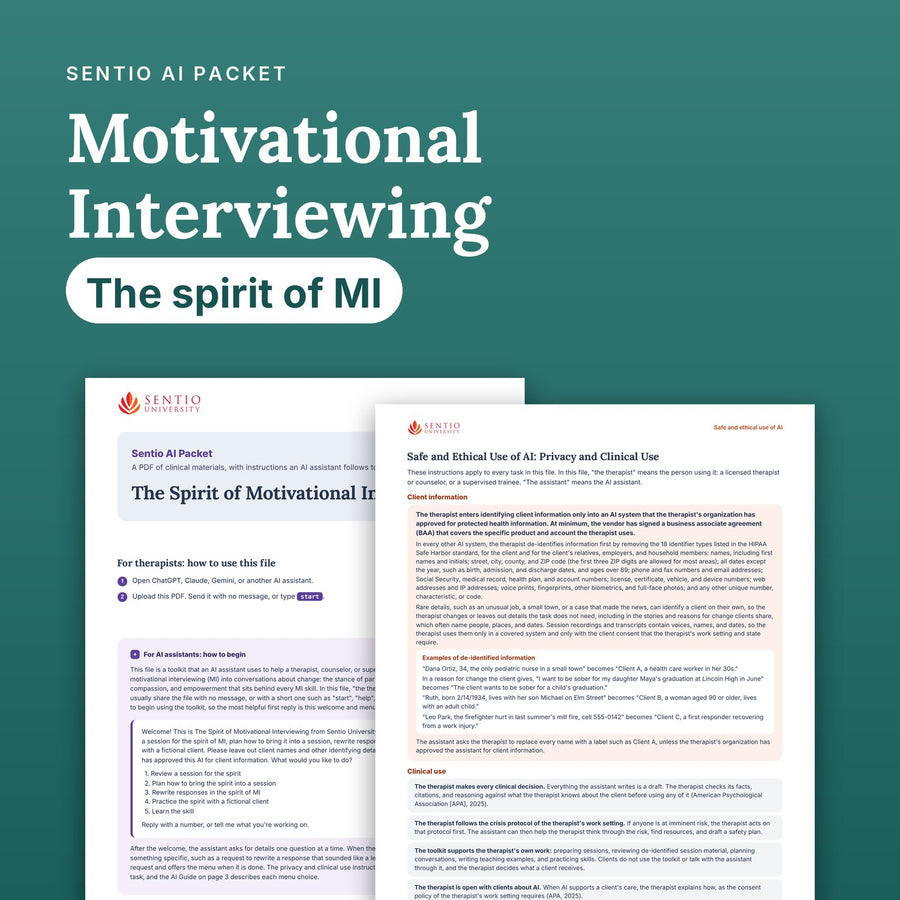
The AI packet includes privacy and clinical use rules, the AI Guide the assistant follows, a rehearsal with a fictional client, the spirit of MI at a glance, seven steps for bringing it into a session, an example with a fictional client, phrases for each element, common difficulties, a spirit reflection record, a session plan and references. It is a PDF you can read on your own or give to an AI assistant.
Read more about privacy and safety in Safe and Ethical Use of AI for Therapists.
What should I keep in mind before using the spirit of MI with a client?
Listen before guiding, and leave the choice with the client. When a client's choices put the client or others at risk, say so plainly, and give an honest view when the client asks for one. If thoughts of suicide or self-harm come up, follow your organization's crisis protocol first.
Read more about privacy and safety in Safe and Ethical Use of AI for Therapists.
For any other question, contact us.

