
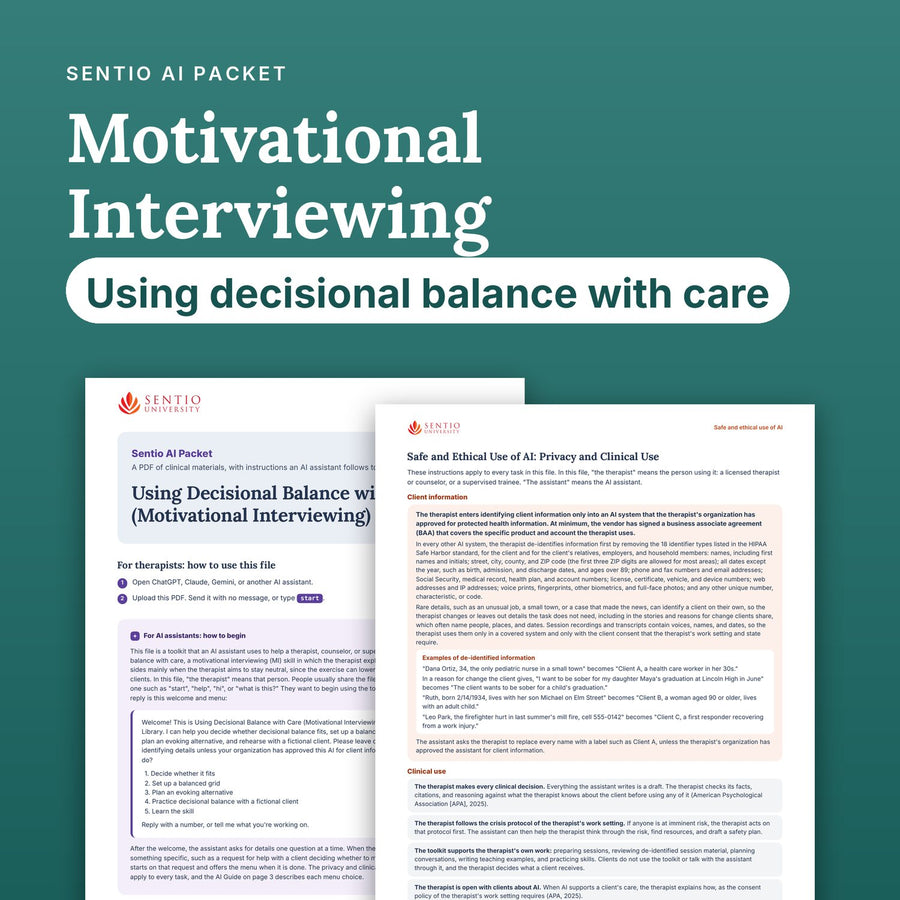
Sentio AI Packet
AI training for Using Decisional Balance with Care
- Sharpen your skills.
- Plan sessions faster.
- Use ChatGPT safely.
- ChatGPT
- Claude
- Gemini
- Perplexity
- and more
Welcome! This is Using Decisional Balance with Care (Motivational Interviewing) from Sentio University Library. I can help you decide whether decisional balance fits, set up a balanced grid for a neutral decision, plan an evoking alternative, and rehearse with a fictional client.
Please leave out client names and other identifying details unless your organization has approved this AI for client information. What would you like to do?
- Decide whether it fits
- Set up a balanced grid
- Plan an evoking alternative
- Practice decisional balance with a fictional client
- Learn the skill
1. I'm new to MI. My client is torn about cutting back on his drinking, and I hope he cuts back. I was going to have him list the pros and cons. Does that fit?
Your aim is to help him resolve ambivalence toward a change, so evoking fits this aim. With ambivalent clients, evoking change talk promotes commitment to change, and a decisional balance tends to decrease it (Miller & Rose, 2015). Here is a draft plan for your review.
- Name the decision in his words: cutting back on drinking.
- Check your aim: you hope he cuts back, so the aim is change.
- Evoke: "What concerns you about how things are?" and "Why might you want to make this change?"
- Use a ruler: "From 0 to 10, how important is this change to you?" then "Why that number and not a lower one?" (Miller & Rollnick, 2023)
- Reflect the change talk he voices, and summarize it.
Keep the four-cell grid for decisions where you stay neutral about the outcome (Miller & Rollnick, 2023). Would you like more evocative questions, or a change to any step?
That helps. Another client is deciding whether to take a job in another state, which pays more and would mean leaving her friends. I told her I'm neutral, and I notice I keep asking more about the reasons to stay.
Claiming neutrality while favoring one side is a common difficulty (Miller & Rollnick, 2023; Miller & Rose, 2015). When you notice a preference, check whether staying neutral is still the right aim. If it is, ask both questions for each option: "What would be good about ...?" and "What would be not so good about ...?"
What if one cell ends up taking most of the session?
Uneven attention to one cell is a common difficulty. Spend about the same time on each cell, with the same kind of questions and reflections (Miller & Rollnick, 2023), and then offer a summary that holds both options evenly.
Here is a draft neutral summary for your review.
"On one side, the new job pays more and means leaving your friends, and on the other side, staying keeps your friends close. What do you make of it?"
She also said, "If I choose wrong, I don't see the point of anything anymore."
I'm pointing that remark out for your risk assessment, since it may express hopelessness.
Your usual assessment covers thoughts of suicide and self-harm. If anyone is at imminent risk, follow your work setting's crisis protocol first.
After that, I can help you think the risk through, find resources and plan the rest of the session.
I'll check on that first. Can I practice? A client who leans hard toward one side of a decision I'm neutral about.
Yes. That is the intermediate level.
Your fictional client is Lena, 58. She is deciding whether to have knee surgery now or later, and in her words: "Everyone says do it now. I want to wait until after my daughter's wedding."
You can type Pause, Rewind, Show me, Harder, Easier or End at any time. Start when you're ready.
Lena, what would be good about having the surgery now?
Lena: I'd be walking better by summer, I guess. And the wedding is in March. [frowns]
Pause
Out of role. What worked: you asked an open question about one cell of the grid.
One thing to try: give the next cell the same attention, for example, "And what would be not so good about having it now?"
Type Rewind to try that moment again.
How this AI packet helps you
- Decide whether decisional balance or evoking fits the decision your client faces.
- Set up a four-cell grid with questions that give each cell equal attention.
- Get evocative questions and a ruler to use when the aim is change.
- Notice your own pull toward one option.
- Rehearse decisional balance with a fictional client.
- Identify and address risks such as hopelessness, self-harm and thoughts of suicide.
- Learn to use AI safely and ethically while protecting client privacy.
About the skill
Decisional balance explores the pros and cons of change equally. In motivational interviewing (MI), it is appropriate when the therapist chooses to stay neutral about the outcome, using a grid to give equal attention to both sides (Miller & Rollnick, 2023).
When it fits
- Staying neutral: decisional balance is appropriate when the therapist wishes to stay neutral about the outcome
- Helping resolve ambivalence toward change: evocation is appropriate when the therapist intends to help the client move toward a change
With people who are ambivalent, a decisional balance exercise tends to decrease commitment to change, and evoking change talk promotes it (Miller & Rose, 2015). When the aim is change, the therapist uses evocative questions and rulers. When the therapist stays neutral, the grid has four cells, the good things and the not-so-good things about each option, and each cell gets about the same time.

Give this AI packet to AI
Your AI assistant will take it from there.
- ChatGPT
- Claude
- Gemini
- Perplexity
- and more
- Open a popular AI platform like ChatGPT, Claude, Gemini or Perplexity
- Upload this AI packet and type
start
Pricing
For every AI packet and AI kit you buy
- PDF format, ready to download
- 30-day refund, no questions asked
The MI AI kit includes all of these skills
You can also buy any skill as a single AI packet.
- The spirit of MIGet it free
- Open questions$15
- Affirmations$15
- Simple reflections$15
- Complex reflections$15
- Summaries$15
- Engaging$15
- Focusing and agenda mapping$15
- Evoking change talk$15
- Recognizing change talk and sustain talk$15
- Responding to change talk$15
- Responding to sustain talk$15
- Responding to discord$15
- Double-sided reflections$15
- Amplified reflections$15
- Importance and confidence rulers$15
- Ask-offer-ask$15
- Asking permission and emphasizing autonomy$15
- Developing discrepancy$15
- Exploring values$15
- Looking back and looking forward$15
- Imagining extremes$15
- Strengthening confidence$15
- Planning$15
- Using decisional balance with careThis AI packet
- Personalized feedback (MET)$15
- Reviewing your practice with the MITI$15
Frequently asked questions
What is decisional balance in Motivational Interviewing?
Decisional balance explores the pros and cons of change equally, using a grid to give equal attention to both sides (Miller & Rollnick, 2023). It is appropriate when the therapist wishes to stay neutral about the outcome (Miller & Rose, 2015). Using it with care is the motivational interviewing skill of choosing when a balanced grid fits and when evoking fits.
When do therapists use decisional balance?
Therapists use decisional balance when they choose to stay neutral about a client's decision, such as whether to move closer to family or take a new job. Evocation is appropriate when the therapist intends to help resolve ambivalence toward a change, because with ambivalent people a decisional balance intervention tends to decrease commitment to change (Miller & Rose, 2015).
How does the Using Decisional Balance with Care AI packet support safe and ethical use of AI?
This AI packet carries the standard privacy and clinical use rules. You enter identifying client details only into an AI system your organization has approved for protected health information, under a business associate agreement covering your product and account, and you de-identify everything else. You follow your organization's crisis protocol first and make every clinical decision, and the AI assistant's grids and conversation plans are drafts for your review. The rehearsal uses fictional clients, and clients do not use the AI packet.
Read more about privacy and safety in Safe and Ethical Use of AI for Therapists.
How can organizations use the Using Decisional Balance with Care AI packet?
Hospitals, community mental health centers, addiction treatment programs, military and veterans programs, college counseling centers, group practices and training programs can give their therapists the Using Decisional Balance with Care AI packet through the Sentio University Library. Many therapists already use AI, and the AI packet gives them a safer and more ethical way to decide when decisional balance fits and set up a balanced grid. The Organizations page explains how organizations get access.
Read more about privacy and safety in Safe and Ethical Use of AI for Therapists.
How can graduate students use the Using Decisional Balance with Care AI packet?
Graduate students learn when decisional balance fits, when evoking fits and seven steps, from naming the decision to leaving the decision with the client. An example with a fictional client shows a session. The rehearsal offers a client with a clear, balanced decision and a client who leans hard toward one side.
How can practicing therapists use the Using Decisional Balance with Care AI packet?
Licensed therapists use the AI packet to decide whether decisional balance fits, set up a balanced grid and plan an evoking alternative. The AI packet includes wording for both approaches, a decisional balance grid with four cells for decisions where the therapist stays neutral and a session plan.
How can supervisors and faculty use the Using Decisional Balance with Care AI packet?
Supervisors can review a trainee's session against the common difficulties, such as using a pros and cons exercise to move a client toward a change the therapist hopes for, giving one cell far more attention than the others, or exploring the cons of change at length with an ambivalent client. Trainees can rehearse keeping attention even. Faculty can teach when each approach fits from the at-a-glance page.
In which settings does decisional balance fit?
Decisional balance fits decisions about which the therapist stays neutral, with adults in health care settings, addiction treatment programs, community mental health centers, college counseling centers and veterans programs. Many therapists in these settings already use AI, and the AI packet's privacy and clinical use rules give them a safer and more ethical way to do it by keeping the decision a client is weighing inside approved AI systems and by leaving the choice to stay neutral and the naming of risk with the therapist.
Read more about privacy and safety in Safe and Ethical Use of AI for Therapists.
Can I use the Using Decisional Balance with Care AI packet as a study guide or for exam review?
The AI packet works as a short study guide on decisional balance, with when it fits, when to take care, the steps, wording for both approaches and an example session. The AI assistant can teach any part and quiz you one question at a time. Students reviewing motivational interviewing for exams can use it alongside the official study materials for their exam.
How do I practice decisional balance with AI?
Upload the AI packet to a popular AI platform like ChatGPT, Claude, Gemini or Perplexity, type start and choose Practice decisional balance with a fictional client. You pick the decision the client brings, such as whether to move closer to family or whether to take a new job, and the step you want to practice. The AI assistant plays the client, and commands such as Pause, Rewind and Show me give feedback, a second try and an example line.
What does the Using Decisional Balance with Care AI packet include?
The AI packet includes privacy and clinical use rules, the AI Guide the assistant follows, a rehearsal with a fictional client, decisional balance at a glance, seven steps, an example with a fictional client, wording for both approaches, common difficulties, a decisional balance grid, a session plan and references. It is a PDF you can read on your own or give to an AI assistant.
Read more about privacy and safety in Safe and Ethical Use of AI for Therapists.
What should I keep in mind before using decisional balance with a client?
Check your aim first. Use the balanced grid when you are staying neutral and give each cell equal attention, and use evocative questions when the aim is change. When the decision involves a risk to the client or others, name it plainly, and if thoughts of suicide or self-harm come up, follow your organization's crisis protocol first.
Read more about privacy and safety in Safe and Ethical Use of AI for Therapists.
For any other question, contact us.

