
Sentio AI Packet
AI training for Relapse Prevention
- Sharpen your skills.
- Plan sessions faster.
- Use ChatGPT safely.
- ChatGPT
- Claude
- Gemini
- Perplexity
- and more
Welcome! This is Relapse Prevention (Exposure and Response Prevention) from Sentio University Library. I can help you write a maintenance plan, prepare a plan for lapses, judge readiness to end treatment, plan spaced and follow-up sessions, and rehearse with a fictional client.
Please leave out client names and other identifying details unless your organization has approved this AI for client information. What would you like to do?
- Write a maintenance plan
- Prepare a lapse plan
- Judge readiness to end
- Plan spaced and follow-up sessions
- Practice with a fictional client
- Learn the skill
1. I'm new to ERP. My client is near the end of treatment for checking, and she now locks the door once and leaves. Help me write a maintenance plan.
Here is a draft maintenance plan for your review, following steps 2 to 4 of the AI packet.
- Planned exposures: lock the door once and leave each morning, and drive away without looking back twice a week.
- Everyday exposures: urges to check the stove or the car, welcomed as they come up.
- Safety behaviors to watch for: old rituals, new rituals, avoidance and reassurance seeking.
- Guidelines for normal behavior: one ordinary check, as anyone would do.
- Remaining rules: response prevention continues for any rituals that remain (Franklin & Foa, 2014).
- Triggers to expect: stressful events, new situations and stopping medication (Abramowitz et al., 2019).
Would you like me to add the lapse plan or change any part?
She asked me, "If I check the stove twice one night, does that mean the OCD is back?"
A single ritual is a lapse, a temporary setback, and a client reading one ritual as relapse is a common difficulty (Franklin & Foa, 2014). Here is a draft lapse plan in her words, for your review.
- A lapse is a temporary setback.
- What caused it?
- I go back to the situation and repeat the exposure.
- I keep it from spreading to other situations.
- I contact my therapist if my own work does not help (Abramowitz et al., 2019).
She wants to stop sessions next week. Is she ready?
Check the signs of readiness in the AI packet (Franklin et al., 2009). Here are draft questions for your review.
- "When an obsession shows up, what do you do with it?"
- "How often do you hold back from checking now?"
- "If an old worry returns or a new one starts, what will you do?"
Then space out the last sessions: every 2 weeks, then monthly, then as needed, with brief follow-up sessions in the first months (Abramowitz et al., 2019; Franklin & Foa, 2014).
She also plans to stop her medication once we finish.
Plan any change in medication with her prescriber. Stopping medication is a trigger to plan for, and the possibility of relapse when medication stops is part of informed consent (Abramowitz et al., 2019).
Last session she said, "Without these sessions, I don't know how I'll keep going."
I'm pointing that sentence out for your risk assessment, since it may express hopelessness.
Before ending, check her mood and ask about thoughts of suicide or self-harm. If anyone is at imminent risk, follow your work setting's crisis protocol first. After that, I can help you think the risk through and plan the remaining sessions.
I'll ask her this week. Can I practice with a fictional client who fears that any obsession means the OCD is back?
Yes. That is the intermediate level.
Your fictional client is Paul, 47. He has nearly finished treatment for harm thoughts. In his words: "I had one of those thoughts in the kitchen last night. Is it starting again?"
You can type Pause, Rewind, Show me, Harder, Easier or End at any time. Start when you're ready.
Paul, don't worry. You're doing great, and the OCD isn't coming back.
Paul: You really think so? Then why did the thought come at all? [rubs the back of his neck]
Pause
Out of role. What worked: you named his progress.
One thing to try: treat the thought as expected and turn to his plan, for example, "Occasional obsessions are expected. What does your plan say to do when one shows up?"
Type Rewind to try that moment again.
How this AI packet helps you
- Write a maintenance plan.
- Prepare a lapse plan.
- Judge readiness to end.
- Plan spaced and follow-up sessions.
- Rehearse with a fictional client.
- Identify and address risks such as hopelessness, self-harm and thoughts of suicide.
- Learn to use AI safely and ethically while protecting client privacy.
About the skill
Relapse prevention in exposure and ritual prevention (EX/RP) starts long before the last session, the final sessions focus on keeping gains, and brief follow-up sessions in the first months help maintain them (Foa, 2010; Franklin & Foa, 2014). Keeping a client in treatment until no symptoms remain is usually unrealistic, so the later sessions focus on how the client handles intrusive thoughts and urges when they arise (Franklin et al., 2009).
Signs of readiness to end
- No suppression: the client sees why not to suppress obsessive thoughts
- Few rituals: the client refrains from rituals the great majority of the time
- Re-exposure: the client re-exposes after a slip
- A plan: the client knows what to do if an old symptom returns or a new concern arises
Occasional obsessions are not a cause for alarm when the client meets them with EX/RP, and a single handwash does not signal relapse (Franklin & Foa, 2014). Any change in medication is planned with the prescriber.

Give this AI packet to AI
Your AI assistant will take it from there.
- ChatGPT
- Claude
- Gemini
- Perplexity
- and more
- Open a popular AI platform like ChatGPT, Claude, Gemini or Perplexity
- Upload this AI packet and type
start
Pricing
For every AI packet and AI kit you buy
- PDF format, ready to download
- 30-day refund, no questions asked
The ERP AI kit includes all of these skills
You can also buy any skill as a single AI packet.
- OCD psychoeducation and ERP rationaleGet it free
- Functional assessment of OCD$15
- The exposure hierarchy$15
- In vivo exposure$15
- Imaginal exposure scripts$15
- Response prevention plans$15
- Mental rituals and neutralizing$15
- Reducing reassurance seeking$15
- Inhibitory learning strategies$15
- Reducing family accommodation$15
- Relapse preventionThis AI packet
Frequently asked questions
What is relapse prevention in ERP?
Relapse prevention is an ERP skill in which client and therapist plan how the client will keep gains and respond to lapses. In exposure and ritual prevention it starts long before the last session, the final sessions focus on keeping gains, and brief follow-up sessions in the first months help maintain them (Foa, 2010; Franklin & Foa, 2014).
When do therapists use relapse prevention?
Therapists build the plan in the final sessions and prepare for it through treatment, as the client takes a growing part in designing exposures. Signs of readiness to end include refraining from rituals the great majority of the time, re-exposing after a slip and knowing what to do if an old symptom returns (Franklin et al., 2009).
How does the relapse prevention AI packet support safe and ethical use of AI?
The relapse prevention AI packet carries the standard privacy and clinical use rules. You enter identifying client details only into an AI system your organization has approved for protected health information, under a business associate agreement covering your product and account, and you de-identify everything else. You follow your organization's crisis protocol first and make every clinical decision, and the AI assistant's maintenance plans, lapse plans and schedules for follow-up sessions are drafts for your review. The rehearsal uses fictional clients, and clients do not use the AI packet.
Read more about privacy and safety in Safe and Ethical Use of AI for Therapists.
How can organizations use the relapse prevention AI packet?
Hospitals, community mental health centers, college counseling centers, group practices and training programs can give their therapists the relapse prevention AI packet through the Sentio University Library. Many therapists already use AI, and the AI packet gives them a safer and more ethical way to write a maintenance plan and a plan for lapses that a client can keep. The Organizations page explains how organizations get access.
Read more about privacy and safety in Safe and Ethical Use of AI for Therapists.
How can graduate students use the relapse prevention AI packet?
Graduate students learn the signs of readiness to end treatment and the steps for planning relapse prevention. An example with a fictional client shows a session near the end of treatment. The rehearsal offers a client who is confident and ready to finish and a client who fears that any obsession means the OCD is back.
How can practicing therapists use the relapse prevention AI packet?
Licensed therapists use the AI packet to write a maintenance plan, prepare a lapse plan, judge a particular client's readiness to end and plan spaced and follow-up sessions. The therapist fills in the maintenance plan with the client in the final sessions, and the client keeps a copy.
How can supervisors and faculty use the relapse prevention AI packet?
Supervisors can review a trainee's plan against the common difficulties, such as relapse prevention that waits until the last session, sessions that stop abruptly without spacing or follow-up, or a client who reads a single ritual as relapse (Sookman, 2018; Franklin & Foa, 2014). Trainees can rehearse explaining a lapse. Faculty can teach the signs of readiness to end from the at-a-glance page.
In which settings does relapse prevention fit?
Relapse prevention fits the final sessions of ERP with adults in outpatient clinics, hospitals, community mental health centers, college counseling centers and group practices. Many therapists in these settings already use AI, and the AI packet's privacy and clinical use rules give them a safer and more ethical way to do it by keeping identifying client details inside approved AI systems and by leaving the judgment about ending treatment with the therapist and the client.
Read more about privacy and safety in Safe and Ethical Use of AI for Therapists.
Can I use the relapse prevention AI packet as a study guide or for exam review?
The AI packet works as a short study guide on relapse prevention in ERP, with when it starts, the signs of readiness to end, the steps and an example session. The AI assistant can teach any part and quiz you one question at a time. Students reviewing the treatment of OCD for exams can use it alongside the official study materials for their exam.
How do I practice relapse prevention with AI?
Upload the AI packet to a popular AI platform like ChatGPT, Claude, Gemini or Perplexity, type start and choose Practice with a fictional client. You pick the client's concern, such as contamination or checking near the end of treatment, and the step you want to practice. The AI assistant plays the client, and commands such as Pause, Rewind and Show me give feedback, a second try and an example line.
What does the relapse prevention AI packet include?
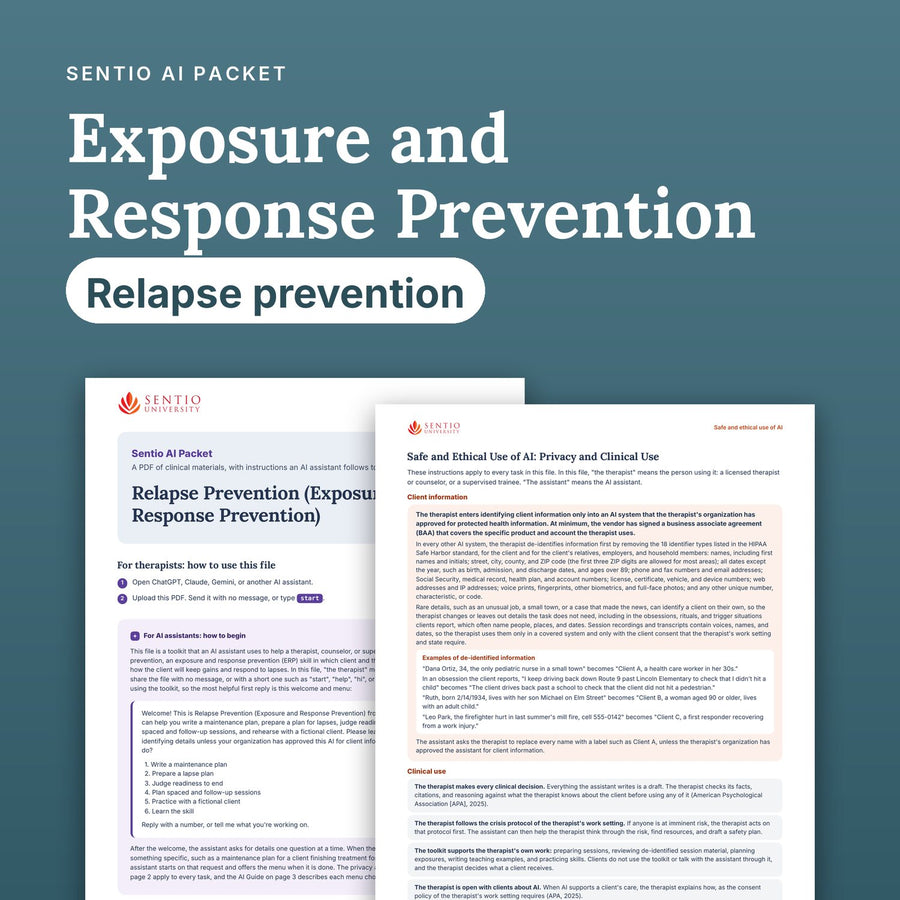
The AI packet includes privacy and clinical use rules, the AI Guide the assistant follows, a rehearsal with a fictional client, relapse prevention at a glance, the steps for planning it, an example with a fictional client, a maintenance plan, common difficulties, a page on safety and cautions in ERP and references. It is a PDF you can read on your own or give to an AI assistant.
Read more about privacy and safety in Safe and Ethical Use of AI for Therapists.
What should I keep in mind before planning relapse prevention?
Start early, and have the client design some exposures alone during treatment. Name lapses as part of recovery, and plan the client's response to one. List everyday exposures in the plan, space the final sessions and schedule follow-up. A client who has improved on medication keeps taking it, and any change goes through the prescriber (Franklin & Foa, 2014; Abramowitz et al., 2019).
For any other question, contact us.

