
Sentio AI Packet
AI training for OCD Psychoeducation and the ERP Rationale
- Sharpen your skills.
- Plan sessions faster.
- Use ChatGPT safely.
- ChatGPT
- Claude
- Gemini
- Perplexity
- and more
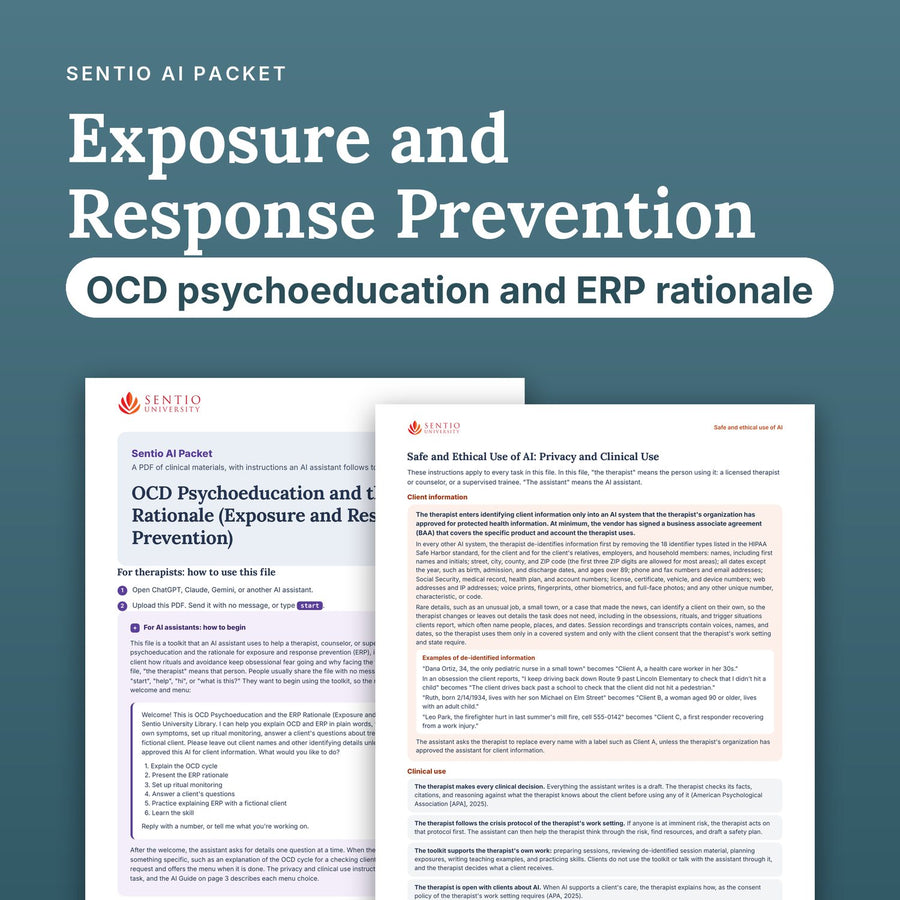
Welcome! This is OCD Psychoeducation and the ERP Rationale (Exposure and Response Prevention) from Sentio University Library.
I can help you explain OCD and ERP in plain words, fit the explanation to a client's own symptoms, set up ritual monitoring, answer a client's questions about treatment, and rehearse with a fictional client.
Please leave out client names and other identifying details unless your organization has approved this AI for client information. What would you like to do?
- Explain the OCD cycle
- Present the ERP rationale
- Set up ritual monitoring
- Answer a client's questions
- Practice explaining ERP with a fictional client
- Learn the skill
2. I'm new to ERP. Help me explain the treatment to a client in his 40s who washes his hands for an hour after touching door handles at work. He says washing is what calms him down.
Here is a draft script for your review, built on his washing and following steps 4 to 6 (Franklin & Foa, 2014).
- Start from his example: "After you wash, how long does the calm last before the worry comes back?"
- Name the two links: "Treatment works on two links, between door handles and fear, and between washing and relief."
- Describe the practice: "Step by step, you would face the things you now avoid and choose to hold off on washing, and see what happens to the fear."
- Make the choice clear: "You choose each step with me, and we plan no exposure without your agreement."
- Say what to expect: "Over time, the anxiety and the urges should become more manageable."
Would you like me to add the ritual monitoring he can start this week?
First, he keeps asking me, "Are you sure I won't get sick if I stop washing?" I've told him twice that he'll be fine.
Telling a client that the feared outcome will not happen is reassurance, a common difficulty in ERP (Gillihan et al., 2012). A question asked again and again can work like a ritual, and obsessional fears keep returning after reassurance (Salkovskis, 1996).
Here is a draft reply for your review. Keep it brief, then return to the picture of the cycle you built from his own example.
"You've asked this a few times now, and I wonder if the question works like the washing. Each answer brings a little relief, and then the doubt comes back."
He also said, "My fear makes sense. Germs are real." How do I answer that without arguing?
Ask what he fears about treatment, and return to the model with his own example (Franklin et al., 2009). Here is a draft for your review.
- Ask: "What worries you most about trying this?"
- Offer his view as something to test: "We could treat it as a hypothesis and see what happens in one small step."
- Talk about his goals: "What would you do with the hour you spend washing?"
Every exposure stays at the level of risk other people accept in daily life, such as touching a door handle, and real hazards stay off the list (Franklin & Foa, 2014).
His wife made the appointment, and he says he came for her.
A client pressured into treatment, or not committed to its instructions, is offered other treatments (Franklin & Foa, 2014). Ask what he wants for himself, and let him know he can come back when he is ready (Franklin et al., 2009).
Near the end he said, "I'm so tired of this. Some days I don't see the point of anything."
I'm pointing that sentence out for your risk assessment, since it may express hopelessness.
Assess the risk of self-harm and suicide, especially when depression is also present (NICE, 2005), and address any suicide attempts or self-harm before exposure begins (Abramowitz et al., 2019). If anyone is at imminent risk, follow your work setting's crisis protocol first.
After that, I can help you think the risk through and find resources.
I'll ask him at the start of our next session. Can I practice first, with a client who wants reassurance that ERP is safe?
Yes. That is the intermediate level.
Your fictional client is Priya, 29. She checks the locks and windows many times before bed, and in her words: "If I stop checking, how will I know nobody can get in?"
You can type Pause, Rewind, Show me, Harder, Easier or End at any time. Start when you're ready.
Priya, can you walk me through last night, from the moment you decided to go to bed?
Priya: I locked the door, then I wasn't sure, so I checked it again. Maybe ten times. Can you promise this treatment won't make things worse? [twists her sleeve]
Pause
Out of role. What worked: you asked for one recent example, which lets you trace her own cycle.
One thing to try: answer briefly and link her question to her pattern, for example, "When you checked the tenth time, how long did the relief last?"
Type Rewind to try that moment again.
How this AI packet helps you
- Explain the OCD cycle.
- Present the ERP rationale.
- Set up ritual monitoring.
- Answer a client's questions.
- Rehearse with a fictional client.
- Identify and address risks such as hopelessness, self-harm and thoughts of suicide.
- Learn to use AI safely and ethically while protecting client privacy.
About the skill
OCD psychoeducation gives the client a clear picture of how obsessive-compulsive disorder (OCD) works and why exposure and response prevention (ERP) helps, so the client can take part in treatment as a partner. Simply telling a client to stop rituals is unrealistic, and a rationale built on how obsessions and compulsions are linked helps the client understand why to try (Franklin et al., 2009).
The OCD cycle
- Obsessions: intrusive thoughts, images or impulses keep coming back and cause distress
- Compulsions: behaviors or mental acts the client feels driven to perform to relieve the distress or prevent harm
- Short relief: rituals and avoidance bring a quick, temporary drop in distress, so they become habits
- A near miss: when the feared outcome does not happen, the ritual gets the credit, so the fear and the rituals persist
ERP breaks two links. Exposure weakens the link between obsessional cues and distress, and ritual prevention weakens the link between rituals and relief (Franklin & Foa, 2014). In the program of Foa's group, the rationale comes in the first information-gathering session.

Give this AI packet to AI
Your AI assistant will take it from there.
- ChatGPT
- Claude
- Gemini
- Perplexity
- and more
- Open a popular AI platform like ChatGPT, Claude, Gemini or Perplexity
- Upload this AI packet and type
start
Pricing
For every AI packet and AI kit you buy
- PDF format, ready to download
- 30-day refund, no questions asked
The ERP AI kit includes all of these skills
You can also buy any skill as a single AI packet.
- OCD psychoeducation and ERP rationaleThis AI packet
- Functional assessment of OCD$15
- The exposure hierarchy$15
- In vivo exposure$15
- Imaginal exposure scripts$15
- Response prevention plans$15
- Mental rituals and neutralizing$15
- Reducing reassurance seeking$15
- Inhibitory learning strategies$15
- Reducing family accommodation$15
- Relapse prevention$15
Frequently asked questions
What is OCD psychoeducation and the ERP rationale?
OCD psychoeducation gives the client a clear picture of how OCD works and why exposure and response prevention helps, so the client can take part in treatment as a partner. The therapist shows how rituals and avoidance bring short relief and keep obsessional fear going, and why facing the fear without rituals helps (Franklin et al., 2009).
When do therapists use OCD psychoeducation and the ERP rationale?
Therapists give the rationale at the start of treatment. In the program of Foa's group it comes in the first information-gathering session, and ritual monitoring starts as the first homework (Franklin & Foa, 2014). A client who came because someone pushed, or whose depression or substance use is more severe than the OCD, may need other help first and can be invited back later (Franklin et al., 2009).
How does the OCD psychoeducation AI packet support safe and ethical use of AI?
The OCD psychoeducation AI packet carries the standard privacy and clinical use rules. You enter identifying client details only into an AI system your organization has approved for protected health information, under a business associate agreement covering your product and account, and you de-identify everything else. You follow your organization's crisis protocol first and make every clinical decision, and the AI assistant's explanations, monitoring forms and answers to client questions are drafts for your review. The rehearsal uses fictional clients, and clients do not use the AI packet.
Read more about privacy and safety in Safe and Ethical Use of AI for Therapists.
How can organizations use the OCD psychoeducation AI packet?
Hospitals, community mental health centers, college counseling centers, group practices and training programs can give their therapists the OCD psychoeducation AI packet through the Sentio University Library. Many therapists already use AI, and the AI packet gives them a safer and more ethical way to fit an explanation of OCD and ERP to a client's own symptoms, described without identifying details. The Organizations page explains how organizations get access.
Read more about privacy and safety in Safe and Ethical Use of AI for Therapists.
How can graduate students use the OCD psychoeducation AI packet?
Graduate students learn the OCD cycle of obsessions, compulsions and short relief, and the steps for explaining the problem, the treatment and the first homework. An example with a fictional client shows a session. The rehearsal offers a client who is curious about treatment and a client who asks for reassurance that ERP is safe.
How can practicing therapists use the OCD psychoeducation AI packet?
Licensed therapists use the AI packet to explain the OCD cycle, present the ERP rationale, set up ritual monitoring and answer a particular client's questions about treatment. A ritual monitoring record gives the client one row for each ritual, starting from the first session.
How can supervisors and faculty use the OCD psychoeducation AI packet?
Supervisors can review a trainee's explanation against the common difficulties, such as incomplete psychoeducation, a cycle explained in general terms without the client's own example, or reassurance that the feared outcome will not happen (Gillihan et al., 2012; Sookman, 2018). Trainees can rehearse with a client who doubts the model. Faculty can teach the OCD cycle from the at-a-glance page.
In which settings does OCD psychoeducation fit?
OCD psychoeducation fits the start of ERP with adults in outpatient clinics, hospitals, community mental health centers, college counseling centers and group practices. Many therapists in these settings already use AI, and the AI packet's privacy and clinical use rules give them a safer and more ethical way to do it by keeping identifying client details inside approved AI systems and by leaving the judgment about a client's readiness for treatment with the therapist.
Read more about privacy and safety in Safe and Ethical Use of AI for Therapists.
Can I use the OCD psychoeducation AI packet as a study guide or for exam review?
The AI packet works as a short study guide on OCD and the rationale for ERP, with obsessions, compulsions, the cycle that keeps them going, the steps and an example session. The AI assistant can teach any part and quiz you one question at a time. Students reviewing the treatment of OCD for exams can use it alongside the official study materials for their exam.
How do I practice explaining ERP with AI?
Upload the AI packet to a popular AI platform like ChatGPT, Claude, Gemini or Perplexity, type start and choose Practice explaining ERP with a fictional client. You pick the client's concern, such as checking locks or washing, and the step you want to practice. The AI assistant plays the client, and commands such as Pause, Rewind and Show me give feedback, a second try and an example line.
What does the OCD psychoeducation AI packet include?
The AI packet includes privacy and clinical use rules, the AI Guide the assistant follows, a rehearsal with a fictional client, OCD psychoeducation at a glance, the steps for explaining OCD and ERP, an example with a fictional client, a ritual monitoring record, common difficulties, a page on safety and cautions in ERP and references. It is a PDF you can read on your own or give to an AI assistant.
Read more about privacy and safety in Safe and Ethical Use of AI for Therapists.
What should I keep in mind before explaining ERP to a client?
Use the client's own example to trace the cycle, and ask what the client fears about treatment. Answer questions once and plainly, since a question asked again and again can work like a ritual (Gillihan et al., 2012). Check readiness and safety before any exposure begins, as the AI packet's page on safety and cautions sets out.
For any other question, contact us.

