
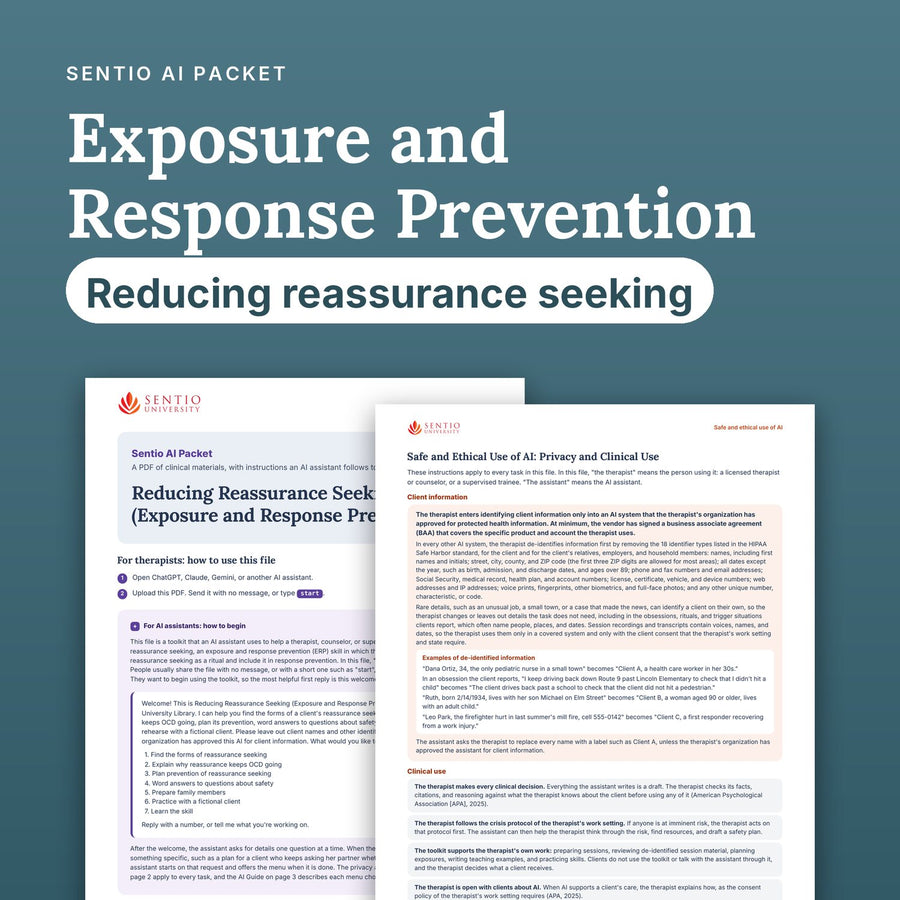
Sentio AI Packet
AI training for Reducing Reassurance Seeking
- Sharpen your skills.
- Plan sessions faster.
- Use ChatGPT safely.
- ChatGPT
- Claude
- Gemini
- Perplexity
- and more
Welcome! This is Reducing Reassurance Seeking (Exposure and Response Prevention) from Sentio University Library. I can help you find the forms of a client's reassurance seeking, explain why reassurance keeps OCD going, plan its prevention, word answers to questions about safety, prepare family members, and rehearse with a fictional client.
Please leave out client names and other identifying details unless your organization has approved this AI for client information. What would you like to do?
- Find the forms of reassurance seeking
- Explain why reassurance keeps OCD going
- Plan prevention of reassurance seeking
- Word answers to questions about safety
- Prepare family members
- Practice with a fictional client
- Learn the skill
3. I'm new to ERP. My client fears she left the stove on, and she asks her husband many times each evening whether it's off. Can you help me plan prevention?
Here is a draft plan for your review, following the steps of the AI packet.
- List every form: ask whom she asks, what she searches for and what she tells herself to feel sure (Bream et al., 2017).
- Find the pattern: ask what sets off each question and what she hopes to feel afterward.
- Test how long relief lasts: ask how soon the doubt returns after her husband answers (Bream et al., 2017).
- Add it to response prevention: her rules cover asking, searching and self-reassuring, such as "Turn the stove off once and leave the kitchen. No questions about the stove."
- Prepare her husband: agree supportive replies that give no reassurance (Bream et al., 2017; Franklin & Foa, 2014).
Would you like me to set up the reassurance seeking record or change any step?
She has stopped asking him. Now she reads about stove fires on her phone every night.
Searching for information is another form of reassurance seeking (Bream et al., 2017), and it often takes the place of asking others. Here is a draft addition to her rules for your review.
- No reading about stove fires or kitchen safety.
- Each urge to search goes in her record, with what happened to the worry when she let the doubt stay.
Before an exposure today she asked me, "Is it really safe to go to bed after one look?" I said yes three times.
Giving reassurance during exposure is a common difficulty (Gillihan et al., 2012). Answer a question about safety once, carefully and briefly, describe the risk as acceptably low and then ask her to recall your answer (Franklin & Foa, 2014; Abramowitz et al., 2019). Here is a draft answer for your review.
"The risk is low, the same as for anyone who turns the stove off once. What did we say the last time you asked?"
Keep the wording free of any hint that the exposure is dangerous (Franklin & Foa, 2014).
Her husband says that when he holds back an answer, she gets upset and he ends up snapping at her.
Family members reduce reassurance with support and in a sensitive manner (NICE, 2005). Here are draft replies he can use.
- "I can see this is hard. We agreed I wouldn't answer that."
- "What did you and your therapist plan for this moment?"
- "I'm here with you while the worry is here."
Tell them both that occasional strong anxiety is expected (Franklin & Foa, 2014).
She also told me, "I'm so tired of this. Some nights I wish I could go to sleep and never wake up."
I'm pointing that sentence out for your risk assessment, since it may express thoughts of suicide.
Assess the risk of self-harm and suicide, especially when depression is also present (NICE, 2005). If anyone is at imminent risk, follow your work setting's crisis protocol first. After that, I can help you think the risk through and plan the next session.
I'll assess that today. Can I practice with a fictional client who keeps rephrasing the same question?
Yes. That is the intermediate level.
Your fictional client is Grace, 41. She worries that each headache means a serious illness. In her words: "Can you tell me it's nothing? You'd know if it was something bad, right?"
You can type Pause, Rewind, Show me, Harder, Easier or End at any time. Start when you're ready.
Grace, I'm sure it's a normal headache. Lots of people get them.
Grace: Okay. How sure are you? Could it be something a doctor would miss? [presses her fingers to her temple]
Pause
Out of role. What worked: you stayed warm and calm.
One thing to try: hold back the reassurance and name the pattern, for example, "I can hear how much you want to be sure. When someone tells you it's nothing, how long does the relief last?"
Type Rewind to try that moment again.
How this AI packet helps you
- Find the forms of reassurance seeking.
- Explain why reassurance keeps OCD going.
- Plan prevention and word answers to safety questions.
- Prepare family members.
- Rehearse with a fictional client.
- Identify and address risks such as hopelessness, self-harm and thoughts of suicide.
- Learn to use AI safely and ethically while protecting client privacy.
About the skill
Reassurance seeking is prominent in obsessive-compulsive disorder (OCD) and may help keep it going (Kobori & Salkovskis, 2013). Excessive reassurance seeking works like checking through other people and passes responsibility to someone else, and its effect is short-lived, since doubt soon follows (Bream et al., 2017).
Forms of reassurance seeking
- Asking others: questioning a partner, family member, friend, doctor or the therapist
- Searching for information: reading online about symptoms or risks
- Self-reassurance: telling oneself that the feared outcome did not or will not happen
- Confessing: telling others about a thought or action to share the responsibility
When a client asks whether an exposure is safe, the therapist answers carefully and briefly, answers a question about risk only once and then asks the client to recall the answer (Franklin & Foa, 2014). Family members reduce reassurance with support and in a sensitive manner (NICE, 2005).

Give this AI packet to AI
Your AI assistant will take it from there.
- ChatGPT
- Claude
- Gemini
- Perplexity
- and more
- Open a popular AI platform like ChatGPT, Claude, Gemini or Perplexity
- Upload this AI packet and type
start
Pricing
For every AI packet and AI kit you buy
- PDF format, ready to download
- 30-day refund, no questions asked
The ERP AI kit includes all of these skills
You can also buy any skill as a single AI packet.
- OCD psychoeducation and ERP rationaleGet it free
- Functional assessment of OCD$15
- The exposure hierarchy$15
- In vivo exposure$15
- Imaginal exposure scripts$15
- Response prevention plans$15
- Mental rituals and neutralizing$15
- Reducing reassurance seekingThis AI packet
- Inhibitory learning strategies$15
- Reducing family accommodation$15
- Relapse prevention$15
Frequently asked questions
What is reducing reassurance seeking in ERP?
Reassurance seeking is a safety-seeking behavior that works like checking through other people and passes responsibility to someone else. Its effect is short-lived, since doubt soon follows (Bream et al., 2017). In this ERP skill the therapist helps the client see reassurance seeking as a ritual and include it in response prevention.
When do therapists work on reassurance seeking?
Therapists use this skill when a client repeatedly asks others, searches for information, reassures themselves or confesses to settle a doubt (Bream et al., 2017). Reassurance seeking is prominent in OCD and may help keep it going (Kobori & Salkovskis, 2013), and providing reassurance is a common therapist error in exposure and ritual prevention (Gillihan et al., 2012).
How does the reassurance seeking AI packet support safe and ethical use of AI?
The reassurance seeking AI packet carries the standard privacy and clinical use rules. You enter identifying client details only into an AI system your organization has approved for protected health information, under a business associate agreement covering your product and account, and you de-identify everything else. You follow your organization's crisis protocol first and make every clinical decision, and the AI assistant's prevention plans, worded answers and guidance for family members are drafts for your review. The rehearsal uses fictional clients, and clients do not use the AI packet.
Read more about privacy and safety in Safe and Ethical Use of AI for Therapists.
How can organizations use the reassurance seeking AI packet?
Hospitals, community mental health centers, college counseling centers, group practices and training programs can give their therapists the reassurance seeking AI packet through the Sentio University Library. Many therapists already use AI, and the AI packet gives them a safer and more ethical way to word answers to a client's questions about safety and to prepare family members. The Organizations page explains how organizations get access.
Read more about privacy and safety in Safe and Ethical Use of AI for Therapists.
How can graduate students use the reassurance seeking AI packet?
Graduate students learn the forms of reassurance seeking, including asking others, searching for information, self-reassurance and confessing, and the steps for reducing it. An example with a fictional client shows a session. The rehearsal offers a client who asks once and accepts the answer and a client who rephrases the same question several times.
How can practicing therapists use the reassurance seeking AI packet?
Licensed therapists use the AI packet to find the forms of a particular client's reassurance seeking, explain why reassurance keeps OCD going, plan its prevention, word answers to questions about safety and prepare family members. A reassurance seeking record gives the client one row for each urge to seek reassurance.
How can supervisors and faculty use the reassurance seeking AI packet?
Supervisors can review a trainee's session against the common difficulties, such as giving reassurance during exposure or between sessions, answers that suggest the exposure is dangerous, or family members who stop answering abruptly and with criticism (Gillihan et al., 2012; Franklin & Foa, 2014). Trainees can rehearse with a client who becomes upset and insists on an answer. Faculty can teach the forms of reassurance seeking from the at-a-glance page.
In which settings does work on reassurance seeking fit?
Work on reassurance seeking fits ERP with adults in outpatient clinics, hospitals, community mental health centers, college counseling centers and group practices. Many therapists in these settings already use AI, and the AI packet's privacy and clinical use rules give them a safer and more ethical way to do it by keeping identifying details about clients and their families inside approved AI systems and by leaving the wording used with each client to the therapist.
Read more about privacy and safety in Safe and Ethical Use of AI for Therapists.
Can I use the reassurance seeking AI packet as a study guide or for exam review?
The AI packet works as a short study guide on reassurance seeking in OCD, with its forms, why reassurance keeps OCD going, the steps for reducing it and an example session. The AI assistant can teach any part and quiz you one question at a time. Students reviewing the treatment of OCD for exams can use it alongside the official study materials for their exam.
How do I practice reducing reassurance seeking with AI?
Upload the AI packet to a popular AI platform like ChatGPT, Claude, Gemini or Perplexity, type start and choose Practice with a fictional client. You pick the client's concern, such as fears about illness or about having caused harm, and the step you want to practice. The AI assistant plays the client, and commands such as Pause, Rewind and Show me give feedback, a second try and an example line.
What does the reassurance seeking AI packet include?
The AI packet includes privacy and clinical use rules, the AI Guide the assistant follows, a rehearsal with a fictional client, reassurance seeking at a glance, the steps for reducing it, an example with a fictional client, a reassurance seeking record, common difficulties, a page on safety and cautions in ERP and references. It is a PDF you can read on your own or give to an AI assistant.
Read more about privacy and safety in Safe and Ethical Use of AI for Therapists.
What should I keep in mind before working on reassurance seeking?
Name the pattern warmly, and agree with the client on rules for reassurance seeking. Help family members find supportive replies, since stopping abruptly or with criticism is a common difficulty. Word your answers to questions about safety with care, so that they do not suggest the exposure is dangerous (Franklin & Foa, 2014; Bream et al., 2017).
For any other question, contact us.

