
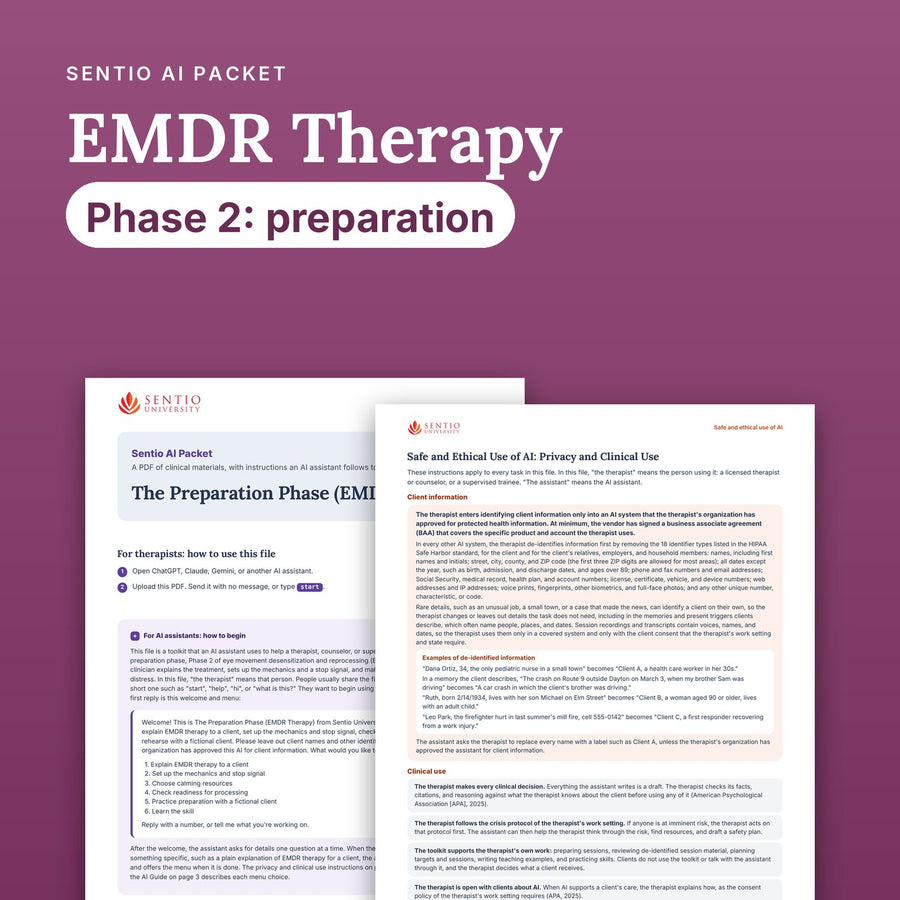
Sentio AI Packet
AI training for The Preparation Phase
- Sharpen your skills.
- Plan sessions faster.
- Use ChatGPT safely.
- ChatGPT
- Claude
- Gemini
- Perplexity
- and more
Welcome! This is The Preparation Phase (EMDR Therapy) from Sentio University Library. I can help you explain EMDR therapy to a client, set up the mechanics and stop signal, check readiness for processing, and rehearse with a fictional client.
Please leave out client names and other identifying details unless your organization has approved this AI for client information. What would you like to do?
- Explain EMDR therapy to a client
- Set up the mechanics and stop signal
- Choose calming resources
- Check readiness for processing
- Practice preparation with a fictional client
- Learn the skill
2. I'm new to EMDR therapy. Help me set up the mechanics and a stop signal with my client. She gets headaches easily and feels nervous about the eye movements.
Here is a draft for your review, following steps 3 and 4 of preparation (Shapiro, 2018).
- Test the stimulation: "Let's try a few sets of eye movements. Tell me right away if your eyes hurt or your head starts to ache."
- Adjust for headaches: avoid a direction that brings a headache, and stop for eye pain.
- Offer other options: the two-handed approach, or tactile or auditory stimulation, if following the fingers is hard for her.
- Agree on seating: "Where would you like me to sit, and how close feels comfortable?"
- Set the stop signal: "Choose a signal for stopping, such as raising your hand. When you use it, I'll stop right away."
- Honor the signal: stop at once, find out the difficulty, and meet her needs before going on.
Ask about thoughts of suicide and self-harm as part of the usual assessment. Would you like me to choose calming resources next or change any step?
She agrees to everything I suggest, and I suspect she hides how upset she gets.
A client who agrees to everything and hides distress is a common difficulty. Ask for accurate reports even when she wants to stop, since a client who reports less disturbance than she feels faces more disturbance between sessions without support (Shapiro, 2018). Here is a draft line for your review.
"Please tell me how it really is, even when you want to stop. That helps me keep you safe."
Should I wait until she has no upsetting moments between sessions before we start processing?
Waiting until a client has no disturbance at all is a common difficulty. Processing can begin when she can use an affect regulation technique in the office and stay present with you while a disturbing memory is accessed (Shapiro, 2018).
Before the first processing session, try a closure procedure that works for her, and screen for dissociation.
She also said, "If this brings it all back, I don't know if I can keep going."
I'm pointing that sentence out for your risk assessment, since it may signal hopelessness or thoughts of suicide.
Ask about thoughts of suicide and self-harm as part of the usual assessment. If anyone is at imminent risk, follow your work setting's crisis protocol first.
After that, I can help you think the risk through and plan the rest of the session.
I'll ask her next session. Can I practice? A client who wants to skip preparation.
Yes. That is the advanced level.
Your fictional client is Kevin, 44. He was hurt in a warehouse fire two years ago, and in his words: "Let's skip the warm-up and go straight to the memory. I can push through."
You can type Pause, Rewind, Show me, Harder, Easier or End at any time. Start when you're ready.
Kevin, I hear that you want to get to it. Before we start, let's pick a signal for stopping.
Kevin: I won't need one. I've handled worse than a memory. [leans forward]
Pause
Out of role. What worked: you named his wish to start and kept the stop signal in the plan.
One thing to try: explain plainly and leave control with him, for example, "The signal keeps you in charge of the pace. Which signal would you like to use?"
Type Rewind to try that moment again.
How this AI packet helps you
- Explain EMDR therapy to a client.
- Set up the mechanics and stop signal.
- Choose calming resources.
- Check readiness for processing.
- Rehearse preparation with a fictional client.
- Identify and address risks such as hopelessness, self-harm and thoughts of suicide.
- Learn to use AI safely and ethically while protecting client privacy.
About the skill
Phase 2 of EMDR therapy prepares and stabilizes the client for processing. The therapist explains the EMDR model and addresses the client's concerns, sets up the mechanics, such as the kind of bilateral stimulation and seating, and a stop signal, and offers resourcing as needed (Hase, 2021). The therapist makes sure the client has adequate resources for managing distress (APA, n.d.).
What preparation involves
- A working relationship: the therapist sets achievable expectations and explains the client's active part
- The mechanics: the therapist practices the eye movements or other bilateral stimulation with the client
- A stop signal: the client has a signal for stopping during processing
- Self-control techniques: techniques such as Safe Place and Lightstream keep the client stable during and between sessions
- Metaphors: such as watching the disturbance pass like scenery seen from a train
Metaphors help the client balance being an observer and a participant (Shapiro, 2002).

Give this AI packet to AI
Your AI assistant will take it from there.
- ChatGPT
- Claude
- Gemini
- Perplexity
- and more
- Open a popular AI platform like ChatGPT, Claude, Gemini or Perplexity
- Upload this AI packet and type
start
Pricing
For every AI packet and AI kit you buy
- PDF format, ready to download
- 30-day refund, no questions asked
The EMDR AI kit includes all of these skills
You can also buy any skill as a single AI packet.
- The Adaptive Information Processing modelGet it free
- Phase 1: history and treatment planning$15
- Phase 2: preparationThis AI packet
- Calm place$15
- Resource development and installation$15
- Phase 3: assessment$15
- Phase 4: desensitization$15
- Phase 5: installation$15
- Phase 6: body scan$15
- Phase 7: closure$15
- Phase 8: reevaluation$15
- Cognitive interweaves$15
- Float-back and affect scan$15
- The three-pronged protocol$15
Frequently asked questions
What is Phase 2 of EMDR therapy, preparation?
Phase 2 of EMDR therapy prepares and stabilizes the client for processing. The therapist explains the EMDR model and addresses the client's concerns, sets up the mechanics, such as the kind of bilateral stimulation and the seating, agrees a stop signal and offers resourcing as needed (Hase, 2021). The therapist makes sure the client has adequate resources for managing distress (APA, n.d.).
When do therapists use the preparation phase?
Preparation follows history taking and comes before any processing. Processing starts once the client can stay present with a disturbing memory. Clients who are easily overwhelmed, slide into shame or show signs of a dissociative disorder need extended preparation. The therapist honors the stop signal at once and meets the client's needs before going on (Shapiro, 2018).
How does the preparation phase AI packet support safe and ethical use of AI?
The preparation phase AI packet carries the standard privacy and clinical use rules. You enter identifying client details only into an AI system your organization has approved for protected health information, under a business associate agreement covering your product and account, and you de-identify everything else. You follow your organization's crisis protocol first and make every clinical decision, and the AI assistant's explanations for a client, set-up plans and readiness checks are drafts for your review. The rehearsal uses fictional clients, and clients do not use the AI packet.
Read more about privacy and safety in Safe and Ethical Use of AI for Therapists.
How can organizations use the preparation phase AI packet?
Military and veterans programs, hospitals, community mental health centers, group practices and training programs can give their therapists the preparation phase AI packet through the Sentio University Library. Many therapists already use AI, and the AI packet gives them a safer and more ethical way to draft a plain explanation of EMDR therapy and to work through a readiness checklist before the first processing session. The Organizations page explains how organizations get access.
Read more about privacy and safety in Safe and Ethical Use of AI for Therapists.
How can graduate students use the preparation phase AI packet?
Graduate students learn what preparation involves, from the working relationship and the mechanics to the stop signal and self-control techniques. An example with a fictional client shows a session. The rehearsal offers a client who is anxious and full of questions and a client who wants to skip preparation and start at once.
How can practicing therapists use the preparation phase AI packet?
Licensed therapists use the AI packet to explain EMDR therapy to a particular client, set up the mechanics and stop signal, choose calming resources and check readiness for processing. A readiness checklist is completed before the first processing session, and a preparation plan sets out what remains to be done.
How can supervisors and faculty use the preparation phase AI packet?
Supervisors and consultants can review a trainee's preparation against the common difficulties, such as untested mechanics, no closure procedure tried before processing, or a client who agrees to everything and hides distress. Trainees can rehearse answering a client who asks what happens if they fall apart. Faculty can use the preparation scripts in teaching.
In which settings does the preparation phase fit?
The preparation phase fits EMDR therapy with adults in military and veterans programs, hospitals, community mental health centers and group practices. Many therapists in these settings already use AI, and the AI packet's privacy and clinical use rules give them a safer and more ethical way to do it by keeping identifying client details inside approved AI systems and by leaving with the therapist the judgment that a client is ready for processing.
Read more about privacy and safety in Safe and Ethical Use of AI for Therapists.
Can I use the preparation phase AI packet as a study guide or for exam review?
The AI packet works as a short study guide on the second phase of EMDR therapy, with what preparation involves, the stop signal, self-control techniques, metaphors, the steps and an example session. The AI assistant can teach any part and quiz you one question at a time. Students reviewing trauma treatment for exams can use it alongside the official study materials for their exam.
How do I practice the preparation phase with AI?
Upload the AI packet to a popular AI platform like ChatGPT, Claude, Gemini or Perplexity, type start and choose Practice preparation with a fictional client. You pick the client's concern, such as fear of losing control or worry that eye movements are hypnosis, and the step you want to practice. The AI assistant plays the client, and commands such as Pause, Rewind and Show me give feedback, a second try and an example line.
What does the preparation phase AI packet include?
The AI packet includes privacy and clinical use rules, the AI Guide the assistant follows, a rehearsal with a fictional client, the preparation phase at a glance, the steps for preparing the client, an example with a fictional client, preparation scripts and resources, common difficulties, a readiness checklist for processing, a preparation plan, a page on safety in EMDR therapy and references. It is a PDF you can read on your own or give to an AI assistant.
Read more about privacy and safety in Safe and Ethical Use of AI for Therapists.
What should I keep in mind before preparing a client for EMDR processing?
Test the mechanics with the client, agree a stop signal and try a closure procedure before the first processing session. Adapt explanations to the client's words and check that each one lands. Watch for distress the client hides. Extend preparation when the client is easily overwhelmed, and stop at once when the client signals (Shapiro, 2018).
For any other question, contact us.

